Learning as We Go

When I mentioned yesterday that I’d been doing affair piece of thinking recently about the tricky ground of enjoying problematic bits of artistic/cultural expression, it actually wasn’t because I’m a particularly huge fan of Miley Cyrus, Nicki Minaj, or Taylor Swift. Yes, I have a single or two in the iTunes library, but that’s about as far as it goes. The timeliness of yesterday’s VMAs provided an irresistible springboard to broach the subject in a post, but that was an after-the-fact exploration of the topic, not the inspiration for this line of internal study.

One piece that has the topic on my mind is that I purchased Roxane Gay’s book of essays Bad Feminist, and am eagerly waiting for the day I clear my reading decks enough to start seeing an absorbing what she has to say about these matters.

Henry_Rollins_TA_2More pressingly, I’ve been trying to figure out since last Thursday what to say about Henry Rollins.

Rollins writes a regular blog for the LA Weekly, and last Thursday, he wrote a provocatively titled essay* where he expressed his anger and confusion about Robin Williams’ suicide. The post is actually a fascinating exercise in internal contradiction, because Rollins acknowledges the impossibility of understanding another person’s pain in the grips of depression — speaking explicitly of friends and roommates who have struggled with the same, but also, to my perception, with a strong undercurrent of Rollins having had his own personal experiences with depression. And yet, for all that evident level of understanding — and even for the explicit admission that “I get it, but maybe I don’t,” Rollin’s essay lands on this position:

I simply cannot understand how any parent could kill themselves.

How in the hell could you possibly do that to your children? . . . I think as soon as you have children, you waive your right to take your own life.

[. . . ] Almost 40,000 people a year kill themselves in America, according to the Centers for Disease Control and Prevention. In my opinion, that is 40,000 people who blew it.

Now, whatever my level of benign mostly-indifference is for Miley, Nicki and Taylor, I am unabashedly a fan of Henry Rollins — especially his spoken-word performances. (Stand-up? Storytelling? I never quite know what to call it.) In all my years in Philly, the only time I ever went down to Atlantic City was one night when Mr. Mezzo and I got tickets to see a Rollins spoken-word show there.**

Yet, however much I enjoy his spoken-word stuff, the level of impatience and humorously channeled rage those spoken-word pieces often reveal have always had me wondering about the level of Rollins’ impatience with human fallibility and weakness. I know “weakness” is such a charged word, but that’s really how it always played to my system.

Rollins would speak with such disdain about the mental/ethical weaknesses of prejudice, and would talk in such detail about the ind of discipline he used in his own life — the whole ascetic “straight-edge” thing, eschewing drugs and alcohol, dedicated to weights and fitness, and minimizing his possessions. I enjoyed going to his shows and listening to the recordings, but I always assumed if I were ever to meet Rollins, he’d have little but disdain for my life, with my weight, my occasional drinking, and my addictions to shopping and hoarding and physical possessions.

So I was disappointed to see last Thursday’s column, but I won’t say I was especially surprised. With the sorts of bright-line divisions I imagined him drawing between “strength” and “weakness,” I could imagine how his thought process would have led him to classifying suicide as an act of weakness. (Just so we’re clear: not at all a perspective I agree with. But I could halfway imagine the thought chain that took him there.)

Thus began a more intense meditation on “being a fan of problematic things.” For there I was, caught between the place of deeply — DEEPLY — disagreeing with Rollins’ essay, and yet knowing the equally deep affection I have for his past work.

And then things took a turn.*** Saturday morning, I got word that a brief apology had been posted on Rollins’ own website:

The article I wrote in the LA Weekly about suicide caused a lot of hurt. This is perhaps one of the bigger understatements of all time. I read all the letters. Some of them were very long and the disappointment, resentment and ringing clarity was jarring.

That I hurt anyone by what I said, and I did hurt many, disgusts me. It was not at all my intent but it most certainly was the result.

I have had a life of depression. Some days are excruciating. Knowing what I know and having been through what I have, I should have known better but I obviously did not.

In this post, Rollins promised a longer follow-up essay in the LA Weekly today. In it, he does a damn solid apology. Doesn’t take the “that’s not what I intended!”  road, or any of the derailment bingo plays that so often crop up in these hard conversations.

After reading carefully and responding as best I could, it was obvious that I had some work to do in order to educate myself further on this very complex and painful issue. I am quite thick-headed, but not so much that things don’t occasionally permeate.

In the piece, I said there are some things I obviously don’t get. So I would like to thank you for taking the time to let me know where you’re coming from. None of it was lost upon me. [. . .]

I understand it is my task to learn about this. It might take a while, but I will get on it. It is my belief about an ingrained sense of duty that will make this challenging, but I am always up for improvement.

What I most appreciated here — especially in the light of the ways I am in ongoing study of my own limitations (limitations of perspective, of compassion, of blind privilege…) — is Rollins’ acknowledgement that he has a lot to learn, and that he’s still struggling with his conflicting feelings about this issue. He doesn’t offer defensive justifications, but he doesn’t pretend to have it all magically worked out in the distance between Thursday and Monday.

Instead, there’s self-reflection, self-awareness, an owning of the rigid beliefs that led to the initial conclusions. And a commitment to continued learning, continued study, continued growth.

I’m up for that.

* Call me censor, call me chicken-shit, but here’s where I draw my own small moral line in the sand. I’ll include the accurate title in the hyperlink, and you can go read the essay for yourself, but I am not reproducing that particular sentiment here in my own digital living room.

** Train down, played the slots enough to pay for dinner, watched the show, then took the train back home. Do we know how to party, or do we know how to party?

*** Every now and then, my limited capacity to only do one post a day actually helps rather than hinders.

———-

Image credit: Jonathan Klinger, shareable via a Creative Commons License (retrieved from http://commons.wikimedia.org/wiki/File:Henry_Rollins_TA_2.jpg )

Shake Your Booty

The MTV VMAs are tonight. (Actually, for all I know, the online streaming red carpet/pre-show thing is probably happening even as I type.)

I won’t be watching them live (True Blood finale!), but in some perverse attempt to pretend I’m still in touch with current entertainment trends, I will be DVRing it to watch in bits and pieces over the next few nights.

From one perspective, I’m not quite sure why I even continue this yearly VMA ritual. As I age further and further out of the MTV/culturally  relevant demographic, there’s more people I don’t recognize at all, more songs and bits I fast forward through, and more jokes and references that I just don’t get (and some, as I sometimes say, that I may get, but I don’t want — if you catch my drift).

But I keep watching, I guess for those moments when I do find a new artist or song to appreciate, and also because I’m naturally interested in seeing cultural trends unfold “live” before me on the TV screen. Assuming a high likelihood of at least one water cooler moment emerging from the brouhaha, I like being able to form my own opinion of that moment from having seen it and reflected upon it — rather than just basing my opinion on someone else’s condemnation.

Though it’s worth admitting that sometimes my view of that “water cooler” moment is based both on my own personal viewing and also on input from other cultural commentary. For example, during last year’s Mileygate, I was able to come up with plenty of opinions about the sexual politics of the performance, but it took a lunchtime conversation with some fresh-out-of-college co-workers to raise my awareness about the troubling elements of cultural appropriation that were embedded in the performance.

I’d never heard of twerking before, you see. And after that conversation, I did some research. Hadley Freeman in The Guardian helped me more clearly see the minstrel show undertone of the production:

a young wealthy woman from the south doing a garish imitation of black music and reducing black dancers to background fodder and black women to exaggerated sex objects.

Meanwhile, Anne Theriault (writing in HuffPo Canada, but who I also follow avidly on her own blog, The Belle Jar) expressed her outrage at white feminists silence over things I should have seen when watching the performance — the crass objectification of women of color in the stage show’s choreography and in Cyrus’ performance.

Even worse, in her performance last night Miley used black women as props — like,literal props — and barely anyone said anything. I saw very few people displaying any outrage over the fact that Miley was, at one point, slapping a faceless black woman on the ass as if she was nothing more than a thing for Miley to dominate and humiliate. I saw barely anyone discussing the fact that Miley’s sexual empowerment, or whatever you want to call it, should not come at the cost of degrading black women.

All in all, it’s a small object lesson in the value I hold in seeing something with my own eyes before condemning or opining upon it, but also in the ways I need to keep listening and learning. I mean, seriously, looking back one year later at my level of blindness around the racist undertones (overtones, through-tones) there… I mean, it’s like, Hello, white privilege! There you are again!

gotham_twerk_by_arzeno-d6l2vl1And why am I rehashing all this one year later? Because we now have two twerking videos freshly released, sitting at the flashpoint of controversy, and with both performers scheduled to sing at tonight’s awards show.

In one corner, Taylor Swift, whose new video Shake It Off is earning critique for its own cultural appropriation of hip-hop culture and the sexualization/objectification of twerking and women of color — most especially the moment where, to quote Hillary Crosley in Jezebel, “she celebrates her true self by crawling through a bridge of brown and black women’s butts.”

In the other, there’s Nicki Minaj, whose Anaconda video is a hyper-sexualized invocation (celebration?) of tweaking and black women’s booties.

So how does one rate which is most troubling? Does Swift get a pass because her video is tamer in its sexual content, or because she now asserts that she’s coming at her work and life from a feminist perspective? Or is Minaj’s video the less offensive one because Minaj is speaking from within her own culture and cultural experience, and because the video, as Lindsay Zoladz suggests in Vulture, is not about pandering to the male gaze:

One thing I find striking about the video is the complete lack of men in its surreal, bubblegum-Amazon world (except, of course, for Drake, who I’ll get to in a minute). The song itself describes — and, arguably, objectifies — a series of male characters, but we don’t see them in the video. Instead, it’s just Nicki and her dancers, going about their day — you know, just making some fruit salad, doing some cardio — in this hallucinatory all-female universe. At one point she eyes the camera seductively like she’s about to eat a banana, but instead chops it in half and chucks the peel away away with a diabolical smirk. . . . The staying power of “Anaconda” might not outlast its viral moment, but while it’s trending let’s at least acknowledge its slyly confrontational power.

I’m far from the only one making this triangle of comparison between Cyrus, Swift and Minaj. It all comes up in this Washington Post point-counterpoint that’s ostensibly focused just on the Taylor Swift single/video.Instead, the conversation weaves among all three singers and their twerking, as well as name-checking a bunch of other current artists whose cultural appropriation is, shall we say, a bit suspect.

But rather than playing the competition game — choosing to raise one singer in my estimation at the cost of the other — and rather than giving either woman a pass for the troubling elements of their discourse, I’m instead going to use this moment to bring in something I’ve been thinking about a lot lately: how to both enjoy and critique artistic and cultural expression.

Liking problematic things doesn’t make you an asshole. In fact, you can like really problematic things and still be not only a good person, but a good social justice activist (TM)! After all, most texts have some problematic elements in them, because they’re produced by humans, who are well-known to be imperfect. But it can be surprisingly difficult to own up to the problematic things in the media you like, particularly when you feel strongly about it, as many fans do. We need to find a way to enjoy the media we like without hurting other people and marginalised groups. (Social Justice League)

And then, on the flip side of my own flip side is my desire not to blame either woman too harshly for the problematic pieces of their discourse. Because we all live in this kyriarchic, misogynist miasma. It infects our lives, our thought patterns — how could it not infect our artistic and creative expressions, too?

So ultimately — at least in these last pre-show minutes — I’m with Michelle Lhooq in The Guardian, seeing these various performances as more a symptom of our diseased culture than a root cause:

Slapping a parental advisory warning on Nicki Minaj’s bum will not change the way black women are exoticised. Banning videos by Robin Thicke, DJ Snake, and Calvin Harris, who use female bodies as trophies hard won of their overpowering masculinity, will not deflect the male gaze. Calling out Miley Cyrus’ career-advancing performance of racial drag, or Lily Allen’s casual racism is important, but what we really need is a broader spectrum of depictions of female sexuality – especially when it comes to women of colour – in mainstream culture. . . . Because the real problem is not that women of colour are over-sexualised in music videos, but rather how absent they usually are in the dominant culture as well as in discussions of cultural issues. Music videos shouldn’t be the only ways that mainstream society gets a glimpse of “otherness” but all too often, they are.

We’ll see if I’ve changed my mind after watching the DVR recording from tonight. Because if one or the other performance turns out to spectacularly offensive, culturally tone-deaf, or otherwise problematic, well then that’s new data. And new data sometimes changes the equation.

———-

Image credit: “Gotham Twerk” by Arzeno, shareable via a Creative Commons License (retrieved from http://arzeno.deviantart.com/art/Gotham-Twerk-398203237 )

Raising My Hand

Last night when I was writing about the ALS Ice Bucket Challenge, I toyed with the notion of posting links to some of my favorite videos of celebrities doing the challenge. I decided against it for a number of reasons — my favorite celebrity may not be yours, and besides, anyone interested in looking up their own favorite celeb’s enactment of the challenge can do so with their own visit to Professor Google’s office hours (24/7, don’tcha know!).

But there was one video that stopped me in my tracks and that I had to share.

Orlando Jones explains in more detail on his Tumblr page:

I am, of course, talking about the disease of apathy.  If (and hopefully when) Michael Brown’s killer is brought to justice and convicted of 1st degree murder, it still won’t prevent this from happening again. We cannot accept this as the status quo. We MUST continue the fight at the ballot box, in the media and by working to create systemic change. I’m not naive to the dirty politics (redistricting, voter ID requirements, etc) that will try to prevent us from our goal. But I refuse to give up hope. My “bullet bucket challenge” is not about pointing fingers and it’s not about being angry. Every shell casing in that bucket represents the life of someone who fought and died in the goal for civil rights and human dignity. As a member of law enforcement (yes I really am a reserve sheriff) I will not stand idly by while others violate civil and human rights under the cover of authority and I will insist that other good cops rise to the same standard as well. As a black man I will demand more from myself and my community. I will not allow outsiders to co-opt our struggle in order to commit violence in our name. I’m channeling my outrage into action so I no longer feel powerless. It’s not about black or white. It’s not about rich or poor. It’s about us vs. them. There are more of us — from all races, genders and identities — then there will ever be of them. And we will be victorious.

“The hottest places in hell are reserved for those who, in times of great moral crisis, maintain their neutrality”

And no, I’m not so entirely vapid that it took one of the stars of Sleepy Hollow to get me thinking about events in Ferguson, MO.  I even made a small post about the topic, a week or so ago.  However, I very much focused on one Pollyanna bright spot in the midst of everything — and events have certainly moved on apace since that moment of hope.

And I stayed silent. Not because I was completely oblivious to the unfolding events. Since multiple news sources — including Digiday, TechTimes and the Washington Post — have explored why there is such a sharp differential between what shows up on Facebook (ice buckets) and Twitter (police violence in Ferguson), and since I am about 20,000 times more active on Facebook than I am on Twitter, you might think that my silence was caused by obliviousness.

But no. Whether it’s the political progressiveness of most of my Facebook friends, or my own habit of posting/liking/commenting on politically progressive content and articles, or some combination of the two, Ferguson has never been entirely off my Facebook feed. And since I am also one of those old geezers who still uses traditional news channels (TV news, magazines, etc.), there’s been that avenue for continued awareness, too.

But I stayed silent. I didn’t know what I had to say that would be insightful or of value. I was painfully aware of the depth of my white privilege, and deeply afraid that I might say something ignorant, embarrassingly naive, or just generally bone-headed in its/my privilege-blinders. And so I stayed silent.

ferguson-or-baghdadBut I cannot be silent any more.

I can’t tell you exactly what pushed me over the line. Orlando Jones’ challenge/invitation. The infuriating news that, at least as of the time this article was published, the amount of donations for Officer Darren Wilson surpass those for the Michael Brown Memorial Fund. Perhaps it was the stark reminders of how appalling strong the strands of racism run in society: a society where people will misattribute the fraternity handshake of a uniformed officer (none other than the same Capt. Ron Johnson I wrote about last week) as “gang signs,” and where a CNN anchor wonders, on-screen and completely unironically, why police aren’t using “water cannons” to subdue protesters in Ferguson. (Because that was so appropriate and worked so well back in the 60’s.)

Perhaps most tragic and infuriating of all was Tuesday’s shooting of Kajieme Powell, as well as the release of cell-phone video documenting the event. As cogently analyzed by Ezra Klein for Vox:

But there is still something wrong with that video. There is something wrong that the video seems obviously exculpatory to the police and obviously damning to so many who watch it. The dispute over the facts in the Michael Brown case offers the hope that there is a right answer — that Wilson either did clearly the right thing or clearly the wrong thing. The video of the Powell case delivers a harder reality: what the police believe to be the right thing and what the people they serve believe to be the right thing may be very different.

So: I cannot be silent any more. This much I take freely from Orlando Jones. #WeAreAllFerguson, and a core piece of standing up is (as he says both in the video and the accompanying Buzzfeed interview) to “listen without prejudice, love without limits, and reverse the hate.”

However, I know that I stand in the midst of my privilege, in the luxury of being able to “turn on” and “turn off” my awareness of systemic racism as it suits me. Ultimately, these are not my stories to tell. I am not the expert, and my voice should not be the loudest in this conversation.

But here, on JALC, my (white, female, privileged) voice is the only one. And I haven’t quite worked out how to speak authentically from my shoes without then going to that place where it’s all about me and not about the systemic evils of racism and militarization.

So for tonight, I’ll wrap up with a few last resources.

First, a detailed timeline from Josh Voorhees at Slate that presents

a day-by-day accounting of the specific law enforcement actions that exacerbated that pre-existing tension. . . . Here is our best attempt at a Ferguson timeline, with law enforcement behavior that ranges from the rational to the possibly justified to the highly questionable to the downright unconstitutional.

The timeline has links to other articles that drill into specific events or connected issues — if the timeline doesn’t bring you to a boil of outrage on its own, then the linked articles should certainly do the trick. (And if they don’t, then you and I see the world through very different lenses.)

Then two quick links — as much as for my own later reading and my own growth as for anyone else’s:

Listen without limits, love without prejudice, reverse the hate.

And speak upStand and be counted.

———-

Image credit: http://memegenerator.net/instance/53544872


Generosity Served Cold

Mr. Mezzo did the whole ALS Ice Bucket challenge this evening.

glowing-ice-bucketYes, this is thoroughly behind the times and at the tail-end of the trend, but it has taken this long for said philanthropic faddishness to work its way around to us — an artifact of precisely how deeply middle-aged and uncool we are.

Obviously, this thing has been an incredibly viral phenomenon, and it has earned its share of fans and detractors. Head among the detractors is Will Oremus in Slate, who acknowledges that the campaign has raised some real dollars for ALS research, but also complains:

Yet it’s hard to shake the feeling that, for most of the people posting ice bucket videos of themselves on Facebook, Vine, and Instagram, the charity part remains a postscript. Remember, the way the challenge is set up, the ice-drenching is the alternative to contributing actual money. Some of the people issuing the challenges have tweaked the rules by asking people to contribute $10 even if they do soak themselves. Even so, a lot of the participants are probably spending more money on bagged ice than on ALS research.

As for “raising awareness,” few of the videos I’ve seen contain any substantive information about the disease, why the money is needed, or how it will be used. More than anything else, the ice bucket videos feel like an exercise in raising awareness of one’s own zaniness, altruism, and/or attractiveness in a wet T-shirt.

Arielle Pardes of Vice has a similar concern:

The idea is to dump a bucket of ice water over your head and “nominate” others to do the same, as a way of promoting awareness about ALS (a.k.a. Lou Gehrig’s disease). If you don’t accept the challenge, you have to donate $100 to an ALS association of your choice. It’s like a game of Would-You-Rather involving the entire internet where, appallingly, most Americans would rather dump ice water on their head than donate to charity.

There are a lot of things wrong with the Ice Bucket Challenge, but most the annoying is that it’s basically narcissism masked as altruism. By the time the summer heat cools off and ice water no longer feels refreshing, people will have completely forgotten about ALS. It’s trendy to pretend that we care, but eventually, those trends fade away.

Now, I don’t entirely disagree with Oremus’ or Pardes’ assessment. But there’s a lot that doesn’t track with my sidelines view.

First off, the complaint that the rules of the game are for people to show off with this ice-dumping video as a way to avoid donating to a good cause. Except: I don’t know a single person who has done that. Instead, it’s been a yes/and movement: participate in the fun, plus make a donation. And indeed, some presentations of “the rules” makes that part of things explicitly clear.

Sure, there may be some show-offs who are seizing their moment of Internet fame and skipping out on the charitable cause. But last I checked (yesterday’s NYTimes), the ALSA had received $41.8 million in donations since this all started on July 29th. The newspaper provides a telling point of comparison: the Association only received $19.4 million in gifts for its entire FY 2013. So, whatever else this may be about, real honest-to-Gaia charitable donations are being spurred by the frivolity.

And, moving on to complaint #2: if folks are showing off their wonderfulness and their altruism while making a donation? Here’s the thing: “Looking good” and publicly displaying one’s altruism has been part of philanthropy at least since Carnegie built his first library in 1888 — and probably a good sight earlier than that.

As Tom Watson opines in Forbes (responding to the Pardes quote I included above):

I wonder if she’s ever been to a big ticket charity gala? Seen the big shots competing for auction items? Visited a local hospital or museum and noticed the wing named for well-known local philanthropist I.M. Arichguy? Watched the main stage at the Clinton Global Initiative? Heard of corporate philanthropy? And so on.

Narcissism is part of public philanthropy, though it may be too harsh a word. Enlightened self-interest is better — because it’s not just showing off. There’s a reason why people put their names on public foundations and new hospital wings and it’s not just ego; any fundraiser can tell you it encourages others to give. Given a choice of a named gift or an anonymous one, any nonprofit organization would choose the name. Public good works encourage others.

As far as I’m concerned, the ice-bucket videos up on Facebook (or Vine, or Instagram — or wherever the cool kids have fled to now that old geezers like me know about Facebook, Vine and Instagram) are just a new-tech flavor of old-style philanthropy. And considering how many seminars and books are currently being written trying to figure out how to engage “the younger generation” in philanthropic causes, it may be a profitable idea* to examine why this has been so darn successful instead of going into pooh-poohing mode.

And, finally? As far as the awareness-raising goal of the trend? (Complaint #3.) Again, I can see where detractors are partly-right, insofar as there being tremendous variability in how effectively folks’ videos identify 1) that the challenge is for ALS awareness; 2) what ALS is; and 3) why the money and the research is so strongly needed. Nonetheless, videos like Anthony Carbajal’s, which have been amplified by big-number sites like Upworthy and HuffPo, have done a tremendous amount to hit all those data points — and to suggest that the awareness-raising goals of the challenge, if not perfectly enacted by every participant, are still powerful enough to be noticeable:

Or, to quote Bo Stern:

Another headline whined, Is the Ice Bucket Challenge Going to Cure ALS?”  Um, no (and – btw – that’s a stupid bar to set for any fundraiser.)  Critics complain that the challenge is really about feeding our American narcism and does nothing for ALS awareness or funding.  They assert that people should just quietly donate their money and move on with their lives.

I get that they’re cranky, but I think maybe they don’t realize what it’s like to face this insidious disease and then realize that it’s nearly invisible to the rest of the world.  As I watch my husband become entombed inside his own body, I feel desperate for people to understand that this sort of inhumane condition exists. . . . [H]ere’s the deal: We are in for the fight of our lives with this monster, and the very LAST thing I want is for people to give quietly, anonymously, and then slink away. Raise the roof!  Raise a ruckus!  Call all sorts of attention to yourself!  I will be happy for you and every Facebook like you receive, as you nudge ALS an inch or two closer to the collective public consciousness.

As with everything else on this planet, the ALS Ice Bucket Challenge is a mixed bag, with a dose of the good, the bad, the vain and the open-hearted.

Still, I think it’s more in the positive ledger column than not. ‘Cos when push comes to shove, I’m going to take the votes and voices of those living “on the front lines” over the opinions of any of the rest of us talking heads. (Myself most especially included.)

* See what I did there? I so punny….

———-

Image credit: Grant Fredericksen, shareable via a Creative Commons License (retrieved from https://www.flickr.com/photos/chatterstone/9719565845/ )

On Porn and “Potterotica”

I guess it’s my week to talk about sexualized body parts?

This Button Poetry video from this year’s National Poetry Slam caught my attention yesterday:

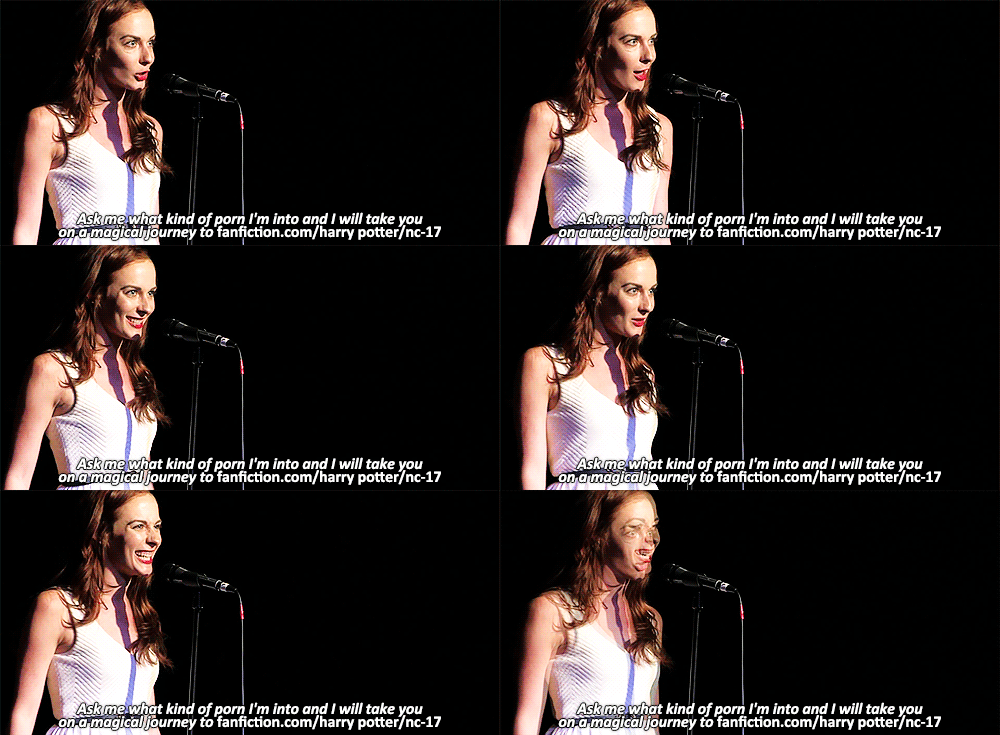
The title of Brenna Twohy’s spoken-word poem Fantastic Breasts and Where to Find Them is a punnish play on the title of a volume about the Potter-verse, Fantastic Beasts and Where to Find Them (emphasis added), published by J.K. Rowling some years ago as a companion to the 7-book saga of “the boy who lived.”

Twohy articulated the goal of her poem to Buzzfeed thusly:

I wanted to highlight how unrealistic most pornography’s portrayal of sex is, and how that creates really damaging expectations for both men and women.

twohy-ask-me-whatMission accomplished (at least for the most part) to hilarious and devastating effect. Particularly pointed is Twohy’s observation that a taste for fan-fiction erotica is to be considered “unrealistic” — while mainstream porn is somehow seen as more real. Which is about as laughable a deception as I’ve heard since… well, unfortunately, just since yesterday, when folks were declaring that public breast-feeding is immoral. (Seriously, y’all. The patriarchy just needs to shut up and die in a fire. Now.)

In yesterday’s Independent, Jonathan Owen discusses a recent poll of British teenagers that reveals:

the majority [of poll participants] warn of the “damaging” and “addictive” effect of sexual images and videos readily available online. 80 per cent say it is too easy for young people to stumble across it and most recall “accessing pornography was seen as typical” while they were at school.

At least 70 per cent agree that “pornography leads to unrealistic attitudes to sex” and “can have a damaging impact” on views of sex or relationships.

A quick visit to Professor Google turned up a wealth of other articles unpacking the sexual myths and unrealistic expectations fostered by the mainstream porn industry. For example:

The gist of all these different articles is perhaps most entertainingly summarized by Noah Brand and Ozy Frantz in Alternet:

The problem is, learning about sex from porn is like learning about firearms from action movies. Action movies sacrifice realism for the sake of storyline or a really cool explosion. Action movies don’t teach you gun safety. Action movies don’t talk about alternatives to violence. And action movies use some tropes—such as the infinite ammo supply—that may move the story along but don’t reflect reality. That’s not a problem, as long as everyone treats them as entertaining fantasies.

Unfortunately, for many young people becoming sexually active today, the entertaining fantasies of mainstream porn are the teacher they’ve spent the most time with, and mainstream porn is a terrible teacher.

Even more than the general unrealistic nature of mainstream pornography, Twohy chooses to highlight a particular strain of misogyny and violence against women that runs through so many adult films.

[SIDEBAR] I will admit to having some level of discomfort over a piece that lambastes porn culture for allowing men to fantasize about sex with barely-legal teens while offering — however ironically — the “more empowering” alternative of a book series where the main characters are under-18 for a majority of the time. Also, having quickly perused some of the titles and advertised pairings in the “mature” section of the Harry Potter stories on fanfiction.net, I see the potential for a lot of uncomfortable power dynamics (Snape & Hermione) and Stockholm syndrome (Draco & oh, everybody).** Blurred lines of consent all over the place… [/SIDEBAR]

Nonetheless, the general thrust*** of Twohy’s piece feels really true and honest and on-point about the culture that mainstream porn participates in and which it helps perpetuate. To quote HuffPo (who also quotes part of Twohy’s poem):

a 2010 Violence Against Women study found that 90 percent of porn video content online and off included verbal or physical aggression towards women.

“I know a slaughterhouse when I see one,” Twohy says of the porn industry. “It looks like 24/7 live streaming, reminding me that men are going to fuck me whether I like it or not, that there is one use for my mouth and it is not speaking, that a man is his most powerful when he’s got a woman by the hair.”

Twohy suggests that the “slaughterhouse,” an uneasy analogy where the slicing instruments aren’t knives but part of a video editing suite, does more than just provide shots of women’s segmented body parts. It also creates a culture where domestic violence isn’t only expected, but accepted.

And more than that, Twohy steps — for an uncomfortable, searingly honest moment — into the ways that we all internalize these messages about how men and women are expected to perform in romantic and sexual situations — men, rough, cruel, aggressive; women, compliant and sex kittenish.

The first time a man I loved held me by the wrists and called me a whore, I did not think “Run.” I thought, “This is just like the movies.”

I have seen that training, on film and in real life.

It everybody fucks over, the patriarchy does.

* Yes, I dare say it has.

** You know how yesterday I took a bullet and read the comments sections on things so you wouldn’t have to? That favor-doing stops tonight — I was not going down that particular rabbit hole. Not for anything.

*** Sorry, couldn’t resist.

———-

Image credit: http://iwatchforsasha.tumblr.com/post/95066205780/fantastic-breasts-and-where-to-find-them


Form vs. Function

So, as someone who is child-free by choice, I’ve had an informal policy of staying as far away from the “mommy wars” as it is possible for me to stay. Breast-feeding vs. formula, maintaining external employment vs. becoming a stay-at-home-mom, “mainstream” product choices vs. natural/organic ones — every choice has its costs and benefits, and every mother has her own unique circumstance that leads to a particular set of choices (some of which may even be forced-choices determined by economic or other constraints).

Since I have never faced these choices and I am never walking a mile in these particular stirrups, my general approach has been to hold an attitude of respect for each mother and her parenting choices,* on the belief that each mom is doing the best she can in any given moment.

But then there’s that moment when the mommy wars play out very personally in the life of someone in my circle of acquaintance:

Ingrid Wiese-Hesson was shopping at an Anthropologie store in Beverly Hills when her 6-week-old son, Xavier, began crying because he was hungry.

Wiese-Hesson then sat down in the store to breastfeed the infant, and that was when the store’s manager reportedly intervened.

“The exact words to me were ‘I’m here to escort you to the ladies room so that you can finish breastfeeding’,” Wiese-Hesson said. “She opened up the bathroom, and she said ‘sorry, there’s no chair’, and of course the only thing in the bathroom was the toilet seat.” (CBS Los Angeles)

Ingrid posted her experience on Facebook and it blew up and went viral almost instantly (as one might guess from seeing the clip from last night’s 11’o’clock news).  More details and slices of analysis are available at a number of places online, including information about a “nurse-in” that took place today in the store (LAist); an AdWeek post that connects the uncomfortable dots between this real-life incident and a recent student-designed public awareness campaign aimed at preventing exactly this sort of harassment; and a CBS Money Watch post that gives really good snark:

At high-end retailer Anthropologie, shoppers can select from body-baring items like its $118 see-through Gladiolus Sheer Silk Blouse. But when it comes to breastfeeding, one store location deemed a woman was showing just too much of her body.

Assuming AdWeek’s excerpt from and analysis of CA state law is on-point —

The Anthropologie manager’s actions were not just unwise, they were also in violation of Hesson’s legal rights. From the California Civil Code: “Notwithstanding any other provision of law, a mother may breastfeed her child in any location, public or private, except the private home or residence of another, where the mother and the child are otherwise authorized to be present.”

— then there’s a certain open-and-shut nature to the legal question here. Ingrid was absolutely, 100% within her rights to breastfeed her son in the Anthropologie store, and the store manager broke the damn law by  interrupting her and escorting her to the bathroom.

david-horsey-breastfeeding-moms-20120705-001So I’m going to set the legal question aside from now and just let my mind boggle from the fucking insanity of this all. What rational and reasonable objection would anyone have to a woman breast-feeding her six-week-old baby?

Answer: objections a-plenty, but nothing rational or reasonable, as far as I can tell. I know the first rule of following feminist stories in mass-market media sites is “don’t read the comments!” — well, I did, so you don’t have to. (Taking one for the team.) There were a few different rhetorical tactics, but objections pretty much all fell into being one flavor or another of this: breastfeeding should be done in private because it’s immoral/unseemly/inappropriate for it to be seen in public.

And here’s where I go into a sputtering place of incoherent rage and puzzlement. Because, to paraphrase Henry Rollins when talking about racism: these folks are tripping over an entry-level concept, a curb about 6 inches high. It’s inappropriate to publicly use your boobs to feed an infant? Feeding babies is actually the main purpose for which women’s breasts were invented! How can it be deemed immoral for babies to be fed in public?

Because, as Anna Quindlen said way back in 1994:

[T]he subtext of the public breast-feeding battle is the inability to make a distinction between what is female and what is sexual, what is indecent and what is utilitarian. And maybe it’s epitomized in a letter that The Albany Times-Union got from an irate citizen who asked whether women who nursed in public would be having sex on the streets as well, as though the connection between nursing and fornication was self-evident.

(Yes, 1994. Twenty years ago. The more things change, the more they fucking don’t.)

After all, I bet no one would object to a baby being bottle fed in public, and I bet the same judgmental asshats complaining so voraciously about Ingrid’s choice to publicly breastfeed would also be giving her the judgmental side-eye if she had chosen to delay her son’s feeding and “subjected” the other customers to hearing the sounds of an unhappy, hungry, crying baby. It’s only because someone’s mammary glands are involved that this has become such A Thing.

I know that the policing and sexualizing of women’s bodies is pretty stupidly crazy even on the best of days. But still. What is it about breasts? How did these secondary-sex characteristics become so thoroughly fetishized and sexualized in the culture? Why is Anthropologie okay selling see-through shirts for the sake of showing off in the attractiveness/sexuality game, but not okay with a woman discreetly using her breasts for their actual, original biological purpose?

I know, I know: it’s the damn patriarchy again. After all, no one’s having a fit about all those exposed Adam’s apples…

* Aside from those that are obviously neglectful and/or abusive.

———-

Image credit: http://articles.latimes.com/2012/jul/12/nation/la-na-tt-breastfeeding-moms-20120705    (David Horsey at the LA Times.)

On Self-Rejection and Synchronicity

With one breath, with one flow
You will know
Synchronicity

A sleep trance, a dream dance,
A shared romance,
Synchronicity

A connecting principle,
Linked to the invisible
Almost imperceptible
Something inexpressible.
Science insusceptible
Logic so inflexible
Causally connectible
Yet nothing is invincible.

~ The Police, Synchronicity I

One of the reasons The Cruise was such a treasured experience was that it gave me a chance to touch into the energies of my ancestral lands, at least a little bit. I’m Scottish on one side and Lithuanian on the other, so this trip to the Baltic states was my first-ever chance to explore the Lithuanian side of my heritage.

During our time there, one of our tour guides shared stories from his childhood — both his own experiences growing up as well as myths and folktales that were told to him during his early years. One such story was about the rooster.

Now this caught my attention especially. You see, I was born in the autumn of 1969, which means my animal in the Chinese zodiac is — you guessed it — the rooster.

———-

Chinese astrology isn’t ever something I’ve studied. Actually, let me just say I’ve never really studied astrology at all. (End of sentence. Full stop.)

Still, somewhere in my childhood I saw the list of animals and years and matched my birthdate to the rooster.

Oh, let’s be real. The self-proclaimed online guide to the Chinese zodiac puts things this way:

Most people’s understanding of Chinese astrology and the Chinese zodiac doesn’t extend beyond what they see on the paper placemats that cover the tables of their favorite Chinese restaurants.

Yes, that was me. I can see it in my mind’s eye: a red paper placement with a ring of animal pictures and their associated years around the border. And there was Mr. Rooster sitting at 1969.

rooster-cockerel1I remember being generally dissatisfied with that match-up. At the time, I don’t think I knew the slightest bit about what types of personality traits were associated with different animals/astrological signs. I was just making a visceral, childish comparison: there were cool animals (dragon, tiger, snake), strong and useful animals (horse, ox, sheep) and lovable animals (rabbit, dog). And then there was the rooster. But at least I wasn’t the rat.

My dissatisfaction with being “a rooster” was so instinctual and unreasoning that my guess, looking back with these decades of perspective, is that I would have disliked whatever sign matched up to me. The habits of comparison and finding myself less-than were just so strong back then, the degree of self-rejection so total, I don’t see myself as being satisfied with any sign that was mine, however glamorous the associated animal.

‘Cos ultimately, I just didn’t want to be me.

———-

So when our tour guide started talking about how the rooster was an especially treasured animal in Lithuanian folk tales, my ears, they perked up. According to his telling, roosters were treasured because they were the one animal not afraid of the devils or demons — in fact, the rooster’s voice was believed to be the one noise that could drive the demons away.

I haven’t found much online to further illuminate or corroborate this snippet of folklore our tour guide mentioned. The closest I’ve found is an entry on this website about different pieces of folklore regarding protection against witches:

During the Middle Ages, the cock was an important Christian symbol of resurrection and vigilance. A rooster represented God, goodness, and lightness. Cocks’ places were earned at the top of buildings, domes, and church steeples. They crowed at the birth and death of Christ, and they herald the dawn, “which brings light to the sins of the night and rouses men to the worship of God.”

Witches Sabbats were dispersed, and enchantments were dissolved, by the crow of a rooster. The rites of Satan ended because the Holy Office of the Church had begun. The 4th-century Christian Latin poet Prudentius sang, “They say that the night-wandering demons, who rejoice in dunnest shades, at the crowing of the cock tremble and scatter in sore affright.” In the time of Saint Benedict, Lauds and Matins were recited at dawn and became known as Gallicinium, or Cock-crow.

Now, as a card-carrying witch myself,* there’s a bit of disconnect between this interpretation and my own beliefs about who needs protecting from whom. But, knowing how often Pagan folklore was folded into medieval Christianity, I don’t think it’s too far of a stretch to imagine one of my Lithuanian fore-mothers, a wise women and a witch, standing against the demons with a rooster on her shoulder.

After all, if Baba Yaga’s hut has hen’s legs, and the goddess Gabija sometimes chooses the form of a rooster for her earthly visits, why not an ancestress with a rooster familiar?

Amazing how a piece of synchronicity can give you a perspective shift, turning an old source of dissatisfaction into something to embrace. To claim.

* Okay, not card-carrying. I’ve lapsed on my membership dues.

———-

Image credit: http://danielmackie.wordpress.com/2012/10/11/rooster-in-various-mythologies/


Teaching, Trust and Testing

The aspirational arithmetic behind that whole “study an hour a day to become an international expert in your field” thing goes something like this:

  1. Studying/reading an hour a day adds up to you reading/absorbing about a book a week;
  2. Which adds up to about 50 books over the year;
  3. Which adds up to a whole lot of learning.

Now, obviously, by setting more moderate goals about how much “ed-reading” I’m trying to do each day, I have ensured that my own personal arithmetic will be adding up a bit more modestly. Still, I’m pleased to say I’ve finished the first book I started when I set this plan for myself. Two-and-a-half weeks ain’t so bad, all things considered.

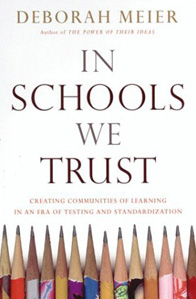
SchoolsWeTrustCoverEven though it’s a complete non-sequiteur, the first thing I noticed about Deborah Meier’s In Schools We Trust was that it was published by Beacon Press. I know of Beacon as the UUA‘s publishing house, but I’d not noticed till today what a vast array of non-UU books is in Beacon’s catalog. Upon reflection, this only makes sense, or else I fear Beacon might have what they call an “unsustainable business model.” Still, I hadn’t even remotely thought of Beacon as publishing education books till I picked this one up. Now I might as well export their entire catalog over to my reading wish list as I continue my ed-reading self-study project.

But on to more substantive matters…

Meier’s book is subtitled Creating Communities of Learning in an Era of Testing and Standardization, and although it was published in 2002, it still senses, to my readerly eyes, as speaking to the current state of schools and schooling. After all, who could read the following passage —

[S]ocial distrust plays itself out in education in the form of draconian attempts to “restore accountability” through standardized schooling and increasing bureaucratization.

The tragedy of this approach is that it undermines what I think is the best way to make schools trustworthy and raise standards. Standardization and bureaucratization fuel the very distrust thy are aimed to cure. Even more tragically, standardization and bureaucratization undermine the possibilities for the kind of education we all claim is sorely lacking. (2)

— and not feel its contemporaneousness?

In case you’re interested, here’s a few other reviews:

Meier arranges her book into three sections. Part One discusses different aspects of building a culture of trust within schools: teacher collaboration, parent engagement, being aware of the powerful impacts and implications of race and class differences within the members of a school community (teachers, children, educators). Meier also discusses the importance of creating an environment where children feel safe taking learning risks:

Learning happens fastest when the novices trust the setting so much that they aren’t afraid to take risks, make mistakes, or do something dumb. Learning works best, in fact, when the very idea that it’s risky hasn’t even occurred to kids. . . . No one is sorting or ranking us. . . . We’re in the company of people who are most firmly on our side, no matter what. (18)

Throughout these chapters, Meier offers concrete suggestions drawn from her own experience founding small, innovative public schools in NYC and Boston. Meier outlines 7 key qualities for such schools on pages 20-22. To paraphrase:

  1. Safety, both physical safety from violence and also safety from ridicule and safety to learn and make mistakes.
  2. A supportive “expert-to-learner” ratio, achieved by understanding that school communities can draw on other adults and older peers to create a more vibrant & effective learning community.
  3. Opportunities for students to show their own expertise and passion for a topic/subject.
  4. Flexibility in how learners can experience, explore and assimilate new content knowledge.
  5. Setting aside rigid timetables to allow “time for ideas to grow” (21).
  6. Learning that is engaging and enjoyable.
  7. A commitment to connecting school/curricular content to students’  authentic, lived experiences.

Part Three of the book addresses some customary fallacies and misconceptions about the small-school movement, arguing against the common belief that small, successful urban schools are so rare, the products of such exceptional circumstances (a superstar principal, a deep-pocketed foundation, etc.) that their  models of success could never be replicated to serve all the U.S. children in need of better, safer, more engaging schools. In fact, Meier argues, the “failures” often seen in attempts to scale up successful small schools are most often caused by city and state bureaucracies making choices that impose standardization at the cost of standards — at the cost of actual success in teaching and learning.

There’s no way to guarantee that any particular system will work, or will work forever, or will not need endless revising. But until we get over the idea that there is a one-size-fits-all solution to schools, above all for schools that are trustworthy enough to do the job well, we won’t allow ourselves to do the difficult long-term work of redesigning the system, not just the schools. What we need is a new kind of system whose central task is to protect the public space needed for innovation. We need a lean, mean system, with a limited but critical accountability function, to be the guardian of our common public interest, but one that respects the fact that schools must be first and foremost responsive to their own constituents — the members of their community — not to the system. That’s the rub. (172-3, emphasis added)

———-

You may have notched I skipped passed Part Two of Meier’s book. I did so because its contents — a devastating critique of standardized testing and its primacy in the U.S. educational system — seemed to me not-entirely connected to the book-ended discussion in Parts One and Three about what successful school models could look like and how to achieve them.

Don’t get me wrong: I think Meier’s critique of big testing is powerfully on point. When I called it a “devastating critique,” up above, that was not empty praise on my part.

Quite frankly, I’m afraid to start a more detailed summary with pull-quotes, for fear I will instead try to type out all 70 pages of this verbatim. And I just don’t have that kind of time.* Suffice to say, for the moment, that Meier has added immensely to the depth of my understanding of standardized testing, as well as to the depth of my contempt for its current use in schools. Even if you’re not interested in Meier’s thoughts about school design, Part Two of her book is eminently worth reading as its own little “capsule volume.”

So, a valuable first book in my new Earl-Nightengale-inspired ed-reading project. With any luck, I’ll finish book #2 at a similar fortnightly pace and circle back here.

Now all I need to do is figure out if there’s any sort of note-taking system I want to use to capture what I’m learning and any connections I start to make. Are these “21st century book reports” enough for that purpose, or is there something else that’s worth the doing?

* Or that level of disregard for copyright and the limits of “fair use” conventions.

———-

Image credit: http://en.wikipedia.org/wiki/In_Schools_We_Trust

Handing Out Sticks

Famous blogger Matt Walsh has kicked off a bit of a tempest by writing two posts about Robin Williams’ death. The first one, basically, tried to draw a bright-line boundary between the concepts of depression and suicide. This interpretive framework (and Walsh’s reasons for wanting to drawing this sharp boundary) is pretty well summarized here:

First, suicide does not claim anyone against their will. No matter how depressed you are, you never have to make that choice. That choice. Whether you call depression a disease or not, please don’t make the mistake of saying that someone who commits suicide “died from depression.” No, he died from his choice. He died by his own hand. Depression will not appear on the autopsy report, because it can’t kill you on its own. It needs you to pull the trigger, take the pills, or hang the rope. To act like death by suicide is exactly analogous to death by malaria or heart failure is to steal hope from the suicidal person. We think we are comforting him, but in fact we are convincing him that he is powerless. We are giving him a way out, an excuse. Sometimes that’s all he needs — the last straw.

Then, after the post went viral and lots of people took issue with it, Walsh wrote a somewhat testy follow-up to: 1) decry the vitriol of individuals who misrepresented/misunderstood his first post and 2) provide more detailed justification of his position.

Among the many voices I’ve seen either directly or indirectly rebutting Walsh’s argument….

Pastor Jean-Daniel Williams, who writes:

If I commit suicide, perhaps, as you claim, it will be ‘’my’’ choice. But I doubt it. I have spent more than half my life listening to my own body betray me, my own mind telling me that it would be better to die. . . . Living is the pro-active choice. Is suicide a choice? It has been a free choice every time I have ever said no so far. I have chosen to say no. That is not because we can blindly, arrogantly, say that it is a moral choice, though. It is because I have been really lucky that I am (still) healthy enough to say no. The thing is, saying ‘’no’’ to suicide is evidence that I am healthy enough to say no. But, if I should ever commit suicide, it will not be because ‘’I’’ made the choice, but because my depression would have.

Kristi, on the blog “What is Matt Walsh wrong about today?” provides some valuable information about the effect of depression on one’s cognitive and decision-making capabilities:

Matt says suicide is a choice, but what makes a choice a choice is the presence of logic, reason, and objectivity to evaluate its merits. Depression can rob your brain of the ability to think that way. My friend Derek, a pharmacist, knows a thing or two about this. In his own words:

“In a euthymic (or normal, mildly-positive) attitude, the effect of a choice is either a reward, perhaps the blast of dopamine from a great run, or a detriment, the exhaustion of inactivity. In a person with clinical depression, both sides of that choice respond with a similar lack of neurotransmission.

A patient suffering from severe depression may not even be able to tell the choice apart. Even if objectively they know that running is good, couch is bad, they will experience the same neurochemical state regardless.”

[. . . ] So no, depression doesn’t appear on autopsy reports. But when a 500-lb thirty-year old drops dead at his desk, the autopsy reads “cardiac arrest” rather than “morbid obesity”. As usual, Matt is glossing over nuances. He thinks things are black and white—that a choice is a choice. He’s wrong. In absence of a healthy neurological system, not all actions are choices.

[SIDEBAR] Even though the fat activist in me is yearning to give significant bandwidth to the false assumptions and lack of medical evidence in Kristi’s facile conflation of “cardiac arrest” and “morbid obesity,” I’m mostly going to let it slide because I’m on a different topical horse tonight. Allow me merely a gentle hat tip to my HAES basics post, my critique of BMI, and my puzzlement at the unproductive insanity of fat-shaming. [/SIDEBAR]

[SIDEBAR THE SECOND] I am clearly way too ill-informed about the blogosphere as I hang out typing furiously in my little isolated corner of the wild, wild web. I don’t think I had ever heard of Matt Walsh till this folderol, yet he’s a prominent enough Internet figure to have earned his own dedicated counter-narrative. I don’t know if I’m impressed or horrified. [/SIDEBAR THE SECOND]

Although he doesn’t name check Walsh at all, Peter DeGiglio might as well be writing a targeted counterpoint against Walsh, articulating more reasons for understanding Williams’ death as being caused by the disease of depression:

I tried to get the old friend to understand by using my go-to comparison in this conversation. I asked, “Well, what if it was cancer?” His answer came back like a clichèd line from an after-school special. He proclaimed, “Well, that you can’t help!”

And therein, my friends, lies the problem in our dialogue on mental illness. [. . .]

What I believe people need to understand is that Robin Williams took his own life because he lost his battle with a serious medical condition. Take again my cancer analogy. Think about it: The last possible stage of any type of cancer that can effect a person is death. When one loses their battle with cancer, they die. The cancer cells take over and shut down the body for good. The same can be said for Bi-Polar Disorder and Major Depressive Disorder (aka simply “Depression”). The last possible stage of these diseases is death. The difference is that instead of cancer cells destroying the body, the body is destroyed instead by thoughts and feelings, causing the afflicted person to be convinced that the only way to end the suffering is through death at their own hands.

Essentially, he had “Thought Cancer”

———–

I feel half-vulture playing all this out on the screen. Yet another fan doing pop psychology when a celebrity dies, and doing so without much regard for the feelings of those individuals who are actually, acutely, intimately affected by his death.

So why am I even sailing these rocky waters?

Because however much I disagree with Walsh’s perspective, no matter how fervently I believe that those suggesting we say Williams died of depression are onto a deep psychological and spiritual truth — well, here’s an uncomfortable truth of my own.

Part of me wants Walsh to be right.

I want to believe that my depression is something I can rein in, get under control. I’ve been really lucky to be able to manage the condition for several years now without prescriptions. This is nothing I’m saying as a mark of strength, of health, or of any other sort of virtue. The operative word is “luck.” Yes, I work damn hard to maintain my psychological health, but I also know you can do everything “right” and still be challenged with disease. So, yeah, I am deeply grateful for my good fortune, but I know that tomorrow’s health and tomorrow’s brain chemistry are far from guaranteed.

It’d be easier if Walsh were right. More comforting, in a childish control-freak kind of way. To know that I just need to find and follow the proper recipe so’s to be sure that I will never have to stare down the maw of despair and depression again.

But that’s not how life works.

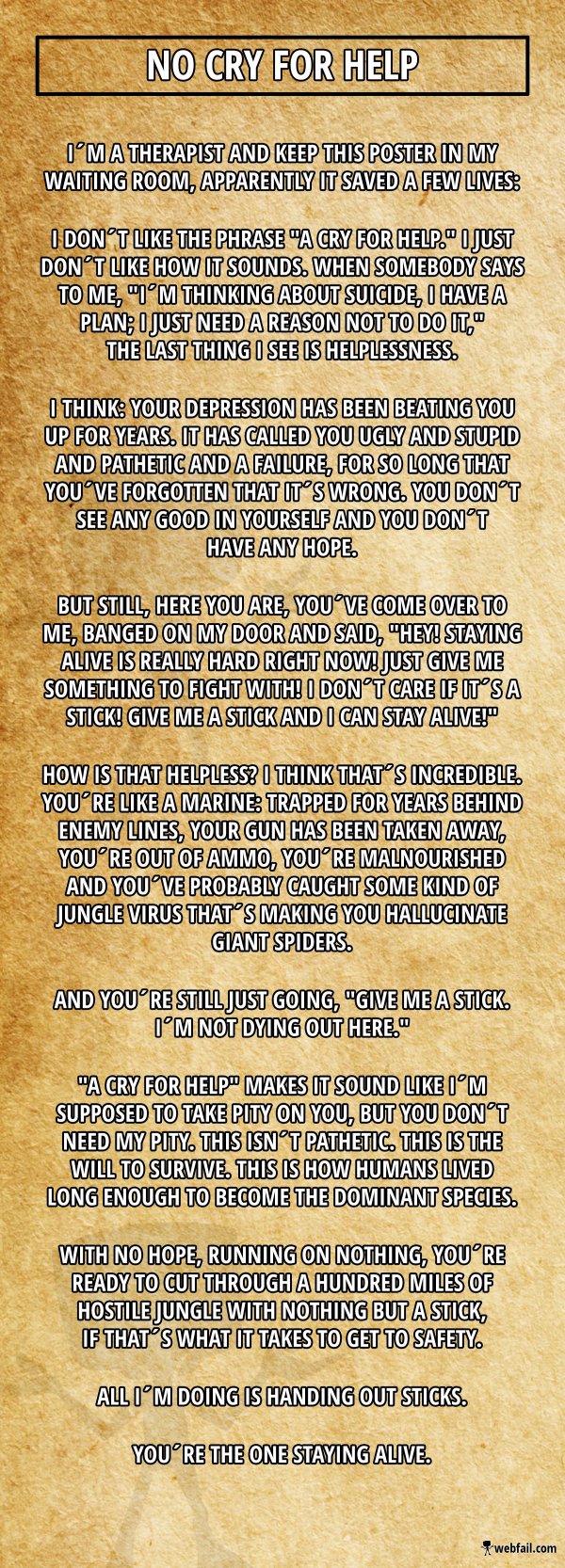
no-cry-for-help

———-

Image credit: http://en.webfail.com/855852d8b8b

Creating (a) Space

Somewhere in the back of my mind, I’d been holding the hope that we would be all the way unpacked and organ-imized at the one-year anniversary of moving into our “house on the hill.”

Well, we still have a few weeks till that anniversary — 24 days, to be exact — but I’m ready to call it: I will not be making that hoped-for deadline.

buried-boxesQuite frankly, the momentum for unpacking and all has ground to a complete halt during the last few months.

There’s plenty of good reasons for that. First, there was The Cruise, which took us out-of-town for more than a fortnight, and which required a certain amount of packing/unpacking of its own accord. There’s also the fact that one of the benefits we wanted to create by moving north from Philly was the ability to spend our weekends up at the lake in NH — and we’ve certainly spent a few of our summer weekends happily living out that intention. And then there’s been a few busy patches at work (she says, putting it ever-so-mildly).

But as I began to be aware that the one-year anniversary was approaching and to realize that I was going to miss my secret goal, I started looking at the ways I’ve been giving zero effort to unpacking, and I asked myself what other factors might have contributed to this stop in momentum. And I began wondering if those other factors had both a practical and an energetic dimension to them.

On the practical front, we’ve hit the stage where some of the unpacked boxes are definitively things we want to keep (old tax files, my cross-stitching supplies, etc.) but that don’t actually have any storage furniture to be unpacked into. (Some of our old furniture — including the filing cabinet and some shelving units — got jettisoned during the move, either because it was too old to be worth keeping, or because the ceiling in our finished basement — which is where these items are intended to be stored — is just a teensy-weensy bit too low.)

The energetic front is sort of linked to the practical lack of storage furniture: I didn’t have a vision for the room where the unpacked boxes are currently living.

———-

Let me set the stage to make this all (I hope!) slightly more comprehensible. The architectural features of the house mean that the finished basement falls roughly into three separate rooms, plus a wide long hallway. These “rooms” are open to one another, but still function as separate areas of space. When we moved in, we knew that the first room at the bottom of the stairs was going to be a little library/reading nook area, and that was, for the most part, set up pretty quickly. The hallway was wide enough that we could put up shelves for my prodigious CD collection (plus our movies), which was perfect because the third room, where the hallway leads to, was where we wanted to set up a media room. Those CD shelves were also taken care of pretty quickly, while the future media room and the undetermined center room were where the tons and tons of unpacked boxes waited for attention.

As we unpacked, we kept consolidating the geography so that a higher and higher percentage of unpacked boxes were in the center room, the room we simply began calling “unpacking central.” By taking this approach, we were able to get the media room clear — or, at least, clear enough — so we could start setting it up. The decor is still what we’ve been calling nouveau dorm room, but the core elements — big screen TV, soundbar, PS3 — are there, and we can deal with having milk-crate shelving for the time being.

And then there’s unpacking central.

———-

It was actually really helpful for a while not to have any other vision for the center room aside from its current role as unpacking central. The unpacking process, as a whole, has required me to really come face to face with all my hoarding/shopaholic impulses — facing up not only to the shame around that specific behavior pattern, but also to all the emotional baggage and patterning that led me to be a hoarder to begin with. Quite frankly, it’s been hard emotional work. Good work, important work, work well-worth the doing. Absolutely worth the effort. But hard, nonetheless.

Amidst that hard work, I definitely appreciated not having the extra burden of pressure in thinking “We could already have our ______ (game room, exercise room, whatever), if only I could get my fucking act together!

Yeah, it was nice to not have that piece of internal monologue running.

But my recent spate of inaction had me wondering if I had now become just a little bit too complacent in that room’s identity as “unpacking central” — like, somewhere in the back of my mind, was I thinking “Well, we don’t even know what we’re gonna use the room for, so what’s the hurry to finish cleaning it up?!?

So tonight, Mr. Mezzo and I did a little bit of talking and visioning about the kind of hybrid storage/crafting/creative nook we want to create for that center room. We don’t have everything figured out, but enough is settled that we can take advantage of Massachusetts’ tax free shopping weekend with an Ikea run tomorrow to get a couple storage pieces.

Two birds with one stone: start creating and carrying forward a vision to help re-inspire me towards the unpacking, plus some furniture pieces that mean unpacked item actually have a damn place to go.

So maybe we won’t hit the one-year moving anniversary. Maybe by Yule, instead…

———-

Image credit: http://doingitwright.wordpress.com/2013/07/13/the-5-laws-of-moving-house/