I guess it’s my week to talk about sexualized body parts?
This Button Poetry video from this year’s National Poetry Slam caught my attention yesterday:
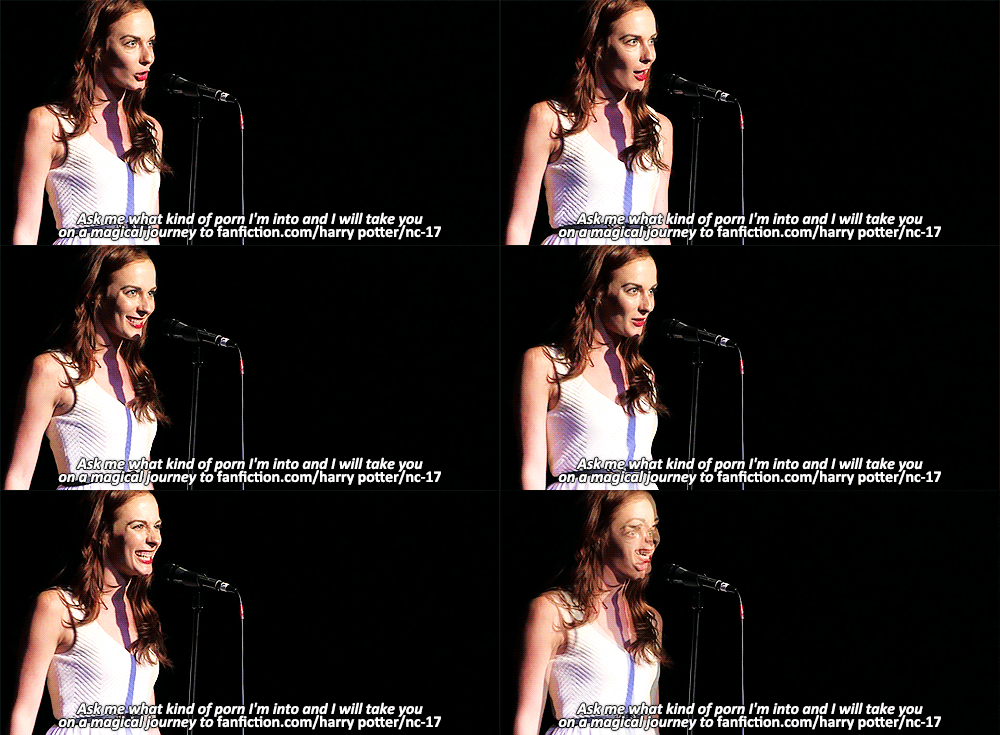
The title of Brenna Twohy’s spoken-word poem Fantastic Breasts and Where to Find Them is a punnish play on the title of a volume about the Potter-verse, Fantastic Beasts and Where to Find Them (emphasis added), published by J.K. Rowling some years ago as a companion to the 7-book saga of “the boy who lived.”
Twohy articulated the goal of her poem to Buzzfeed thusly:
I wanted to highlight how unrealistic most pornography’s portrayal of sex is, and how that creates really damaging expectations for both men and women.
Mission accomplished (at least for the most part) to hilarious and devastating effect. Particularly pointed is Twohy’s observation that a taste for fan-fiction erotica is to be considered “unrealistic” — while mainstream porn is somehow seen as more real. Which is about as laughable a deception as I’ve heard since… well, unfortunately, just since yesterday, when folks were declaring that public breast-feeding is immoral. (Seriously, y’all. The patriarchy just needs to shut up and die in a fire. Now.)
In yesterday’s Independent, Jonathan Owen discusses a recent poll of British teenagers that reveals:
the majority [of poll participants] warn of the “damaging” and “addictive” effect of sexual images and videos readily available online. 80 per cent say it is too easy for young people to stumble across it and most recall “accessing pornography was seen as typical” while they were at school.
At least 70 per cent agree that “pornography leads to unrealistic attitudes to sex” and “can have a damaging impact” on views of sex or relationships.
A quick visit to Professor Google turned up a wealth of other articles unpacking the sexual myths and unrealistic expectations fostered by the mainstream porn industry. For example:
The gist of all these different articles is perhaps most entertainingly summarized by Noah Brand and Ozy Frantz in Alternet:
The problem is, learning about sex from porn is like learning about firearms from action movies. Action movies sacrifice realism for the sake of storyline or a really cool explosion. Action movies don’t teach you gun safety. Action movies don’t talk about alternatives to violence. And action movies use some tropes—such as the infinite ammo supply—that may move the story along but don’t reflect reality. That’s not a problem, as long as everyone treats them as entertaining fantasies.
Unfortunately, for many young people becoming sexually active today, the entertaining fantasies of mainstream porn are the teacher they’ve spent the most time with, and mainstream porn is a terrible teacher.
Even more than the general unrealistic nature of mainstream pornography, Twohy chooses to highlight a particular strain of misogyny and violence against women that runs through so many adult films.
[SIDEBAR] I will admit to having some level of discomfort over a piece that lambastes porn culture for allowing men to fantasize about sex with barely-legal teens while offering — however ironically — the “more empowering” alternative of a book series where the main characters are under-18 for a majority of the time. Also, having quickly perused some of the titles and advertised pairings in the “mature” section of the Harry Potter stories on fanfiction.net, I see the potential for a lot of uncomfortable power dynamics (Snape & Hermione) and Stockholm syndrome (Draco & oh, everybody).** Blurred lines of consent all over the place… [/SIDEBAR]
Nonetheless, the general thrust*** of Twohy’s piece feels really true and honest and on-point about the culture that mainstream porn participates in and which it helps perpetuate. To quote HuffPo (who also quotes part of Twohy’s poem):
a 2010 Violence Against Women study found that 90 percent of porn video content online and off included verbal or physical aggression towards women.
“I know a slaughterhouse when I see one,” Twohy says of the porn industry. “It looks like 24/7 live streaming, reminding me that men are going to fuck me whether I like it or not, that there is one use for my mouth and it is not speaking, that a man is his most powerful when he’s got a woman by the hair.”
Twohy suggests that the “slaughterhouse,” an uneasy analogy where the slicing instruments aren’t knives but part of a video editing suite, does more than just provide shots of women’s segmented body parts. It also creates a culture where domestic violence isn’t only expected, but accepted.
And more than that, Twohy steps — for an uncomfortable, searingly honest moment — into the ways that we all internalize these messages about how men and women are expected to perform in romantic and sexual situations — men, rough, cruel, aggressive; women, compliant and sex kittenish.
The first time a man I loved held me by the wrists and called me a whore, I did not think “Run.” I thought, “This is just like the movies.”
I have seen that training, on film and in real life.
It everybody fucks over, the patriarchy does.
* Yes, I dare say it has.
** You know how yesterday I took a bullet and read the comments sections on things so you wouldn’t have to? That favor-doing stops tonight — I was not going down that particular rabbit hole. Not for anything.
Back during JALC’s first lifespan, I took some small enjoyment from watching my WordPress dashboard to see what sorts of google searches brought readers to my posts. (I even used that as an excuse for a quick one-liner-type post way back when.) Google has since redone its programming, so there’s much less of that possible on JALC’s current life cycle.
Nowadays, most everything is hidden behind an “unknown search terms” privacy curtain. I haven’t the slightest level of understanding as to why certain terms making it out from behind the curtain to appear on my dashboard, but since I know the dashboard list is a mysteriously reduced and redacted version of the “real” list, I just haven’t really paid that dashboard feature much attention this time around.
Until I got back form my trip Sunday night and saw a new phrase in that screen field:
we hate ragen chastain
In case you don’t know, Ragen Chastain is a fat activist, someone I would say is out helping lead the movement. She has a book, an active speaking calendar and is currently co-organizing an online Fat Activism Conference that will take place from August 22-24. And she has a blog, a blog that is one of my go-to sources to continue expanding my awareness and evolving my thinking around fat acceptance and health at every size.
I would wager that Chastain and I wouldn’t see eye to eye on everything. For example, my guess is that she would consider my recent HCG journey simply to be a capitulation to diet culture, even though I contextualized it for myself as a detox experience. And, you know what? If she did have some questions about my motivations, and how mixed they might have been, I can respect that. ‘Cos Gaia knows, I had to do a lot of my own inner discernment to keep unwinding my old weight loss programming so that I could keep the goals of my HCG journey distinct from losing weight. And the uncomfortable reality is that no matter how hard I worked to keep my own focus in the detox lens, my decision to do HCG meant that I financially supported a company that makes its living off of diet culture, women’s insecurity, and size policing. (Ugh.)
So yeah, I can respect how Chastain and I might have differing opinions on some things. But the level of puzzlement and shock I felt about that search term being used to find this blog is largely driven by the great level of respect I feel for Chastain, her work, her voice. (My best guess, looking back at my old posts, is that the phrase must have made contact with one of my own FA/HAES rants where I quoted one of Chastain’s posts and then talked about “hating” some fat-shaming shenanigan-or-other.)
The other piece of my upset about having been, even ever-so-peripherally, connected to that phrase is the general sense of despair and discouragement I feel about the ugly way that people treat each other, out here on the Interweb.
Every time, the people with whom I share this experience express shock. It is always, always, a surprise that a woman who does public advocacy is subjected to this sort of abuse.
And it shouldn’t be. Because every single woman I know who does public advocacy is subjected to it. . . .
And then we are told not to talk about it. We are told that we empower the people who do this to us. No. NO. Victims do not empower abusers. People who refuse to acknowledge that abuse do. People who tell victims to be silent do.
I am not going to be silent. I am tired of people being surprised. I am tired of hearing “I’m sorry this happens to you.” I don’t want shock and I don’t want pity.
I want your fucking awareness and I want your fucking anger.
I want us to talk about the real costs of being a woman who does public advocacy. I want us to acknowledge how the costs of providing a safe space is that we stand on the line and absorb massive amounts of abuse. I want us to make noise about the people who create an atmosphere in which women are discouraged from participation.
And I want people to stop telling me to be quiet about it.
In addition to the politicized, misogynist harassment, there’s the general garden-variety flavors of awfulness.
Actress Zelda Williams, daughter of comedy great Robin Williams who died Monday from an apparent suicide, has quit social media after receiving taunts from Internet trolls.
Williams abandoned her Twitter and Instagram accounts Tuesday after saying at least two people were sending her Photoshopped images of her father’s dead body and other disturbing messages.
“I’m sorry. I should’ve risen above,” she wrote in her final tweet. “Deleting this from my devices for a good long time, maybe forever. Time will tell. Goodbye.”
The episode proves that, with the anonymity of the Internet, some people will be horrible no matter the situation. (CNN)
Though I don’t know enough of the facts to say this for sure, I can’t help wondering whether Williams’s daughter was receiving more online harassment than his two sons, and whether she was targeted for that higher level of harassment because — well, because we live in a fucking kyriarchy, that’s because. And if my vague suspicions are true, well then there’s a very fine lineindeed between “garden-variety” Internet awfulness and the misogynist endeavor to silence women’s voices.
I don’t often use the word “hate” to describe my feelings for people. Cultural trends, political positions, social patterns, even individual actions — those I’ll use the term for often enough, but not so much for referencing an individual person, in their entirety. So suffice it to say that I’m really kinda hating the way that JALC was connected (however temporarily, however peripherally) to someone on just that sort of hate-filled trip.
* PS– Am I the only one who found it odd that the WaPo’s main angle was to talk about how online harassment was viewed by or affecting the female writer’s male partner? I’m not saying, I’m just saying…
———–
Image credits:
South Park: http://designaterobertson.blogspot.com/2012/05/your-south-park-tigers.html
Although it was all over my Facebook wall a month or so ago, I never forwarded the Always #LikeAGirl ad before today, nor did I choose to say anything on JALC about it.
My hesitation was similar* to that when Pantene urged women “Don’t let labels hold you back” several months ago, in an ad Sheryl Sandberg helped take epically viral, or when the Dove “Real Beauty Sketches” ad went epically viral some months before that:
My feelings about these female empowerment campaignsad campaigns are always pretty similar, one to the next. Basically, I feel conflicted. On the one hand, these ads do bring up aspects of my own lived experience, whether it’s the double standards I’ve faced around being “bossy” or “bitchy,” or my habit of being hyper-self-critical, around my physical appearance and, sometimes, pretty much everything else about me.
On the other hand, it’s a little bit galling — okay, a lot galling — to have these quasi-empowering “accept yourself” messages come from companies for whom a significant percentage of the profit margin is based on the proposition that women will feel bad enough about themselves to buy your product so that we can be groomed, tweezed, moisturized or shampooed in such a way as to overcome our innate debased female-ness and become more socially acceptable.
Quite frankly, my conflicted feelings about this trend have reached a high enough level that I never even bothered to watch the Always ad above, or Pantene’s went-viral-one-month-ago “Sorry Not Sorry” ad before tonight when I was preparing this post for JALC.
So, yeah, I’ve never been in the corner of Dr. Bernice Ledbetter, who writes over on HuffPo that these ads are “truly a banner in the battleground of the feminist movement.”
I actually find that perspective quite sincerely and incredibly baffling. Do you not see how the women in the Dove ad are mostly, white, thin, not-too-old, and conventionally attractive to such a degree that the deeper message of the piece can easily function as little more than “The hearts of conventionally beautiful women can grow a little warmer today”? Can you explain to me how women getting shinier, bouncier hair is a viable solution for misogynist attitudes and prejudices against female intelligence, agency and ambition? As Emily Shire observes about the #LikeAGirl ad:
Yes, it’s far more appealing on the surface to have pads and tampons promoted as somehow part of a larger goal to change the meaning of “like a girl.” But the campaign is shamelessly emotionally exploitative. It demonstrates real problems—femaleness as a derogatory statement, decrease in self-confidence as women mature—in a beautiful and clear way, but then pretends a corporate manufacturer of panty liners meant to “help you feel fresh ever day” can solve them.
(And again, notice here how problems that are deeply-rooted and systemic, based in cultural norms, problems that are perpetuated and policed as much by external messages as by internalized ones — the very nature of what I call “the miasma of misogyny” — are presented as something to be solved by women’s policing of their femaleness and their female bodies.)
And yet, however much I’m able to see the problematics in these “short films,” their innate and even troubling limitations, I still admit I kind of like them. My affection hasn’t been strong enough for me to join in amplifying their viral distribution, or perhaps my awareness of the flaws has been too strong to allow me to join in the fun. But I don’t have it in me to work up the same kind of feminist outrage about these ads as I’ve displayed here on other occasions.
Which is why I so appreciate Natalie Baker over at Bitch Magazine for reminding me today that it’s possible to live in a yes/and rather than an either/or place.**
So here we are, once again, stuck in another good vs. not good enough debate: either these ads are radically tackling sexism through a historically appalling medium or it doesn’t matter what these ads say because corporations don’t actually care and will say anything to make a buck.
What if it’s both? That is to say, what if these companies are forwarding feminist messaging despite not actually caring about it? And what if that still helps us?
Like Jezebel said back when the Always ad was first released:
While all ad companies are bullshit liars to a point, willing to do or say whatever it takes to get your money, I would rather have empowerment cheese over shame-based guilt, which seems to be the two usual suspects in a capitalist economy.
That’s a sentiment Ican get on board with, especially when I think back to Super Bowl Sunday’s usual dreck. To return to Baker:***
For those of us who surround ourselves with intersectional anti-oppressive ideology, what’s considered progress in the mainstream can feel like a joke. But that’s our piece of the jigsaw—to be progressive is by definition to be ahead of the curve. While we don’t need to be naively over-celebratory about billion-dollar conglomerates pandering to female consumers, I do get immense enjoyment from the fact that such companies are doing so, not because they want to, but because they have to. . . . I can get down with those messages, even when they’re being generated out of corporations’ self-interest.
In fact, I like that they’re doing it out of self-interest. I don’t want feminism to be charity. I want companies to consider supporting feminism to be necessary for their survival.
(Emphasis added.)
Yeah, it’s all advertising, so at some core level it’s all inherently corporatized and bullshit on account of that perspective. On the other hand, if the growing prevalence of these ads indicates (and even encourages) movement towards the tipping point when the patriarchy/kyriarchy transmutes? I can get on board with that.
So, maybe less of a banner moment (sorry, Dr. Ledbetter!) and perhaps more of a weathervane. Showing the shifts in the cultural currents, a change in the wind of how people think and talk and feel.
* Okay, my hesitation was a little different because I hadn’t yet revived JALC, so I didn’t have to make the “blog or not to blog” call on it. Just the (arguably more public) “to Facebook or not to Facebook” call.
** Yes, this was posted 3 days ago, but I read it today. As such, she reminded me today. And I am grateful for that.
*** In case I haven’t said so clearly enough, please go read the entire post in its entirety. All of it.
I was on the search for something quick and whimsical today, and I think I may have found it:
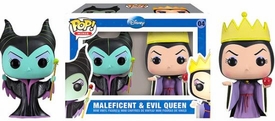
Australian retailer BlackMilk just launched its Princess & Villains collection inspired by the ladies of Disney. To be clear, this is a line for adults. As in, adult humans are encouraged to wear this clothing on their bodies. (h/t Jezebel)
I’m pretty much in agreement with Jezebel’s Kara Brown about the ugly/tacky quotient on these. Seriously. This is a line of clothing I am not particularly upset doesn’t run into plus sizes. (I know: from a general fat activism perspective, it’s troubling when any high fashion line perpetuates thin-ness as the only body type worth draping in fashionable clothing. But speaking only for my own personal taste in clothing? I’m not real upset to have this particular line barred from me on account of the sizing and sourcing choices.)
But if nothing else, it’s a good excuse for a bit of a link-fest. (That turned into something more substantive than I originally expected. I quite literally cannot stop myself from pontificating, sometimes…)
———-
First off, some things I learned existed while Googling for this post: Disney wedding dresses. And haute coutureadaptations of Disney Princess gowns. (Who knew?)
And then there’s this gallery on DeviantArt that presents Disney Princesses/Heroines garbed in “their” Princes’ outfits. True confession: There’s a number of these folks I don’t recognize at all. I used to keep up with Disney releases, but clearly I stopped doing so longer ago than I thought I had…
Anyhow. This Princess-to-Prince gallery I remember seeing back when it went viral last fall, but this one, which presents more historically accurate gowns for the characters, was new to me today.
———-
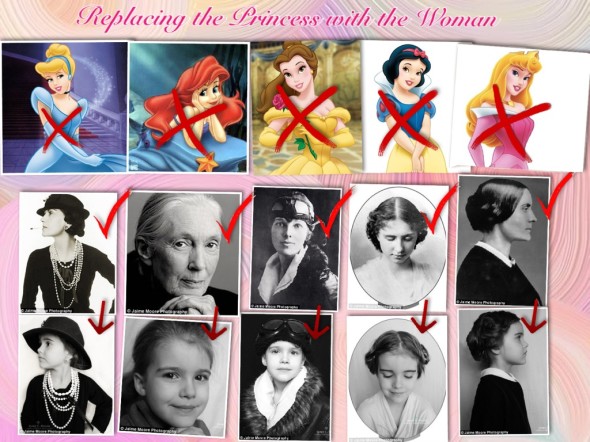
“Princess Culture” is a bit of a tricky, problematic thing.
In one corner of the debate are those who point to its influence as another source for the misogynist miasma that helps reinforce the ways girls/women should be primarily focused on their attractiveness and marriageability. For example, Peggy Orenstein, author of Cinderella At My Daughter:
It’s part of this culture that encourages girls to define themselves through beauty and play-sexiness—and eventually, real sexiness—and I don’t think that’s the yardstick we want our daughters measuring themselves by.
Experts say femininity, identity and sexuality have become a performance for girls. Girls perform sexual confidence but they don’t connect it to erotic desire. It’s not about their own desire, their own self-determination.
As a parent, I didn’t realize how much of my job was going to be protecting my kid’s childhood from being a marketer’s land grab—companies telling her who she should be.
Disney’s redesign of the character tamed her unruly hair, expanded her breasts, shrank her waist, enlarged her eyes, plastered on makeup, pulled her (now-glittering) dress off her shoulders, and morphed her defiant posture into a come-hither pose. The bow-wielding Merida of Brave — a character who explicitlyfought against the princess world her mother tried to push her into in the film — was becoming what she hated, and inadvertently revealing the enormously problematic nature of Disney’s Princess line.
And yet, there are also those who see Disney Princesses in a different light. Possibly as a mild expression of societal — I would say “patriarchal” — values already embedded in the culture. Values more strongly caused and propagated by other sources:
It’s true that princess culture is complicit in keeping in place many of the troubling stressors women and girls suffer. But when you talk to me about impossible beauty standards and eating disorders, I’d point to Photoshop and the “obesity epidemic” before I’d point to stylized animation. When you talk to me about early sexualization of children, consider the retailers selling padded inch-thick push-up bras in the kid’s department before looking at Disney’s chaste kisses between adults. (Unless you think a kid shouldn’t see their parents kissing, in which case… I don’t think we’ll ever be on the same page.)
These are problems, sure, but they’re not problems Disney created, and Disney isn’t the primary villain here. At least not while my seven-year-old is walking by billboards for Victoria’s Secret the size of a school bus.
And then there’s even a more pointed critique of those wishing to critique Princess Culture:
Some say “Princess Culture” promotes materialism, patriarchy, and a sadistic need for long, shiny hair. Many moms worry a Snow White doll will turn their pre-K Amazons into simpering ninnies more concerned with looks than grades and goals. But they’re wrong—and I speak from personal experience. The truth is, Princess Culture helped me become more confident, more adventurous, and more okay with being different. It also helped me understand and embrace the concept of feminism at a very early age. Seriously. (Elle.)
I have enough passing nostalgia for my years loving Disney animation that I can definitely feel the pull to defend what may have been treasured bits of childhood. Still, I’m more on the side of those who remain troubled by Princess Culture. To quote Orenstein’s book (as excerpted here at NPR):
It is tempting, as a parent, to give the new pink-and-pretty a pass. There is already so much to be vigilant about, and the limits of our tolerance, along with our energy, slip a little with each child we have. So if a spa birthday party would make your six-year-old happy (and get her to leave you alone), really, what is the big deal? After all, girls will be girls, right? I agree, they will — and that is exactly why we need to pay more, rather than less, attention to what is happening in their world. According to the American Psychological Association, the girlie-girl culture’s emphasis on beauty and play-sexiness can increase girls’ vulnerability to the pitfalls that most concern parents: depression, eating disorders, distorted body image, risky sexual behavior. In one study of eighth-grade girls, for instance, self-objectification — judging your body by how you think it looks to others — accounted for half the differential in girls’ reports of depression and more than two-thirds of the variance in their self-esteem. Another linked the focus on appearance among girls that age to heightened shame and anxiety about their bodies. Even brief exposure to the typical, idealized images of women that we all see every day has been shown to lower girls’ opinion of themselves, both physically and academically. Nor, as they get older, does the new sexiness lead to greater sexual entitlement. According to Deborah Tolman, a professor at Hunter College who studies teenage girls’ desire, “They respond to questions about how their bodies feel — questions about sexuality or arousal — by describing how they think they look. I have to remind them that looking good is nota feeling.”
As such, I’m very glad to see signs of the Princess Counter-Culture. Like Orenstein’s media and activity suggestions for interested parents — including a Hiyao Miyazaki shout-out!! Or Supreme Court Justice Sonia Sotomayor giving career advice on Sesame Street:
In addition to lots of laundry and lots of sleep, one other thing I’ve been doing since getting back home from The Trip is catching up on the video lectures and quizzes for the Coursera course I’m taking about the Beatles.*
In a lot of ways this is a “gimme” course: I’ve watched, listened and read enough about the band and its members to be reasonably well-informed from the get-go. Still, it’s fun to hear this professor’s take on things, and I have learned a new thing or two along the way.
Like the full story embedded in the lyrics to Norwegian Wood.
In the song, a young mad is “had” — i.e., fooled — by a comely lass when he accompanies her to her (pretentiously under-furnished) apartment expecting sexytimes, only to be rebuffed when she says she needs to get a good night’s sleep prior to the next workday.
That much I’d understood. But this next part was the part I’d missed: when he wakes up the next morning alone, the song’s narrator sets the girl’s apartment on fire in revenge for the (so-called) cock-blocking.
To quote Paul McCartney (the co-lyricist), looking back at many years’ distance:
[A] lot of people were decorating their places in wood. Norwegian wood. It was pine really, cheap pine. But it’s not as good a title, Cheap Pine, baby…
So she makes him sleep in the bath and then finally in the last verse I had this idea to set the Norwegian wood on fire as revenge, so we did it very tongue in cheek. She led him on, then said, ‘You’d better sleep in the bath’. In our world the guy had to have some sort of revenge. It could have meant I lit a fire to keep myself warm, and wasn’t the decor of her house wonderful? But it didn’t, it meant I burned the fucking place down as an act of revenge, and then we left it there and went into the instrumental.
He sets her apartment on fucking fire. (Who knew? Okay, bad question: evidently everyone in the world knew but me.)
Talk about a disproportional response to sexual rejection. In his discussion of this song and the story its lyrics tell, the professor said something mild about how the song could be seen as “sort of misogynistic,” and I found myself spluttering at the computer screen, “you think?!?”
I kind of get why the professor chose not to open up the topic for much further exploration. Although some elements of historical and cultural context are inevitably coming into the discussion, his chosen approach is primarily to be taking a musicological quasi-close-reading approach to the stylistic features of the songs and albums — melody, harmonics, orchestration, lyrical complexity, etc. At some level, I suppose I could be thankful he at least called out the misogyny of the scenario, rather than allowing the song’s portrayal of sexual entitlement to remain normalized.
Still, I am so wishing I had magic access to Paul McCartney right now to ask some follow up questions. When you decided that in the song’s world, this guy deserved his revenge, did you mean to portray that as a reasonable response, or an UNreasonable one? You were about 23 when you wrote the song — do you think you’d want to tell a similar or different sort of story if you were writing about sexual miscommunication and rejection today? What acts of friendliness are permitted between two individuals before one is seen as “leading the other on”?
Alas, my press pass is expired (on account of me never having one), and I still haven’t made an appointment with Mr. Ollivander to collect my magic wand. So my curiosity will have to remain unsatisfied.
By the way? Check here for a handy-dandy chart that’s been making the rounds to let you know when a woman owes her partner sex. And despite the geneder-specificity of the graphic, it really cuts both (all?) ways: no individual (gender-inclusive) ever owes another individual (again, gender-inclusive) sex.
Who knew my response to Burwell v. Hobby Lobby was going to turn out to be a tetralogy? It’s like I’m channeling Douglas Adams when So Long, and Thanks for all the Fish came out. (pour one out for my homies)
Where was I? Oh yeah, the unexpected tetralogy. The elephant in the closet.
My other posts and link roundups have said a lot about the bad science and reasoning in the Burwell v. Hobby Lobby decision, about the slippery slope of its implications for other targets of prejudice, and the catastrophic implications of the decision insofar as what it suggests about women’s rights and women’s bodies. But I’ve (unconsciously) sidestepped the hot-button issue at the heart of it all: a woman’s right to have an abortion.
Yes, the Supreme Court precedent of Burwell v. Hobby Lobby is now being used to challenge a women’s reproductive rights right pretty much across the board, but the case started with the dividing line the Green family wished to draw between most contraceptives and the four they (incorrectly) believed to be abortifacients. Yes, that belief is factually incorrect, but it does starkly highlight the moral boundary that the Green family (and many other individuals) wants to live within. “This far, but no farther. Preventing pregnancy is okay, but we will not support abortion.”
I’m sure I could find my usual bouquet of articles to quote and synthesize in that way I do when I’m thinking through an issue and saying my piece about it. But that’s not where my head and heart are at tonight.
Instead, a highlighted link to one single article on A is For by actress Martha Plimpton. It’s a long read, and a rich one — Plimpton interweaves the Burwell v. Hobby Lobby decision with McCullen v. Coakley in a way I have thus far been unable to do, and uses both of these SCOTUS decisions as backdrop for a longer discussion of the state of, and absolute need for, abortion rights in the country. Rather than trying to summarize it all, I’m just going to recommend you head on over and read it in its entirety. (Content note: the article includes the famous post-mortem image of Gerri Santoro first printed in Ms. Magazine in 1973. Be prepared.)
I’ll just pull one quote over to here:
So many of us seem to have forgotten what life was like before Roe v. Wade, when women were dying in pools of their own blood. Or were being interrogated on hospital gurneys by police while they were bleeding out during a miscarriage. Or being raped by hack abortionists in unlicensed offices. Or needing hysterectomies because of botched illegal abortions. Or having to wait until too late in their terms because they couldn’t get an abortion in time, being forced to abort in filthy, unsafe, terrifying, life-threatening situations.
So many of us are deluded enough to believe—or have been duped into believing—that advances in women’s rights are the result of a curious flight of fancy that some ill-informed, hysterical woman made us think was a good idea for a minute, and not the excruciating reality of life for women before them. “That buffer zone? That was silly!” “That right to terminate a pregnancy? That was just your imagination, you thinking you need that.” “That contraception mandate? Why, you foolish ninny! Who told you you could have that? A LIBERAL? Ha ha! Rights, schmights. Don’t you know your body is public property?” Ridiculous women and their “needs” fucking up everything for all the fun people.
In the Salon piece I quoted a few times yesterday,* Dawn Johnson reminds us that.
The typical American woman wishing to have only two children spends thirty years, three-quarters of her reproductive life, seeking to avoid unintended pregnancy. Half of all pregnancies in the United States (more than three million a year) are unintended. More than half of American women will experience an unintended pregnancy.
So you need to be vigilant for a few decades of time, and hope that you don’t end up on the wrong side of those 50-50 odds of unintended pregnancy.
I was four years old when the Roe v. Wade decision affirmed a woman’s right to have an abortion. I may have a few more years of (hypothetical) reproductive life in these old ovaries, but the basic truth is that for all of my sexual maturity, I have known that I had access to contraception and abortion services if I needed them. Yes, the courts have been chipping away at this right almost since the Roe v. Wade decision was first issued, but the core essence of this right held up for all the years I personally had need of it.
On the other hand, my niece recently turned 18. I don’t know if she’s sexually active yet — and all my over-protective aunt instincts are rising in me to say “I hope she’s not sexually active yet!” But I intellectually understand how, even if she isn’t sexually active right now, she could be soon. Or if she isn’t, she has friends and classmates and future college room-mates who are/will be.
The pace of attacks on abortion rights has only been accelerating in the last few years. Exactly what tattered cloth of choice will my niece and her age cohort be inheriting? They are at the start of those thirty years of reproductive life, and I would guess that most of these young women are starting this journey from the perspective of trying to prevent unwanted pregnancies. But they are doing so when access to contraceptives and abortion services are as difficult, as barrier-laden, and as INaccessible as they have ever been in my lifetime.
What sort of compromised freedom are these young women being forced to inherit? And thirty years from now, will their daughters and nieces have any rights left at all?
* Okay, I’m linking to more than one article. You can take the scholar out of school, but you can’t take schoolish habits out of the scholar…
The Supreme Court wasted no time in delivering a message to anyone who thought its Hobby Lobby ruling was limited to religious objections to coverage of purported abortion methods:
You’re wrong.
The day after handing down the Hobby Lobby decision on Monday, the court issued orders pertaining to six pending cases in which employers claimed religious objections to allcontraceptive services required under the Affordable Care Act. The court either ordered appeals courts to reconsider their rejection of the employers’ claims in light of the Hobby Lobby decision, or let stand lower courts’ endorsement of those claims.
With Tuesday’s orders, the conservative majority has effectively endorsed the idea that religious objections to insurance that covers any form of preventative healthcare for women have merit. . . . The cases that must now be reopened aren’t even based on junk science, just general pious resistance to women’s health services. And at least one of those cases is only tenuously about religious freedom. “I don’t care if the federal government is telling me to buy my employees Jack Daniel’s or birth control,” Michael Potter, the founder of Eden Foods told Irin Carmon. “What gives them the right to tell me that I have to do that? That’s my issue, that’s what I object to, and that’s the beginning and end of the story.” As one judge wrote, “Potter’s ‘deeply held religious beliefs’ more resembled a laissez-faire, anti-government screed.”
So, to take John Stewart one step farther, not only does the sincerely-held-but-factually-innacurate belief of an abstract business entity matter more than the legal and reproductive rights of actual human females, so, too, does the self-serving faux-belief of someone who’s parroting religious language as a justification to deny employees part of their compensation package. (See here for more about the issue of health insurance as earned compensation rather than a piece of corporate largesse.)
It’s enough to make me want to run screaming through the streets. Party on, Amurrica, with your false narratives of Independence Day and freedom, while you light off sticks of brightly colored dynamite. The country will never be free until all its peoples are free and we’ve got a long damn way to go on that score.
But I digress. Ahem. Where was I? Oh yeah, having a screaming pigtails moment about the lying liars who talk about this case as if it were about religious freedom rather than misogyny. Me and Ann Friedman, both:
There are two competing narratives about the Hobby Lobby case and how big of a deal it is. To hear the all-male Supreme Court majority and many legal analysts tell it, this . . . will result in a minor inconvenience for a small number of women who work for certain employers or have certain insurance plans or wish to use certain forms of contraception. It may not even be about women at all. . . .
Then there’s my own interpretation, . . . most accurately expressed as an outraged scream, sort of a combination groan-wail, issued while beating my fists against the desk on either side of my laptop.
I love the vividness of that description, and how on-point it is for my own sometimes-inarticulate rage around all many layers of awfulness in this decision. And around the casual misogyny of those out in the public I’ve seen supporting the Burwell v. Hobby Lobby decision as if it’s a good thing.
There’s not enough time left in the evening to try and point-counterpoint everything that could be said about the misogyny at play here, so I will content myself to a few main threads.
One: “What are you so upset about? This is just about 4 specific contraceptives!”
Except, as the lede above discusses, it took less than 24 hours for the scope of implication to expand well beyond “4 specific contraceptives.” The LA Times refers to 100 pending cases that have been given fresh life with this ruling, while MSNBC links to a list of 149 companies whose cases to limit women’s reproductive freedom are active and pending somewhere in the court system. Some of these companies and cases object not only to all forms of contraception, but also to any sort of medical counseling about contraception or abortion. To quote the LA Times, “The floodgates aren’t about to open–they’re already open.” (At the risk of being too self-referential, I said much the same last night.)
And, even if it were just about those “4 specific contraceptives,” there would still be something very wrong with this decision. From Salon:
Women choose among available methods of contraception based on a range and a combination of factors that may change over the course of their lives, including their particular life circumstances, health needs, economic resources, and religious and other beliefs. Contraceptive methods vary dramatically in their effectiveness, which provides another contributing factor in women’s decisions. Hormonal IUDs can be forty-five times more effective than oral contraceptives and ninety times more effective than male condoms in preventing pregnancy, based on typical use.
Forty-five times and ninety-times more effective, y’all. That is statistically significant, as they say in the research biz. Also, Cynthia Greenlee in The Root explains the various reasons — biological, cultural, societal — that the contraceptive methods specifically targeted by Hobby Lobby are often the best choices for women of color. Meaning that the negative ramifications of the Burwell v. Hobby Lobby decision are likely to be most painfully felt by women who are doubly marginalized in the kyriarchy, particularly women of color and those of low socio-economic status.
No, that’s not even remotely a little bit surprising. But it’s still appalling. Which brings me to…
Two: “What are you so upset about? Women can choose to work elsewhere!”
I love the by-your-bootstraps boner that so many (predominantly white, male) social conservatives have. We all have free choice on everything, it is said, but then every choice has its associated consequences. You can chose to work somewhere that gives you more contraceptive choices, but then you have to sacrifice the more-than-minimum-wage that Hobby Lobby pays its employees. Or, you can take the higher salary but then you have to live with the paternalistic reproductive oversight of an abstract business entity that has more legal rights than you do as a living, breathing woman.*
An in an abstract, college-freshman Philosophy 101 kind of way, there is some sliver of truth there. We all have choices, and choices have consequences. But to my eyes, this abstracted notion of choice gets very messy once you have to confront the fact that in the really real lived world, it is marginalized (and multiply marginalized) individuals who more frequently face hard choices or have to feel the most devastating consequences of those hard choices. To return to NY Mag:
This idea — that women can always find another way to get the coverage or care they need — underpins just about every recent restriction on women’s health. What’s another 24-hour mandatory abortion waiting period? To a woman who lives 25 miles from the nearest provider, it’s everything. What’s one more tweak to a law about the width of clinic doors? To a clinic that can’t afford to remodel, it’s everything. What’s a minor policy change that means you have to pay full price for that IUD? To a woman who makes $14 an hour, it’s everything.
A choice isn’t really a choice when you can’t find another job, or when it’s the end of the month and the checking account is empty and the morning-after pill costs $50 without insurance, or when the only approved birth control methods won’t work for you. For decades, activists have invoked a woman’s “right to choose” — choose when it’s the right time for her to have children and when it’s not, and to choose which contraceptive method to use in the meantime. In theory, women are still allowed to make these choices in America. In practice, though, to choose you must have options. Health insurance is one of the things that guarantees options and access. Freedom, as the conservatives say, isn’t free. For a choice to be a true choice and not a default, sometimes we have to subsidize it.
Almost one-third of women report that they would change their choice of contraceptive method if cost were not a factor. That’s tens of millions of women. . . . Especially for women of limited economic means – like the full-time minimum wage worker to whom Justice Ginsburg referred who cannot possibly afford a month’s salary for an IUD – the religious views of their bosses (or the bosses of their spouse or parent) may now trump their own religious beliefs, as well as needs that flow from their own health, family, and life circumstances. . . . Justices and their families, one expects, will not struggle with the choice between an IUD or new shoes and a winter coat for their children. Or confront the inability to purchase any of the above. But thanks to the Court’s ruling, more women are likely to experience such harms – at least unless and until the other branches of our government act to protect women from the imposition of their bosses’ religious beliefs.
(Quick word nerd sidebar. Isn’t it just so fun when legal and social positions that are all about restricting women’s choices and freedoms get couched in the language of “Everyone has choices”?!? More screaming pigtails for me.)
And speaking of choices, let’s move right along to my third and final thread, before I run out of gas.
Three: “What are you so upset about? Just keep your legs closed!”
Ah yes, here’s the final nail in the choice-consequence coffin. Burwell v. Hobby Lobby and its limiting of contraceptive options is to be praised because it means that immoral women will no longer be able to indulge in the sin of consequence-free sex.
Lest you think the phrasing in my header there is offensively overwrought, check out this piece over at Cosmopolitan** which excerpts many, many offensive comments and tweets that say things exactly as rude as “just keep your legs closed” — and many, many ruder things besides.
Demanding that women close our legs and calling us whores for planning our pregnancies confirms the feminist suspicion that opposition to contraception and abortion is less about “life” than it is about a sense that sexually active women are doing something wrong and should be chastened for it. . . .
For women, having an opinion on the Internet virtually guarantees you’ll face abuse, often the sexualized kind. But it’s especially rich seeing misogynist and sexually hostile commentary come from the very people who claim women are just being hysterical when we characterize the Hobby Lobby case as misogynist and hostile to sex.
If nothing else, the virulence of this rhetoric helps ensure the misogyny and retrograde societal values at play show through whatever veneers are being used as covering. To return one last time to Ann Friedman in NY Mag:
My rights feel very much scare-quoted — not rights at all, but a veneer of choice. The medical care that is critical to my ability to live and work — and, yeah, have consequence-free sex — was dismissed by the Supreme Court as relatively unimportant. . . . You don’t choose to need a liter of new blood. You do, however, choose to have sex — if you’re a woman. And so contraception, the majority of justices say, is different. The implication is that women can freely choose to either abstain from sex or have lots of children, which most of us understand is not a choice at all.
Or, as my friend Alice Isak observed: “You women, with your slutty, slutty bodies. Always thinking you should get to use those bodies as you see fit, just because you happened to be born in them!”
So, given all of this, is it okay for me to upset now?
Oh never mind, I don’t need anyone’s permission: I’m upset. More than than, I’m justifiably outraged.
* Yeah, I’m repeating myself. That’s ‘cos the stupidity of this detail especially pisses me off. To quote John Oliver’s response to the question of whether corporations are people who can exercise their religious rights, “No, no they’re not. Okay, we’re done. Are we done here? Are we done? I feel like we’re done. . . . Apparently, we’re not done.”
** Okay, I will betray my own prejudices here in saying 1) I never thought I’d be linking to anything from Cosmo, and 2) if Cosmo is deconstructing and analyzing the misogyny in something, then that something is pretty epically fuckin’ misogynistic.
I am about a month behind the times in commenting on this, but back near the middle-to-end of May, I saw an NPR post about a distressing batch of reviews responding to Tara Erraught’s performance as Octiavian in Der Rosenkavalier at the Glyndenbourne Festival.
What is stunningly apparent is just how much a woman’s body matters onstage — way more, if these five critics are to be believed, than her voice, her technique, her musicality or any other quality. . . . Bonus disgrace points to [Rupert] Christiansen [of The Telegraph], by the way, for going after the other lead in Rosenkavalier for having the temerity to be a working parent: “Kate Royal … has recently sounded short of her best and stressed by motherhood.” Kudos for pinpointing motherhood as the source of Royal’s putative shortcomings. She couldn’t possibly have been overbooked, or feeling under the weather — couldn’t have been any other reason, right?
Tsioulcas observes that the lone dissenting voice in this chorus of fat-shaming was a female opera critic; she also does a bit of counterpoint to see if these critics are as likely to mention issues of weight/stature when reviewing the work of male classical singers. (They’re not. In other news: water is wet.)
As tempting as it might be to reduce this controversy to some simplistic formula like “men critics are bad patriarchal meanies while women support each other,” that kind of reductiveness is not entirely what I see going on here. To shift to Maclean’s summary of the point-counterpoint:
Elle magazine accused critics of “fat-shaming” Erraught, who isn’t even particularly heavy by normal standards. It seemed to many like the culmination of at least a decade of unrealistic expectations for opera singers’ looks, especially among women. . . . Alice Coote, a star English mezzo-soprano, blogged on the music news site Slipped Disc to defend Erraught and remind critics that opera is “all about the human voice.” And Elle’s Natalie Matthews wondered “why bring up her weight at all?” finding the issue irrelevant to opera singing.
Others argue that it isn’t irrelevant at all. They fear that the view expressed by Coote and others could bring back the days when singers like Luciano Pavarotti were cast for singing alone, even in parts they were physically unfit for. “I don’t believe opera is all about singing,” says Wayne Gooding, editor of Opera Canada. “It’s all about music theatre. There are many reasons why somebody may not be appropriate for a particular role: wrong kind of voice, or wrong timbre, too old or too young, and yes, wrong look.” [Conrad L.] Osborne adds that “physical appropriateness, within reason, is a perfectly legitimate artistic consideration.”
(Okay, yeah, that passage also lends itself a bit to gender bifurcation, considering that once again the voices defending Erraught are female, and the voices defending body-policing are male. But that wasn’t what I was intending to look at. Move along, nothing to see here…)
Let me hone in on the pieces I wanted to chew over: the emphasis of opera as musical theater, and the tricky territory of artistic vision in creating a stage production of any show. As Anne Midgette summarized last week in the Washington Post*– the column that got me thinking that maybe, weeks later, it still was worth writing about this:
On one side of this debate are those who hold that opera is a musical experience and therefore looks are not as important as sound (witness the success of extremely large singers such as Luciano Pavarotti and Montserrat Caballé). On the other are those who aver that opera is also a theatrical experience and that appearance matters. Guess what. You’re both right. I’ve been at opera performances where the staging was awful but the singing was glorious, and nothing else mattered. I’ve been at opera performances where the production was so compelling that I was willing to overlook so-so singing. These things have to be taken on a case-by-case basis. Any time you make rules about what art “has” to be, you’re doing it wrong.
I do want there to be room for artists and creators and theater companies to be able to communicate a unique vision in their artworks, whether that be a painting, a poem, or a stage production. And it’s an uncomfortable truth that if your artistic creation has any focus to it, then there are likely other viable choices and representations that have been excluded in the creation of a particular emphasis.
Off the top of my head, I can think of three vastly different productions of Macbeth — one I attended, one was directed by a friend of mine, and the third had a friend as a member of the acting company. They all had fascinating “hooks” to them — one a meditation on ethnic violence with stagecraft that alluded to the Serbo-Croatian wars in the 1990s; one an all-female cast that thoughtfully turned the all-male productions of Shakespeare’s day inside-out; and the final one an exploration of the legacy of European colonization and of military dictatorship. Each one of these was a worthwhile lens through which to explore the original text, and there is absolutely no way that all three of those lens could have co-existed in a single production. So maybe it’s perfectly legitimate for a director to prioritize whatever he wants to prioritize in casting a show, whether it’s weighing voice over looks or vice-versa.
Except.
There’s a reason I used the gendered pronoun “he” in talking about directors, above. HuffPo: “According to Fandor, women make up a total of five percent — five percent! — of the directors in Hollywood, down from nine percent in 1998.” The Guardian: “Only 24% of directors employed by the theatres during 2011-12 were women. Looking at creative crews as a whole (directors, designers, sound designers, lighting designers and composers) only 23% of the total employed were women.”
To quote Midgette again:
The reason that “Taragate” has blossomed into such a focus of opinion and argument is that it encapsulates current flash points in our society: how we talk about weight and think about weight and how we look at and evaluate women and women’s bodies. . . . [T]here’s also a disingenuous way in which male critics (and the majority of performing-arts critics are still men) protest that it is perfectly relevant to criticize a woman not for what she does, but for how she looks. . . .
I will defend the right of critics to have strong opinions and unpopular opinions and to offer blunt and unflattering descriptions of performers. And I continue to aver that people would be even more upset if critics went away and there were no criticism at all. But it’s naive in a #YesAllWomen world to deny the implicit sexism of the discourse here. And to offer it is less an offense to our womanhood than to our intelligence.
Are there times that the emphasis on physicality can have artistic integrity to it, and if so, when and under what conditions? And when is that emphasis just another vehicle to reinforce patriarchal/misogynist cultural standards?
———-
One of the reasons this all has been so top-of-mind for me is that I am trying to decide whether to audition for a show this upcoming week. It’s been a production/audition cycle that’s been on my radar since I first started thinking about community theater a month ago, and I still haven’t figured out what I’m going to do.
I’ve felt the pain of not receiving a part, knowing (and sometimes even having it acknowledged) that I was a better singer and actor than the woman cast, but also knowing that the woman cast was thinner and prettier than me. And so I wonder whether there’s any chance of goodness stemming from bringing my “overweight” body into the audition hall, or if that’s just such a set-up for judgement and rejection that it’s not even worth engaging in.
I’d better figure this out soon. ‘Cos if I’m going to do it, I need to choose in time to actually make the audition window. And if I choose against auditioning, I want that to be an actual conscious choice, rather than me dithering until the window of opportunity closes on its own and I never actually had to take ownership of my life and choices.
This lady’s still (and forever?) fat. Is she singing? The jury’s out.
* See, they do have some respectable journalists on staff!
[Trigger warning: discussion of rape and other sexual assaults; quotations that show profound misogyny, slut-shaming and victim-blaming; and rebuttals that share stats and stories about rape and rape culture, and yeah, with a lot of profanity. A LOT of profanity.]
I am totallycheating tonight. The Day 7 prompt for Writing 101 is about creating a sense of contrast: “Focus today’s post on the contrast between two things. The twist? Write the post in the form of a dialogue.”
But I am currently so enraged and stabby-feeling over George Will’s latest exercise in newspaper-subsidized misogyny that it was inevitably going to be my topic tonight, no matter what I had to do to shoe-horn it into the Writing 101 structure. (Honestly, as far as ideological contrast goes, we have that in abundance. As far as dialogueis concerned? That’s more of a stretch.)
———-
Women, Higher Education, and Sexual Assault: a Point-Counterpoint Between George Will and Mezzo Sherri
Colleges and universities are . . . learning that when they say campus victimizations are ubiquitous (“micro-aggressions,” often not discernible to the untutored eye, are everywhere), and that when they make victimhood a coveted status that confers privileges, victims proliferate.
Dude, even though it didn’t exist by the same name, the conceptual underpinning for our current understanding of microaggression has been around since at least 1905, when Freud first theorized about the sublimated violence/victimization cycle in so much of modern humor. And even if your current status as rich, urbane, white male — sort of the royal flush of the privilege poker hands — makes it hard for you to perceive microagressions with “an untutored eye,” here’s a tip from Charles Davis at VICE: “You don’t need a reference manual to not make people feel bad; you just need to listen every once in a while, learn a thing or two, and try to be more considerate, particularly around people you just met. Since when did stopping to think before you open your stupid mouth become such a bad thing?”
And excuse me? Being the target of sexual violence is a “coveted status”? In whose bizarro world is that true? After all, the rest of your column just oozes compassion and acceptance for those individuals who have experienced sexual assault. Oh wait: the rest of your column is actually “contributing to a society that is utterly dismissive of their experiences.” (PolicyMic)
Consider the supposed campus epidemic of rape, a.k.a. “sexual assault.”
1. Here’s some basic set theory for you: all rapes are indeed sexual assaults, but not all sexual assault is rapes. (Or, to break it down even further, here’s how I used to explain that concept to my SAT students back in the day: All of my bracelets are jewelry, but notall of my jewelry is bracelets.) I point this out just because if you’re going to use irony quotes to make fun of a term, it might be best to actually understand the term you’re mocking, and oh, maybe to check in and see if your mockery actually functions as humor or instead just shows your own woeful ignorance about a topic. (Also see above, re: microaggressions.)
2. Supposed epidemic? Really? I know you’re gonna quibble with this statistic later on below the fold, but let me just lay it out there anyhow. The CDC reports that 19% of undergraduate women had experienced “attempted or completed sexual assault” since entering college. Now this is a statistic you’ll see reproduced by lots of advocacy and service organizations (sometimes rounded up to the “1 in 5” phraseology we’ll be discussing soon), but please note I did not go to a partisan or activist source here. I went to the C-D-motherfucking-C. 19% of undergraduate women experience some sort of sexual assault, and 37% of female rape survivors are first raped between the ages of 18-24. And yes, that final age range admittedly extends beyond the usual age window for undergraduate students, but still. How much more of an epidemic do you need?! How many women need to suffer before you can get up a compassion boner for them?!?
Herewith, a Philadelphia magazine report about Swarthmore College, where in 2013 a student “was in her room with a guy with whom she’d been hooking up for three months”
Slut-shaming at its finest. Because of course, once you’ve said yes at one time in one context that means automatic consent for all future times in all future contexts. And by the way, just emphasize how foul your perspective is:
“They’d now decided — mutually, she thought — just to be friends. When he ended up falling asleep on her bed, she changed into pajamas and climbed in next to him. Soon, he was putting his arm around her and taking off her clothes. ‘I basically said, “No, I don’t want to have sex with you.” And then he said, “OK, that’s fine” and stopped.. . . And then he started again a few minutes later, taking off my panties, taking off his boxers. I just kind of laid there and didn’t do anything — I had already said no. I was just tired and wanted to go to bed. I let him finish. I pulled my panties back on and went to sleep.’”
Six weeks later, the woman reported that she had been raped.
Well, she reported having been raped because that’s actually the legal definition applicable to the events as described here. But hey, why should an insignificant thing like factuality matter between friends?
Now you’ve been nice enough not to state the most evil of your assumptions outright, but they’re palpably there, oozed between the lines of suggestion and innuendo.
Why didn’t she fight harder after saying the first “no”? Because we’ve been trained (over and over again) NOT to do so! Even if it’s slightly off the subject, perhaps this video will help explain the level of understood threat that might cause a young woman to decide against “fighting back.”
I had a friend in college who was date-raped sophomore year. (I know: I must be lying about this, and this event couldn’t actually have really occurred because George Will has decreed that college sexual assault is merely a “so-called epidemic.”) She carried some guilt for a while about not having “struggled more” — and I remember her sharing the moment of insight that emerged during a session with her therapist where my friend realized that she had, to the best of her ability in the midst of this awful experience, made a threat assessment and consciously concluded that if she didn’t stop struggling that she would be killed, or at least seriously, seriously wounded. It is perfectly understandable that someone may make a decision to stop resisting, wether because of cultural programming, threat assessment, or some other reason(s). That choice to cease actively fighting back in no way excuses a rapist from the legal and moral responsibility of having committed such a harmful act against another human being.
Why did she wait so long to report this crime?* Maybe because she knew that jerk faces like you would blame her or doubt her. Maybe because even the most “casual look at our criminal justice system, military justice system and the academic disciplinary system under scrutiny right now reveals that each tend to punish survivors, not reward them.” (Salon, emphasis added.)
I could find story after story that demonstrates the ways women reporting sexual assault get interrogated about their clothes, alcohol use, sexual history, and general behavior/decorum, but to save us all some time, here’s a photo gallery that both captures many of these victim-blaming attitudes but also wonderfully eviscerates them.
(I’m skipping ahead a few paragraphs because I only have enough patience to dialogue with one last passage.)
The statistics are: One in five women is sexually assaulted while in college, and only 12 percent of assaults are reported. Simple arithmetic demonstrates that if the 12 percent reporting rate is correct, the 20 percent assault rate is preposterous. Mark Perry of the American Enterprise Institute notes, for example, that in the four years 2009 to 2012 there were 98 reported sexual assaults at Ohio State. That would be 12 percent of 817 total out of a female student population of approximately 28,000, for a sexual assault rate of approximately 2.9 percent — too high but nowhere near 20 percent.
Oh, I see what you did there: it’s like SAT algebra all over again! (98 over x equals 12 over 100; and then once you solve for x put that number over the total population number to get your percentage…)
I’ve said it before, and I’ll say it again: CDC. The 19% assault rate has been confirmed by the C-D-motherfuckin’-C.** So rather than taking the 12% report rate as the hard-and-true fact and using that to invalidate the CDC’s confirmed statistic, why not try this idea on for size: maybe the 12% number is wrong! And that notion is even kind of awfully plausible, since this figure can only ever be “an inferred estimate, because there is no directly measured number of unreported assaults.” (Pharyngula.)
Oh, and by the way? If a 2.9% rate of sexual assault is “too high” by your assertion, and considering the fact that the actual assault rate of 19% has been confirmed by the C-D-motherfuckin’-C, do you want to go back and rethink any of your prior statements about a “so-called” epidemic?
Just wondering.
* I almost put the word crime in those mocking irony quotes (as I assume George would have done), but I just couldn’t do it.
** I swear, if I ever go back to writing anything based on my dissertation research, I am working this phrase in there somehow.
(Trigger warning: rape, murder, talking about violent images though not using them.)
One of the things so powerful to me about the #YesAllWomen conversation that has been taking place in the weeks since the Isla Vista killings, is the ways that there seems to be a wider acknowledgement growing about the layers and levels of misogyny that are operating in US culture, as well as around the world.
The international nature of the problem has been very much on my mind since I saw the shocking image of two Dalit girls, aged 14 and 16, hanging from nooses, after having been (allegedly) gang-raped and (definitively) murdered.
You won’t be seeing that image here, nor will I be knowingly linking to any articles that use it. Manasi Gopalakrishnan reports:
The girls’ family alleged that the two teenagers were raped and tortured before finally being hanged from a mango tree in a nearby orchard. Incensed by alleged police inaction, the families refused to take down the bodies from the tree for several hours. Finally the local police registered a case of rape only after several members of the girls’ community protested in front of the police station. [Emphasis added.]
In that sense, the parents’ initial gesture reminds me very much of Mamie Till’s choice to have an open-casket funeral for her son, Emmet, and her subsequent decision to allow funereal photos of her son to be published in Jet magazine. “I wanted the world to see what they did to my baby,” Mrs. Till is reported to have said. And yet in this day and age when images can travel the globe so quickly, I am not at all clear as to whether these parents in Uttar Pradesh would want their daughters’ postmortem image propagated in so widespread a fashion, and so I will not be aiding in that process. (Quite frankly, I even wonder if Mamie Till might have made a different choice in the Internet age. Or maybe her courage would have found identical expression. I simply don’t know.)
As with Eliot Rodger’s actions and their intersections with US issues such as (definitely) gun control and (allegedly) mental illness, there are multiple factors at stake in this horrifying crime. The caste system. Lack of toilets in poverty-affected regions. There’s even a new report that a state official investigating the case has stated one of the two murder victims may not have been raped.
(I don’t know enough yet to suss out if I think this last one is the first step of a government cover-up — at least two of the arrested suspects are policemen — or the first step at bringing careful investigative work to uncover the truth what the official has suggested might have been an honor killing or one motivated by a property dispute.)
Even with those other factors, it is undeniable that misogyny is a huge part of the cultural foundation for these crimes to occur. Mallika Dutt reports in Time that “In the context of past rapes, Mulayam Singh Yadav, head of Uttar Pradesh’s governing party, the Samajwadi Party, has said, ‘Boys will be boys. They make mistakes.’” A different Indian State Minister, Babulal Gaur, has recently said “Sometimes [rape] is right, sometimes it is wrong.”
As we continue to examine the negative effects of misogyny and cultures that impose toxic definitions of masculinity, it’s important not to be blind to privileges of race, sexual orientation, gender identity, classism, or cultural myopia. A lot of feminist discourse I see on the web is very stuck in these blinders, and in the same way that cultural evolution will require men to become aware to the privileges they carry in a misogynist society, it also requires those of us carrying privilege on other nexuses to wake up to that.
Hear in your head every mansplaining nice guy or even every well intentioned usually great dude you know starting a statement with these words-
“but not all men…”
Now stop.
Okay White ladies let me explain you a thing. I’m gonna blow your mind.
That anger and frustration giving you bubble guts right now is how I feel when White women won’t listen to me.
Sit with that for a minute. Understand that how you feel when the response to your pain, your words, your experiences in regard to sexism and misogyny is not all men, but I’m a nice guy etc is the same feeling I have when White women run to interrupt, or otherwise stomp over my experiences, pain and words.
It’s an important reminder — and considering that the Facebook page where I first saw this essay then erupted into an argument about the “unnecessary hosility” of the essay saying something as cruel and abusive as “shut up for five minutes” (gasp!) — it’s a reminder we really need to be hearing.
 Mission accomplished (at least for the most part) to hilarious and devastating effect. Particularly pointed is Twohy’s observation that a taste for fan-fiction erotica is to be considered “unrealistic” — while mainstream porn is somehow seen as more real. Which is about as laughable a deception as I’ve heard since… well, unfortunately, just since yesterday, when folks were declaring that public breast-feeding is immoral. (Seriously, y’all. The patriarchy just needs to shut up and die in a fire. Now.)










 Self-Love: It's Just Another Lifestyle Change