Tempted by Convention

Mr. Mezzo and I spent the weekend up at the lake house with my Mom. One of the benefits of moving to Boston was the fact that we can have more regular weekend access to the place, so the promising weather forecast made it seem like a great time for the first visit of the season. Besides, what with yesterday being the fifth anniversary of my father’s way-sudden passing, it just felt best for Mom to have company rather than to be left alone with possibly-gloomy thoughts.
feelings-pieNot that we talked about any of that. Not the anniversary, not about my motivations for coming up this weekend, not about what she might be feeling/remembering, not about my own feelings and memories. None of that was discussed.

Though truth be told, I didn’t expect anything different on that score. There’s a reason for all those cliches about emotionally reticent, laconic New Englanders. And the superficiality of conversation among families in the corporate/country club set.

But I did tell Mr. Mezzo, as we were breezing through the Hampton Tolls Friday night, that I was wondering whether Mom would say anything about my weight loss. After all, if my body looks different enough for hairdressers and co-workers to notice, one would think that the change would be obvious enough for one’s own flesh and blood to be aware.

Mr. Mezzo predicted that she wouldn’t say anything. At least, he figured she wasn’t going to bring up the topic independently. As he explained it to me when I asked, he thought she might say something if the subject came up organically, but he knew he wasn’t gonna bring it up, and he knew for damn sure I wasn’t gonna bring it up. So, he concluded, silence was likely to rule.

I wasn’t so sure. Yes, she’s been nice and polite about not nagging me for becoming fat, but it felt like there might be a chance of her going to the super-enthusiastic place about how much better I look now, how great it is that I’ve finally gotten thinner — the kind of compliments I wrote about previously, and the kind which would inspire an internal wry smile and a silent monologue about “Oh, so there’s the judgement about my body type she’s been polite enough to keep hidden all this time.”

So I just wasn’t sure whether or not the topic would come up, and then I wasn’t entirely sure how explicitly I was going to talk about my detox journey if the topic arose. (Somehow, I don’t imagine my mother being all that open to the subject. I rather imagine her being in the whole narrow-minded Industrial Age “quackwatch” kind of place.)

But when all was said and done, I needn’t have wasted any time wondering or rehearsing what I might say. Because Mr. Mezzo’s prognostication won out and the topic of my body shrinkage remained as subterranean as any consideration of my father’s passing.

I am mostly deeply relieved at that turn of events.

But I am aware of a small part in me that is disappointed.

I get it. I know I still carry a small kernel of my younger self with me, that little girl who naturally wishes for her parents to show their affection and approval.* And even if there’s lots of reasons that I find compliments about weight loss to be deeply problematic, I know my mom’s not even remotely aware of FA/HAES, and she’s really not likely to be agreeing with that perspective. So, that part of me which yearns for acknowledgement would kinda sorta be okay with taking in a problematic compliment, because sometimes that feels better than no compliment at all.

[SIDEBAR] There’s also a whole other angle in contemplating how deep the cultural programming around body size goes. Kate Harding once wrote about the “cognitive dissonance” phase of the fat acceptance journey, “thinking it made perfect sense that the OBESITY CRISIS hype was way overblown, and even if it weren’t, dieting doesn’t work anyway — but still wanting to lose weight.” And Cat observes that for a fat person to want to lose weight “is the sane choice when you live in a world that finds you disgusting.” So, I also wonder if there’s a piece of me that would kinda sorta be okay with weight loss compliments on account of the residual weight of all that cultural baggage. [/SIDEBAR]

So whichever way you slice it, there’s lots of feels, some of it self-contradictory. ‘Twas ever thus.

* I’m guessing I’m not the only one, but I’m not going to assume I know about anyone’s soul but my own.

———-

Image credit: http://static.someecards.com/someecards/usercards/MjAxMy1jYzgzZjk3NDA2YWRiODA1.png

Baby Jiu Jitsu

A Dance of Appreciation and Avoidance

Baby Jiu JitsuOne of my other weekend activities was to get a somewhat-overdue haircut (and a color touch-up, though that was more on-time).

I had a haircut scheduled two weeks ago, but my hairdresser got sick, and I just decided to grit my teeth and wait till the Saturday coloring appointment I already had on the books.

The upshot of all this scheduling information is that my last haircut prior to this one was the weekend before I flew down to begin the HCG protocol. So, my hairdresser hadn’t seen me since this whole journey began. And I guess I look different enough now for it to be noticeable.

“You look great! Have you lost weight?”

Welcome to the compliment minefield.

———-

[HAES/FA Basics Break]

Just for clarity, let’s recap some of the reasons why this particular “compliment” is deeply problematic and not very complimentary.

As a start, here’s Regan Chastain at Dances with Fat:

People who undertake weight loss attempts are often encouraged to motivate themselves by hating their current bodies.  When they are successful at short term weight loss, they are encouraged to look back at their “old body” with shame, scorn, and hatred.  And that’s a big problem.

Not just because at some point the person will probably start to think “if everyone is talking about how great I look now, how did they think I looked before?” but also because the vast majority of people gain back their weight in two to five years.  Then they are living in a body that they taught themselves to hate and be ashamed of, remembering all of those compliments. Yikes.

Tracy I at Fit, Feminist, and (almost) Fifty unpacks some of the deeper implications of this compliment, and its collusion within a structure of the Foucauldian panopticon:*

It reinforces the idea that it’s okay to let people know that we are monitoring and judging their bodies. One thing that shocked my friend in the story I opened with was that she really didn’t even know the person who commented on her weight.  And yet the person felt completely entitled to say something. What kind of a twisted world do we live in where the state of our bodies is fair game for comments from whoever feels like making them?

Finally, here’s a meditation from Michelle Parrinello-Cason at Balancing Jane on the question of what exactly we’re praising when we compliment weight loss.

What if I say “Have you lost weight? You’re looking great!” to someone who has been starving himself for weeks. Now I’ve reinforced that behavior.

What if I tell someone she looks great when she’s actually suffering weight loss as a side effect from a deadly disease (as happened to this woman’s friend who was suffering from Lupus).

We don’t know what we’re praising if we’re only praising a result. If our goal is to encourage people to take care of themselves and to be healthy, then shouldn’t we make sure that we’re actually encouraging people to, you know, take care of themselves and be healthy?

If someone gets up an hour early and went for a run, we should praise that. That’s hard work.

If someone cooked healthy meals all week long for themselves and their family, we should praise that. That’s hard work. [. . .]

If we rethink the way that we give praise, we can begin to restructure our norms. If we praise hard work instead of outcomes and acknowledge beauty wherever we see it and the people who are doing that hard work don’t get any thinner, we’re still reinforcing positive, healthy changes. Isn’t that what we really want to value as a culture?

[/Break]

———-

For all that I agree with these multiple analyses about the problems behind my hairdresser’s statement, I also agree with Golda Poretsky at Body Love Wellness about the root cause of these “compliments”:

I think people are, in some ways, nearly literally blinded by weight loss culture. So when they read something or someone as beautiful they make an automatic connection between beauty and weight loss. I really don’t blame people for that. I think that most of us who have woken up from weight loss culture have been truly hurt by it (or have great empathy for someone close to us who has been hurt by it), so people who haven’t had that experience often just see our current weight loss culture as normal.

So the question becomes, what do you do in the moment? Depending on the context and your relationship to that person, you can handle the compliment of “You look great. Did you lose weight?” in many ways.

Among the options Poretsky lists are saying a simple thanks, setting a boundary against public discussion of your weight, or using humor to redirect the conversation. In the moment on Saturday morning, I didn’t select any of those precise options, though I feel as if I kind of rolled them all together, a bit.

I thanked her and said I’d been doing this detox diet for a number of weeks, limiting my food to lean proteins and fresh produce. I was sure some weight loss had occurred as a side effect of the detoxing, but that’s not my focus.

“Do you have an ultimate weight loss goal?”**

“Nope,” I repeated, “that’s not my focus.

And that’s where we left the topic. Me wanting to acknowledge and appreciate her desire to say something nice and kind, while also jiu-jitsuing my way out of the specific value proposition (thin=beautiful=virtuous; fat=ugly=lazy cow) she was unconsciously peddling.

* I stumbled across this blog tonight looking for good links to use here and I am already head over heels in love with Tracy’s intelligence and insights.

** You see, this bit shows as much as anything how deeply unconscious and blinded we are by the weight loss culture. When an otherwise lovely young woman hears a statement about how weight loss isn’t my focus and then without blinking an eye disregards that assertion to ask me my weight loss goal, there’s nothing else to call that but a symptom of cultural insanity.

———-

Image credit: http://www.groundnevermisses.com/2012/02/striking-grappling-traditional-mma.html


Some Fat Acceptance/HAES Basics

(Apologies to anyone who’s a Facebook friend — some of this will be a re-hash of the links I’ve been posting there today.)

It’s occurred to me today that because I’ve been thinking about fat acceptance & health at every size concepts for a few years now, I sometimes talk about these concepts in a very “I hold these truths to be self-evident” way. And maybe, instead, it’s worth unpacking just a little bit about my perspective on questions of fatness and health.

Now to be sure, plenty of bloggers have already dropped the mic on this again and again and again, which may be part of my reticence tonight. After all, why cover ground that has really truly been covered with great insight before?

ANGRY!
ANGRY!

Maybe because the things things these writers have said are worth saying again. And again and again and again, until people finally stop all the fat-shaming and masking their superiority in concern trolling and their obesity panic and bleeping get it.

So here’s my own little piece of the mythbusting puzzle.

Most of what “everyone knows” about fat is pretty much wrong.

To start off, being fat is not automatically unhealthy. Fat people actually tend to live a bit longer, and are more likely to survive cardiac events. There’s also a fair bit of evidence that a lot of health problems supposedly “caused” by fatness might instead be a result of dieting and weight cycling. There is some evidence that certain health risks are tied to having a very specific type of adipose tissue in your body (visceral fat), but guess what? Thin people AND fat people can have too much visceral fat hurting their organs, and unless you’re Superman, I defy you to tell me you have the kind of x-ray vision to know who’s packing VF and who isn’t.

Warning: that last article I linked may give you stabby pains behind the eyes because after reporting on a study that pretty clearly states that the important factors are metabolic health and visceral fat, the author still ends with the concluding thought that these results should not be taken as “an excuse to remain overweight or obese.” Because even though the study shows obesity as a non-factor in measuring health, it’s still somehow a health risk. (Just because?) Ah, rumor-mongering science journalism at its finest.

And while the illustrious staff writers at Time have left such tempting fruit, let’s take on this whole balderdash that implies one’s body shape and size are completely under one’s Ayn Rand-ian will. Because, statistically speaking, diets don’t work. Sorry Not-sorry to burst your bubble on this one: they don’t. And they do incredible harm along the way. The weight loss industry, has a catastrophic “success rate” and an evil jiu jitsu way of transfering its own failings out onto the customer so they feel guilty about it all. Well, to quote Golda Poretsky at Body Love Wellness: “It’s bullshit and it’s bad for ya.”

As for healthy diet and exercise choices, yes they do indeed matter and they can make a big difference in reducing the effect of various “fat-related” conditions like cholesterol levels or blood pressure. But here’s the funny thing: those conditions get reversed independent of any actual weight loss being caused by diet and exercise choices. And considering the negative health effects of being fat-shamed and stigmatized, and considering the fact that fat people have a dramatically lower chance of even getting decent health care on account of the prejudicial attitudes of medical professionals, it’s probably best to steer clear of claiming that a fat person’s health challenges are being caused by weight. ‘Cos I’m seeing a lot of confounding causality here.

I need to get to bed at a reasonable hour, so I’m pulling the cart to a stop here. With one final thought.

Even if fat were unhealthy and if being fat were entirely under an individual’s control, every fat person on this planet would be deserving of fundamental human respect, acceptance and compassion. Just because of their humanity.

The heart-breaking thing is how little respect, acceptance, or compassion fat people get in this culture today —  even though fat isn’t unhealthy and it can’t reliably be controlled.

Data Points

The doctor’s office that prescribed my HCG gave me a booklet to help me track all kinds of things. Portions of food, my water intake, supplements, ketosis level — and, yes, a daily weigh-in.

I’ll admit, I toyed with the notion of skipping that last piece. Ultimately I decided I wanted to respect the protocol in every possible detail. Including weigh-ins: even if I have all kinds of associations between morning weigh-ins and the evils of the diet industry, I’m willing to take on this task in the context of tracking my weight as one among a set of data points.

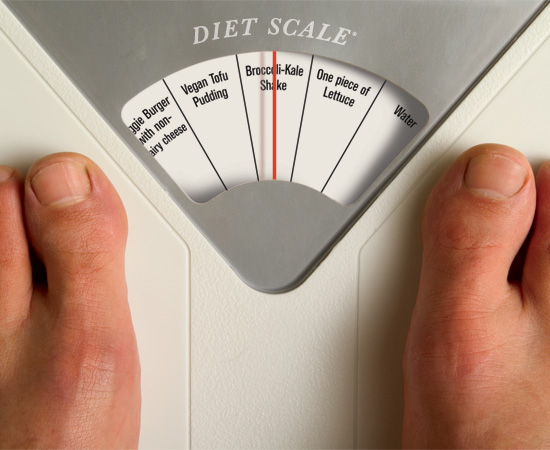
02.scale_So I dragged the scale out of the basement* and threw it into the bathroom, where it and I have been having a daily, emotionally-guarded, one-on-one.

As I expected, this detox process has meant that my numbers on the scale have been going down, a little bit each day. And, as uncomfortable as it is to admit, there’s been part of me enjoying that trajectory. I spent so many years being brainwashed around the value of skinny** that I know there’s part of me that can still fall into that old model of thinking.

Aside from that, there’s been some concrete benefits. Some of my slacks had started getting a bit tight in the past few months, and even though I would have been 100% willing and unashamed to buy a larger size if need be, I can’t deny that I’m glad not to have to spend the money and to instead be feeling more physically comfortable in my current wardrobe.

I was having a similar issue with my wedding rings feeling a tiny bit tight and uncomfortable, and it’s especially nice for those to be back to fitting better.

Anyhow, today, I had my morning date with the scale and the numbers were exactly the same as they were yesterday.

This is entirely unsurprising. All the information about HCG — even from a weight-loss perspective — talks about the inevitability that some days your weight will “plateau” instead of being lower than the day before. I kinda think the diet guides make a really big deal out of this possibility just so someone doing HCG for the purpose of weight loss won’t freak out when this occurs.

But it was fascinating to witness myself when this moment occurred. In an instant, I could recall all the old tricks I would have used, back in the obsessive-dieting days, to make the scale move in a good direction. Maybe I should weigh myself starkers, or try again after another trip to the toilet.

Or maybe not.

For all that I was able to recall the ways a “plateau day” would have thrown the old diet-obsessed Sherri for a loop, perhaps the most surprising thing about this morning was really how little emotional charge today’s date with the scale held for me. I saw the numbers, saw all the possibilities for being negatively impacted emotionally, and just felt fine.

Almost like my weight is just another data point for me.

* And why did I even still have a scale? For the always-important job of checking to make sure my luggage is under the airplane weight limit.

** Oh who am I kidding? From a cultural messages standpoint, I’m still being brainwashed about the value of skinny. We all are.

———-

Image credit: http://simplykierste.com/2013/01/fit-friday-with-erica-the-scale-friend-or-foe.html (And yes, this was a very deliberate choice…)

Not Trying To vs. Trying Not To

I have an incredible addiction to the idea of fitting in. Of looking normal, not seeming too crazy or “woo-woo” or “out there” — whatever punitive descriptions the cult of rationality use to condemn someone who believes in Spirit, the energetic system, and so on. The idea of being judged negatively carries way more import to me than is healthy, as does my level of upset around the possibility of having people make false assumptions about me and my life choices.

Given those emotional addictions, this next series of posts feels very scary to write.

———-

In my first couple posts back here, I alluded vaguely to some self-care and detox “projects” I had coming up in the near future. The most significant of those is that I’ll be starting a round of the HCG detox program near the end of the week.

Anyone googling “HCG” is not going to find much of anything that’s discussed through the lens of detoxing — it’s all been subsumed under the cultural obsession with weight loss. This source at least calls it a detox program, but pretty much the rest of the text is an ad for HCG as a weight loss tool. And this article in Slate, plus this blog (and the two she links to) are pretty typical of everything else I’ve found online about HCG: something worth doing all because it makes the numbers on the scale go down. Because the numbers on the scale are quite possibly the most important detail for measuring* a woman’s value as a human being.

So it’s feeling a little weird as I’m moving towards this experience. I know my focus and intention are on detoxing a life’s worth of accumulated poisons (dietary, environmental, emotional). I know it to my bones.

Point of fact: I’m flying some few hundreds of miles away from Boston so I can start this journey in partnership with a detox center that is coming from that same place of intention, rather than going to the Boston-area places that are all about offering HCG on a menu with lipo, botox and laser peels… If I was in a weight loss frame of mind, there’s options just around the corner that don’t rack up the frequent flyer miles.

My goal in this is not about losing weight. But my research makes me pretty sure that I will lose some weight in the weeks ahead. And I have a lot of complicated feelings about that.

I worry about being seen as someone betraying the ideals of fat acceptance/fat activism by making this choice.

I worry about the likelihood that members of the “general” fat-shaming public will likely applaud me for losing weight, and the ways that false assumption will tempt me towards violent angry outbursts.

I worry that no matter how frequently or clearly I am able to articulate my intention for the HCG to be about detoxing, I worry that the experience will still be co-opted into weight-loss discourse — because that discourse is just so fucking strong in this culture. (After all, even the most outspoken fat activist really secretly just wants to be thin, right?) Something about this possibility of co-option fills me with the fiery rage of a thousand suns. Like by losing weight, I’ll be letting “them” (the fat-shamers) win — and oh! I don’t want to let them win.

And yet. In a place of deep to my core unflinching honesty, I also need to own that I worry about the possibility that some small part of me is going to be happy about losing weight. ‘Cos no matter how strongly I try to speak and live from an FA perspective, I’ve had the same share of fat-shaming brainwashing that you’d expect any middle age, middle class heterosexual American white woman to have had. And even though my internal fat-shamer doesn’t come out a lot, she’s still in my system, just a little bit. And I don’t want to let her win, either.

———-

A week or two ago, I read a post on Fierce, Freethinking Fatties that has given me a tiny bit of a lifeline for at least some of these complicated feelings. The post looks at the possibility of weight loss occurring as a result of someone adopting HAES (health at any every size) principles, and marks the distinction memorialized in my post title:

There is a difference between not trying to lose weight and trying not to lose weight. One means that your focus is elsewhere. . . . The other means that you are actively attempting to either stay the same weight or gain weight. . . . [M]ost people I come across who are fat and follow a HAES lifestyle fall into the first category. The act of practicing HAES usually means that they are interested in increasing their health. They are not trying to lose weight, because they are using other means to measure their success. . . . You might lose weight. And that’s okay. You aren’t going to have to turn in your Body Acceptance club card if you do. It just means that your body is changing because you’re adopting different habits.

(There’s a lot more good stuff where these words came from. Seriously, if you haven’t already followed the link up above, this one will take you there, too.)

I’m not trying to lose weight. But if I do lose weight as a side effect of choices I make for their detox and energetic benefits, that’s okay. In a complicated “mostly-okay-but-also-kinda-anxious” sort of way. But it’s what I’ve got for now.

* “Measuring.” Like weight. See what I did there? *grin*

———-

Edit: Because “any” and “every” start with different vowels and create different acronyms when used in phrases, and because it is a nice show of respect to get people and organizations’ names correct…

Wrongness and Weight

So, I’m cautiously interested in the conversation going on in the comments to this post by Roni Noone over at We are the Real Deal. (I say “cautiously,” because the some of the comments in the thread have been taking a bit of a turn towards anger and intolerance. We’ll have to see what happens.)

There’s certainly stuff that could be said regarding the assumptive slip Roni makes between “having a healthy conscious relationship with food” and losing weight — as if one were always to lead to the other. But the piece I’m keying in on right now is this series of semi-rhetorical questions from the opening of her post:

Aren’t I suppose to be spreading a message of self love and body contentment? I mean, I definitely shouldn’t be inspiring people to lose weight? That’s just plain wrong. Isn’t it?

The anxieties expressed in Roni’s questions are also forefronted in her chosen post title: Is it Wrong to Want to Lose Weight?

Wrongness. So many times this comes back to notions of wrongness.

Wrongness about appearance — too blond, too short, too fat, too skinny, too flat-chested, too red-headed, hips too big, figure too boyish, wrong facial shape, too “ethnic,” too “white bread.” Too just plain wrong because we don’t thread the needle of what is deemed attractive in a celebrity culture. (And here’s a familiar reminder that even celebrities don’t come up to the standards of celebrity beauty.)

A couple months ago, I was asked, in an FA context, if I saw myself as beautiful. And I admitted that I’m not quite There yet. But here’s the thing, I remember saying.

I never saw myself as beautiful when I was younger and thin, either. I grew up skinny and had a really awkward adolescence, in which I had physical characteristics (flat-chested, glasses, braces) that in my white, upper-middle-class high school marked me as unattractive. As far as I can guess, there may have been a magic week or two during my transition for “too skinny” to “too fat” where I hit the mark of what I “ought” to weigh. But I wouldn’t be surprised if during those magic weeks where I weighed the supposedly-right amount, I carried some other marker that kept me from being attractive — or, more accurately, from feeling attractive.

Because there’s so much judgement out there, and so much internalized self-judgement that stems from that. And — no shocker here — the judgements, the feelings of wrongness aren’t even remotely limited to questions of weight, or appearance, or the physical realm. There’s plenty of societal messages about the ways to act, to live, to be. Which plays into all the ways we feel wrong in our behaviors, our choices, our circumstances.

I truly believe that fat is a feminist issue. But for me, fat acceptance is part of the larger challenge of self-acceptance. And for me, self-acceptance and self-esteem are very much spiritual issues. Letting go of feeling wrong. Letting go of the self-protective, defensive instinct to make someone else wrong when I’m feeling judged and threatened. Opening my heart to the possibility that each and every person I encounter is 100% perfect in this moment.

So, do I think it’s wrong to want to lose weight? No, I don’t.* We want what we want, and none of it is wrong, and going into the self-beat-up for wanting the “wrong” thing is only going to perpetuate  the patterns of self-judgement that keep me feeling bad about myself.

Where Roni’s questions get a little tricky for me is when she asks about “inspiring” folks to lose weight. Because that will all very much depend on how she wants to go about inspiring people. If it’s a process of living her own choices and speaking openly about them, and letting people choose freely whether or not to follow her path, I’m pretty much on board. (Insofar as I fully believe in the perfection of Roni’s choices for Roni while choosing myself not to aspire towards weight loss.)

But if her version of “inspiring” includes blindness to the perfection of choice for those embracing HAES — and that assumptive slip I mentioned above gives me some reason to fear that sort of blindness — then I’m a bit more troubled about the potential for this to be yet another message about how the FA/HAES community is wrong in our choices and our beliefs.

So Roni isn’t wrong. And I’m not wrong.

When we’re able to tap into compassion for self and make heart-centered authentic choices for ourselves, each of us is wonderfully right.

* Not that anyone needs my approval anyways.

A Tale of Two Blogs

Once upon a time, I was a stick-skinny girl.

Then (around age 20) I hit my second puberty and became a girl with an hourglass figure. And still pretty skinny.

Then (around age 30) my metabolism changed again and I became Officially Overweight. And I learned to diet. And I lost weight. And I gained weight. And some of that project is documented here on the blog I kept from 2004-2007. And then some of the self-loathing that accompanied the weight cycling carried over here into the blog I kept (sort of) during 2007.

But then I started to change the way I thought about my body and being overweight. And a teeny tiny bit of that made it over onto blog #2. And I thought about continuing the conversation there, but decided …… no.

So now (as I’m approaching 40) I’ve decided to open up a new space for my writing. Not because I want to wish away my history but simply because I chose to open up a new space.

So here I am. Making another change for myself.