Not Flawless, but Feminist

I watched the first 20 minutes or so of last week’s VMAs on the night of the telecast, using the miracle of DVR-time-shifting to watch a small bit of the ceremony after the True Blood finale concluded. And even though I wasn’t wearing my pre-cog goggles, I will say that the performances I watched had a bit of a feeling of prelude about them. Like I couldn’t have told you what the main event was going to be, but those opening acts most certainly were not it.

Continue reading “Not Flawless, but Feminist”

Avert Your Eyes

I lead a strange sort of double-life when it comes to things popular and pop-culture-like. On the one hand, I feel as if I live my life on the “geek culture” fringe — as evidenced, I’m sure, by past references to Comic-Con staples like Joss Whedon, True Blood and Game of Thrones. There’s lots of big “mainstream” hits and trends — Survivor, American Idol, Real Housewives all spring to mind — which have in their own time and place saturated the airwaves, and yet which I have never ever seen. Quite frankly, sometimes my monastic schedule, with its endless cycle of work, write, study, sleep, even keeps me from staying up-to-date on geek culture. (This many weeks later, and I still haven’t seen Guardians of the Galaxy. Guess that’s another membership card I’ll be handing in…)

On the other hand, my continued engagement with mainstream morning news (GMA) and print journalism (Entertainment Weekly) means I have a pretty good sense of what the pop culture trends and happenings are, moment to moment.

Continue reading “Avert Your Eyes”

The Games We Play

(a.k.a. Gaming the System, part 2.)

spy_vs_spy_by_ragdollnamedgaryThere’s times when I feel as if, when writing my “flagrantly feminist” posts, that I’m veering uncomfortably close to dividing the world into two teams: men as the “black hats,” the villains, the aggressors, the colonizers; and women as the “white hats,” the heroes, speaking truth to power and conscientiously standing up for what’s Right and True and Good.

And if I’ve ever implied that I’ve sorted the world into those two teams, please let me say clearly for the record: that would be bullshit, ’twere I to do so. Unmitigated, odiferous bullcrap.

Though I can see how it might happen. Continue reading “The Games We Play”

Gaming the System

I’m not really a gamer. At least, not as I understand the term.

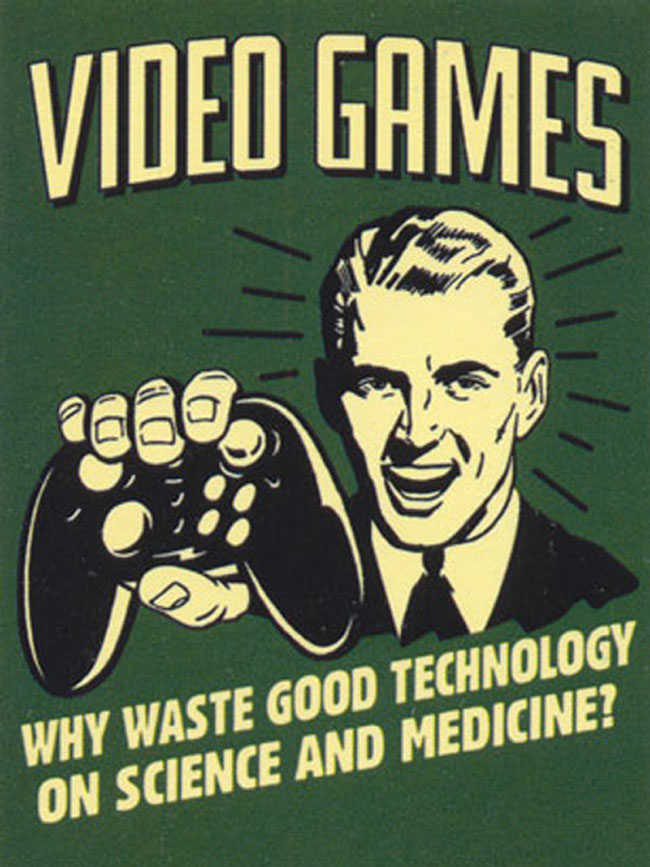
videogamesYes, I spend way too much time playing iPad games, but it’s all amateur hour stuff: endless runners, connect-3 games, nostalgia favorites like Tetris. That kind of thing. Whenever the topic of gaming comes up, I jokingly say that I have the videogame tastes of a 9-year-old. Earlier in the summer, my nephew saw me playing Jetpack Joyride and said “I remember that game! My friends and I used to play it back in 7th grade.” So maybe my tastes are that of a 12-year-old rather than a 9-year-old, but the basic point stands: I’m not a gamer.

A gamer — to my understanding of the term — is someone who plays those extensive role-playing and/or immersive first-person shooter games. Stuff like World of Warcraft, Final Fantasy, Grand Theft Auto, or Halo. (The fact that I don’t have any current titles/examples springing to mind is yet another sign of how not-a-gamer I am, so there you go…)

Continue reading “Gaming the System”

Princesses, to Arms!

[Quick hit: thank you WordPress scheduling feature!]

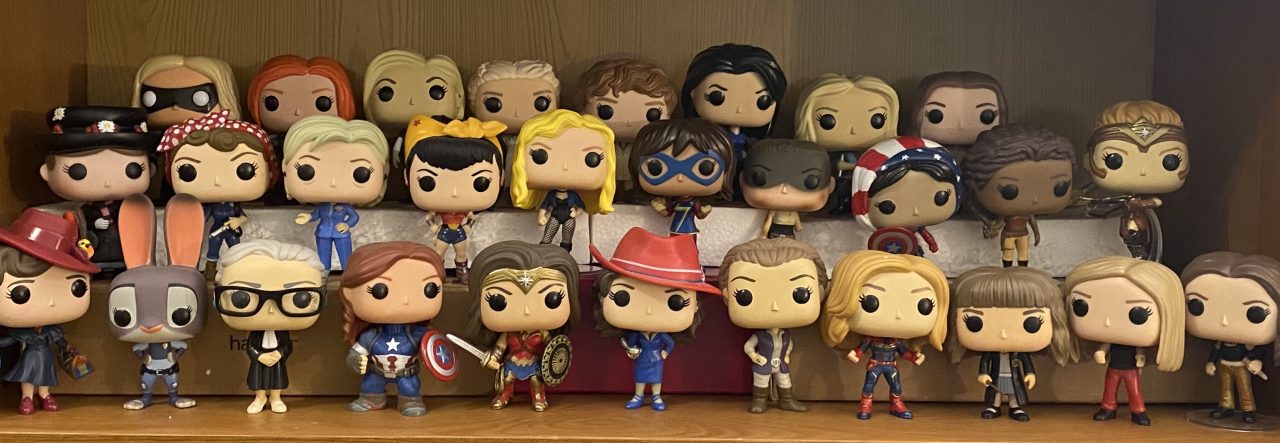
Considering my past musings on Disney Princesses and Princess Culture, I couldn’t let The Will Box‘s photo set of Disney Princesses in armor to go by without comment.

princess-armor

The costumes came to my attention in this io9 article. Since I am not much of a cosplay aficionado, I’ll admit I only scrolled through the first dozen or so pictures to see the Princess remixes — after that, things devolved very quickly to a bunch of pictures of people I don’t know, trying to look like fictional characters I also don’t know, in an expression of a hobby (cosplaying) that I just profoundly don’t get.

Ultimately, one of my discomforts around cosplay is the cultural patterning that so often happens with men armoring themselves up while women sex themselves up (also see: Halloween costuming trends).

To some degree, these armored Princesses still twinge my discomfort on that score, being as the “armor” is still very much of the plate-mail bikini variety. Nevertheless, I am also very interested in and pleased by the subversive remix of presenting these Princesses as individuals capable of their own fights and self-defense, rather than needing to wait around for their princes to rescue them. And all while maintaining enough of the original iconography for the connections to be clear.

———-

Image Credit: The Will Box. (Retrieved from: https://www.facebook.com/media/set/?set=a.575306665931274.1073741976.308639119264698&type=1 )

Learning as We Go

When I mentioned yesterday that I’d been doing affair piece of thinking recently about the tricky ground of enjoying problematic bits of artistic/cultural expression, it actually wasn’t because I’m a particularly huge fan of Miley Cyrus, Nicki Minaj, or Taylor Swift. Yes, I have a single or two in the iTunes library, but that’s about as far as it goes. The timeliness of yesterday’s VMAs provided an irresistible springboard to broach the subject in a post, but that was an after-the-fact exploration of the topic, not the inspiration for this line of internal study.

One piece that has the topic on my mind is that I purchased Roxane Gay’s book of essays Bad Feminist, and am eagerly waiting for the day I clear my reading decks enough to start seeing an absorbing what she has to say about these matters.

Henry_Rollins_TA_2More pressingly, I’ve been trying to figure out since last Thursday what to say about Henry Rollins.

Rollins writes a regular blog for the LA Weekly, and last Thursday, he wrote a provocatively titled essay* where he expressed his anger and confusion about Robin Williams’ suicide. The post is actually a fascinating exercise in internal contradiction, because Rollins acknowledges the impossibility of understanding another person’s pain in the grips of depression — speaking explicitly of friends and roommates who have struggled with the same, but also, to my perception, with a strong undercurrent of Rollins having had his own personal experiences with depression. And yet, for all that evident level of understanding — and even for the explicit admission that “I get it, but maybe I don’t,” Rollin’s essay lands on this position:

I simply cannot understand how any parent could kill themselves.

How in the hell could you possibly do that to your children? . . . I think as soon as you have children, you waive your right to take your own life.

[. . . ] Almost 40,000 people a year kill themselves in America, according to the Centers for Disease Control and Prevention. In my opinion, that is 40,000 people who blew it.

Now, whatever my level of benign mostly-indifference is for Miley, Nicki and Taylor, I am unabashedly a fan of Henry Rollins — especially his spoken-word performances. (Stand-up? Storytelling? I never quite know what to call it.) In all my years in Philly, the only time I ever went down to Atlantic City was one night when Mr. Mezzo and I got tickets to see a Rollins spoken-word show there.**

Yet, however much I enjoy his spoken-word stuff, the level of impatience and humorously channeled rage those spoken-word pieces often reveal have always had me wondering about the level of Rollins’ impatience with human fallibility and weakness. I know “weakness” is such a charged word, but that’s really how it always played to my system.

Rollins would speak with such disdain about the mental/ethical weaknesses of prejudice, and would talk in such detail about the ind of discipline he used in his own life — the whole ascetic “straight-edge” thing, eschewing drugs and alcohol, dedicated to weights and fitness, and minimizing his possessions. I enjoyed going to his shows and listening to the recordings, but I always assumed if I were ever to meet Rollins, he’d have little but disdain for my life, with my weight, my occasional drinking, and my addictions to shopping and hoarding and physical possessions.

So I was disappointed to see last Thursday’s column, but I won’t say I was especially surprised. With the sorts of bright-line divisions I imagined him drawing between “strength” and “weakness,” I could imagine how his thought process would have led him to classifying suicide as an act of weakness. (Just so we’re clear: not at all a perspective I agree with. But I could halfway imagine the thought chain that took him there.)

Thus began a more intense meditation on “being a fan of problematic things.” For there I was, caught between the place of deeply — DEEPLY — disagreeing with Rollins’ essay, and yet knowing the equally deep affection I have for his past work.

And then things took a turn.*** Saturday morning, I got word that a brief apology had been posted on Rollins’ own website:

The article I wrote in the LA Weekly about suicide caused a lot of hurt. This is perhaps one of the bigger understatements of all time. I read all the letters. Some of them were very long and the disappointment, resentment and ringing clarity was jarring.

That I hurt anyone by what I said, and I did hurt many, disgusts me. It was not at all my intent but it most certainly was the result.

I have had a life of depression. Some days are excruciating. Knowing what I know and having been through what I have, I should have known better but I obviously did not.

In this post, Rollins promised a longer follow-up essay in the LA Weekly today. In it, he does a damn solid apology. Doesn’t take the “that’s not what I intended!”  road, or any of the derailment bingo plays that so often crop up in these hard conversations.

After reading carefully and responding as best I could, it was obvious that I had some work to do in order to educate myself further on this very complex and painful issue. I am quite thick-headed, but not so much that things don’t occasionally permeate.

In the piece, I said there are some things I obviously don’t get. So I would like to thank you for taking the time to let me know where you’re coming from. None of it was lost upon me. [. . .]

I understand it is my task to learn about this. It might take a while, but I will get on it. It is my belief about an ingrained sense of duty that will make this challenging, but I am always up for improvement.

What I most appreciated here — especially in the light of the ways I am in ongoing study of my own limitations (limitations of perspective, of compassion, of blind privilege…) — is Rollins’ acknowledgement that he has a lot to learn, and that he’s still struggling with his conflicting feelings about this issue. He doesn’t offer defensive justifications, but he doesn’t pretend to have it all magically worked out in the distance between Thursday and Monday.

Instead, there’s self-reflection, self-awareness, an owning of the rigid beliefs that led to the initial conclusions. And a commitment to continued learning, continued study, continued growth.

I’m up for that.

* Call me censor, call me chicken-shit, but here’s where I draw my own small moral line in the sand. I’ll include the accurate title in the hyperlink, and you can go read the essay for yourself, but I am not reproducing that particular sentiment here in my own digital living room.

** Train down, played the slots enough to pay for dinner, watched the show, then took the train back home. Do we know how to party, or do we know how to party?

*** Every now and then, my limited capacity to only do one post a day actually helps rather than hinders.

———-

Image credit: Jonathan Klinger, shareable via a Creative Commons License (retrieved from http://commons.wikimedia.org/wiki/File:Henry_Rollins_TA_2.jpg )

Shake Your Booty

The MTV VMAs are tonight. (Actually, for all I know, the online streaming red carpet/pre-show thing is probably happening even as I type.)

I won’t be watching them live (True Blood finale!), but in some perverse attempt to pretend I’m still in touch with current entertainment trends, I will be DVRing it to watch in bits and pieces over the next few nights.

From one perspective, I’m not quite sure why I even continue this yearly VMA ritual. As I age further and further out of the MTV/culturally  relevant demographic, there’s more people I don’t recognize at all, more songs and bits I fast forward through, and more jokes and references that I just don’t get (and some, as I sometimes say, that I may get, but I don’t want — if you catch my drift).

But I keep watching, I guess for those moments when I do find a new artist or song to appreciate, and also because I’m naturally interested in seeing cultural trends unfold “live” before me on the TV screen. Assuming a high likelihood of at least one water cooler moment emerging from the brouhaha, I like being able to form my own opinion of that moment from having seen it and reflected upon it — rather than just basing my opinion on someone else’s condemnation.

Though it’s worth admitting that sometimes my view of that “water cooler” moment is based both on my own personal viewing and also on input from other cultural commentary. For example, during last year’s Mileygate, I was able to come up with plenty of opinions about the sexual politics of the performance, but it took a lunchtime conversation with some fresh-out-of-college co-workers to raise my awareness about the troubling elements of cultural appropriation that were embedded in the performance.

I’d never heard of twerking before, you see. And after that conversation, I did some research. Hadley Freeman in The Guardian helped me more clearly see the minstrel show undertone of the production:

a young wealthy woman from the south doing a garish imitation of black music and reducing black dancers to background fodder and black women to exaggerated sex objects.

Meanwhile, Anne Theriault (writing in HuffPo Canada, but who I also follow avidly on her own blog, The Belle Jar) expressed her outrage at white feminists silence over things I should have seen when watching the performance — the crass objectification of women of color in the stage show’s choreography and in Cyrus’ performance.

Even worse, in her performance last night Miley used black women as props — like,literal props — and barely anyone said anything. I saw very few people displaying any outrage over the fact that Miley was, at one point, slapping a faceless black woman on the ass as if she was nothing more than a thing for Miley to dominate and humiliate. I saw barely anyone discussing the fact that Miley’s sexual empowerment, or whatever you want to call it, should not come at the cost of degrading black women.

All in all, it’s a small object lesson in the value I hold in seeing something with my own eyes before condemning or opining upon it, but also in the ways I need to keep listening and learning. I mean, seriously, looking back one year later at my level of blindness around the racist undertones (overtones, through-tones) there… I mean, it’s like, Hello, white privilege! There you are again!

gotham_twerk_by_arzeno-d6l2vl1And why am I rehashing all this one year later? Because we now have two twerking videos freshly released, sitting at the flashpoint of controversy, and with both performers scheduled to sing at tonight’s awards show.

In one corner, Taylor Swift, whose new video Shake It Off is earning critique for its own cultural appropriation of hip-hop culture and the sexualization/objectification of twerking and women of color — most especially the moment where, to quote Hillary Crosley in Jezebel, “she celebrates her true self by crawling through a bridge of brown and black women’s butts.”

In the other, there’s Nicki Minaj, whose Anaconda video is a hyper-sexualized invocation (celebration?) of tweaking and black women’s booties.

So how does one rate which is most troubling? Does Swift get a pass because her video is tamer in its sexual content, or because she now asserts that she’s coming at her work and life from a feminist perspective? Or is Minaj’s video the less offensive one because Minaj is speaking from within her own culture and cultural experience, and because the video, as Lindsay Zoladz suggests in Vulture, is not about pandering to the male gaze:

One thing I find striking about the video is the complete lack of men in its surreal, bubblegum-Amazon world (except, of course, for Drake, who I’ll get to in a minute). The song itself describes — and, arguably, objectifies — a series of male characters, but we don’t see them in the video. Instead, it’s just Nicki and her dancers, going about their day — you know, just making some fruit salad, doing some cardio — in this hallucinatory all-female universe. At one point she eyes the camera seductively like she’s about to eat a banana, but instead chops it in half and chucks the peel away away with a diabolical smirk. . . . The staying power of “Anaconda” might not outlast its viral moment, but while it’s trending let’s at least acknowledge its slyly confrontational power.

I’m far from the only one making this triangle of comparison between Cyrus, Swift and Minaj. It all comes up in this Washington Post point-counterpoint that’s ostensibly focused just on the Taylor Swift single/video.Instead, the conversation weaves among all three singers and their twerking, as well as name-checking a bunch of other current artists whose cultural appropriation is, shall we say, a bit suspect.

But rather than playing the competition game — choosing to raise one singer in my estimation at the cost of the other — and rather than giving either woman a pass for the troubling elements of their discourse, I’m instead going to use this moment to bring in something I’ve been thinking about a lot lately: how to both enjoy and critique artistic and cultural expression.

Liking problematic things doesn’t make you an asshole. In fact, you can like really problematic things and still be not only a good person, but a good social justice activist (TM)! After all, most texts have some problematic elements in them, because they’re produced by humans, who are well-known to be imperfect. But it can be surprisingly difficult to own up to the problematic things in the media you like, particularly when you feel strongly about it, as many fans do. We need to find a way to enjoy the media we like without hurting other people and marginalised groups. (Social Justice League)

And then, on the flip side of my own flip side is my desire not to blame either woman too harshly for the problematic pieces of their discourse. Because we all live in this kyriarchic, misogynist miasma. It infects our lives, our thought patterns — how could it not infect our artistic and creative expressions, too?

So ultimately — at least in these last pre-show minutes — I’m with Michelle Lhooq in The Guardian, seeing these various performances as more a symptom of our diseased culture than a root cause:

Slapping a parental advisory warning on Nicki Minaj’s bum will not change the way black women are exoticised. Banning videos by Robin Thicke, DJ Snake, and Calvin Harris, who use female bodies as trophies hard won of their overpowering masculinity, will not deflect the male gaze. Calling out Miley Cyrus’ career-advancing performance of racial drag, or Lily Allen’s casual racism is important, but what we really need is a broader spectrum of depictions of female sexuality – especially when it comes to women of colour – in mainstream culture. . . . Because the real problem is not that women of colour are over-sexualised in music videos, but rather how absent they usually are in the dominant culture as well as in discussions of cultural issues. Music videos shouldn’t be the only ways that mainstream society gets a glimpse of “otherness” but all too often, they are.

We’ll see if I’ve changed my mind after watching the DVR recording from tonight. Because if one or the other performance turns out to spectacularly offensive, culturally tone-deaf, or otherwise problematic, well then that’s new data. And new data sometimes changes the equation.

———-

Image credit: “Gotham Twerk” by Arzeno, shareable via a Creative Commons License (retrieved from http://arzeno.deviantart.com/art/Gotham-Twerk-398203237 )
Generosity Served Cold

Mr. Mezzo did the whole ALS Ice Bucket challenge this evening.

glowing-ice-bucketYes, this is thoroughly behind the times and at the tail-end of the trend, but it has taken this long for said philanthropic faddishness to work its way around to us — an artifact of precisely how deeply middle-aged and uncool we are.

Obviously, this thing has been an incredibly viral phenomenon, and it has earned its share of fans and detractors. Head among the detractors is Will Oremus in Slate, who acknowledges that the campaign has raised some real dollars for ALS research, but also complains:

Yet it’s hard to shake the feeling that, for most of the people posting ice bucket videos of themselves on Facebook, Vine, and Instagram, the charity part remains a postscript. Remember, the way the challenge is set up, the ice-drenching is the alternative to contributing actual money. Some of the people issuing the challenges have tweaked the rules by asking people to contribute $10 even if they do soak themselves. Even so, a lot of the participants are probably spending more money on bagged ice than on ALS research.

As for “raising awareness,” few of the videos I’ve seen contain any substantive information about the disease, why the money is needed, or how it will be used. More than anything else, the ice bucket videos feel like an exercise in raising awareness of one’s own zaniness, altruism, and/or attractiveness in a wet T-shirt.

Arielle Pardes of Vice has a similar concern:

The idea is to dump a bucket of ice water over your head and “nominate” others to do the same, as a way of promoting awareness about ALS (a.k.a. Lou Gehrig’s disease). If you don’t accept the challenge, you have to donate $100 to an ALS association of your choice. It’s like a game of Would-You-Rather involving the entire internet where, appallingly, most Americans would rather dump ice water on their head than donate to charity.

There are a lot of things wrong with the Ice Bucket Challenge, but most the annoying is that it’s basically narcissism masked as altruism. By the time the summer heat cools off and ice water no longer feels refreshing, people will have completely forgotten about ALS. It’s trendy to pretend that we care, but eventually, those trends fade away.

Now, I don’t entirely disagree with Oremus’ or Pardes’ assessment. But there’s a lot that doesn’t track with my sidelines view.

First off, the complaint that the rules of the game are for people to show off with this ice-dumping video as a way to avoid donating to a good cause. Except: I don’t know a single person who has done that. Instead, it’s been a yes/and movement: participate in the fun, plus make a donation. And indeed, some presentations of “the rules” makes that part of things explicitly clear.

Sure, there may be some show-offs who are seizing their moment of Internet fame and skipping out on the charitable cause. But last I checked (yesterday’s NYTimes), the ALSA had received $41.8 million in donations since this all started on July 29th. The newspaper provides a telling point of comparison: the Association only received $19.4 million in gifts for its entire FY 2013. So, whatever else this may be about, real honest-to-Gaia charitable donations are being spurred by the frivolity.

And, moving on to complaint #2: if folks are showing off their wonderfulness and their altruism while making a donation? Here’s the thing: “Looking good” and publicly displaying one’s altruism has been part of philanthropy at least since Carnegie built his first library in 1888 — and probably a good sight earlier than that.

As Tom Watson opines in Forbes (responding to the Pardes quote I included above):

I wonder if she’s ever been to a big ticket charity gala? Seen the big shots competing for auction items? Visited a local hospital or museum and noticed the wing named for well-known local philanthropist I.M. Arichguy? Watched the main stage at the Clinton Global Initiative? Heard of corporate philanthropy? And so on.

Narcissism is part of public philanthropy, though it may be too harsh a word. Enlightened self-interest is better — because it’s not just showing off. There’s a reason why people put their names on public foundations and new hospital wings and it’s not just ego; any fundraiser can tell you it encourages others to give. Given a choice of a named gift or an anonymous one, any nonprofit organization would choose the name. Public good works encourage others.

As far as I’m concerned, the ice-bucket videos up on Facebook (or Vine, or Instagram — or wherever the cool kids have fled to now that old geezers like me know about Facebook, Vine and Instagram) are just a new-tech flavor of old-style philanthropy. And considering how many seminars and books are currently being written trying to figure out how to engage “the younger generation” in philanthropic causes, it may be a profitable idea* to examine why this has been so darn successful instead of going into pooh-poohing mode.

And, finally? As far as the awareness-raising goal of the trend? (Complaint #3.) Again, I can see where detractors are partly-right, insofar as there being tremendous variability in how effectively folks’ videos identify 1) that the challenge is for ALS awareness; 2) what ALS is; and 3) why the money and the research is so strongly needed. Nonetheless, videos like Anthony Carbajal’s, which have been amplified by big-number sites like Upworthy and HuffPo, have done a tremendous amount to hit all those data points — and to suggest that the awareness-raising goals of the challenge, if not perfectly enacted by every participant, are still powerful enough to be noticeable:

Or, to quote Bo Stern:

Another headline whined, Is the Ice Bucket Challenge Going to Cure ALS?”  Um, no (and – btw – that’s a stupid bar to set for any fundraiser.)  Critics complain that the challenge is really about feeding our American narcism and does nothing for ALS awareness or funding.  They assert that people should just quietly donate their money and move on with their lives.

I get that they’re cranky, but I think maybe they don’t realize what it’s like to face this insidious disease and then realize that it’s nearly invisible to the rest of the world.  As I watch my husband become entombed inside his own body, I feel desperate for people to understand that this sort of inhumane condition exists. . . . [H]ere’s the deal: We are in for the fight of our lives with this monster, and the very LAST thing I want is for people to give quietly, anonymously, and then slink away. Raise the roof!  Raise a ruckus!  Call all sorts of attention to yourself!  I will be happy for you and every Facebook like you receive, as you nudge ALS an inch or two closer to the collective public consciousness.

As with everything else on this planet, the ALS Ice Bucket Challenge is a mixed bag, with a dose of the good, the bad, the vain and the open-hearted.

Still, I think it’s more in the positive ledger column than not. ‘Cos when push comes to shove, I’m going to take the votes and voices of those living “on the front lines” over the opinions of any of the rest of us talking heads. (Myself most especially included.)

* See what I did there? I so punny….

———-

Image credit: Grant Fredericksen, shareable via a Creative Commons License (retrieved from https://www.flickr.com/photos/chatterstone/9719565845/ )

On Porn and “Potterotica”

I guess it’s my week to talk about sexualized body parts?

This Button Poetry video from this year’s National Poetry Slam caught my attention yesterday:

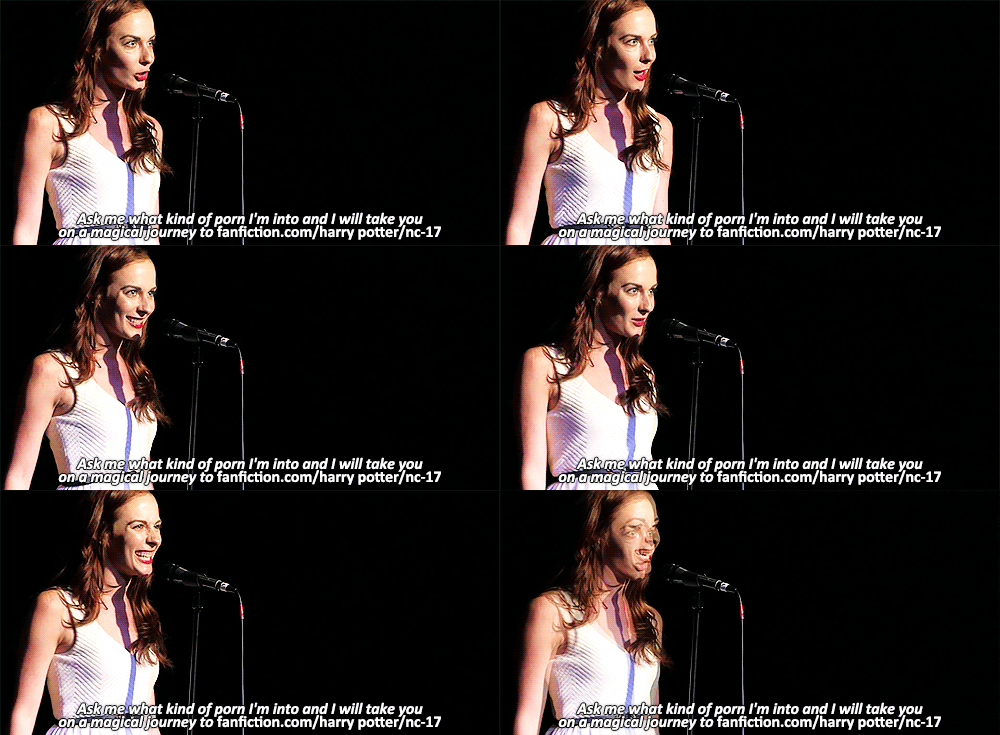
The title of Brenna Twohy’s spoken-word poem Fantastic Breasts and Where to Find Them is a punnish play on the title of a volume about the Potter-verse, Fantastic Beasts and Where to Find Them (emphasis added), published by J.K. Rowling some years ago as a companion to the 7-book saga of “the boy who lived.”

Twohy articulated the goal of her poem to Buzzfeed thusly:

I wanted to highlight how unrealistic most pornography’s portrayal of sex is, and how that creates really damaging expectations for both men and women.

twohy-ask-me-whatMission accomplished (at least for the most part) to hilarious and devastating effect. Particularly pointed is Twohy’s observation that a taste for fan-fiction erotica is to be considered “unrealistic” — while mainstream porn is somehow seen as more real. Which is about as laughable a deception as I’ve heard since… well, unfortunately, just since yesterday, when folks were declaring that public breast-feeding is immoral. (Seriously, y’all. The patriarchy just needs to shut up and die in a fire. Now.)

In yesterday’s Independent, Jonathan Owen discusses a recent poll of British teenagers that reveals:

the majority [of poll participants] warn of the “damaging” and “addictive” effect of sexual images and videos readily available online. 80 per cent say it is too easy for young people to stumble across it and most recall “accessing pornography was seen as typical” while they were at school.

At least 70 per cent agree that “pornography leads to unrealistic attitudes to sex” and “can have a damaging impact” on views of sex or relationships.

A quick visit to Professor Google turned up a wealth of other articles unpacking the sexual myths and unrealistic expectations fostered by the mainstream porn industry. For example:

The gist of all these different articles is perhaps most entertainingly summarized by Noah Brand and Ozy Frantz in Alternet:

The problem is, learning about sex from porn is like learning about firearms from action movies. Action movies sacrifice realism for the sake of storyline or a really cool explosion. Action movies don’t teach you gun safety. Action movies don’t talk about alternatives to violence. And action movies use some tropes—such as the infinite ammo supply—that may move the story along but don’t reflect reality. That’s not a problem, as long as everyone treats them as entertaining fantasies.

Unfortunately, for many young people becoming sexually active today, the entertaining fantasies of mainstream porn are the teacher they’ve spent the most time with, and mainstream porn is a terrible teacher.

Even more than the general unrealistic nature of mainstream pornography, Twohy chooses to highlight a particular strain of misogyny and violence against women that runs through so many adult films.

[SIDEBAR] I will admit to having some level of discomfort over a piece that lambastes porn culture for allowing men to fantasize about sex with barely-legal teens while offering — however ironically — the “more empowering” alternative of a book series where the main characters are under-18 for a majority of the time. Also, having quickly perused some of the titles and advertised pairings in the “mature” section of the Harry Potter stories on fanfiction.net, I see the potential for a lot of uncomfortable power dynamics (Snape & Hermione) and Stockholm syndrome (Draco & oh, everybody).** Blurred lines of consent all over the place… [/SIDEBAR]

Nonetheless, the general thrust*** of Twohy’s piece feels really true and honest and on-point about the culture that mainstream porn participates in and which it helps perpetuate. To quote HuffPo (who also quotes part of Twohy’s poem):

a 2010 Violence Against Women study found that 90 percent of porn video content online and off included verbal or physical aggression towards women.

“I know a slaughterhouse when I see one,” Twohy says of the porn industry. “It looks like 24/7 live streaming, reminding me that men are going to fuck me whether I like it or not, that there is one use for my mouth and it is not speaking, that a man is his most powerful when he’s got a woman by the hair.”

Twohy suggests that the “slaughterhouse,” an uneasy analogy where the slicing instruments aren’t knives but part of a video editing suite, does more than just provide shots of women’s segmented body parts. It also creates a culture where domestic violence isn’t only expected, but accepted.

And more than that, Twohy steps — for an uncomfortable, searingly honest moment — into the ways that we all internalize these messages about how men and women are expected to perform in romantic and sexual situations — men, rough, cruel, aggressive; women, compliant and sex kittenish.

The first time a man I loved held me by the wrists and called me a whore, I did not think “Run.” I thought, “This is just like the movies.”

I have seen that training, on film and in real life.

It everybody fucks over, the patriarchy does.

* Yes, I dare say it has.

** You know how yesterday I took a bullet and read the comments sections on things so you wouldn’t have to? That favor-doing stops tonight — I was not going down that particular rabbit hole. Not for anything.

*** Sorry, couldn’t resist.

———-

Image credit: http://iwatchforsasha.tumblr.com/post/95066205780/fantastic-breasts-and-where-to-find-them


Form vs. Function

So, as someone who is child-free by choice, I’ve had an informal policy of staying as far away from the “mommy wars” as it is possible for me to stay. Breast-feeding vs. formula, maintaining external employment vs. becoming a stay-at-home-mom, “mainstream” product choices vs. natural/organic ones — every choice has its costs and benefits, and every mother has her own unique circumstance that leads to a particular set of choices (some of which may even be forced-choices determined by economic or other constraints).

Since I have never faced these choices and I am never walking a mile in these particular stirrups, my general approach has been to hold an attitude of respect for each mother and her parenting choices,* on the belief that each mom is doing the best she can in any given moment.

But then there’s that moment when the mommy wars play out very personally in the life of someone in my circle of acquaintance:

Ingrid Wiese-Hesson was shopping at an Anthropologie store in Beverly Hills when her 6-week-old son, Xavier, began crying because he was hungry.

Wiese-Hesson then sat down in the store to breastfeed the infant, and that was when the store’s manager reportedly intervened.

“The exact words to me were ‘I’m here to escort you to the ladies room so that you can finish breastfeeding’,” Wiese-Hesson said. “She opened up the bathroom, and she said ‘sorry, there’s no chair’, and of course the only thing in the bathroom was the toilet seat.” (CBS Los Angeles)

Ingrid posted her experience on Facebook and it blew up and went viral almost instantly (as one might guess from seeing the clip from last night’s 11’o’clock news).  More details and slices of analysis are available at a number of places online, including information about a “nurse-in” that took place today in the store (LAist); an AdWeek post that connects the uncomfortable dots between this real-life incident and a recent student-designed public awareness campaign aimed at preventing exactly this sort of harassment; and a CBS Money Watch post that gives really good snark:

At high-end retailer Anthropologie, shoppers can select from body-baring items like its $118 see-through Gladiolus Sheer Silk Blouse. But when it comes to breastfeeding, one store location deemed a woman was showing just too much of her body.

Assuming AdWeek’s excerpt from and analysis of CA state law is on-point —

The Anthropologie manager’s actions were not just unwise, they were also in violation of Hesson’s legal rights. From the California Civil Code: “Notwithstanding any other provision of law, a mother may breastfeed her child in any location, public or private, except the private home or residence of another, where the mother and the child are otherwise authorized to be present.”

— then there’s a certain open-and-shut nature to the legal question here. Ingrid was absolutely, 100% within her rights to breastfeed her son in the Anthropologie store, and the store manager broke the damn law by  interrupting her and escorting her to the bathroom.

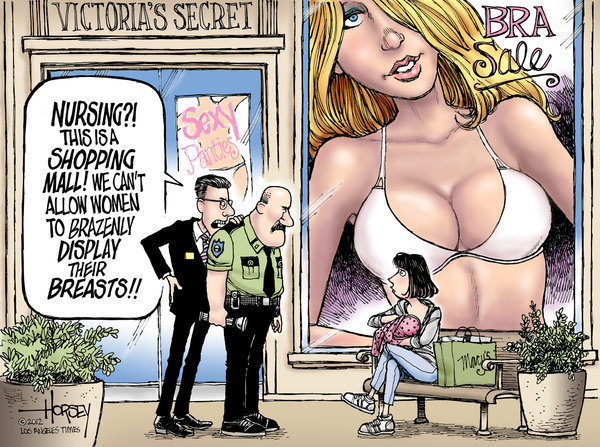
david-horsey-breastfeeding-moms-20120705-001So I’m going to set the legal question aside from now and just let my mind boggle from the fucking insanity of this all. What rational and reasonable objection would anyone have to a woman breast-feeding her six-week-old baby?

Answer: objections a-plenty, but nothing rational or reasonable, as far as I can tell. I know the first rule of following feminist stories in mass-market media sites is “don’t read the comments!” — well, I did, so you don’t have to. (Taking one for the team.) There were a few different rhetorical tactics, but objections pretty much all fell into being one flavor or another of this: breastfeeding should be done in private because it’s immoral/unseemly/inappropriate for it to be seen in public.

And here’s where I go into a sputtering place of incoherent rage and puzzlement. Because, to paraphrase Henry Rollins when talking about racism: these folks are tripping over an entry-level concept, a curb about 6 inches high. It’s inappropriate to publicly use your boobs to feed an infant? Feeding babies is actually the main purpose for which women’s breasts were invented! How can it be deemed immoral for babies to be fed in public?

Because, as Anna Quindlen said way back in 1994:

[T]he subtext of the public breast-feeding battle is the inability to make a distinction between what is female and what is sexual, what is indecent and what is utilitarian. And maybe it’s epitomized in a letter that The Albany Times-Union got from an irate citizen who asked whether women who nursed in public would be having sex on the streets as well, as though the connection between nursing and fornication was self-evident.

(Yes, 1994. Twenty years ago. The more things change, the more they fucking don’t.)

After all, I bet no one would object to a baby being bottle fed in public, and I bet the same judgmental asshats complaining so voraciously about Ingrid’s choice to publicly breastfeed would also be giving her the judgmental side-eye if she had chosen to delay her son’s feeding and “subjected” the other customers to hearing the sounds of an unhappy, hungry, crying baby. It’s only because someone’s mammary glands are involved that this has become such A Thing.

I know that the policing and sexualizing of women’s bodies is pretty stupidly crazy even on the best of days. But still. What is it about breasts? How did these secondary-sex characteristics become so thoroughly fetishized and sexualized in the culture? Why is Anthropologie okay selling see-through shirts for the sake of showing off in the attractiveness/sexuality game, but not okay with a woman discreetly using her breasts for their actual, original biological purpose?

I know, I know: it’s the damn patriarchy again. After all, no one’s having a fit about all those exposed Adam’s apples…

* Aside from those that are obviously neglectful and/or abusive.

———-

Image credit: http://articles.latimes.com/2012/jul/12/nation/la-na-tt-breastfeeding-moms-20120705    (David Horsey at the LA Times.)