A Distorted Shadow of the Truth

I’m very healthy, except for my weight.

It all started because of the interactive at the science museum. It was in an exhibit promoting healthy nutrition and physical activity, and it used proportioned weights to help indicate what sorts and durations of physical exertion would be enough to “burn off” particular food choices. You know, a reproduction of the old fiction about calories in/calories out.

And I tried to keep quiet — I really did. I was with someone I didn’t know all that well, and, for better or for worse, I’m a wimpy enough “activist” that there are lots of times when I choose not to say the many many feminist or fat acceptance-y things that cross my mind in any given moment.

But I just couldn’t stop myself. Because to have that kind of destructive fiction presented as if it were Truth in a goddamn science museum was just beyond the beyond as far as what I could take.

———-

In some of my earlier FA/HAES rants, I’ve talked about the ways that dietary and exercise choices can make a positive impact on your health. (Am rushed now, so will provide citations at appropriate places throughout this post in an update sometime this weekend.) I’m not foolish enough to say that it works for everyone all the time (see the bouquet of sidebars/disclaimers I put down below the dividing line), but I know from my HCG journey that changing my dietary habits has positively impacted my own health. And my individual experience has been corroborated by some of the studies I linked in those earlier rants.

However. The calories in/calories out bullshit and the cultural weight obsession are just so damn destructive. Because they keep people’s focus on the wrong damn thing!

heart-grapes-healthLet’s say you want to improve your health so you decide to shake up your diet and activity routine in whatever way works for you. Eat more fruits and veggies. Eliminate/lessen added sugars. Train for a marathon. Start biking for some of your errand-running. Here’s the not-often-enough-acknowledged truth of one’s genetic set point: those lifestyle changes could be having all kinds of positive impact on your health without making much (if any) alteration in the number on the scale. So, because of all the false conflation between weight and health, because of all the ways we’ve been lied to about how certain calorie/food/exercise equations are unshakeable, it is entirely possible that someone who’s making great and positive changes in their health will instead feel like an absolute and utter failure because the number on the scale isn’t moving.

And so they might give up, or turn towards drastic weight loss methods that are undeniably detrimental to one’s health. And that’s just heartbreaking to me.

I’m very healthy, except for my weight,” she said to me.

Then I’d say you’re healthy. End of sentence,” I replied.

———-

Here’s the small bouquet of sidebars/disclaimers.

  1. No one owes the world to have “health” as their top priority, or anywhere in the top 10 list.
  2. People who have chosen to prioritize health (to whatever degree) can set their own definitions for what’s healthy “enough” — whether that’s five servings of produce per day, or five servings of produce per month.
  3. Diet and exercise choices often make a positive impact on health, but there are lots of factors outside our control, so don’t you dare getting all snooty and superior about anyone who faces health challenges you have been spared.

———-

Another catch up post for Writing 101, done in place of Day 20. (Day 20 is supposed to be a long post — which for me is rather a scary prospect — and so the “due date” is Monday.) Any how, here’s the Day 12 prompt:

Today, write a post with roots in a real-world conversation. For a twist, include foreshadowing.

———-

Image credit: http://www.mindbodygreen.com/0-7272/6-simple-things-you-can-do-in-2013-to-optimize-your-health.html

A Matter of Perspective

different-perspective-238x300Back in college, I took one creative writing class. One of the exercises was to create a scene and tell it from two different perspectives. Being very much in a “write what you know” place, I concocted something about one student dropping by another’s dorm room to pick up notes from a missed class.

I created laughingly amateurish levels of contrast between the two characters and a somewhat tense snip of dialogue for this hand-off. Then I presented the exact same dialogue, Rashomon-style, through both POVs, trying to suggest the truth beneath each set of false assumptions. The borrower, who through the eyes of the lender looked prim, overdressed and snobby, was actually tense because she was late meeting her parents for a dinner out. While the lender, who looked through the borrower’s eyes as disorganized and a slob, was…actually, I can’t quite remember what angle I took for her inner life.

I was unaccountably proud of myself for the discipline I’d shown in reproducing the dialogue so precisely within both pieces, and how I’d worked so hard to make sure that neither girl came off entirely the villain. Which is why the most instructive piece for me about the whole experience was the response of one of my classmates — when the conversation turned to my pieces in the weekly portfolio, it became very clear that she’d bought so entirely into the perspective of the notes-lender that she’d disregarded everything I’d tried to show to explain and justify the borrower’s behavior.

———-

The lens of one’s perspective can be incredibly strong in the way it filters our understanding of what we see and experience in the world. Last fall, I saw coverage of a research study by Yale law professor Dan Kahan:

Kahan conducted some ingenious experiments about the impact of political passion on people’s ability to think clearly.  His conclusion, in Mooney’s words: partisanship “can even undermine our very basic reasoning skills…. [People] who are otherwise very good at math may totally flunk a problem that they would otherwise probably be able to solve, simply because giving the right answer goes against their political beliefs.”

In other words, say goodnight to the dream that education, journalism, scientific evidence, media literacy or reason can provide the tools and information that people need in order to make good decisions.  It turns out that in the public realm, a lack of information isn’t the real problem.  The hurdle is how our minds work, no matter how smart we think we are.  We want to believe we’re rational, but reason turns out to be the ex post facto way we rationalize what our emotions already want to believe.

This study is merely the latest of a healthy line of investigation, much of it done under the umbrella of behavioral economics, into human irrationality, manipulatability and decision-making. My passing interest in this work is one of the reasons I’m so certain that cultural transformation needs to be rooted in both the head (facts) and the heart (emotions).

But the odd offshoot of this is the ways that I’m also a little more suspicious of the notion of “putting myself in someone’s else’s shoes.” I mean, there’s lots and lots of time where the practice of compassion, the striving to understand another person’s perspective is valuable.

Sometimes, though, I wonder if the gulf of perspective is wider than can be crossed in an imagination event. A co-worker of mine back in Philly always talked about the risk of “conversations with disbelievers” — wouldn’t our advocacy energy, she wondered,  be better spent speaking to people who shared some (or all) of our core values but didn’t yet see the connection between those values and our work, rather than by trying to “convert” individual holding values drastically different from ours?

I think there’s something to that.

I also worry about the many, many ways that the news media “ideal” of balanced coverage of an issue is actually a subtle way to reinforce the assumptions and lies of the cultural status quo.  By now, the slogan “Fair and Balanced” has become self-parody, an eternal punchline:

http://www.hulu.com/watch/618470

There’s also the longstanding tradition of stories presenting two talking heads, each on one side of a controversial issue. But what are the cultural prejudices that get reaffirmed by the decision of which topics are controversial and need the point-counterpoint treatment. Remember back when I talked about media response to the book The Obesity Paradox? That story, which dared to suggest that fat prejudice might not be a good idea, required GMA’s medical editor to show up and talk about how we all still need to watch our BMI and monitor our weight. But the 2,600 diet tips and programs that have been profiled on GMA since then? Do you think there’s been any requirement for our sage Dr. to talk about how weight isn’t an accurate measure of health, and the physical harm caused by dieting/weight cycling behaviors? Of course not! (Citations here.)

And then there’s the flip side, when crackpot theories are given far more cultural dominance than they deserve* in the interest on presenting “both sides” of a story. To continue on the thread of climate change:

https://www.youtube.com/watch?v=mL7pCGQIirM

I’m a week behind on my John Oliver, so it’s possible that he did something so incredibly kick-ass this past Sunday night as to take the top spot on my list. But, barring that possibility, I think this moment from Episode 3 is the best damn thing he’s ever done:

(Though bringing down the FCC comments site over net neutrality preventing cable company fuckery was kind of cool, too.)

———-

[Post-script] This meditation was prompted by the Day 9 prompt for Writing 101:

A man and a woman walk through the park together, holding hands. They pass an old woman sitting on a bench. The old woman is knitting a small, red sweater. The man begins to cry. Write this scene.

Today’s twist: write the scene from three different points of view: from the perspective of the man, then the woman, and finally the old woman.

It’s another prompt that seems more aptly designed for fiction writers than for the memoirist/cultural gadfly kind of writer such as myself. But no complaints: it was a fun topic to think about, even if I took the assignment a little “slant” once again. [/Post-script]

* Actually, a “crackpot theory getting more cultural dominance that it rightly deserves” is a pretty damn accurate description of fat shaming/fat stigma, too….

———-

Image credit: http://www.questforanewperspective.com/simple-living/why-have-a-different-perspective/

Tempted by Convention

Mr. Mezzo and I spent the weekend up at the lake house with my Mom. One of the benefits of moving to Boston was the fact that we can have more regular weekend access to the place, so the promising weather forecast made it seem like a great time for the first visit of the season. Besides, what with yesterday being the fifth anniversary of my father’s way-sudden passing, it just felt best for Mom to have company rather than to be left alone with possibly-gloomy thoughts.

feelings-pieNot that we talked about any of that. Not the anniversary, not about my motivations for coming up this weekend, not about what she might be feeling/remembering, not about my own feelings and memories. None of that was discussed.

Though truth be told, I didn’t expect anything different on that score. There’s a reason for all those cliches about emotionally reticent, laconic New Englanders. And the superficiality of conversation among families in the corporate/country club set.

But I did tell Mr. Mezzo, as we were breezing through the Hampton Tolls Friday night, that I was wondering whether Mom would say anything about my weight loss. After all, if my body looks different enough for hairdressers and co-workers to notice, one would think that the change would be obvious enough for one’s own flesh and blood to be aware.

Mr. Mezzo predicted that she wouldn’t say anything. At least, he figured she wasn’t going to bring up the topic independently. As he explained it to me when I asked, he thought she might say something if the subject came up organically, but he knew he wasn’t gonna bring it up, and he knew for damn sure I wasn’t gonna bring it up. So, he concluded, silence was likely to rule.

I wasn’t so sure. Yes, she’s been nice and polite about not nagging me for becoming fat, but it felt like there might be a chance of her going to the super-enthusiastic place about how much better I look now, how great it is that I’ve finally gotten thinner — the kind of compliments I wrote about previously, and the kind which would inspire an internal wry smile and a silent monologue about “Oh, so there’s the judgement about my body type she’s been polite enough to keep hidden all this time.”

So I just wasn’t sure whether or not the topic would come up, and then I wasn’t entirely sure how explicitly I was going to talk about my detox journey if the topic arose. (Somehow, I don’t imagine my mother being all that open to the subject. I rather imagine her being in the whole narrow-minded Industrial Age “quackwatch” kind of place.)

But when all was said and done, I needn’t have wasted any time wondering or rehearsing what I might say. Because Mr. Mezzo’s prognostication won out and the topic of my body shrinkage remained as subterranean as any consideration of my father’s passing.

I am mostly deeply relieved at that turn of events.

But I am aware of a small part in me that is disappointed.

I get it. I know I still carry a small kernel of my younger self with me, that little girl who naturally wishes for her parents to show their affection and approval.* And even if there’s lots of reasons that I find compliments about weight loss to be deeply problematic, I know my mom’s not even remotely aware of FA/HAES, and she’s really not likely to be agreeing with that perspective. So, that part of me which yearns for acknowledgement would kinda sorta be okay with taking in a problematic compliment, because sometimes that feels better than no compliment at all.

[SIDEBAR] There’s also a whole other angle in contemplating how deep the cultural programming around body size goes. Kate Harding once wrote about the “cognitive dissonance” phase of the fat acceptance journey, “thinking it made perfect sense that the OBESITY CRISIS hype was way overblown, and even if it weren’t, dieting doesn’t work anyway — but still wanting to lose weight.” And Cat observes that for a fat person to want to lose weight “is the sane choice when you live in a world that finds you disgusting.” So, I also wonder if there’s a piece of me that would kinda sorta be okay with weight loss compliments on account of the residual weight of all that cultural baggage. [/SIDEBAR]

So whichever way you slice it, there’s lots of feels, some of it self-contradictory. ‘Twas ever thus.

* I’m guessing I’m not the only one, but I’m not going to assume I know about anyone’s soul but my own.

———-

Image credit: http://static.someecards.com/someecards/usercards/MjAxMy1jYzgzZjk3NDA2YWRiODA1.png

The Challenge that Wasn’t


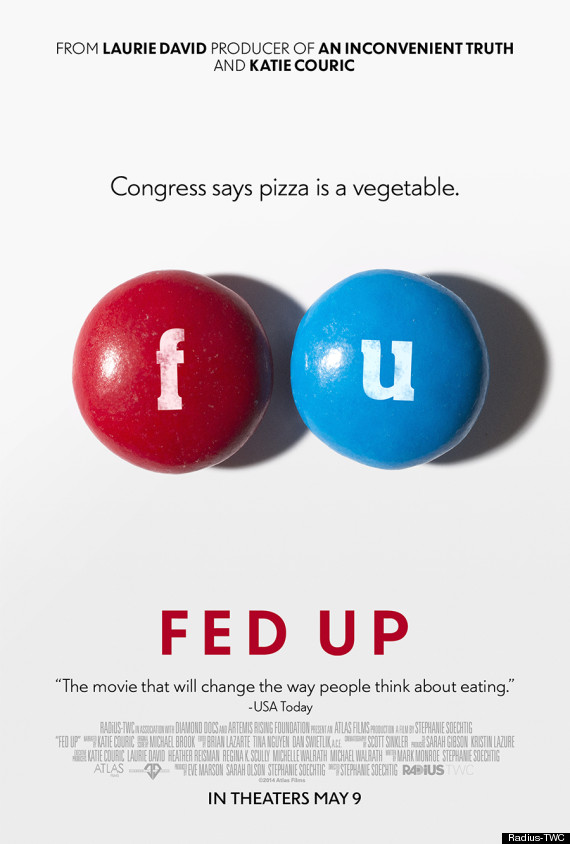
http://www.huffingtonpost.com/2014/04/10/fed-up-poster_n_5127876.html

This morning, Dan Harris and Katie Couric were on GMA reporting out on their separate experiences trying Couric’s 10-Day “Fed Up Challenge.” Basically, the challenge is an awareness-raising publicity stunt designed to accompany the release of the new documentary that, as Mark Bittman describes in the NYTimes, presents “heavy-hitting facts about the dangers of the overconsumption of sugar and other hyperprocessed food.”

Couric and the other filmmakers encouraged a sugar-elimination regime that may sound familiar to followers of my HCG journey: fresh fruits and natural sugars are okay. The challenge instead is about avoiding anything that has added sugar in it. And I’m assuming part of the motivation behind issuing this challenge was to raise some level of public awareness about the shocking number of packaged and processed foods that contain added sugars — even when you might not expect them to.

Of course, the funny thing about Couric’s challenge, when seen through an it’s-all-about-me lens, was the ways that this “new” 10-day challenged overlapped so perfectly and precisely with the final days of my HCG journey. So for me, the “challenge” to avoid added sugars was pretty much routine by the time Couric was talking about it on the news shows.

But that’s just me. I find myself wondering how many folks have chosen/will choose to take this project on.  The website currently lists close to 28,000 registrants, but my mind is racing with so many possibilities — some significant portion of those folks may have tried and stopped, or there could be many more folks who are doing the challenge without registering, and there may be folks who come across the film and the challenge in weeks to come who add themselves to the list of participants — that I can’t tell if the figure of 28,000 participants is a Mama Bear, Papa Bear, or Baby Bear kind of number. (Too big, too small, or just right?)

And whatever the number of participants is, I wonder how many of them are being impacted by the experience. Do they find the preponderance of sugar on food labels as shocking as I did? Are they contemplating changing the structure of their food habits, or are they waiting out the time before going on the next sugar binge? (And, to stop deflecting and judging others and instead to take my own damn inventory: which of those possibilities will be my path? I’ve already had some cheese popcorn and a small piece of chocolate tonight, so it didn’t take me hardly any time post-HCG to dip my toe back into the addictive waters…)

Bittner is hopeful that the movie will make an impact on the American public:

The movie addresses what the former Food and Drug Administration commissioner David Kessler calls “one of the great public health epidemics of our time.” The greater public needs to know that.

As of this writing, the movie is in 19 markets, and doing well. If it were in hundreds of theaters, it would probably change more lives than any movie released this year, because if people see the film, they will get the message. It’s not a subtle one.

And it certainly seems as if there’s enough fear of impact that the inevitable backlash from the corporate machine has started. (As, thankfully, has the backlash against the backlash, most cogently embodied by Boston’s own* Union of Concerned Scientists.)

So, I remain curious to see how this will unfold.

———-

I’m also feeling into the question of whether I’m going to see the movie, and if so, when and where I will choose to do so. I have some hesitation because of all the ways I expect the film will give me stabby feelings. Both in the desire to strike out against the food industry, but also, I fear, in my desire to take a knife to the filmmakers themselves.

Because I am pretty damn sure that the film’s argument in many instances is going to boil down to “It’s sugar’s fault for making us fat!” After all, the HuffPo teaser for the film from which I got the poster, above, leads not with the scientifically accurate and scarier facts about diabetes and the food industry, but instead with society’s true monster-under-the-bed: being fat!**

The more nuanced and accurate perspective would be to say: “Sugar causes numerous health challenges and deficits which are sometimes but not always correlated with (not causing) weight gain, so we should focus on the sugar and not on monitoring people’s body size.”

Anyone want to quote me Vegas odds for that possibility? Don’t bother: I know full well there’s not a snowball’s chance in Rome of seeing that inconvenient polemic anywhere in Fed Up. More’s the pity.

* Okay, “Cambridge,” not Boston proper. I’m still having some hometown pride…

** And believe me when I say that was the least offensive of the options I found to link to as image sources.

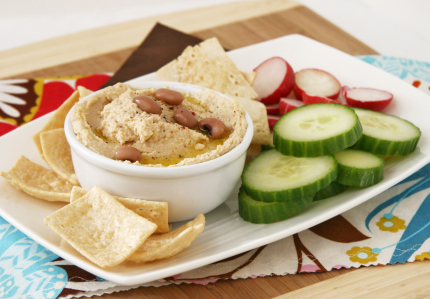
Plate of hummus with veggies and pita chips

Transitional Thoughts

So the shots are done, the super-low-calorie transition days are behind me, and I’m now officially into the next (final?) phase of the HCG experience.

A few vignettes, mostly food-related:

———-

Plate of hummus with veggies and pita chipsI had understood that sugars, grains, breads, and starchy veggies (corn, carrot, potatoes) were all still forbidden during this phase. What I didn’t wake up to until yesterday was that things like beans, lentils, and chickpeas are also verboten. So my fantasies of enjoying celery sticks with hummus or making a batch of my three-bean chili are on hold for another few weeks.

———-

I’m trying to get a bit more understanding of the body sensations around hunger and satiation. At this stage of the protocol, there’s no limits on the amount of food you can have — just a strong recommendation to be conscious of eating only till you’re full, rather than going into any addictive eating patterns.

Being aware of actual hunger and stopping points is something I haven’t always (often?) been paying attention to in the last couple years, so it’s kind of a new sensation.

———-

Now that I don’t have to monitor my portions so obsessively, Mr. Mezzo and I can go back to doing some cooking together. Which is a nice return to form.

We’re probably going to use my HCG cookbook for a good stretch of these weeks. The flavors are good, we can figure out how to adjust the portions to make things with a full package of chicken or beef, and that way we’ll know that I’m avoiding sugars and starches like I’m supposed to.

———-

I’ll be doing a gall bladder/liver cleanse late next week into the weekend. The first step of that? Cutting all oils and fats out of your diet for a few days.  Just a few days after I was allowed to bring them back into my diet after a six-week break.

Yeah, there’s some flavor of irony to that.

———-

The first use of Chapstick was every bit as blissful as I had hoped it would be.

———-

I am astonished to see the sheer quantity of foods that have added sugar in them. It took me a LONG time reading labels at Whole Foods to find mustard, spaghetti sauce, salad dressing and almond butter that don’t have added sugars and are thus permissible to me right now.

I still haven’t found any ketchup or flavored yogurt that would work.

Even though I haven’t been strongly focused on this detox movement as a way to “create healthier eating habits” for myself, I had been quietly toying in the back of my mind with the notion of making this experience the starting point for a longer-term reduction in the quantity of added sugar in my life.

On the one hand, my recent label-reading has me thinking that could be a really important step, considering all the hidden ways sugar’s been pushed into the cultural system. On the other hand, there’s a whiny child part of me that’s feeling annoyed with how hard it’s going to be if I do keep moving towards sugar reduction, because of all the ways it’s hidden in the food supply.

———-

I have not succumbed to old addictions by coating myself with cheese sauce. Yet.

But I am so making some form of cheese omelette for myself this weekend.

I also have fantasies of getting a Dunkin’ Donuts iced coffee — no flavor, no sweetener, just ice coffee and cream. If I add my own Stevia drops, I think that might just be within my new set of restrictions.

———-

Image credit: http://naturalnoshing.wordpress.com/2012/01/01/black-eyed-pea-hummus/

Baby Jiu Jitsu

A Dance of Appreciation and Avoidance

Baby Jiu JitsuOne of my other weekend activities was to get a somewhat-overdue haircut (and a color touch-up, though that was more on-time).

I had a haircut scheduled two weeks ago, but my hairdresser got sick, and I just decided to grit my teeth and wait till the Saturday coloring appointment I already had on the books.

The upshot of all this scheduling information is that my last haircut prior to this one was the weekend before I flew down to begin the HCG protocol. So, my hairdresser hadn’t seen me since this whole journey began. And I guess I look different enough now for it to be noticeable.

“You look great! Have you lost weight?”

Welcome to the compliment minefield.

———-

[HAES/FA Basics Break]

Just for clarity, let’s recap some of the reasons why this particular “compliment” is deeply problematic and not very complimentary.

As a start, here’s Regan Chastain at Dances with Fat:

People who undertake weight loss attempts are often encouraged to motivate themselves by hating their current bodies.  When they are successful at short term weight loss, they are encouraged to look back at their “old body” with shame, scorn, and hatred.  And that’s a big problem.

Not just because at some point the person will probably start to think “if everyone is talking about how great I look now, how did they think I looked before?” but also because the vast majority of people gain back their weight in two to five years.  Then they are living in a body that they taught themselves to hate and be ashamed of, remembering all of those compliments. Yikes.

Tracy I at Fit, Feminist, and (almost) Fifty unpacks some of the deeper implications of this compliment, and its collusion within a structure of the Foucauldian panopticon:*

It reinforces the idea that it’s okay to let people know that we are monitoring and judging their bodies. One thing that shocked my friend in the story I opened with was that she really didn’t even know the person who commented on her weight.  And yet the person felt completely entitled to say something. What kind of a twisted world do we live in where the state of our bodies is fair game for comments from whoever feels like making them?

Finally, here’s a meditation from Michelle Parrinello-Cason at Balancing Jane on the question of what exactly we’re praising when we compliment weight loss.

What if I say “Have you lost weight? You’re looking great!” to someone who has been starving himself for weeks. Now I’ve reinforced that behavior.

What if I tell someone she looks great when she’s actually suffering weight loss as a side effect from a deadly disease (as happened to this woman’s friend who was suffering from Lupus).

We don’t know what we’re praising if we’re only praising a result. If our goal is to encourage people to take care of themselves and to be healthy, then shouldn’t we make sure that we’re actually encouraging people to, you know, take care of themselves and be healthy?

If someone gets up an hour early and went for a run, we should praise that. That’s hard work.

If someone cooked healthy meals all week long for themselves and their family, we should praise that. That’s hard work. [. . .]

If we rethink the way that we give praise, we can begin to restructure our norms. If we praise hard work instead of outcomes and acknowledge beauty wherever we see it and the people who are doing that hard work don’t get any thinner, we’re still reinforcing positive, healthy changes. Isn’t that what we really want to value as a culture?

[/Break]

———-

For all that I agree with these multiple analyses about the problems behind my hairdresser’s statement, I also agree with Golda Poretsky at Body Love Wellness about the root cause of these “compliments”:

I think people are, in some ways, nearly literally blinded by weight loss culture. So when they read something or someone as beautiful they make an automatic connection between beauty and weight loss. I really don’t blame people for that. I think that most of us who have woken up from weight loss culture have been truly hurt by it (or have great empathy for someone close to us who has been hurt by it), so people who haven’t had that experience often just see our current weight loss culture as normal.

So the question becomes, what do you do in the moment? Depending on the context and your relationship to that person, you can handle the compliment of “You look great. Did you lose weight?” in many ways.

Among the options Poretsky lists are saying a simple thanks, setting a boundary against public discussion of your weight, or using humor to redirect the conversation. In the moment on Saturday morning, I didn’t select any of those precise options, though I feel as if I kind of rolled them all together, a bit.

I thanked her and said I’d been doing this detox diet for a number of weeks, limiting my food to lean proteins and fresh produce. I was sure some weight loss had occurred as a side effect of the detoxing, but that’s not my focus.

“Do you have an ultimate weight loss goal?”**

“Nope,” I repeated, “that’s not my focus.

And that’s where we left the topic. Me wanting to acknowledge and appreciate her desire to say something nice and kind, while also jiu-jitsuing my way out of the specific value proposition (thin=beautiful=virtuous; fat=ugly=lazy cow) she was unconsciously peddling.

* I stumbled across this blog tonight looking for good links to use here and I am already head over heels in love with Tracy’s intelligence and insights.

** You see, this bit shows as much as anything how deeply unconscious and blinded we are by the weight loss culture. When an otherwise lovely young woman hears a statement about how weight loss isn’t my focus and then without blinking an eye disregards that assertion to ask me my weight loss goal, there’s nothing else to call that but a symptom of cultural insanity.

———-

Image credit: http://www.groundnevermisses.com/2012/02/striking-grappling-traditional-mma.html


Biostatisticians Manufacturing Insecurity

obama not trueThere’s been a small flurry of press around one of the latest entries to my ever-expanding reading list, Dr. Carl Lavie’s The Obesity Paradox: When Thinner is Sicker and Heavier Means Healthier.

This story over at Good Morning America is pretty typical of what you might expect from such coverage:

  1. gasps of surprise at the notion that fatness and fitness could coexist in human form
  2. the usual journalist concern-trolling comment about “won’t this just let overweight people feel okay about themselves?” — because it would, of course, be awful if any fat person actually had self-love or self-acceptance*
  3. a concluding tag from the network medical editor desperately trying to reaffirm the badness of fatties and the continued relevance of using the BMI (“body mass index”) as a measure of your general health and fitness.

It’s almost enough to make me giving up watching my usual morning news show, because here’s the thing: BMI is not in the slightest bit a relevant or useful measure for someone’s health or fitness.

The person who dreamed up the BMI said explicitly that it could not and should not be used to indicate the level of fatness in an individual.

The BMI was introduced in the early 19th century by a Belgian named Lambert Adolphe Jacques Quetelet. He was a mathematician, not a physician. He produced the formula to give a quick and easy way to measure the degree of obesity of the general population to assist the government in allocating resources. In other words, it is a 200-year-old hack.

At least The New York Times is taking a more reasonable approach in its response to Lavie’s book. (Of course, the Times employs Gina Kolata, so I’ve come to learn I can expect a little bit better of them than from the usual muck-raking hacks.)

It’s a little frustrating to have all of this trumpeted as if Lavie’s saying something that’s never been said before, when this is ground that’s been well-trod by Linda Bacon, Paul Campos, Eric Oliver, and yes, Gina Kolata. But I guess I’d rather have more and more sources revealing these inconvenient truths, in hopes that we’ll hit a point of critical mass and the cultural discourse will turn.

———-

Prompted by all this recent conversation about the BMI, I was inspired to do two things.

First, I took a trip down memory lane and over to Shapely Prose’s BMI Project: a set of pictures that shows the wide variety of beautiful, healthy woman and men who would be stigmatized as over or underweight all because of this fucked up wacky BMI obsession.

Second, I did some math to figure out where I currently fall on this dreaded rubric and what the delta is between my current shape and the holy grail of a BMI equalling 24.9 or below. Current BMI: 35.2, which matches me exactly to one of the BMI project folks on the top row of the flickr page. Pounds I would need to drop in order to reach 24.9: 64.

Which is totally fucked up bananas. It is even more clearly bananas when I look at my “BMI twin” on the Flickr set and try to imagine it.

(It’s that old trick of being able to see more beauty in and feel more compassion for others than for the self. Heck, I’ll use whatever’s in my arsenal to keep growing my level of self-love and body acceptance.)

* Here’s when I started screaming at the TV. I think I scared Mr. Mezzo.

———-

Image credit: http://www.quickmeme.com/meme/3rdhji

A Culture of Shame

What are all these military people going to do when they lose their jobs? And then I thought, well, hang on: we’ve got all these service industries now, things like psychotherapy, and the military approach to psychotherapy would really be kind of perfect. Really efficient and fast! You know, “Listen, you are nothing. You are a worm. And if you don’t get that mother complex solved by 0400 hours, you are dead meat!”

~~ Laurie Anderson, The Mysterious “J”

Gunnery seargent hartmannWhen I was writing about Fat Acceptance/HAES a couple nights ago and had to stop midstream, as it were, I was very aware that I hadn’t really said everything about fat shaming that I would want to. I mentioned the ways that fat shaming carries negative health effects for the target of such stigma, but I didn’t really unpack the general insanity of fat shaming. Or, to be more precise, the bananas nature of how fat shaming is usually justified as a means of informing/inspiring some poor fattie into losing weight and getting healthier.

Of course, those two concepts don’t even really go together, because weight /= health, but I’m using that phrasing to indicate the double level of bananas that’s going on here. First is the delusion that weight and health are equated, but even if that particular myth were true, I still trip over the insanity of the expectation that shaming and stigmatizing someone will inspire them to make positive change in their life.

Now, just in case you’re silly enough to think that engaging in fat-shaming will inspire some one to get on the healthy-eating-and-exercise train, let me give you a quick hit to a study from back in 2007:

We have seen over the years that it does not work to make people feel worse about their bodies. The data are striking — talking about weight, worrying too much about diet, focusing on it increases risk not only of eating disorders, but also of being overweight.

So, no: shaming not effective. (As Kate Harding once said: Special Delivery from the Duh Truck.)

One more thing: considering how steeped our culture is in anti-fat rhetoric, does a fat-shamer really think that his or her observation of my fatness is something that’s going to be news to me — or to any fat person?

So I’ll admit: considering that these two notions — 1)  fat people already know they’re fat; 2)  shaming doesn’t do anything to build positive choices, but instead just beats someone down — are so very common sense indeed, I’ve pretty much assumed that anyone who does indulge in fat shaming (no matter how prettily it’s couched in concern trolling language), is just kinda being an asshole.

Fat Heffalump pretty fully eviscerated that particular behavior pattern a few months ago when she pointed out that You’re not the First to Tell a Fat Person…  Taking direct aim at concern trolling and claims that “I’m just worried for your health!” she has this to say:

No you’re not.  If you were, you would be standing beside me fighting fat stigma and advocating for equitable health treatment for all.  You don’t give a damn about the health and wellbeing of fat people.  You don’t care that fat people can’t get treatment for everything from the common cold through to cancer because they are all blamed on their fatness and they’re just given a diet, not actual treatment.  You don’t care that the public vilification of fat people causes depression, anxiety and post-traumatic stress disorder.  You don’t care that fat people are dying because they are so shamed by the medical profession that they can’t bring themselves to go back to the doctor when they are ill.  Claiming you care about our wellbeing is a lie.

And the inimitable Regan at Dances with Fat more recently pointed out that Being a Jerk is Not Actually Brave:

We are aware that you think “Fat bad, thin good, shame the fatties grunt grunt grunt”. We can hear this message  386,170 times every year.  I’ve been fat for 17 years, which means I’ve heard it around 6,564,890 times.  How can you possibly think that hearing it 6,564,891 times is going to improve my life?   Being 6,564,891 does not make you special or brave, it makes you one more doody in a big ole pile of poo.  It is an act of hubris that is almost beyond understanding to not only be a bully, but to ask for credit by claiming that your bullying is an act of bravery. […]

Or you could swim against the stream and treat fat people like the intelligent human beings we are- not like confused misguided sheep who need your strong guidance – and encourage others to do the same.  Let there be a fat person who only hears 386,169 messages about their body because you refused to pile on the shame and body hate.  That’s brave.

But, if I can come down off my own high horse for a moment, it’s worth mentioning that — however common sense it may feel to me that shaming has no positive effect on a person or situation — the fact remains that we do a lot of shaming in this culture.

And not just about fatness. Almost any aspect of life that comes up for judgement and it deemed to “need changing” comes up for that Nike drill sergeant (“Just do it!”) so beautifully satirized by Laurie Anderson, above. And maybe I’m right, sitting in my own little superiority-tower: maybe we’re all just assholes.

Or maybe there’s some deeper delusion we’re all trapped in, to honestly halfway think that the way to change a life’s path is to try and block off the “undesirable” option with a pile of shit and shame.

Something worth further examination.

———-

Image credit: http://rcoll-rorscharch.blogspot.com/2013/11/the-worst-kinds-of-fathers.html

Some Fat Acceptance/HAES Basics

(Apologies to anyone who’s a Facebook friend — some of this will be a re-hash of the links I’ve been posting there today.)

It’s occurred to me today that because I’ve been thinking about fat acceptance & health at every size concepts for a few years now, I sometimes talk about these concepts in a very “I hold these truths to be self-evident” way. And maybe, instead, it’s worth unpacking just a little bit about my perspective on questions of fatness and health.

Now to be sure, plenty of bloggers have already dropped the mic on this again and again and again, which may be part of my reticence tonight. After all, why cover ground that has really truly been covered with great insight before?

ANGRY!
ANGRY!

Maybe because the things things these writers have said are worth saying again. And again and again and again, until people finally stop all the fat-shaming and masking their superiority in concern trolling and their obesity panic and bleeping get it.

So here’s my own little piece of the mythbusting puzzle.

Most of what “everyone knows” about fat is pretty much wrong.

To start off, being fat is not automatically unhealthy. Fat people actually tend to live a bit longer, and are more likely to survive cardiac events. There’s also a fair bit of evidence that a lot of health problems supposedly “caused” by fatness might instead be a result of dieting and weight cycling. There is some evidence that certain health risks are tied to having a very specific type of adipose tissue in your body (visceral fat), but guess what? Thin people AND fat people can have too much visceral fat hurting their organs, and unless you’re Superman, I defy you to tell me you have the kind of x-ray vision to know who’s packing VF and who isn’t.

Warning: that last article I linked may give you stabby pains behind the eyes because after reporting on a study that pretty clearly states that the important factors are metabolic health and visceral fat, the author still ends with the concluding thought that these results should not be taken as “an excuse to remain overweight or obese.” Because even though the study shows obesity as a non-factor in measuring health, it’s still somehow a health risk. (Just because?) Ah, rumor-mongering science journalism at its finest.

And while the illustrious staff writers at Time have left such tempting fruit, let’s take on this whole balderdash that implies one’s body shape and size are completely under one’s Ayn Rand-ian will. Because, statistically speaking, diets don’t work. Sorry Not-sorry to burst your bubble on this one: they don’t. And they do incredible harm along the way. The weight loss industry, has a catastrophic “success rate” and an evil jiu jitsu way of transfering its own failings out onto the customer so they feel guilty about it all. Well, to quote Golda Poretsky at Body Love Wellness: “It’s bullshit and it’s bad for ya.”

As for healthy diet and exercise choices, yes they do indeed matter and they can make a big difference in reducing the effect of various “fat-related” conditions like cholesterol levels or blood pressure. But here’s the funny thing: those conditions get reversed independent of any actual weight loss being caused by diet and exercise choices. And considering the negative health effects of being fat-shamed and stigmatized, and considering the fact that fat people have a dramatically lower chance of even getting decent health care on account of the prejudicial attitudes of medical professionals, it’s probably best to steer clear of claiming that a fat person’s health challenges are being caused by weight. ‘Cos I’m seeing a lot of confounding causality here.

I need to get to bed at a reasonable hour, so I’m pulling the cart to a stop here. With one final thought.

Even if fat were unhealthy and if being fat were entirely under an individual’s control, every fat person on this planet would be deserving of fundamental human respect, acceptance and compassion. Just because of their humanity.

The heart-breaking thing is how little respect, acceptance, or compassion fat people get in this culture today —  even though fat isn’t unhealthy and it can’t reliably be controlled.

Data Points

The doctor’s office that prescribed my HCG gave me a booklet to help me track all kinds of things. Portions of food, my water intake, supplements, ketosis level — and, yes, a daily weigh-in.

I’ll admit, I toyed with the notion of skipping that last piece. Ultimately I decided I wanted to respect the protocol in every possible detail. Including weigh-ins: even if I have all kinds of associations between morning weigh-ins and the evils of the diet industry, I’m willing to take on this task in the context of tracking my weight as one among a set of data points.

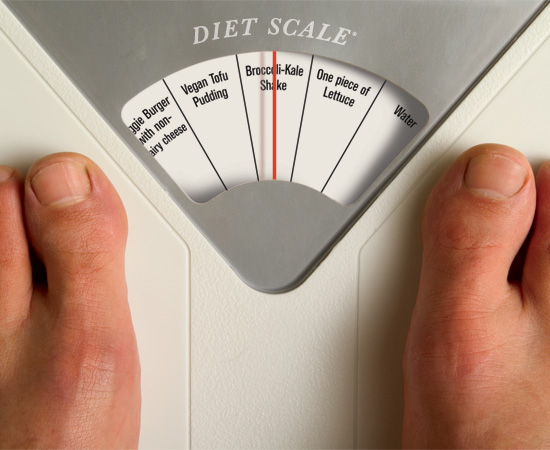
02.scale_So I dragged the scale out of the basement* and threw it into the bathroom, where it and I have been having a daily, emotionally-guarded, one-on-one.

As I expected, this detox process has meant that my numbers on the scale have been going down, a little bit each day. And, as uncomfortable as it is to admit, there’s been part of me enjoying that trajectory. I spent so many years being brainwashed around the value of skinny** that I know there’s part of me that can still fall into that old model of thinking.

Aside from that, there’s been some concrete benefits. Some of my slacks had started getting a bit tight in the past few months, and even though I would have been 100% willing and unashamed to buy a larger size if need be, I can’t deny that I’m glad not to have to spend the money and to instead be feeling more physically comfortable in my current wardrobe.

I was having a similar issue with my wedding rings feeling a tiny bit tight and uncomfortable, and it’s especially nice for those to be back to fitting better.

Anyhow, today, I had my morning date with the scale and the numbers were exactly the same as they were yesterday.

This is entirely unsurprising. All the information about HCG — even from a weight-loss perspective — talks about the inevitability that some days your weight will “plateau” instead of being lower than the day before. I kinda think the diet guides make a really big deal out of this possibility just so someone doing HCG for the purpose of weight loss won’t freak out when this occurs.

But it was fascinating to witness myself when this moment occurred. In an instant, I could recall all the old tricks I would have used, back in the obsessive-dieting days, to make the scale move in a good direction. Maybe I should weigh myself starkers, or try again after another trip to the toilet.

Or maybe not.

For all that I was able to recall the ways a “plateau day” would have thrown the old diet-obsessed Sherri for a loop, perhaps the most surprising thing about this morning was really how little emotional charge today’s date with the scale held for me. I saw the numbers, saw all the possibilities for being negatively impacted emotionally, and just felt fine.

Almost like my weight is just another data point for me.

* And why did I even still have a scale? For the always-important job of checking to make sure my luggage is under the airplane weight limit.

** Oh who am I kidding? From a cultural messages standpoint, I’m still being brainwashed about the value of skinny. We all are.

———-

Image credit: http://simplykierste.com/2013/01/fit-friday-with-erica-the-scale-friend-or-foe.html (And yes, this was a very deliberate choice…)