
When the Fat Lady Sings

BrunnhildeI am about a month behind the times in commenting on this, but back near the middle-to-end of May, I saw an NPR post about a distressing batch of reviews responding to Tara Erraught’s performance as Octiavian in Der Rosenkavalier at the Glyndenbourne Festival.

As summarized by Anastasia Tsioulcas (from a compilation gathered by Norman Lebrecht on his blog Slipped Disc),

What is stunningly apparent is just how much a woman’s body matters onstage — way more, if these five critics are to be believed, than her voice, her technique, her musicality or any other quality. . . . Bonus disgrace points to [Rupert] Christiansen [of The Telegraph], by the way, for going after the other lead in Rosenkavalier for having the temerity to be a working parent: “Kate Royal … has recently sounded short of her best and stressed by motherhood.” Kudos for pinpointing motherhood as the source of Royal’s putative shortcomings. She couldn’t possibly have been overbooked, or feeling under the weather — couldn’t have been any other reason, right?

Tsioulcas observes that the lone dissenting voice in this chorus of fat-shaming was a female opera critic; she also does a bit of counterpoint to see if these critics are as likely to mention issues of weight/stature when reviewing the work of male classical singers. (They’re not. In other news: water is wet.)

As tempting as it might be to reduce this controversy to some simplistic formula like “men critics are bad patriarchal meanies while women support each other,” that kind of reductiveness is not entirely what I see going on here. To shift to Maclean’s summary of the point-counterpoint:

Elle magazine accused critics of “fat-shaming” Erraught, who isn’t even particularly heavy by normal standards. It seemed to many like the culmination of at least a decade of unrealistic expectations for opera singers’ looks, especially among women. . . . Alice Coote, a star English mezzo-soprano, blogged on the music news site Slipped Disc to defend Erraught and remind critics that opera is “all about the human voice.” And Elle’s Natalie Matthews wondered “why bring up her weight at all?” finding the issue irrelevant to opera singing.

Others argue that it isn’t irrelevant at all. They fear that the view expressed by Coote and others could bring back the days when singers like Luciano Pavarotti were cast for singing alone, even in parts they were physically unfit for. “I don’t believe opera is all about singing,” says Wayne Gooding, editor of Opera Canada. “It’s all about music theatre. There are many reasons why somebody may not be appropriate for a particular role: wrong kind of voice, or wrong timbre, too old or too young, and yes, wrong look.” [Conrad L.] Osborne adds that “physical appropriateness, within reason, is a perfectly legitimate artistic consideration.”

(Okay, yeah, that passage also lends itself a bit to gender bifurcation, considering that once again the voices defending Erraught are female, and the voices defending body-policing are male. But that wasn’t what I was intending to look at. Move along, nothing to see here…)

Let me hone in on the pieces I wanted to chew over: the emphasis of opera as musical theater, and the tricky territory of artistic vision in creating a stage production of any show. As Anne Midgette summarized last week in the Washington Post*– the column that got me thinking that maybe, weeks later, it still was worth writing about this:

On one side of this debate are those who hold that opera is a musical experience and therefore looks are not as important as sound (witness the success of extremely large singers such as Luciano Pavarotti and Montserrat Caballé). On the other are those who aver that opera is also a theatrical experience and that appearance matters. Guess what. You’re both right. I’ve been at opera performances where the staging was awful but the singing was glorious, and nothing else mattered. I’ve been at opera performances where the production was so compelling that I was willing to overlook so-so singing. These things have to be taken on a case-by-case basis. Any time you make rules about what art “has” to be, you’re doing it wrong.

I do want there to be room for artists and creators and theater companies to be able to communicate a unique vision in their artworks, whether that be a painting, a poem, or a stage production. And it’s an uncomfortable truth that if your artistic creation has any focus to it, then there are likely other viable choices and representations that have been excluded in the creation of a particular emphasis.

Off the top of my head, I can think of three vastly different productions of Macbeth — one I attended, one was directed by a friend of mine, and the third had a friend as a member of the acting company. They all had fascinating “hooks” to them — one a meditation on ethnic violence with stagecraft that alluded to the Serbo-Croatian wars in the 1990s; one an all-female cast that thoughtfully turned the all-male productions of Shakespeare’s day inside-out; and the final one an exploration of the legacy of European colonization and of military dictatorship. Each one of these was a worthwhile lens through which to explore the original text, and there is absolutely no way that all three of those lens could have co-existed in a single production. So maybe it’s perfectly legitimate for a director to prioritize whatever he wants to prioritize in casting a show, whether it’s weighing voice over looks or vice-versa.

Except.

There’s a reason I used the gendered pronoun “he” in talking about directors, above. HuffPo: “According to Fandor, women make up a total of five percent — five percent! — of the directors in Hollywood, down from nine percent in 1998.” The Guardian: “Only 24% of directors employed by the theatres during 2011-12 were women. Looking at creative crews as a whole (directors, designers, sound designers, lighting designers and composers) only 23% of the total employed were women.”

To quote Midgette again:

The reason that “Taragate” has blossomed into such a focus of opinion and argument is that it encapsulates current flash points in our society: how we talk about weight and think about weight and how we look at and evaluate women and women’s bodies. . . . [T]here’s also a disingenuous way in which male critics (and the majority of performing-arts critics are still men) protest that it is perfectly relevant to criticize a woman not for what she does, but for how she looks. . . .

I will defend the right of critics to have strong opinions and unpopular opinions and to offer blunt and unflattering descriptions of performers. And I continue to aver that people would be even more upset if critics went away and there were no criticism at all. But it’s naive in a #YesAllWomen world to deny the implicit sexism of the discourse here. And to offer it is less an offense to our womanhood than to our intelligence.

Are there times that the emphasis on physicality can have artistic integrity to it, and if so, when and under what conditions? And when is that emphasis just another vehicle to reinforce patriarchal/misogynist cultural standards?

———-

One of the reasons this all has been so top-of-mind for me is that I am trying to decide whether to audition for a show this upcoming week. It’s been a production/audition cycle that’s been on my radar since I first started thinking about community theater a month ago, and I still haven’t figured out what I’m going to do.

I’ve felt the pain of not receiving a part, knowing (and sometimes even having it acknowledged) that I was a better singer and actor than the woman cast, but also knowing that the woman cast was thinner and prettier than me. And so I wonder whether there’s any chance of goodness stemming from bringing my “overweight” body into the audition hall, or if that’s just such a set-up for judgement and rejection that it’s not even worth engaging in.

I’d better figure this out soon. ‘Cos if I’m going to do it, I need to choose in time to actually make the audition window. And if I choose against auditioning, I want that to be an actual conscious choice, rather than me dithering until the window of opportunity closes on its own and I never actually had to take ownership of my life and choices.

This lady’s still (and forever?) fat. Is she singing? The jury’s out.

* See, they do have some respectable journalists on staff!

———-

Image credit: http://www.phrases.org.uk/meanings/it-aint-over-until-the-fat-lady-sings.html

A Matter of Perspective

different-perspective-238x300Back in college, I took one creative writing class. One of the exercises was to create a scene and tell it from two different perspectives. Being very much in a “write what you know” place, I concocted something about one student dropping by another’s dorm room to pick up notes from a missed class.

I created laughingly amateurish levels of contrast between the two characters and a somewhat tense snip of dialogue for this hand-off. Then I presented the exact same dialogue, Rashomon-style, through both POVs, trying to suggest the truth beneath each set of false assumptions. The borrower, who through the eyes of the lender looked prim, overdressed and snobby, was actually tense because she was late meeting her parents for a dinner out. While the lender, who looked through the borrower’s eyes as disorganized and a slob, was…actually, I can’t quite remember what angle I took for her inner life.

I was unaccountably proud of myself for the discipline I’d shown in reproducing the dialogue so precisely within both pieces, and how I’d worked so hard to make sure that neither girl came off entirely the villain. Which is why the most instructive piece for me about the whole experience was the response of one of my classmates — when the conversation turned to my pieces in the weekly portfolio, it became very clear that she’d bought so entirely into the perspective of the notes-lender that she’d disregarded everything I’d tried to show to explain and justify the borrower’s behavior.

———-

The lens of one’s perspective can be incredibly strong in the way it filters our understanding of what we see and experience in the world. Last fall, I saw coverage of a research study by Yale law professor Dan Kahan:

Kahan conducted some ingenious experiments about the impact of political passion on people’s ability to think clearly.  His conclusion, in Mooney’s words: partisanship “can even undermine our very basic reasoning skills…. [People] who are otherwise very good at math may totally flunk a problem that they would otherwise probably be able to solve, simply because giving the right answer goes against their political beliefs.”

In other words, say goodnight to the dream that education, journalism, scientific evidence, media literacy or reason can provide the tools and information that people need in order to make good decisions.  It turns out that in the public realm, a lack of information isn’t the real problem.  The hurdle is how our minds work, no matter how smart we think we are.  We want to believe we’re rational, but reason turns out to be the ex post facto way we rationalize what our emotions already want to believe.

This study is merely the latest of a healthy line of investigation, much of it done under the umbrella of behavioral economics, into human irrationality, manipulatability and decision-making. My passing interest in this work is one of the reasons I’m so certain that cultural transformation needs to be rooted in both the head (facts) and the heart (emotions).

But the odd offshoot of this is the ways that I’m also a little more suspicious of the notion of “putting myself in someone’s else’s shoes.” I mean, there’s lots and lots of time where the practice of compassion, the striving to understand another person’s perspective is valuable.

Sometimes, though, I wonder if the gulf of perspective is wider than can be crossed in an imagination event. A co-worker of mine back in Philly always talked about the risk of “conversations with disbelievers” — wouldn’t our advocacy energy, she wondered,  be better spent speaking to people who shared some (or all) of our core values but didn’t yet see the connection between those values and our work, rather than by trying to “convert” individual holding values drastically different from ours?

I think there’s something to that.

I also worry about the many, many ways that the news media “ideal” of balanced coverage of an issue is actually a subtle way to reinforce the assumptions and lies of the cultural status quo.  By now, the slogan “Fair and Balanced” has become self-parody, an eternal punchline:

http://www.hulu.com/watch/618470

There’s also the longstanding tradition of stories presenting two talking heads, each on one side of a controversial issue. But what are the cultural prejudices that get reaffirmed by the decision of which topics are controversial and need the point-counterpoint treatment. Remember back when I talked about media response to the book The Obesity Paradox? That story, which dared to suggest that fat prejudice might not be a good idea, required GMA’s medical editor to show up and talk about how we all still need to watch our BMI and monitor our weight. But the 2,600 diet tips and programs that have been profiled on GMA since then? Do you think there’s been any requirement for our sage Dr. to talk about how weight isn’t an accurate measure of health, and the physical harm caused by dieting/weight cycling behaviors? Of course not! (Citations here.)

And then there’s the flip side, when crackpot theories are given far more cultural dominance than they deserve* in the interest on presenting “both sides” of a story. To continue on the thread of climate change:

https://www.youtube.com/watch?v=mL7pCGQIirM

I’m a week behind on my John Oliver, so it’s possible that he did something so incredibly kick-ass this past Sunday night as to take the top spot on my list. But, barring that possibility, I think this moment from Episode 3 is the best damn thing he’s ever done:

(Though bringing down the FCC comments site over net neutrality preventing cable company fuckery was kind of cool, too.)

———-

[Post-script] This meditation was prompted by the Day 9 prompt for Writing 101:

A man and a woman walk through the park together, holding hands. They pass an old woman sitting on a bench. The old woman is knitting a small, red sweater. The man begins to cry. Write this scene.

Today’s twist: write the scene from three different points of view: from the perspective of the man, then the woman, and finally the old woman.

It’s another prompt that seems more aptly designed for fiction writers than for the memoirist/cultural gadfly kind of writer such as myself. But no complaints: it was a fun topic to think about, even if I took the assignment a little “slant” once again. [/Post-script]

* Actually, a “crackpot theory getting more cultural dominance that it rightly deserves” is a pretty damn accurate description of fat shaming/fat stigma, too….

———-

Image credit: http://www.questforanewperspective.com/simple-living/why-have-a-different-perspective/

Hashtag Feminism

#wecandoitI had so much else to say last night about that damn George Will op-ed that I didn’t have time to touch on one thread of the counter-discourse against his misinformed and misogynist rant: the hashtag conversation about #SurvivorPrivilege.

Feminist writer and activist Wagatwe Wanjuki states in an interview on Buzzfeed:

I honestly started the hashtag as a way to share my frustration with the notion that survivors have privilege. It’s one of those situations where I felt like I should laugh so I don’t cry, so I used my sarcasm to start a conversation about how difficult it is to be a survivor. I hope the hashtag will help highlight the absurdity of George Will’s column and that survivors are struggling in the aftermath of sexual violence. No one wants to be the victim of a violent crime.

If you peruse the tweets reproduced in that article, or in similar articles at DCist, Feministing, Ms., and PolicyMic — or, for the moment, if you follow the live twitter feed, though batten down the hatches for the inevitable MRA backlash in 3, 2, 1… — you will see an array of experiences that is likely every bit as heart-breaking and outrage-inducing as you would expect it to be.

For example:

https://twitter.com/wagatwe/statuses/476056156792954880

https://twitter.com/sarahnmoon/statuses/476099428756242432

Meanwhile, in another corner of the galaxy, Shonda Rhimes gave the commencement speech at Dartmouth this past Sunday. (Transcript here.) Among the customary mixture of self-revelation (“Shonda, how do you do it all? The answer is this: I don’t”) and platitudes (“Don’t be a dreamer, be a do-er”) is a passage about the importance of activism in the world:

And while we are discussing this, let me say a thing. A hashtag is not helping. #yesallwomen #takebackthenight #notallmen #bringbackourgirls #StopPretendingHashtagsAreTheSameAsDoingSomething

Hashtags are very pretty on twitter. I love them. I will hashtag myself into next week. But a hashtag is not a movement. A hashtag does not make you Dr King. A hashtag does not change anything. It’s a hashtag. It’s you, sitting on your butt, typing into your computer and then going back to binge watching your favorite show. For me, it’s Game of Thrones.

Volunteer some hours. Focus on something outside yourself. Devote a slice of your energies towards making the world suck less every week.

(Emphases added by HuffPo.)

As part of an ongoing work project, I’ve been having some conversations with colleagues about the nature of societal and systems change.* We’ve been talking about this topic within the context of educational reform, but the core principles around creating change carry across contexts and topics — including misogyny, patriarchal structures and rape culture.

Let me distill these conversations down to a kindergarten level.  The research suggests that in order for real change to occur, real, lasting, sustained change, three pillars all need to be in place:

  1. People need to know the truth about something (especially when evidentiary truth goes against your assumptions or beyond the limitations of your personal experience)
  2. People need to care, to think that a particular issue matters and that the effort of making change is worth something
  3. People need do-able, impactful actions they can take to make individual change or influence systemic/societal change

So in one way, Shonda’s right: talk alone is not enough to “make the world suck a little less every week.” But I think she goes too far when she says “A hashtag is not helping.” Because action alone isn’t enough — or maybe action would be enough on its own if we lived in a miraculous utopia where everyone was instinctively knowledgeable about and motivated towards right action.

But we don’t live in that magical utopia, so unless people are given information to help them drop their privilege blinders, and unless they are inspired to give a shit, then nothing is gonna evolve.

In other words: hashtags help.

* There are moments my job sucks, and then there are moments when it is really-super-cool.

———

Image credit: http://nymag.com/thecut/2013/12/can-feminist-hashtags-dismantle-the-state.html


Either George Will or He Won’t

[Trigger warning: discussion of rape and other sexual assaults; quotations that show profound misogyny, slut-shaming and victim-blaming; and rebuttals that share stats and stories about rape and rape culture, and yeah, with a lot of profanity. A LOT of profanity.]

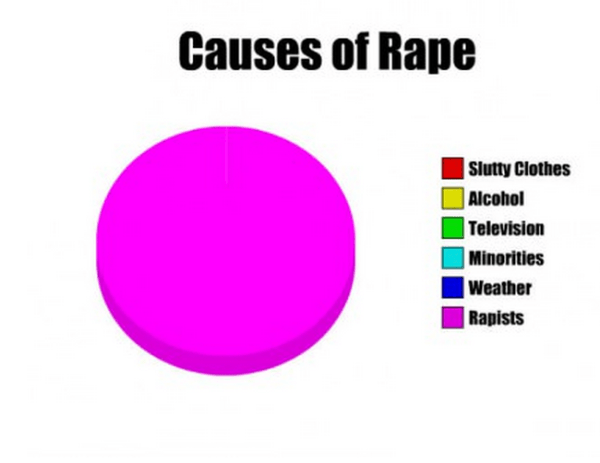
causes-of-rapeI am totally cheating tonight. The Day 7 prompt for Writing 101 is about creating a sense of contrast: “Focus today’s post on the contrast between two things. The twist? Write the post in the form of a dialogue.

But I am currently so enraged and stabby-feeling over George Will’s latest exercise in newspaper-subsidized misogyny that it was inevitably going to be my topic tonight, no matter what I had to do to shoe-horn it into the Writing 101 structure. (Honestly, as far as ideological contrast goes, we have that in abundance. As far as dialogue is concerned? That’s more of a stretch.)

———-

Women, Higher Education, and Sexual Assault: a Point-Counterpoint Between George Will and Mezzo Sherri

Colleges and universities are . . . learning that when they say campus victimizations are ubiquitous (“micro-aggressions,” often not discernible to the untutored eye, are everywhere), and that when they make victimhood a coveted status that confers privileges, victims proliferate.

Dude, even though it didn’t exist by the same name, the conceptual underpinning for our current understanding of microaggression has been around since at least 1905, when Freud first theorized about the sublimated violence/victimization cycle in so much of modern humor. And even if your current status as rich, urbane, white male — sort of the royal flush of the privilege poker hands — makes it hard for you to perceive microagressions with “an untutored eye,” here’s a tip from Charles Davis at VICE: “You don’t need a reference manual to not make people feel bad; you just need to listen every once in a while, learn a thing or two, and try to be more considerate, particularly around people you just met. Since when did stopping to think before you open your stupid mouth become such a bad thing?”

And excuse me? Being the target of sexual violence is a “coveted status”? In whose bizarro world is that true? After all, the rest of your column just oozes compassion and acceptance for those individuals who have experienced sexual assault. Oh wait: the rest of your column is actually “contributing to a society that is utterly dismissive of their experiences.” (PolicyMic)

Consider the supposed campus epidemic of rape, a.k.a. “sexual assault.”

1. Here’s some basic set theory for you: all rapes are indeed sexual assaults, but not all sexual assault is rapes.  (Or, to break it down even further, here’s how I used to explain that concept to my SAT students back in the day: All of my bracelets are jewelry, but not all of my jewelry is bracelets.) I point this out just because if you’re going to use irony quotes to make fun of a term, it might be best to actually understand the term you’re mocking, and oh, maybe to check in and see if your mockery actually functions as humor or instead just shows your own woeful ignorance about a topic. (Also see above, re: microaggressions.)

2. Supposed epidemic? Really? I know you’re gonna quibble with this statistic later on below the fold, but let me just lay it out there anyhow. The CDC reports that 19% of undergraduate women had experienced “attempted or completed sexual assault” since entering college. Now this is a statistic you’ll see reproduced by lots of advocacy and service organizations (sometimes rounded up to the “1 in 5” phraseology we’ll be discussing soon), but please note I did not go to a partisan or activist source here. I went to the C-D-motherfucking-C. 19% of undergraduate women experience some sort of sexual assault, and 37% of female rape survivors are first raped between the ages of 18-24. And yes, that final age range admittedly extends beyond the usual age window for undergraduate students, but still. How much more of an epidemic do you need?! How many women need to suffer before you can get up a compassion boner for them?!?

Herewith, a Philadelphia magazine report about Swarthmore College, where in 2013 a student “was in her room with a guy with whom she’d been hooking up for three months”

Slut-shaming at its finest. Because of course, once you’ve said yes at one time in one context that means automatic consent for all future times in all future contexts. And by the way, just emphasize how foul your perspective is:

“They’d now decided — mutually, she thought — just to be friends. When he ended up falling asleep on her bed, she changed into pajamas and climbed in next to him. Soon, he was putting his arm around her and taking off her clothes. ‘I basically said, “No, I don’t want to have sex with you.” And then he said, “OK, that’s fine” and stopped.. . . And then he started again a few minutes later, taking off my panties, taking off his boxers. I just kind of laid there and didn’t do anything — I had already said no. I was just tired and wanted to go to bed. I let him finish. I pulled my panties back on and went to sleep.’”

Six weeks later, the woman reported that she had been raped.

Well, she reported having been raped because that’s actually the legal definition applicable to the events as described here. But hey, why should an insignificant thing like factuality matter between friends?

Now you’ve been nice enough not to state the most evil of your assumptions outright, but they’re palpably there, oozed between the lines of suggestion and innuendo.

Why didn’t she fight harder after saying the first “no”? Because we’ve been trained (over and over again) NOT to do so! Even if it’s slightly off the subject, perhaps this video will help explain the level of understood threat that might cause a young woman to decide against “fighting back.”

I had a friend in college who was date-raped sophomore year. (I know: I must be lying about this, and this event couldn’t actually have really occurred because George Will has decreed that college sexual assault is merely a “so-called epidemic.”) She carried some guilt for a while about not having “struggled more” — and I remember her sharing the moment of insight that emerged during a session with her therapist where my friend realized that she had, to the best of her ability in the midst of this awful experience, made a threat assessment and consciously concluded that if she didn’t stop struggling that she would be killed, or at least seriously, seriously wounded. It is perfectly understandable that someone may make a decision to stop resisting, wether because of cultural programming, threat assessment, or some other reason(s). That choice to cease actively fighting back in no way excuses a rapist from the legal and moral responsibility of having committed such a harmful act against another human being.

(This is also, by the way, why affirmative consent standards are so necessary. Yes means yes!)

Why did she wait so long to report this crime?* Maybe because she knew that jerk faces like you would blame her or doubt her. Maybe because even the most “casual look at our criminal justice system, military justice system and the academic disciplinary system under scrutiny right now reveals that each tend to punish survivors, not reward them.” (Salon, emphasis added.)

I could find story after story that demonstrates the ways women reporting sexual assault get interrogated about their clothes, alcohol use, sexual history, and general behavior/decorum, but to save us all some time, here’s a photo gallery that both captures many of these victim-blaming attitudes but also wonderfully eviscerates them.

(I’m skipping ahead a few paragraphs because I only have enough patience to dialogue with one last passage.)

The statistics are: One in five women is sexually assaulted while in college, and only 12 percent of assaults are reported. Simple arithmetic demonstrates that if the 12 percent reporting rate is correct, the 20 percent assault rate is preposterous. Mark Perry of the American Enterprise Institute notes, for example, that in the four years 2009 to 2012 there were 98 reported sexual assaults at Ohio State. That would be 12 percent of 817 total out of a female student population of approximately 28,000, for a sexual assault rate of approximately 2.9 percent — too high but nowhere near 20 percent.

Oh, I see what you did there: it’s like SAT algebra all over again! (98 over x equals 12 over 100; and then once you solve for x put that number over the total population number to get your percentage…)

I’ve said it before, and I’ll say it again: CDC. The 19% assault rate has been confirmed by the C-D-motherfuckin’-C.** So rather than taking the 12% report rate as the hard-and-true fact and using that to invalidate the CDC’s confirmed statistic, why not try this idea on for size: maybe the 12% number is wrong! And that notion is even kind of awfully plausible, since this figure can only ever be “an inferred estimate, because there is no directly measured number of unreported assaults.” (Pharyngula.)

Oh, and by the way? If a 2.9% rate of sexual assault is “too high” by your assertion, and considering the fact that the actual assault rate of 19% has been confirmed by the C-D-motherfuckin’-C, do you want to go back and rethink any of your prior statements about a “so-called” epidemic?

Just wondering.

* I almost put the word crime in those mocking irony quotes (as I assume George  would have done), but I just couldn’t do it.

** I swear, if I ever go back to writing anything based on my dissertation research, I am working this phrase in there somehow.

———-

Image credit: http://michonnemicheaux.wordpress.com/2013/12/11/before-you-make-excuses-for-rape-tw/

Exposing the Vein of Hatred

(Trigger warning: rape, murder, talking about violent images though not using them.)

see no evil-PM-800x413One of the things so powerful to me about the #YesAllWomen conversation that has been taking place in the weeks since the Isla Vista killings, is the ways that there seems to be a wider acknowledgement growing about the layers and levels of misogyny that are operating in US culture, as well as around the world.

The international nature of the problem has been very much on my mind since I saw the shocking image of two Dalit girls, aged 14 and 16, hanging from nooses, after having been (allegedly) gang-raped and (definitively) murdered.

You won’t be seeing that image here, nor will I be knowingly linking to any articles that use it. Manasi Gopalakrishnan reports:

The girls’ family alleged that the two teenagers were raped and tortured before finally being hanged from a mango tree in a nearby orchard. Incensed by alleged police inaction, the families refused to take down the bodies from the tree for several hours. Finally the local police registered a case of rape only after several members of the girls’ community protested in front of the police station. [Emphasis added.]

In that sense, the parents’ initial gesture reminds me very much of Mamie Till’s choice to have an open-casket funeral for her son, Emmet, and her subsequent decision to allow funereal photos of her son to be published in Jet magazine. “I wanted the world to see what they did to my baby,” Mrs. Till is reported to have said. And yet in this day and age when images can travel the globe so quickly, I am not at all clear as to whether these parents in Uttar Pradesh would want their daughters’ postmortem image propagated in so widespread a fashion, and so I will not be aiding in that process. (Quite frankly, I even wonder if Mamie Till might have made a different choice in the Internet age. Or maybe her courage would have found identical expression. I simply don’t know.)

As with Eliot Rodger’s actions and their intersections with US issues such as (definitely) gun control and (allegedly) mental illness, there are multiple factors at stake in this horrifying crime. The caste system. Lack of toilets in poverty-affected regions. There’s even a new report that a state official investigating the case has stated one of the two murder victims may not have been raped.

(I don’t know enough yet to suss out if I think this last one is the first step of a government cover-up — at least two of the arrested suspects are policemen — or the first step at bringing careful investigative work to uncover the truth what the official has suggested might have been an honor killing or one motivated by a property dispute.)

Even with those other factors, it is undeniable that misogyny is a huge part of the cultural foundation for these crimes to occur. Mallika Dutt reports in Time that “In the context of past rapes, Mulayam Singh Yadav, head of Uttar Pradesh’s governing party, the Samajwadi Party, has said, ‘Boys will be boys. They make mistakes.’” A different Indian State Minister, Babulal Gaur, has recently said “Sometimes [rape] is right, sometimes it is wrong.”

All of which is to remind us that “#YesAllWoman isn’t just an American thing.”

As we continue to examine the negative effects of misogyny and cultures that impose toxic definitions of masculinity, it’s important not to be blind to privileges of race, sexual orientation, gender identity, classism, or cultural myopia. A lot of feminist discourse I see on the web is very stuck in these blinders, and in the same way that cultural evolution will require men to become aware to the privileges they carry in a misogynist society, it also requires those of us carrying privilege on other nexuses to wake up to that.

As Shannon Barber writes in luna luna,

Hear in your head every mansplaining nice guy or even every well intentioned usually great dude you know starting a statement with these words-
“but not all men…”
Now stop.
Okay White ladies let me explain you a thing. I’m gonna blow your mind.
That anger and frustration giving you bubble guts right now is how I feel when White women won’t listen to me.
Sit with that for a minute. Understand that how you feel when the response to your pain, your words, your experiences in regard to sexism and misogyny is not all men, but I’m a nice guy etc is the same feeling I have when White women run to interrupt, or otherwise stomp over my experiences, pain and words.
It’s an important reminder — and considering that the Facebook page where I first saw this essay then erupted into an argument about the “unnecessary hosility” of the essay saying something as cruel and abusive as “shut up for five minutes” (gasp!) — it’s a reminder we really need to be hearing.
———-


Permission to Speak

One week later and I’m still reading and link-collecting and doing a lot of thinking about the Isla Vista murders. Part of me feels apologetic about this, even self-indulgent. After all, I wasn’t even remotely affected directly by these events. I have no six-degrees-of-separation ties to any of the individuals involved or to the locations where the events occurred. (I mean, yes, I was born in the same state, but we moved away from CA before I turned two, and I have zero sense of myself as a west coaster.* I don’t even know where Santa Barbara is in geographic relation to my birthplace.)

gag orderSo there’s lots of ways that I’m privileged to have some distance from these events: a fact for which I am extremely grateful, and one which also makes me somewhat embarrassed to be giving it such brain-space and blog-space. I even felt the temptation to title “Yet Another Post” from me about these events with some variant on the plea “Stop me, before I post again!

But then I read this post from the Standing on the Side of Love blog.** In it, the author juxtaposes the legacy of Elliot Rodger’s misogynist writings and videos with the passing of Maya Angelou and her legacy of speaking out about the existence and effects of sexual violence. Then both of these events were further counterpointed against the simultaneously bombshell and matter-of-fact observation that in the week prior to writing her post, the blogger herself had been sexually assaulted.

These milestones all occurring this week make it so clear to me that patriarchy still rules our society, that sexual assault and misogyny are not limited to one incident but are a ubiquitous threat, in varying levels, to all of us. The humanity of every person is threatened by this reality. I wanted to share my story both to help me heal personally, and to provide information that yes, all women, and all people of all gender identities might find useful.

And then, in following the links from that post and my Facebook feed, I came across two other sites. First, a report on a study which reveals the way adolescent and tween girls understand (and wildly under-report) sexual harassment “as ‘normal stuff’ that ‘just happens’ because it’s what ‘guys do.'” Then there’s the tumblr analogue of the #YesAllWomen twitter movement: When Women Refuse, a collection of stories about domestic and sexual violence that is intended to demonstrate “that Rodger’s mass murder was not an anomaly, but instead part of a larger cultural pattern of violence against women.”

And I thought about my own checkered history of experiencing sexual violence, street harassment and misogyny. The rape in college. Years in Philly which were very mild, all things considered, but still contained a few catcall/honking incidents, the occasional groping, and a couple drunken “encounters” where I wasn’t entirely sure in my (inebriated) head that it’d be a good idea to “back out now.” And all of that happened soaked in the cultural miasma of a patriarchal system. For example: the many incidents throughout my schooling where the message from peers (and some teachers/administrators) was that I was too smart, too ambitious, too opinionated for a girl to be. And so part of the lessons I took from my childhood were about learning to live small, stay quiet, conceal the truth of my mind’s intelligence and my heart’s wisdom.

I am not sharing this in hopes of earning my own “victim cred,” nor to make a simplistic point about how my past experiences make it “okay” for me to be as deeply affected by last weekend’s events as I have been. Well, maybe it’s a bit of yes and no on that last point. Yes, it’s likely my resonance with these events and the ensuing discourse has been deepened by my own past traumas. But no, I don’t need any sort of excuse to be thinking or feeling deeply about this — or about anything else, for that matter.

It’s a messy tangle, rather than a straight line trajectory (this is why the metaphor to miasma is so present with me right now), but I am certain there’s a web of connections between the cultural expectations of women’s silence,docility, and availability; the patterns of sexual violence, harassment, and patriarchal retribution that have come so harshly to light this past week; and my own instincts towards self-silencing as I considered writing “Yet Another Post” touching on these issues.

But it’s a knot that needs untangling. And so I keep writing — even if sometimes all I’m writing about is about the right to write.

Every hard-fought sentence, every awkward phrase, every word a prayer. May we release this. May we be healed.

* Nope. I’m a New Englander, through and through, no matter what my birth certificate says.

** Yay, Unitarian Universalists!!

———-

Image credit: http://ravenblackcat.com/blog/2012/5/18/countdown-to-blackout-anxiety-a-gag-order.html

Tipping into Jealousy

This morning, I spent some time writing in my pen and paper journal* to study the eruption of anger and envy I was wrestling with last night. Given everything I said — even in the moment of my emotional tantrum-ing — about my heartfelt wish for a full-society evolution past the chokehold of patriarchal, misogynist structures, then why was I so quick to fall into that resentful funk?

As best as I was able to sort it through, there are two primary threads to it: a sense of distrust and, more prominently, my addiction to being accepted and acknowledged.

First, the distrust. I’ve already written about the eerie sense of similarity I feel between Elliot Rodgers and George Sodini’s actions, and the ways both those mass murders are part of a long and ugly tradition of misogynist crimes. So even as I try to hope that things might finally change in the culture, I’m also feeling a lot of distrust that anything really will. Maybe there will just be this temporary explosion of rhetoric which quickly sinks back into complacency and the status quo.

I very much hope that isn’t the pattern that unfolds. And for all my snarky distrust, I have some portion of hope in my system. The tone of the discussion just senses different this time around. I’m not naive enough to think that everything will unfold as uninterrupted progression from today forward, but I wonder if we’ve reached (or if we’re approaching) a tipping point of cultural awareness. Once enough folks wake up, I believe, the old opiates won’t work to stop evolution.

blue-ribbonBut the deeper, darker piece of self-examination has had me taking a really close look at how my addiction to being right and being acknowledged is so strong that part of me is really envious and resentful around the idea of the culture reaching this tipping point.

Like, I get that the awareness of misogyny has to become common knowledge for things to change, but if it becomes common knowledge then those of us who were at the vanguard, thinking and talking about these issues ahead of the curve, then we won’t get credit. And the truth is, even if I can claim a place in the vanguard, it’s probably only a molecule’s worth if real estate. But man, the desire to “get credit” for that molecule’s worth of territory is hella strong.

Ultimately, I tried to boil things down to the essence and asked myself baldly and bluntly: “What do I care about more? Humanity’s evolution or getting the credit?”

The answer is that the soul-force me DOES care more about evolution occurring than anything else. But it’s a closer race than I would prefer it to be, measuring my investment in evolution against my investment in acknowledgement.

It has been really sobering to see how virulent this addiction is, and then to force myself to face up to the truth of it. Facing up to the real truth — that yes, even this thing I am so tangled and addicted to, this yearning for acknowledgement, yes, even this I am willing to give up if it means the culture can shift.

But, of course, the giving up of the addiction is a day-by-day (minute-by-minute?) practice, rather than anything as simple as turning off the faucet…

So, as with so many things: more to study. Progress rather than perfection, ongoing awakening rather than an arrival point.

* Yes, I keep an analog journal in addition to a blog. Why? As with so many of the dangling participles I leave around here, that’s a story for another day.

———-

Image credit: http://nursegail.com/nursing-profession-most-trusted-gallup-poll/blue-ribbon/

More on #YesAllWomen

CassandraBoxGreat Galloping Gaia, it’s 10 PM and I’m just now starting to write. This does not bode well for my sleep quantity tonight or well-restedness tomorrow.

Ugh.

I was trying to come up with something coherent to say about the propagation of the #YesAllWomen hashtag that wouldn’t just be a bricolage of quotations from other authors about the topic.

https://twitter.com/wagnerfilm/status/470831393639890944

And then somehow, I started re-reading this post & comment thread about street harassment, and then this one about the ongoing mental calculations so many women must compute when faced with the question of  “Schrodinger’s rapist.” And down the rabbit-hole I went.

Yes, dear reader, I was a small part of the conversation when that term was coined and first unpacked. No wonder I’m so exhausted by this latest unfolding of bearing witness and backlash. I was charred by a small firestorm of bearing witness and backlash during JALC’s first life-cycle, 5 years ago.

My small hope is that perhaps this time around, there’s more of a chance for widespread awareness-raising and maybe just maybe some cultural change. Because at least this time, the bearing witness has leapfrogged out of the feminist blogosphere into wider communications channels. Here’s a few:

However, I’ve seen mentioned along the way that the woman who started #YesAllWomen has actually locked down her twitter account due to the level of harassment she was receiving in “thanks” for her activism. That’s not exactly the kind of detail that makes me feel optimistic for humanity’s evolution towards kindness and empathy.

And then there’s the ugliness of my own sexism and envy.

Don’t get me wrong: in my heart, I know that the patriarchy is bad for everyone, and that the best way to evolve past it is for everyone — woman and men, cis and trans, gender-neutral and any other form of gender self-identification I’m too ignorant to know — to work together.

In that spirit, the better part of me is glad and grateful to see the voices of male allies in the #YesAllWomen conversation.

Still, when I see a male author making a point like this?

and this is important, so listen carefully—when a woman is walking down the street, or on a blind date, or, yes, in an elevator alone, she doesn’t know which group you’re in. You might be the potential best guy ever in the history of history, but there’s no way for her to know that. A fraction of men out there are most definitely not in that group. Which are you? Inside your head you know, but outside your head it’s impossible to.

This is the reality women deal with all the time.

There’s a really ugly part of me that’s annoyed. Because this is the exact same kind of point we were making 5 years ago in the original “Schrodinger’s rapist” thread on Shapely Prose. And we got excoriated for it. Gas-lighted, name-called up down and diagonally across the feminist bingo card, the whole damn ugly she-bang.

And I want very much to defuse my annoyance. Phil Plait (the Slate author who inadvertently got my back up) has done nothing wrong. He’s respectful, insightful, he even walks himself back from the possibility of straying into mansplaining territory. In short: everything I would wish for in the family of allies working to build a less sexist and more humanist culture.

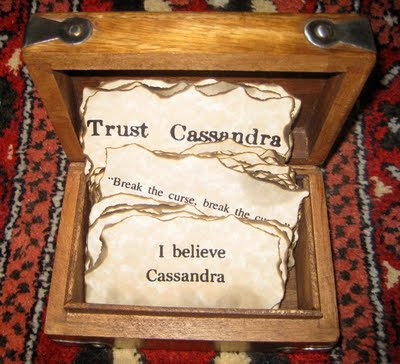
Still. D’you ever feel like you’ve been living the life of Cassandra? Why did so many years, so many deaths, so many acts of violence large and small have to occur before this kind of message was even remotely able to be heard across a wider landscape?

Maybe I’ll be more open-hearted and less cross and churlish after a good night’s sleep. (Which I might get tomorrow night, if I’m smarter about starting my writing earlier in the damn evening!)

———-

Image credit: http://mysteryarts.blogspot.com/2009/12/breaking-curse-of-cassandra.html


Misogyny Taking Aim — Again

Isla-Vista-memorial-900x600Here we go again. Six murdered, 13 wounded, by a young man swearing “retribution” against the women who “never gave [him] a chance.

Although news of the Isla Vista murders broke into my awareness yesterday morning (as I’m sure they did for many of the east coasters who were safe a-bed when the shootings occurred), I couldn’t find the words or the courage in last night’s blog-post to touch into my feelings about this latest explosion of misogynist violence.

After all, last time I dipped my toe into these waters, it prompted a festival of “not all men” defensiveness and mansplaining that wore me the hell down in ways I can scarcely articulate.

[Sidebar]  Let me get this on the table from the get-go. If your first reaction in the face of these events and whatever I have next to say about them is to enter a self-avowed feminist space (see that tagline, above, about me being “fat, feminist and feisty”?) in order to proclaim some variation of “not all men are like that” and/or “patriarchy hurts men too,” then you, my friend, are part of the fucking problem. Please go do some self-edumacating about the ways those observations — though in their own way true — can function in the wrong contexts as yet another expression of patriarchal privilege. (And just to be super-duper crystal clear: this place at this moment would be one of those wrong contexts.) [/Sidebar]

Of course, the horribly, bleakly comical aspect for me at this very moment is that after this whole big lead-up, I can still scarcely find words to express my anger.

At some bone-deep culturally and emotionally worn-down place, I can scarcely find my anger among the feelings of cultural exhaustion and repetition. Because Elliot Rodger’s rampage, and the videotaped and diarized vitriol that has emerged in the two days since, are incredibly awful and horrible and exceptional and at the same time so very, very banal and familiar.

As Katie McDonough writes in Salon:

But it also denies reality to pretend that Rodger’s sense of masculine entitlement and views about women didn’t matter or somehow existed in a vacuum. These things matter because the horror of Rodger’s alleged crimes is unique, but the distorted way he understood himself as a man and the violence with which discussed women — the bleak and dehumanizing lens through which he judged them — is not. Just as we examine our culture of guns once again in the wake of yet another mass shooting, we must also examine our culture of misogyny and toxic masculinity, which devalues both women’s and men’s lives and worth, and inflicts real and daily harm. We must examine the dangerous normative values that treat women as less than human, and that make them — according to Elliot Rodger — deserving of death. [. . .]

I have seen these videos before. Women have heard these threats before, and been forced to consider how seriously they should take a man who tells them on Twitter that he knows where they live and that, “You are going to die and I am the one who is going to kill you.” If Rodger had posted his angry monologue to YouTube or fired it off in an email to a woman online and then gone about his day — seething privately and without violence about his wounded sense of entitlement and the sting of having his resentful and warped desires unfulfilled — the country wouldn’t be talking about him. Because until the moment that he is alleged to have killed six women and men, Elliot Rodger was every bit the same as the other men who are defined by their resentment toward women and their sense of bitter victimization in the world.

McDonough and I are far from alone in having this awful sense of deja vu all over again. The Belle Jar and The Guardian both remind us that just last month, a young woman in Connecticut was stabbed to death for the ultimate crime of declining someone’s invitation to prom. The Free Republic connects the dots between the Isla Vista murders and numerous similar hate crimes, including the Ecole Polytechnique shootings that came strongly to my mind, both five years ago and yesterday.*

Even the connections between Rodgers and the Men’s Rights and Pick-Up Artist communities feel terrifyingly old hat to me. I don’t know for sure that George Sodini was involved in similar groups/endeavors — my five-years ago post doesn’t make it clear, and I only have the stomach tonight to pull links on two sets of misogyny-fueled crimes, rather than three — but it certainly has that tone on it in my memories.

[UPDATE] Because the scholar in me is constitutionally unable to leave dangling assertions without back-up, I’ve done a bit more digging in the clear light of morning. Sodini did indeed attend some “pick-up artist” seminars, and was at least marginally connected to that community. So yeah: the more thing stay the same, the more things stay the same. [/UPDATE]

So, what is there left to say? All I have tonight are a few semi-coherent musings.

The patriarchy is broken. Please, by all that is ethical and holy, let us as a society — as a humanity — find a way to break beyond these structures.

If you have any doubts that the attribution of these crimes to a seed of misogyny is disproportionate, check out the diversity of sharings being offered online via the hashtag #yesallwoman. As observed in The Atlantic:

Like all widely embraced hashtags, #YesAllWomen encompasses content so diverse that everyone is bound to disagree with some of it. I submit that the vast majority of men who explore it with an open mind will come away having gained insights and empathy without much time wasted on declarations that are thoughtless. I hope that the inevitable backlash doesn’t dissuade anyone from taking a look.

And finally, all I can say now is a variation of what I said five years ago. The more that we as a society (ad our media outlets) paper over the connections between Rodger’s misogynist views and the matrix of patriarchy and misogyny that infiltrates contemporary culture, the less of a chance we will have to evolve beyond this tragic state of affairs. And the more inevitable it will be that more shootings, more stabbings, more violent rampages will occur in the name of patriarchal pride and of women’s assumed role as sexual property.

“Why do men feel threatened by women?” I asked a male friend of mine. So this male friend of mine, who does by the way exist, conveniently entered into the following dialogue. “I mean,” I said, “men are bigger, most of the time, they can run faster, strangle better, and they have on the average a lot more money and power.” “They’re afraid women will laugh at them,” he said. “Undercut their world view.” Then I asked some women students in a quickie poetry seminar I was giving, “Why do women feel threatened by men?” “They’re afraid of being killed,” they said.

Margaret Atwood, Writing the Male Character

* The Belle Jar made a similar connection in an earlier version of her post — that text was deleted between last night and today, and I, for one, am sorry to see it go.

———-

Image credit: http://www.thechannels.org/news/2014/05/25/isla-vista-community-mourns-tragedy-with-candlelight-vigil/

water well

The Well of Intuition

This great power, intuition, is composed of lightning-fast inner seeing, inner hearing, inner sensing, and inner knowing.

Over generations, these intuitive powers became as buried streams within women, buried by disuse and unfounded charges of disrepute. . . . I think we can be confident that things lost in the psyche are all still there. So, too, this well of women’s instinctual intuition has never been lost, and whatever is covered over can be brought back out again.

~~ Clarissa Pinkola Estes, Women Who Run With the Wolves, 76

Although my focus with the HCG journey was on detoxing rather than the usually-marketed weight loss routine, I will admit that I wondered whether the experience would support me in being able to move more fully towards intuitive eating. After all, the dietary regimen has given me a chance to get out of the habit of processed food, and I also had lots of opportunity to study the ways that my hungers are sometimes more about emotional needs than actual physical sustenance.

However, having been out of my dietary/cooking routines during the four days of the retreat, I’m not sure that intuitive eating thing has really kicked in. Instead, I can recall several moments when I kept eating — taking cashew after cashew out of the bag for a snack, or going back for that extra little bit of egg salad at lunchtime — well past the point of physical hunger. Responding instead to emotional tension or anxiety.

I don’t say this out of some self-flagellating, confessional instinct. After all, as I’ve said before (and will surely say again and again): I am not striving for a perfection movement.

What instead interests me is the awareness that I don’t yet have a lot of faith in my ability to eat intuitively.

Or, quite honestly, in any level of my intuition.

water well
http://brianmercerbooks.wordpress.com/2013/12/01/when-the-well-runs-dry-part-1/

The concluding movement from the weekend was a highly creative and individualized one, a movement that very much asked us to tune into our intuition. And although I have enough admiration for Clarissa Pinkola Estes that I will not choose to argue with her when she suggests that the well of intuition can always be mined and revived, I still gotta say that my intuition is feeling pretty far underwater.

I’m still too much trapped in my brain, caught up in the fear of “getting it wrong” to have the kind of surrender, the clear channel that allows my intuitive wisdom to come to the fore. And, as with my witnessing around those “extra” cashews, I am trying to name this in the spirit of honest self-examination rather than in a blaming/shaming tone. ‘Cos that sort of beat-up is the same kind of mind voice and ego eruption as the ones that kept me bottled up during the weekend.

Now I know, even in my self-imposed containment, I had some small offerings of intuition to make. And I also take some comfort in trusting that my faith and believing were contributions of their own flavor — perhaps an energetic support to those individuals who were more able to open up their creativity and intuitive insights.*

Still, it’s an area where I can keep studying, an area I can look to grow and express more fully. Which is why I started listening to the audiobook of Women Who Run With the Wolves during this morning’s commute. It’s probably well past time for me to become acquainted with this classic of feminist spirituality.

* Yeah, I know: coming up with this kind of justification to feel better about my contribution does serve also as a between-the-lines admission that, however much I’m trying to stay in witnessing rather than in self-castigation, there’s a little bit of that “mad at myself” piece going on. So, yeah: that happened.