A Little of that Human Touch

Ain’t no mercy on the streets of this town
Ain’t no bread from heavenly skies
Ain’t nobody drawin’ wine from this blood
It’s just you and me tonight

Tell me in a world without pity
Do you think what I’m askin’s too much ?
I just want something to hold on to
And a little of that human touch
Just a little of that human touch

~ Bruce Springsteen, Human Touch

While I’ve been under the weather* having a very individual-sort of challenging week, the rest of the country has been having its own sort of shitty week, what with the floods and the plagues and human decency going all to shit in Ferguson Missouri.

Because I’m still a bit ailing, I’m going to make this more of a link-fest than a work of original commentary — for the most part. Here’s a basic timeline that takes events up to President Obama’s statement Thursday afternoon.

And now a few scattered threads of what’s caught my attention since.

First, some basic pointers from Kate Harding on understanding these events from a lens of racial-cultural privilege.

2. Recognize that Michael Brown’s death was not an isolated incident.

In 2012, more than 300 black people were executed by police, security guards, or vigilantes. In the last month, three other unarmed African-American men—Eric Garner in New York, John Crawford III in Beavercreek, Ohio, and Ezell Ford in Los Angeles—have been killed by police. Those are the ones we know about.

3. Stop saying “This can’t be happening in America.”

I understand the impulse, I really do. But that impulse only comes to those who are insulated and isolated from how America treats poor people and people of color every day. Langston Hughes wrote “America never was America to me” in 1935. If you didn’t quite understand that poem in your junior high or high-school lit classes, read it again, while you think about what’s happening in Ferguson. Let it sink in.

Then, two articles pondering the, um, “selective” ways that many mainstream media outlets choose to portray black victims of violent crime: one from NPR and one from HuffPo. The HuffPo piece particularly illustrates the discomfiting tension that exists between the portrayal of black victims of crime as compared to white (alleged) perpetrators of crimes. Yes, Virginia, race privilege is so fucked up that white criminals still get treated better than black crime victims:

This is by no means standard media protocol, but it happens frequently, deliberately or not. News reports often headline claims from police or other officials that appear unsympathetic or dismissive of black victims. Other times, the headlines seem to suggest that black victims are to blame for their own deaths, engaging in what critics sometimes allege is a form of character assassination. When contrasted with media portrayal of white suspects and accused murderers, the differences are more striking. News outlets often choose to run headlines that exhibit an air of disbelief at an alleged white killer’s supposed actions. Sometimes, they appear to go out of their way to boost the suspect’s character, carrying quotes from relatives or acquaintances that often paint even alleged murderers in a positive light.

Amidst the outrage and indignation over Mike Brown’s death, Feministing calls attention to an equally discomfiting tension — one around the way that black male victims of crime receive more media attention, public support, societal outrage/sympathy than do black female crime victims.

How are the deaths and beatings of women — cis and trans — at the hands of the police or with their complicity so much less compelling? I think the obvious answer here is misogyny and transmisogyny, not on one specific occasion or by one specific person, but at the systemic level: what tweets get tweeted and retweeted, what events seem newsworthy, and what bodies are deemed to hold value.

I want to mourn the deaths of Mike Brown and Eric Garner and Trayvon Martin, and I want to question why the deaths of Renisha McBride and Islan Nettles and Kathryn Johnston haven’t gotten similar traction. Why the beating of Marlene Pinnock isn’t on all of our lips. Why the nation is not familiar with the names of Stephanie Maldonado, or of Ersula Ore. And how many women’s names do we not know because they don’t dare come forward? Because the violence they experience at the hands of the police is sexual, and the shame and stigma around sexual violence silences them?

The truth is that, in the predominantly male-led civil rights organizations who lead efforts to respond to police brutality, in the male-dominated media that covers them, and in the hearts and minds of many people in this country, women who are of color, who are sex workers, undocumented immigrants, transgender (or, god forbid, more than one of those at once) are rarely candidates for “innocence,” and are often blamed for their own deaths, forgotten, or hardly counted at all.

But finally, the piece that gives me small glimmer of hope is the contrast between Wednesday’s protest — and the militarized police response to them (text and images from Slate), and last night.

The man at the front of the march, was Missouri Highway Patrol Capt. Ronald S. Johnson, a Ferguson native.

“I’m not afraid to be in this crowd,” Johnson declared to reporters.

Johnson, a towering African American man who wiped sweat from his brow as he pointed out neighborhood hangouts and restaurants he used to frequent, was put in charge of crowd control earlier in the day, replacing the St. Louis County police who had been overseeing the police response to the protests. . . .

Protesters said they were still angry, demanding justice for Brown and answers from local police about why he was shot and who the offending officer was.

But, they said, Johnson’s willingness to physically interact with them, rid the streets of heavy police equipment, and help them coordinate protests was a welcome change in tone.

“Thank you so much for being here,” said Karen Wood, who fought back tears as she held both of Johnson’s hands imploring him to bring answers to residents and maintain calm in the streets.

“This is about human rights, about human beings,” she cried. (Washington Post)

It’s about human rights. Human beings. Meeting one another in an open-hearted way, with that human touch.

ari-hug-it-outAnd no, it’s not a magic wand to make all the troubles and tensions magically go away. There’s still hard work to be done, hard conversations to be had.

But ain’t it something to see how that human touch at least makes the hard work possible?

* It’s been a lovely stomach bug/depression cocktail — I don’t recommend it.

———-

Image credit: http://giphy.com/gifs/pzl20V6IWOjK

Beyond the Filters of Human Decency

Back during JALC’s first lifespan, I took some small enjoyment from watching my WordPress dashboard to see what sorts of google searches brought readers to my posts. (I even used that as an excuse for a quick one-liner-type post way back when.) Google has since redone its programming, so there’s much less of that possible on JALC’s current life cycle.

Nowadays, most everything is hidden behind an “unknown search terms” privacy curtain. I haven’t the slightest level of understanding as to why certain terms making it out from behind the curtain to appear on my dashboard, but since I know the dashboard list is a mysteriously reduced and redacted version of the “real” list, I just haven’t really paid that dashboard feature much attention this time around.

Until I got back form my trip Sunday night and saw a new phrase in that screen field:

we hate ragen chastain

In case you don’t know, Ragen Chastain is a fat activist, someone I would say is out helping lead the movement. She has a book, an active speaking calendar and is currently co-organizing an online Fat Activism Conference that will take place from August 22-24. And she has a blog, a blog that is one of my go-to sources to continue expanding my awareness and evolving my thinking around fat acceptance and health at every size.

I would wager that Chastain and I wouldn’t see eye to eye on everything. For example, my guess is that she would consider my recent HCG journey simply to be a capitulation to diet culture, even though I contextualized it for myself as a detox experience. And, you know what? If she did have some questions about my motivations, and how mixed they might have been, I can respect that. ‘Cos Gaia knows, I had to do a lot of my own inner discernment to keep unwinding my old weight loss programming so that I could keep the goals of my HCG journey distinct from losing weight. And the uncomfortable reality is that no matter how hard I worked to keep my own focus in the detox lens, my decision to do HCG meant that I financially supported a company that makes its living off of diet culture, women’s insecurity, and size policing. (Ugh.)

So yeah, I can respect how Chastain and I might have differing opinions on some things. But the level of puzzlement and shock I felt about that search term being used to find this blog is largely driven by the great level of respect I feel for Chastain, her work, her voice. (My best guess, looking back at my old posts, is that the phrase must have made contact with one of my own FA/HAES rants where I quoted one of Chastain’s posts and then talked about “hating” some fat-shaming shenanigan-or-other.)

SPmobThe other piece of my upset about having been, even ever-so-peripherally, connected to that phrase is the general sense of despair and discouragement I feel about the ugly way that people treat each other, out here on the Interweb.

Often, I see the most virulent, soul-staining ugliness in misogynist response to feminist writing of some sort or other. For further commentary on this subject, see Chastain’s blog, Shakesville, Jezebel, Pacific Standard, Forbes, and the Washington Post.* To quote Shakesville:

Every time, the people with whom I share this experience express shock. It is always, always, a surprise that a woman who does public advocacy is subjected to this sort of abuse.

And it shouldn’t be. Because every single woman I know who does public advocacy is subjected to it. . . .

And then we are told not to talk about it. We are told that we empower the people who do this to us. No. NO. Victims do not empower abusers. People who refuse to acknowledge that abuse do. People who tell victims to be silent do.

I am not going to be silent. I am tired of people being surprised. I am tired of hearing “I’m sorry this happens to you.” I don’t want shock and I don’t want pity.

I want your fucking awareness and I want your fucking anger.

I want us to talk about the real costs of being a woman who does public advocacy. I want us to acknowledge how the costs of providing a safe space is that we stand on the line and absorb massive amounts of abuse. I want us to make noise about the people who create an atmosphere in which women are discouraged from participation.

And I want people to stop telling me to be quiet about it.

In addition to the politicized, misogynist harassment, there’s the general garden-variety flavors of awfulness.

Actress Zelda Williams, daughter of comedy great Robin Williams who died Monday from an apparent suicide, has quit social media after receiving taunts from Internet trolls.

Williams abandoned her Twitter and Instagram accounts Tuesday after saying at least two people were sending her Photoshopped images of her father’s dead body and other disturbing messages.

“I’m sorry. I should’ve risen above,” she wrote in her final tweet. “Deleting this from my devices for a good long time, maybe forever. Time will tell. Goodbye.”

The episode proves that, with the anonymity of the Internet, some people will be horrible no matter the situation. (CNN)

buffy_hush1Though I don’t know enough of the facts to say this for sure, I can’t help wondering whether Williams’s daughter was receiving more online harassment than his two sons, and whether she was targeted for that higher level of harassment because — well, because we live in a fucking kyriarchy, that’s because. And if my vague suspicions are true, well then there’s a very fine line indeed between “garden-variety” Internet awfulness and the misogynist endeavor to silence women’s voices.

I don’t often use the word “hate” to describe my feelings for people. Cultural trends, political positions, social patterns, even individual actions — those I’ll use the term for often enough, but not so much for referencing an individual person, in their entirety. So suffice it to say that I’m really kinda hating the way that JALC was connected (however temporarily, however peripherally) to someone on just that sort of hate-filled trip.

* PS– Am I the only one who found it odd that the WaPo’s main angle was to talk about how online harassment was viewed by or affecting the female writer’s male partner? I’m not saying, I’m just saying…

———–

Image credits: 

South Park: http://designaterobertson.blogspot.com/2012/05/your-south-park-tigers.html

Buffy: http://mentalunlockdown.com/2014/04/19/hush-ed-or-hearthstones-positive-result-from-the-gentlemens-visit/

Bubbles of Holiness

I’ve been watching the spontaneous online “wake” that’s sprung up after news of Robin Williams’ death broke yesterday evening. Like so many fans I’ve seen commenting on news reports and Facebook posts, I’m saddened and touched by this loss more strongly than I’ve been affected by other celebrity deaths.

what dreams may comeIt’s kind of silly. I certainly came no closer to meeting or crossing paths with Williams than with any other famous person. And yet the humanity and empathy that shone through his stand-up and scripted performances so strongly to me made me feel, just a little tiny bit, like Williams was part of my heart’s family. And so I’m feeling a surprisingly personal (almost even self-indulgent) sense of loss.

I deliberately chose not to say anything about this last night. In part that stems from an ongoing practice of learning to slow myself down, to take at least a tiny bit of reflective time before commenting on emotionally-charged events. Mostly, I was waiting to see if the initial reports of Williams’ death as an “apparent suicide” would turn out to be confirmed. (Which they were today by the county sheriff’s office.)

I’m fortunate enough that I haven’t tripped across a lot of judgement-monkeys in my online travels. I’m sure they’re out there, though. The kind of folks described by Dean Burnett in The Guardian:

However, despite the tremendous amount of love and admiration for Williams being expressed pretty much everywhere right now, there are still those who can’t seem to resist the opportunity to criticise, as they do these days whenever a celebrated or successful person commits suicide. You may have come across this yourself; people who refer to the suicide as “selfish”. People will utter/post phrases such as “to do that to your family is just selfish”, or “to commit suicide when you’ve got so much going for you is pure selfishness”, or variations thereof.

If you are such a person who has expressed these views or similar for whatever reason, here’s why you’re wrong, or at the very least misinformed, and could be doing more harm in the long run.

Burnett goes on to say some very smart things about the real, visceral, illogical and non-discriminatory nature of clinical depression — puncturing a number of misconceptions about our typical (lack of!) understanding for mental illness. He also has some incredibly on-point things to say about the lack of compassion — one could even say, “emotional selfishness,” of someone wanting to take this kind of finger-wagging response to the news of Williams’ death.

But why would you want to publicly declare that the recently deceased is selfish? Especially when the news has only just broken, and people are clearly sad about the whole thing? Why is getting in to criticise the deceased when they’ve only just passed so important to you? What service are you providing by doing so, that makes you so justified in throwing accusations of selfishness around? . . . Perhaps you feel that those expressing sorrow and sadness are wrong and you need to show them that you know better, no matter how upsetting they may find it? And this is unselfish behaviour how, exactly?

A brilliant but tortured individual has taken his own life, and this is a tragedy. But levelling ignorant accusations of selfishness certainly won’t prevent this from happening again. People should never be made to feel worse for suffering from something beyond their control.

Darn tooting.

Hollis Easter also has posted two very useful essays: one generally giving counsel about how to (and not to) talk about suicide in the wake of Williams’ death, and one focusing more specifically on the possible risks of using the common phrase “suicide is a permanent solution to a temporary problem” when talking about Williams’ (or anyone’s) suicide.

In a beautiful yes/and to Burnett’s post, Easter has many of the same cautions (and more besides) against the sorts of judgmental comments Burnett criticizes — as well as calling appropriate attention to the faux-sympathetic-but-subtly-judgemental ones like talking about how “if only he’d fought harder or gotten help!” Easter also has concrete advice about how to openly and compassionately talk about suicide if there’s anyone in your life who shares with you that they’re having suicidal thoughts and ideas. I say the advice is about how to talk to people in the situation, but that’s not exactly true, since a lot of the best advice boils down to this:

But really, just do your best to be direct in listening about suicide. Avoid catchphrases and pat advice, and just listen.

Make it less about what you say and more about what they say.

The advice is especially on point for this circumstance, but the core of it — hold compassion, stay in empathy, do more listening than talking — feel pretty on point in lots of life’s situations. The notes about compassion and empathy even bring me full-circle back to the ways that I value Robin Williams. How I would even say I love him — this wild, human, warm-hearted, genius I never knew beyond celluloid and VHS tape and video disc. How I will miss him.

One final quote, from Anne Lamott:

Gravity yanks us down, even a man as stunning in every way as Robin. We need a lot of help getting back up. And even with our battered banged up tool boxes and aching backs, we can help others get up, even when for them to do so seems impossible or at least beyond imagining. Or if it can’t be done, we can sit with them on the ground, in the abyss, in solidarity. You know how I always say that laughter is carbonated holiness? Well, Robin was the ultimate proof of that, and bubbles are spirit made visible.

Rest in peace.

———-

Image credit: http://addisonround2.blogspot.com/2012/07/meiles-nera.html

Life, Liberty, and the Pursuit of Home Baking

I stumbled across this post today —

[SIDEBAR] Okay, let’s be real: a friend of mine posted it on Facebook, which is just about how all the articles I write about on JALC initially come to my attention. I like to pretend I’ve minimized Mark Zuckerberg’s presence in my life, and I certainly try not to use the platform as a way to “show off” or brag on my life. Clearly, though, I spend rather a lot of time there, if the frequency of my JALC-sourcing articles posted there is any indication. In all honesty, there’s a lot of nights (tonight included), where I pop on over for the precise purpose of finding bloggerly inspiration. [/SIDEBAR]

Anyhow. So, I “stumbled across” this post today by Glennon Doyle Melton writing about her kitchen. Evidently, she’d written about her kitchen recently and then been flooded with all sorts of helpful ads and offers so she could remodel it to make if more acceptable. Melton talks about how that initial flood of pretend-helpful criticism prompted her to feel some insecurity, and even consider starting the wheels on some sort of kitchen remodel.

But as I lay down to sleep, I remembered this passage from Thoreau’s Walden: “I say beware of all enterprises that require new clothes and not a new wearer of the clothes.” Walden reminds me that when I feel lacking- I don’t need new things, I need new eyes with which to see the things I already have. So when I woke up this morning, I walked into my kitchen wearing fresh perspectacles.

Melton’s descriptions of the everyday miracles that can be seen when looking through “perspectacles”* are brilliantly on the mark. I think my favorite is the coffee maker —

I can’t even talk about this thing. Actually, let’s take a moment of reverent silence because this machine is the reason all my people are still alive. IT TURNS MAGICAL BEANS INTO A LIFE-SAVING NECTAR OF GODS. EVERY MORNING.

— but it’s ALL well worth the reading, and it reminds me of a favorite Louis CK bit:

(I don’t care if I’ve posted this here before. I may post it a million more before I’m done with JALC.)

Melton’s ultimate point is pretty well-summed-up here:

In terms of parenting, marriage, home, clothes – I will not be a slave to the Tyranny of Trend any longer. I am almost 40 years old and no catalog is the Boss of Me anymore. . . . I know how I like my house. I like it cute and cozy and a little funky and I like it to feel lived in and worn and I like the things inside of it to work.  That’s all. And for me – it’s fine that my house’s interior suggests that I might not spend every waking moment thinking about how it looks.

Sometimes it seems that our entire economy is based on distracting women from their blessings. Producers of STUFF NEED to find 10,000 ways to make women feel less than about our clothes, kitchens, selves so that we will keep buying more.

This dose of perspective is especially timely since Mr. Mezzo and I are actually preparing for a kitchen remodel. Or planning for one. Or preparing to plan for one — that’s probably the best statement of where we are in the process.

It’s not like Melton’s perspectacles are making me rethink the notion entirely. As far as I can tell, there are a few key distinctions between her situation and ours. To begin with, and most importantly: not all the things inside of it actually work the way they’re supposed to. Everything in our kitchen is original to the house’s late 1980’s construction, and the age has begun to show. The oven’s temperature control is wonky, the dishwasher racks are beginning to rust, and I’m just waiting for the day our microwave gives up the ghost. In addition, there’s a few other features — poorly designed pantry, completely unwanted trash compactor, an island that’s bigger than we want and a wasted wall that could be used for more counters and cabinets if we shrunk said island — I would enjoy changing, which is why then it makes more sense to go for the full redo rather than just replacing one or two appliances.

Also, unlike Melton’s title (“Give Me Gratitude or Give Me Debt,”) we don’t have to go into debt for this project. Our house prices was “discounted” from what you might expect this house and zip code to have been priced at — in large part because of this old, teetering-on-the-edge-of-functional kitchen. So we’ve been able to save and set aside a small nest egg that is earmarked for the kitchen remodel.

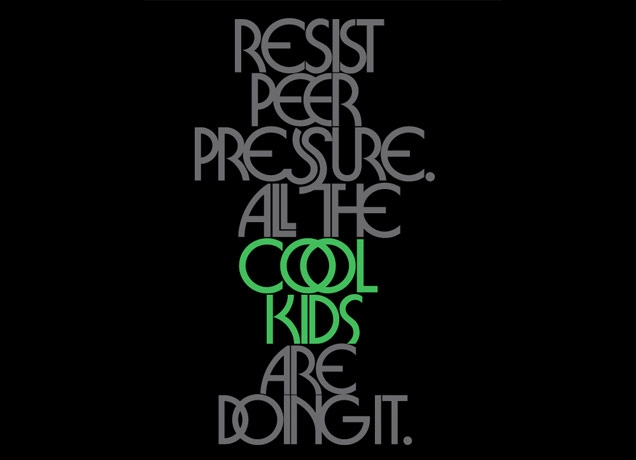
resist-peer-pressureStill, as we prepare to evaluate new designs for the kitchen, choose appliances and cabinets and counters, I know that Melton’s warning about falling victim to the “tyranny of trend” will be good ones to carry with me. ‘Cos, you know what? If it helps our project stay within budget, maybe we don’t need to get the most expensive marble countertops, or whatever the top-trend new shiny kitchen things are. A better designed space where all the things inside it work? So I can once again have the capacity to bake bread and cookies?

It’s a great way to think of the core goal.

* I am SO adding this term to my daily lexicon.

———-

Image credit:

https://www.threadless.com/product/1685/Resist_peer_pressure_All_the_cool_kids_are_doing_it


At War with Stephen Covey

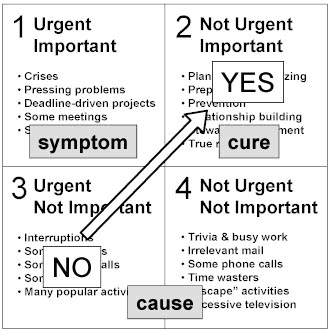
Have you ever seen Stephen Covey’s Four Quadrants of time management? I wouldn’t be surprised if you had: Gaia knows they’re everywhere across the Internet, and they’re also featured as a core component of many many management and success seminars.

covey_quadrants

I’ve cherry-picked a reproduction of the quadrants that makes the point I want. The trick, according to this structure, is to maximize your investment in the “Important but Not Urgent” quadrant, so that important things don’t elevate to “Urgent and Important” (i.e., crisis level). In the meantime, be very wary of the “Urgent but Not Important” category, because this is where the majority of the time sucks and distractors are likely to be housed. (The expectation here is that “Not Urgent/Not Important” things are fairly easy to jettison, while the urgent unimportant things can sometimes be harder to let go of. Fair enough.)

But what if it’s pretty much all urgent and important?

I feel as if I live much of my life by what I have come to call the “bonfire method of project management.”  Which conflagration is burning hottest and brightest, most likely to take down the homestead? Well, throw a little water (effort, time attention) in that direction so it dies down a touch. Now re-assess: which fire is hottest now?

Lather, rinse, repeat. (Yes, I know: I’m mixing my elements along with my metaphors. Bad witch!)

This pattern may be nothing more than an ongoing demonstration at the way I suck at self-motivation and planning ahead. Regardless, I am living a week where pretty much everything feels legitimately Important. And the tension I’m feeling is that the most urgent (time-sensitive) of these important things are all the items driven by external responsibilities — hitting the next work deadline, doing my homework for the retreat weekend, packing for the trip — while the items on the list that are arguably less urgent (i.e., most readily postpone-able) are the tasks and practices I have chosen for myself — journal-writing, ed-reading, JALC.

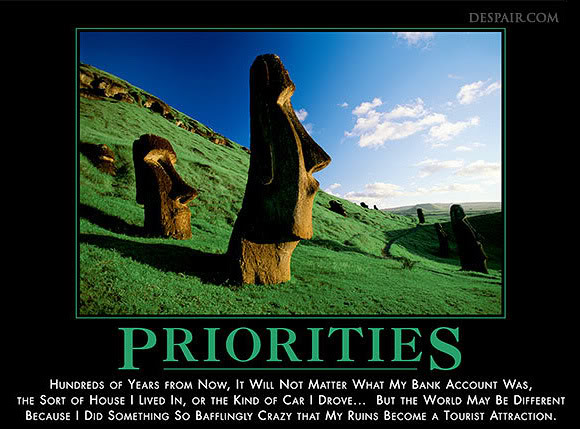
priorities_despairYes, this is, admittedly, an oversimplification. After all, no one forced me into my wacky non-profit career, and even though the retreat homework and travel is a function of me following someone else’s  direction, the retreat is also an investment in my soul’s growth.

Still, this is another pattern that often runs in my life: putting a higher priority on my responsibilities to others as compared to my responsibility to myself. After all, one of the trickiest parts of Covey’s whole structure is figuring out an answer to this key question: Important to whom?

I was listening to The Jayhawks recently, and there’s a snatch of song lyric that captures this for me:

I don’t expect you to see
But she’s important to me, babe
I guess it’s just one man’s problem

(MetroLyrics)

After all, I bet those “Urgent but Not Important” things you’re supposed to be so wary of in your ruthless Covey-an self-management structure are things that are actually legitimately important to someone, if not to you. So that ruthlessly efficient choice setting you up for success could also be the kind of choice that’s screwing some other poor sap over.

Maybe blogging or journal-writing or reading about education all seem like stupid priorities compared to Huge Essential Work projects and Elevated Cutting-Edge Soul Development work. Or, at least, maybe they would seem that way to someone outside my skin, outside my system, outside my soul and aura.

But they feel vitally important to me, babe. One woman’s priorities.

Which is why I continue cheating my sleep these past few days, trying to sprinkle some water on every last one of these important bonfires.

I don’t exactly know how I’m gonna make it to the plane intact at this pace, or, after that, how I’ll have enough gas in the tank to survive the weekend. But I’m just gonna have to figure that out step by step and minute by minute.

Because every bit of this matters.

———-

Image credits:

Covey’s quadrants: http://www.myrkothum.com/a-beginners-guide-to-time-management/

Priorities: http://s205.photobucket.com/user/johanan_rakkav/media/Parody%20Posters/poster_priorities.jpg.html


In Need of Eyebrow Pencil

You ever heard of trichotillomania? It’s a disorder where someone pulls out their own hair — sometimes a little, sometimes a lot, sometimes just eyebrows & eyelashes, sometimes from the scalp or other areas of the body.

The Trichotillomania Learning Center defines the disorder thusly:

Trichotillomania (trick-o-til-o-MAY-nee-ah) is a disorder that causes people to pull out the hair from their scalp, eyelashes, eyebrows, pubic area, underarms, beard, chest, legs or other parts of the body, resulting in noticeable bald patches. Hair pulling varies greatly in its severity, location on the body, and response to treatment. For some people, at some times, trichotillomania is mild and can be quelled with a bit of extra awareness and concentration. For others, at times the urge may be so strong that it makes thinking of anything else nearly impossible.

Trichotillomania (also referred to as TTM or “trich”) is currently defined as an impulse control disorder but there are still questions about how it should be classified. It may seem to resemble a habit, an addiction, a tic disorder or obsessive-compulsive disorder. Most recently, it is being conceptualized as part of a family of “body-focused repetitive behaviors” (BFRBs) along with skin picking and nail biting.

I’m bringing this up on account of the fact that my eyebrows are currently half-gone. Seriously. At this point, I’m trying to figure out whether it’s better to just pluck the rest of things out and draw my “eyebrows” on with a makeup pencil until they have a chance to grow back, or continue muddling forward with my patchy half-torn-out eyebrows as-is. (At least the frames of my glasses and the cut of my bangs provide some level of camouflage, whichever approach I choose.)

FrankenfurterEyebrowNow, I’ve never been sure as to whether the term “trichotillomania” officially applies to me — I don’t have any sort of formal diagnosis, nor have I bothered to have a doctor’s consultation about the topic. And I feel some level of concern around the possibility of taking a condition that is a very real source of struggle for folks (see: ABC News, Psych Central, Psychology Today and U.S. News & World Report) and co-opting it as a description for my own unconscious stress-behaviors.

And yet, half of my eyebrows are gone, and I don’t see any of the rest of my co-workers with strangely patchy brows. I was also particularly fascinated to see the connection drawn by the TLC between hair-pulling and other repetitive behaviors like nail-biting. Because after sternly self-discplining myself to cease that habit for a month so I could be well-manicured for The Cruise, I am fully off-the-wagon on that score, and my nails have all been bit to shreds.

So I guess it’s safe to say I’m not handling my stress as well as one might hope.

Oh well. At some level, it’s hard to get myself worked up over this particular limitation in my ability to handle the stresses of life. Maybe the the term trichotillomania would fit, if I ever chose to talk to a diagnostician about it. Even if that’s true, I’m fortunate enough to have a very mild expression of this behavior: now-and-again patchy eyebrows and occasionally a pulled-outeyelash or two. I’ve had this habit for decades, and it’s never escalated beyond that.

So all things considered and as odd as this may sound: I remain profoundly grateful for the plain dumb luck that has allowed me to have such (relatively) good fortune in my life. Even if I will be combing my bangs a little bit low for a few weeks….

———-

Image credit: http://globalgrind.com/2013/08/06/guide-steps-to-perfect-eyebrows-photos/


“Showing Up” In Virtual Space

Okay, I’ll admit: I am not feeling flush with inspiration tonight. I’ve looked at some of the go-to feminist sources on my Facebook feed for something to pontificate about. I’ve been thinking about what’s going on in my life to see if there’s something insightful or reflective that I want to say. And I got nuthin’.

However, I’m quite aware that I skipped posting Friday and Saturday night (though I did try and compensate with a split-the-difference Saturday afternoon post), so I’d like to turn that trajectory around by getting something up.

secret-to-bestseller

Especially since I’ll be off-the-grid at the end of this coming week and through the weekend — meaning, inevitably, more silence — and it’s another crazy deadlines week starting tomorrow — which may mean yet still more silence.

So what’s a young girl middle-aged blogger to do?

———-

I’m sure we’ve all heard, at one time or another, the notion that the most important ingredient to any learning/mastery/creative process is to “just show up!”

For example, this quote from an interview with Isabel Allende:

What’s the most important thing you’ve learned about writing?

Show up. Show up in front of the computer or the typewriter. And if I show up long enough – it happens.

Or this post from a blogger who cautions against advice that makes writing seem too “difficult” — an excuse for us to continue procrastinating, he says — and who insists on the simple necessity of the “just show up” message:

I am not about to tell you that writing is easy. Writing is hard. Writers never stop fearing that what they write isn’t good enough. They can’t come up with good ideas. They come up with brilliant ideas that don’t work. They write terrible things and good things. And they try to make sure that people never see the terrible things, and that as many as possible see the good things.

No writer I know thinks writing is easy.

But no writer I know thinks writing is complicated.

If you’ve been waiting to write because you think that one day someone will give you the advice that makes writing easy, stop waiting. No one can make it easy.

All we can do is make it simple.

Show up. Write.

Or there’s any number of similar sentiments in this collection of bits of writing advice from actual real writers.*

And I get this approach. I do. I believe in this approach. Even though I eventually decided not to finish my dissertation or my Ph.D., I will tell you that my most productive months on that project were once I was able to shift from a place of full-on “frozen by depression and writer’s block” to embracing the idea of daily writing on the project. Every day, putting my inner critic into her lockbox for at least a tiny little bit and putting fresh words on the page. (I know the recommendation of a Ph.D. dropout may not mean much in this context, but this was one of my productivity bibles. I can’t speak highly enough for how it benefitted my life and my work.)

So, yes, I’m a believer in “just” showing up at the page.** It’s why I strive for a daily journal-writing practice. It’s why I am often the one at work most willing to send out that “sacrificial first draft” to get a project moving. (‘Cos this much I know for sure: if we don’t get started, we ain’t never getting to the finish line.)

Mucha-MuseIn short: I am not the kind of writer who sits waiting for my muse to waft in looking like an Alphonse Mucha engraving, with her artful Art Nouveau tresses and dresses wafting on an unseen breeze. But I’m not yet sure I’ve figured out the finer points of bringing this insight into my blogging practice.

Because everything I know about “showing up at the page” is predicated on the notion of there being a first draft — whether you call it “sacrificial” or, following Anne Lamott, “shitty” — and then an editing process by which the first draft becomes something more polished, worthy of publication. But when the draft-to-publish cycle is as truncated as it is in the blogosphere, what does it look like to have the practice of showing up at the (web)page? Does it mean publishing things that are half-formed, rougher? (In short, publishing shittier things?) Does it mean cultivating more of a practice of drafting, revising, and editing for blogposts? (Which, I’ll admit, feels a touch daunting for my life’s schedule. Maybe I should cut back on even more TV…)

I don’t have this conundrum worked out yet. But, with the willingness to navel-gaze and write about the writing process, I at least found something to reflect on that justifies a post for tonight.

I’ll take care of tomorrow’s post — if there is one — tomorrow.

* ‘Scuse the snark — the post’s title, although clear as clear could be just hit a nerve tonight. D’you think maybe we’d be expecting writing advice form fry-cooks or makeup artists?

** Had to use the scare quote, ‘cos the word “just” in “just show up” kind of cheapens how essential showing up at the page is. It obscures the raw, radical courage of showing up.

———-

Image credits:

Secret to a bestseller: http://elizparker.wordpress.com/2014/04/30/writers-show-up-by-getting-a-writing-buddy/

Mucha, “Muse”: http://www.alfonsmucha.org/Muse.html

Step by Step, Across the Galaxy

norman-rockwell-facebookOne or two days ago, I did that thing you’re never supposed to do: I shared an infographic on my Facebook wall without actually double-checking the sources and the veracity of the information.

You can read all about it here. About the infographic, I mean, not the Facebook part of things. The Facebook faux pas is a tale as old as time, as the sages say.

At the very bottom of the post is a copy of the original infographic with what turned out to be incorrect (or at least, unverifiable) stats about the cultural decline of reading. Once he found that the original stats — which were really super shocking (80% of households haven’t bought a book in the last year, stuff like that) — were unverified, the infographic creator did a v.2 that brought in some different statistics that could be verified.

The funny-ironic thing, as far as I was concerned, is the way I would have been equally happy to post the v.2 “corrected” info graphic rather than the more dramatic/problematic v.1. Because what had most caught my eye was a quote that stayed intact between v.1 and v.2, in large part because it was so obviously aspirational rather than scientific: “If you read one hour per day in your chosen field, you will be an international expert in 7 years.”

The concept is attributed to motivational speaker Earl Nightingale on personal development/coaching to success sites like here, or most clearly presented by author and success coach Brian Tracy here:

Earl Nightingale said many years ago that one hour per day of study in your chosen field was all it takes. One hour per day of study will put you at the top of your field within three years. Within five years you’ll be a national authority. In seven years, you can be one of the best people in the world at what you do.

I’ve been chewing over that notion ever since I saw the quote.

I talk now and again about the fields of public education and educational reform. It’s the field I’ve been working in for a few years now, but I still only feel as if I know the tiniest bit about it. So the quote on the infographic started me thinking: what could I accomplish if I followed through on my often-stated desire to become more of an expert in my field? If I made a more serious commitment to reading/learning more about education? Could I make the time for regular self-study, and, if so, how might that benefit my work and my life?

Now, the truth is that I already have lots of daily practices going on. The morning journal-writing. Blogging here on JALC. Coursera classes. Regular commitment to ongoing household responsibilities like dishes and laundry and such. So I found myself of two minds as I considered this new daily practice. On the one hand, I found it a little bit intimidating. Can I really take another thing on?

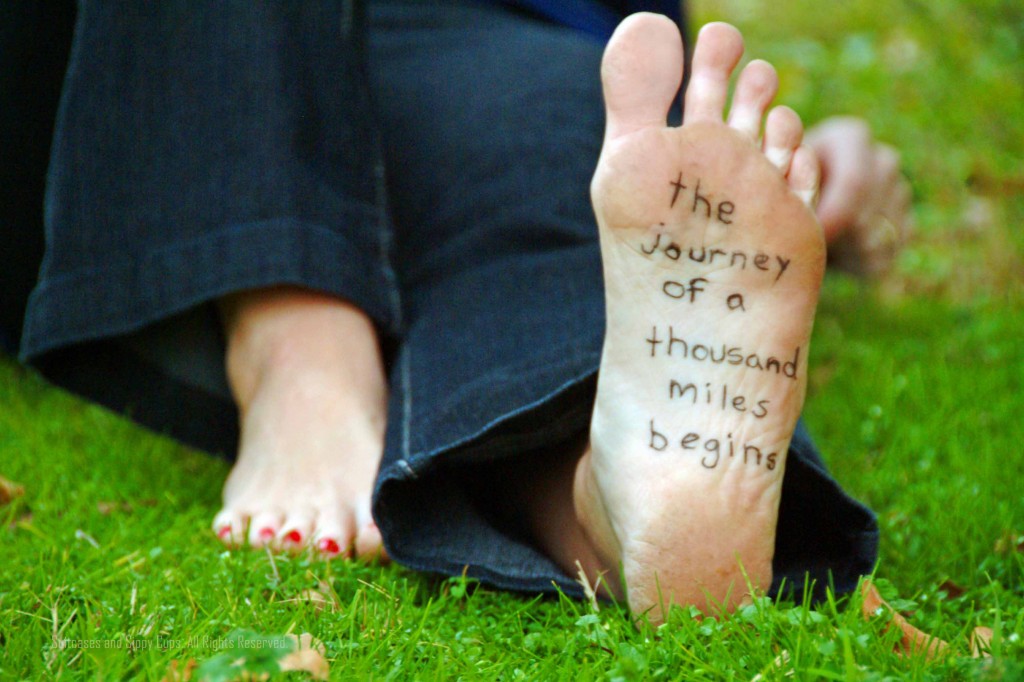
journey-beginsOn the other hand, I find Nightingale’s concept really inspiring in its reminder that small, sustained effort can add up in really significant ways. Yes, in many ways, this is a familiar and often-stated concept. After all, isn’t there a proverb about the thousand-mile journey beginning with one small step? But sometimes it is really impactful for me when a new phrasing or formulation allows me to see a familiar-ish concept in a new way. Like when I read a book, some years ago, spring-boarding off the proverb to point out that the author’s small steps had, without her really noticing, carried her across the universe.* The Nightingale quote now, like de Grandis some years ago, helps shift my attention away from the sense of a slow, endless slog — 1,000 miles times 5,280 feet/mile, divided by 2.5 feet/step** — towards the reminder of what can be accomplished with sustained effort.

And yeah, I have a fair number of daily practices already. But I also spend enough time doing the TV/Facebook zombie thing that the hours could almost add up to being their own part-time job. Besides, the activities in question here (reading and thinking) are things that come to me as naturally as breathing. And even if an hour each day feels a bit like a stretch, I know that smaller pieces of effort can also add up:

As I’ve said before, we overestimate what we can do in a week, and underestimate what we can do in a year. But if you spend 15 minutes a week reading your industry journal and it takes you four weeks to read it, is that a bad thing? Of course not- it probably only comes once a month anyway!

So, in concert with this fellow, I’ve started spending 15 minutes each night reading a bit about education, starting with another book I borrowed from the company “library.”

As with so much else in my life, I imagine this to be a “progress, not perfection” kind of movement. I imagine there will be times when my daily practices need to be triaged and weighed against one another. Last night, for example, after our drive up to the lake, I found myself prioritizing education reading and early bedtime over JALC post. (Heck, we have baseball tickets and I won’t be able to post tonight, either, so a midday Saturday post kinda works better anyhow.)

Some nights I can imagine prioritizing JALC over ed-reading,and some nights I can imagine prioritizing both of those activities over sleep. Day by day, I’ll work it out. Heck, I wasn’t entirely sure I’d be able to stick with JALC when I resurrected it, and yet here we are 5 months later. (Which is, by the way, 4 months longer than JALC’s first-phase lifespan. Go figure.)

Step by enjoyable step, around the world and back again.

* The book in question is currently not available to me, so I can’t confirm the precise quote. (After the Facebook error, I feel as if I should be extra-aware about such things as the accuracy of my citations and the credibility of those sources I quote.)

** Why doesn’t my keyboard have a division sign? Ah, the indignities of aging, when one’s native symbol set slowly gets displaced by the new generation’s symbology…

———-

Image credits:

Norman Rockwell: http://mote-historie.tumblr.com/post/76317464830/now-son-do-you-know-what-you-did-wrong-yes-sir

The journey begins: http://www.suitcasesandsippycups.com/2012/01/a-journey-of-a-thousand-miles-blah-blah-blah.html

Advertising Awareness

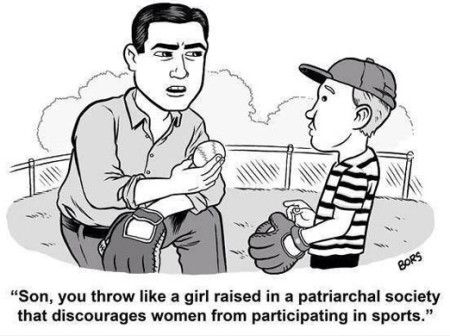
Although it was all over my Facebook wall a month or so ago, I never forwarded the Always #LikeAGirl ad before today, nor did I choose to say anything on JALC about it.

My hesitation was similar* to that when Pantene urged women “Don’t let labels hold you back” several months ago, in an ad Sheryl Sandberg helped take epically viral, or when the Dove “Real Beauty Sketches” ad went epically viral some months before that:

My feelings about these female empowerment campaigns ad campaigns are always pretty similar, one to the next. Basically, I feel conflicted. On the one hand, these ads do bring up aspects of my own lived experience, whether it’s the double standards I’ve faced around being “bossy” or “bitchy,” or my habit of being hyper-self-critical, around my physical appearance and, sometimes, pretty much everything else about me.

On the other hand, it’s a little bit galling — okay, a lot galling — to have these quasi-empowering “accept yourself” messages come from companies for whom a significant percentage of the profit margin is based on the proposition that women will feel bad enough about themselves to buy your product so that we can be groomed, tweezed, moisturized or shampooed in such a way as to overcome our innate debased female-ness and become more socially acceptable.

Quite frankly, my conflicted feelings about this trend have reached a high enough level that I never even bothered to watch the Always ad above, or Pantene’s went-viral-one-month-ago “Sorry Not Sorry” ad before tonight when I was preparing this post for JALC.

So, yeah, I’ve never been in the corner of Dr. Bernice Ledbetter, who writes over on HuffPo that these ads are “truly a banner in the battleground of the feminist movement.”

I actually find that perspective quite sincerely and incredibly baffling. Do you not see how the women in the Dove ad are mostly, white, thin, not-too-old, and conventionally attractive to such a degree that the deeper message of the piece can easily function as little more than “The hearts of conventionally beautiful women can grow a little warmer today”? Can you explain to me how women getting shinier, bouncier hair is a viable solution for misogynist attitudes and prejudices against female intelligence, agency and ambition? As Emily Shire observes about the #LikeAGirl ad:

Yes, it’s far more appealing on the surface to have pads and tampons promoted as somehow part of a larger goal to change the meaning of “like a girl.” But the campaign is shamelessly emotionally exploitative. It demonstrates real problems—femaleness as a derogatory statement, decrease in self-confidence as women mature—in a beautiful and clear way, but then pretends a corporate manufacturer of panty liners meant to “help you feel fresh ever day” can solve them.

(And again, notice here how problems that are deeply-rooted and systemic, based in cultural norms, problems that are perpetuated and policed as much by external messages as by internalized ones — the very nature of what I call “the miasma of misogyny” — are presented as something to be solved by women’s policing of their femaleness and their female bodies.)

And yet, however much I’m able to see the problematics in these “short films,” their innate and even troubling limitations, I still admit I kind of like them. My affection hasn’t been strong enough for me to join in amplifying their viral distribution, or perhaps my awareness of the flaws has been too strong to allow me to join in the fun. But I don’t have it in me to work up the same kind of feminist outrage about these ads as I’ve displayed here on other occasions.

Which is why I so appreciate Natalie Baker over at Bitch Magazine for reminding me today that it’s possible to live in a yes/and rather than an either/or place.**

So here we are, once again, stuck in another good vs. not good enough debate: either these ads are radically tackling sexism through a historically appalling medium or it doesn’t matter what these ads say because corporations don’t actually care and will say anything to make a buck.

What if it’s both? That is to say, what if these companies are forwarding feminist messaging despite not actually caring about it? And what if that still helps us?

Like Jezebel said back when the Always ad was first released:

While all ad companies are bullshit liars to a point, willing to do or say whatever it takes to get your money, I would rather have empowerment cheese over shame-based guilt, which seems to be the two usual suspects in a capitalist economy.

That’s a sentiment I can get on board with, especially when I think back to Super Bowl Sunday’s usual dreck. To return to Baker:***

For those of us who surround ourselves with intersectional anti-oppressive ideology, what’s considered progress in the mainstream can feel like a joke. But that’s our piece of the jigsaw—to be progressive is by definition to be ahead of the curve. While we don’t need to be naively over-celebratory about billion-dollar conglomerates pandering to female consumers, I do get immense enjoyment from the fact that such companies are doing so, not because they want to, but because they have to. . . . I can get down with those messages, even when they’re being generated out of corporations’ self-interest.

In fact, I like that they’re doing it out of self-interest. I don’t want feminism to be charity. I want companies to consider supporting feminism to be necessary for their survival.

(Emphasis added.)

son-you-throw-like-a-girl-raised-in-a_12707Yeah, it’s all advertising, so at some core level it’s all inherently corporatized and bullshit on account of that perspective. On the other hand, if the growing prevalence of these ads indicates (and even encourages) movement towards the tipping point when the patriarchy/kyriarchy transmutes? I can get on board with that.

So, maybe less of a banner moment (sorry, Dr. Ledbetter!) and perhaps more of a weathervane. Showing the shifts in the cultural currents, a change in the wind of how people think and talk and feel.

* Okay, my hesitation was a little different because I hadn’t yet revived JALC, so I didn’t have to make the “blog or not to blog” call on it. Just the (arguably more public) “to Facebook or not to Facebook” call.

** Yes, this was posted 3 days ago, but I read it today. As such, she reminded me today. And I am grateful for that.

*** In case I haven’t said so clearly enough, please go read the entire post in its entirety. All of it.

———-

Image credit: http://www.funniestmemes.com/funniest-memes-son-you-throw-like-a-girl-raised-in-a/

Cruise Control

So one of the things that cruises are notorious for —

Wait, did I ever mention that The Trip was a cruise? I can’t recall and I’m too damn lazy to go look it up. In case this is new news, and just to get this down on the record: The Trip was a cruise.

Display on the first cruise day, in the Windjammer (the buffet restaurant)So anyhow, one of the things that cruises are notorious for is the quantity and quality of the food you’re served. Actually, I’m not enough of a hard-cross cruise traveler to know whether all cruises are known for having good food, or if it’s more like the same rep an all-you-can-eat Vegas buffet has: food that’s notable  more for the available amount than for the flavor profile. (Even if most cruise ships have food that’s more adequate than exceptional, the ship we were on is on this list of the “best cruise ships for foodies,” so trust me when I say that not only was there tons of food available, it was tasty, tasty stuff.)

Now, there’s a whole lot of rhetoric out there about how it’s inevitable to gain weight on a cruise, with various fat-panic/fat-shaming suggestions on how to approach that “problem.” For example:

  1. controlling your on-ship behavior to minimize weight gain
  2. doing a little prophylactic weight loss ahead of time to build your “buffer zone”
  3. going on x, y, or z post-vacation diet plan
  4. deliberately infecting yourself with a parasite or the norovirus in order to stay skinny

(Okay, maybe I made that last one up. And, for once, no, I won’t be providing links to sources. I don’t feel like actively participating in Diest Culture, and you can find this kind of shit so easily with the simplest of google searches.)

It was an interesting comparison across the years, thinking back to the first-ever cruise Mr. Mezzo and I took back in 2007, right when I was at the verge of learning about fat acceptance and adopting that perspective for myself and my worldview. That first cruise also had lots of good food. I indulged, and I know I gained weight — though at this distance, I can’t recall what the number was. And I felt so ashamed for all of it. For my lack of dietary discipline, for my laziness in not becoming a cruise-ship gym-rat, and then for my inability to diet and lose the weight after I got back on land.

martinisThis time around, I decided adamantly against imbibing a guilt-and-shame chaser with any of the meals, martinis, or desserts I had while vacationing. I have no idea if my food was any less rich or sugar-laden this time around as in ’07. (I’d guess not much appreciable difference, then and now.) But I do know I’m feeling lots better than I did 7 years ago — if for no other reason than the fact that I’m not mired deep in a self-shaming and self-punishment cycle. ‘Cos honestly, when I let those voices loose in my head, it’s never to my benefit. Spiritually, emotionally, or physically.

Having said that, I am feeling a bit logy after-the-fact. I’m guessing, based on my HCG experience from the spring, that I’m mostly feeling the after-effects of the dramatic uptick in added sugar during those two weeks (read: desserts, martinis and Belgian chocolate). And I’m kind of fascinated by the way, as far as I can tell, that my spring detox journey helped me more attuned to my body so I could notice this change, but my history of fat acceptance work and my ongoing growth around overall self-acceptance has in a place where I’m not upset or blaming myself about it.

belgian-chocolateInstead, I’m just quietly moving back to some of the cooking routines and rituals I used during the spring, adopting something that’s closer to “clean eating” than I was doing recently. Now, don’t get me wrong. I am not on some extreme ascetic kick. Beyond my own natural sense of fullness, I am setting zero limits on the quantity of food I’m eating.  I’m even having a little taste of “added sugar” each night after dinner (I say again: Belgian chocolate. You don’t think we were coming home without a small stash of that to enjoy, did you?)

I’m just trying to listen to my body. And if my body is craving greens and chicken rather than my cruise staples of pasta and red meat, I’ma good with that.

Plus a little of that Belgian chocolate. Yummy and absolutely guilt-free.

———-

Image credits:

Fruit buffet: http://forsythfamily.com/caribbeancruise.htm

Martinis: http://zynkah.hubpages.com/hub/10-Best-Flavored-Martini-Recipies

Chocolate: http://www.moonlight-mile.com/belgian-chocolate/