Going (Semi-)Viral

A funny thing happened this past week. A friend of mine shared an upsetting incident on Facebook where she experienced public prejudice against breast-feeding. Her story then went viral, earning (well-deserved) media coverage and public outrage.

That’s not the funny part. The funny thing is what happened next: I wrote a blog post about the event, and then I went viral, too.

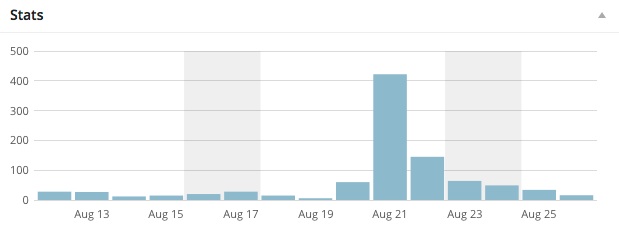
See exhibit A, WordPress’s visitor stats summary for JALC during the last couple weeks:
stats copy

The August 12-19 stretch shows me with my customary rate of site visitors — usually somewhere in the 15-25 range, with slight upticks and down-drops depending on factors like weekday vs. weekend, if I skipped a day, etc.

August 20 is when I posted about Ingrid’s experience: you can already see the uptick to 60 site visitors in those hours between hitting “Publish” and midnight, as a few folks started sharing my post within their own networks.

The next day, August 21st was when things hit big (relatively speaking). Yeah, that’s more than 400 hits — and from there, things have dropped off until yesterday and today I seem to have re-equalized back where I started.

So, all told, this is a very mild flavor of “going viral,” as compared to Youtube videos that get hundreds of thousands, or even millions of hits. Still, it was such a disproportionate spike in attention that it feels like the junior baby blogger version of “going viral.” And the sorts of study and self-examination the experience has invited for me — well, I wonder how different these reflections would be if I were talking about 4,000 hits rather than 400. I’m thinking: perhaps not that different at all.

First: Who woulda thunk it? For the most part, my writing here on JALC has been divorced from expectations about achieving any particular readership level on any timetable. The practice for me has been a practice of showing up, of experimenting with regular, focused writing. Finding my voice again. Yes, at some level there’s the prayer of my words being read and having positive impact — otherwise I’d just be writing in my diary rather than in a blog. But I’ve maintained a pretty decent level of non-attachment from any expectations about how many readers I want to have and how quickly I want them to appear.

And if you asked child-free me what sort of post I’d predict might be the first one to get public traction, there’s no way on this earth I would have predicted it be something about breast-feeding and the mommy wars. Talk about a subject that’s completely outside of my field of knowledge! (Okay, not completely, since I do have breasts as an anatomical feature of my body. But still.)  You never know what’s going to hit a nerve and garner that flash of attention. Like catching lightning in a bottle, that is. Write something true and honest and authentic, and I guess sometimes it’ll hit a nerve, fall in with a moment of zeitgeist. But to predict what’s going to hit that zeitgeist energy? Not within my current powers, as so clearly evidenced by the disconnect between my expectations and the actual happening of which JALC post first topped 550 views.

SecondYou never know what’s going to hit a nerve and garner that flash of attention. I’ll admit, however well I’ve maintained a state of non-attachment around my readership numbers where they were at a low and steady pace, that there was something sincerely exciting about seeing the bar graph keep climbing during the 21st. And when I sat down the evening of the 21st to write my first post-viral post, I could absolutely feel myself on a precipice. Feeling the demand that I “measure up” to this new level I’d achieved, feeling the temptation towards finding some other juicy topic that’d be “click bait” and that could build some kind of popularity for myself.

I walked myself back from that precipice, reminding myself: it’s like catching lightning in a bottle, that is. All I can do is continue showing up at the screen, writing as true and authentically as I can, taking on the topics that grab me and won’t let go until I say what I have to say. That’s why I wrote my post to begin with — even though I’ve spent years trying not to comment on parenting choices or the mommy wars. Something about Ingrid’s story just grabbed me, and I couldn’t rest until I wrote about it. That’s the feeling I need to keep following: I can’t rest until I write about this, rather than I think this will get good traffic.

So who knows? Maybe another post of mine will hit a zeitgeist moment a few weeks from now. Or a few years from now. Or never again. It’s all in service, however it unfolds.

I just need to keep in the practice of it. Say it plain, say it true. Stay as authentic as I can be.
On Porn and “Potterotica”

I guess it’s my week to talk about sexualized body parts?

This Button Poetry video from this year’s National Poetry Slam caught my attention yesterday:

The title of Brenna Twohy’s spoken-word poem Fantastic Breasts and Where to Find Them is a punnish play on the title of a volume about the Potter-verse, Fantastic Beasts and Where to Find Them (emphasis added), published by J.K. Rowling some years ago as a companion to the 7-book saga of “the boy who lived.”

Twohy articulated the goal of her poem to Buzzfeed thusly:

I wanted to highlight how unrealistic most pornography’s portrayal of sex is, and how that creates really damaging expectations for both men and women.

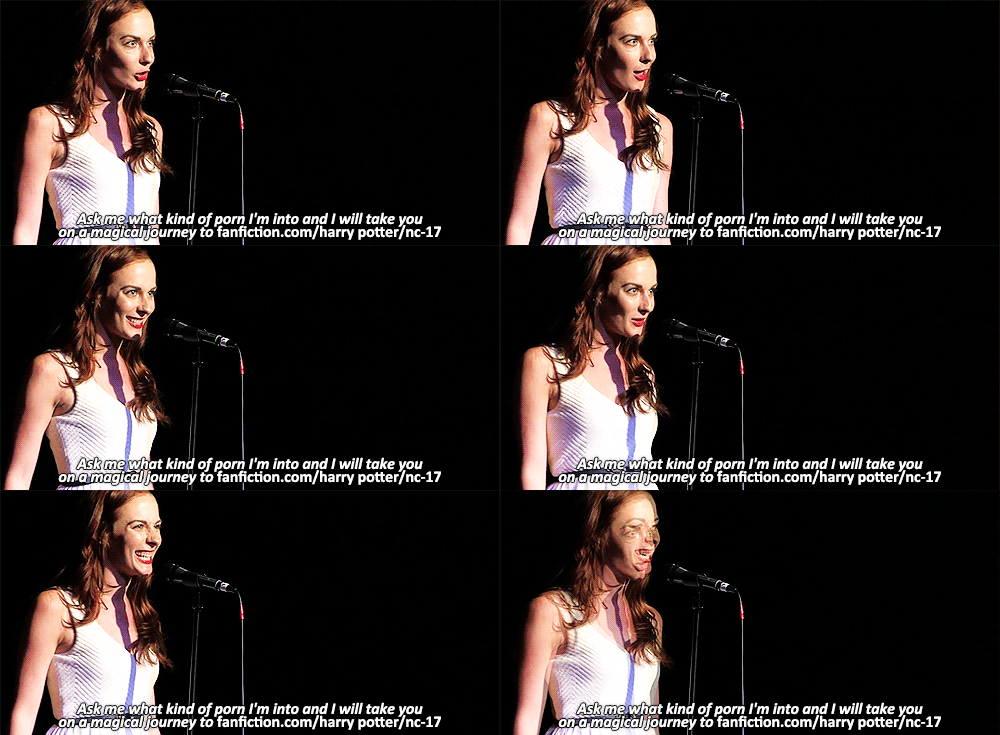
twohy-ask-me-whatMission accomplished (at least for the most part) to hilarious and devastating effect. Particularly pointed is Twohy’s observation that a taste for fan-fiction erotica is to be considered “unrealistic” — while mainstream porn is somehow seen as more real. Which is about as laughable a deception as I’ve heard since… well, unfortunately, just since yesterday, when folks were declaring that public breast-feeding is immoral. (Seriously, y’all. The patriarchy just needs to shut up and die in a fire. Now.)

In yesterday’s Independent, Jonathan Owen discusses a recent poll of British teenagers that reveals:

the majority [of poll participants] warn of the “damaging” and “addictive” effect of sexual images and videos readily available online. 80 per cent say it is too easy for young people to stumble across it and most recall “accessing pornography was seen as typical” while they were at school.

At least 70 per cent agree that “pornography leads to unrealistic attitudes to sex” and “can have a damaging impact” on views of sex or relationships.

A quick visit to Professor Google turned up a wealth of other articles unpacking the sexual myths and unrealistic expectations fostered by the mainstream porn industry. For example:

The gist of all these different articles is perhaps most entertainingly summarized by Noah Brand and Ozy Frantz in Alternet:

The problem is, learning about sex from porn is like learning about firearms from action movies. Action movies sacrifice realism for the sake of storyline or a really cool explosion. Action movies don’t teach you gun safety. Action movies don’t talk about alternatives to violence. And action movies use some tropes—such as the infinite ammo supply—that may move the story along but don’t reflect reality. That’s not a problem, as long as everyone treats them as entertaining fantasies.

Unfortunately, for many young people becoming sexually active today, the entertaining fantasies of mainstream porn are the teacher they’ve spent the most time with, and mainstream porn is a terrible teacher.

Even more than the general unrealistic nature of mainstream pornography, Twohy chooses to highlight a particular strain of misogyny and violence against women that runs through so many adult films.

[SIDEBAR] I will admit to having some level of discomfort over a piece that lambastes porn culture for allowing men to fantasize about sex with barely-legal teens while offering — however ironically — the “more empowering” alternative of a book series where the main characters are under-18 for a majority of the time. Also, having quickly perused some of the titles and advertised pairings in the “mature” section of the Harry Potter stories on fanfiction.net, I see the potential for a lot of uncomfortable power dynamics (Snape & Hermione) and Stockholm syndrome (Draco & oh, everybody).** Blurred lines of consent all over the place… [/SIDEBAR]

Nonetheless, the general thrust*** of Twohy’s piece feels really true and honest and on-point about the culture that mainstream porn participates in and which it helps perpetuate. To quote HuffPo (who also quotes part of Twohy’s poem):

a 2010 Violence Against Women study found that 90 percent of porn video content online and off included verbal or physical aggression towards women.

“I know a slaughterhouse when I see one,” Twohy says of the porn industry. “It looks like 24/7 live streaming, reminding me that men are going to fuck me whether I like it or not, that there is one use for my mouth and it is not speaking, that a man is his most powerful when he’s got a woman by the hair.”

Twohy suggests that the “slaughterhouse,” an uneasy analogy where the slicing instruments aren’t knives but part of a video editing suite, does more than just provide shots of women’s segmented body parts. It also creates a culture where domestic violence isn’t only expected, but accepted.

And more than that, Twohy steps — for an uncomfortable, searingly honest moment — into the ways that we all internalize these messages about how men and women are expected to perform in romantic and sexual situations — men, rough, cruel, aggressive; women, compliant and sex kittenish.

The first time a man I loved held me by the wrists and called me a whore, I did not think “Run.” I thought, “This is just like the movies.”

I have seen that training, on film and in real life.

It everybody fucks over, the patriarchy does.

* Yes, I dare say it has.

** You know how yesterday I took a bullet and read the comments sections on things so you wouldn’t have to? That favor-doing stops tonight — I was not going down that particular rabbit hole. Not for anything.

*** Sorry, couldn’t resist.

———-

Image credit: http://iwatchforsasha.tumblr.com/post/95066205780/fantastic-breasts-and-where-to-find-them


Form vs. Function

So, as someone who is child-free by choice, I’ve had an informal policy of staying as far away from the “mommy wars” as it is possible for me to stay. Breast-feeding vs. formula, maintaining external employment vs. becoming a stay-at-home-mom, “mainstream” product choices vs. natural/organic ones — every choice has its costs and benefits, and every mother has her own unique circumstance that leads to a particular set of choices (some of which may even be forced-choices determined by economic or other constraints).

Since I have never faced these choices and I am never walking a mile in these particular stirrups, my general approach has been to hold an attitude of respect for each mother and her parenting choices,* on the belief that each mom is doing the best she can in any given moment.

But then there’s that moment when the mommy wars play out very personally in the life of someone in my circle of acquaintance:

Ingrid Wiese-Hesson was shopping at an Anthropologie store in Beverly Hills when her 6-week-old son, Xavier, began crying because he was hungry.

Wiese-Hesson then sat down in the store to breastfeed the infant, and that was when the store’s manager reportedly intervened.

“The exact words to me were ‘I’m here to escort you to the ladies room so that you can finish breastfeeding’,” Wiese-Hesson said. “She opened up the bathroom, and she said ‘sorry, there’s no chair’, and of course the only thing in the bathroom was the toilet seat.” (CBS Los Angeles)

Ingrid posted her experience on Facebook and it blew up and went viral almost instantly (as one might guess from seeing the clip from last night’s 11’o’clock news).  More details and slices of analysis are available at a number of places online, including information about a “nurse-in” that took place today in the store (LAist); an AdWeek post that connects the uncomfortable dots between this real-life incident and a recent student-designed public awareness campaign aimed at preventing exactly this sort of harassment; and a CBS Money Watch post that gives really good snark:

At high-end retailer Anthropologie, shoppers can select from body-baring items like its $118 see-through Gladiolus Sheer Silk Blouse. But when it comes to breastfeeding, one store location deemed a woman was showing just too much of her body.

Assuming AdWeek’s excerpt from and analysis of CA state law is on-point —

The Anthropologie manager’s actions were not just unwise, they were also in violation of Hesson’s legal rights. From the California Civil Code: “Notwithstanding any other provision of law, a mother may breastfeed her child in any location, public or private, except the private home or residence of another, where the mother and the child are otherwise authorized to be present.”

— then there’s a certain open-and-shut nature to the legal question here. Ingrid was absolutely, 100% within her rights to breastfeed her son in the Anthropologie store, and the store manager broke the damn law by  interrupting her and escorting her to the bathroom.

david-horsey-breastfeeding-moms-20120705-001So I’m going to set the legal question aside from now and just let my mind boggle from the fucking insanity of this all. What rational and reasonable objection would anyone have to a woman breast-feeding her six-week-old baby?

Answer: objections a-plenty, but nothing rational or reasonable, as far as I can tell. I know the first rule of following feminist stories in mass-market media sites is “don’t read the comments!” — well, I did, so you don’t have to. (Taking one for the team.) There were a few different rhetorical tactics, but objections pretty much all fell into being one flavor or another of this: breastfeeding should be done in private because it’s immoral/unseemly/inappropriate for it to be seen in public.

And here’s where I go into a sputtering place of incoherent rage and puzzlement. Because, to paraphrase Henry Rollins when talking about racism: these folks are tripping over an entry-level concept, a curb about 6 inches high. It’s inappropriate to publicly use your boobs to feed an infant? Feeding babies is actually the main purpose for which women’s breasts were invented! How can it be deemed immoral for babies to be fed in public?

Because, as Anna Quindlen said way back in 1994:

[T]he subtext of the public breast-feeding battle is the inability to make a distinction between what is female and what is sexual, what is indecent and what is utilitarian. And maybe it’s epitomized in a letter that The Albany Times-Union got from an irate citizen who asked whether women who nursed in public would be having sex on the streets as well, as though the connection between nursing and fornication was self-evident.

(Yes, 1994. Twenty years ago. The more things change, the more they fucking don’t.)

After all, I bet no one would object to a baby being bottle fed in public, and I bet the same judgmental asshats complaining so voraciously about Ingrid’s choice to publicly breastfeed would also be giving her the judgmental side-eye if she had chosen to delay her son’s feeding and “subjected” the other customers to hearing the sounds of an unhappy, hungry, crying baby. It’s only because someone’s mammary glands are involved that this has become such A Thing.

I know that the policing and sexualizing of women’s bodies is pretty stupidly crazy even on the best of days. But still. What is it about breasts? How did these secondary-sex characteristics become so thoroughly fetishized and sexualized in the culture? Why is Anthropologie okay selling see-through shirts for the sake of showing off in the attractiveness/sexuality game, but not okay with a woman discreetly using her breasts for their actual, original biological purpose?

I know, I know: it’s the damn patriarchy again. After all, no one’s having a fit about all those exposed Adam’s apples…

* Aside from those that are obviously neglectful and/or abusive.

———-

Image credit: http://articles.latimes.com/2012/jul/12/nation/la-na-tt-breastfeeding-moms-20120705    (David Horsey at the LA Times.)

Handing Out Sticks

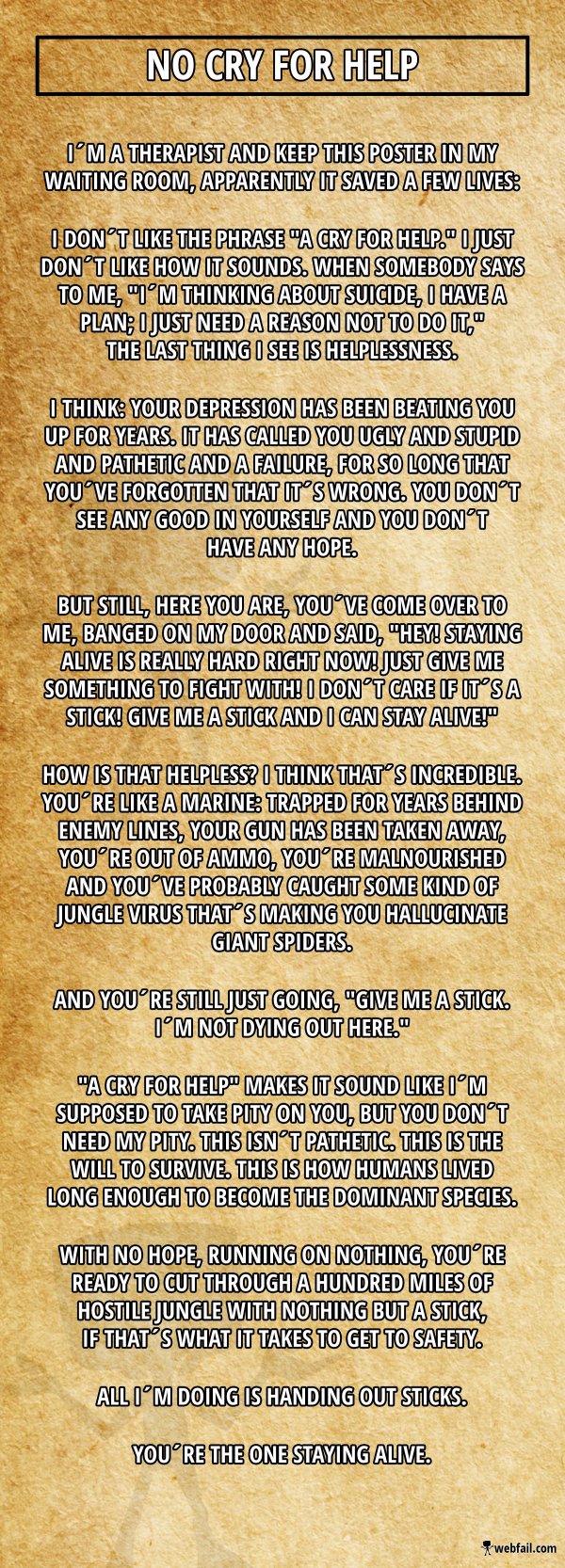
Famous blogger Matt Walsh has kicked off a bit of a tempest by writing two posts about Robin Williams’ death. The first one, basically, tried to draw a bright-line boundary between the concepts of depression and suicide. This interpretive framework (and Walsh’s reasons for wanting to drawing this sharp boundary) is pretty well summarized here:

First, suicide does not claim anyone against their will. No matter how depressed you are, you never have to make that choice. That choice. Whether you call depression a disease or not, please don’t make the mistake of saying that someone who commits suicide “died from depression.” No, he died from his choice. He died by his own hand. Depression will not appear on the autopsy report, because it can’t kill you on its own. It needs you to pull the trigger, take the pills, or hang the rope. To act like death by suicide is exactly analogous to death by malaria or heart failure is to steal hope from the suicidal person. We think we are comforting him, but in fact we are convincing him that he is powerless. We are giving him a way out, an excuse. Sometimes that’s all he needs — the last straw.

Then, after the post went viral and lots of people took issue with it, Walsh wrote a somewhat testy follow-up to: 1) decry the vitriol of individuals who misrepresented/misunderstood his first post and 2) provide more detailed justification of his position.

Among the many voices I’ve seen either directly or indirectly rebutting Walsh’s argument….

Pastor Jean-Daniel Williams, who writes:

If I commit suicide, perhaps, as you claim, it will be ‘’my’’ choice. But I doubt it. I have spent more than half my life listening to my own body betray me, my own mind telling me that it would be better to die. . . . Living is the pro-active choice. Is suicide a choice? It has been a free choice every time I have ever said no so far. I have chosen to say no. That is not because we can blindly, arrogantly, say that it is a moral choice, though. It is because I have been really lucky that I am (still) healthy enough to say no. The thing is, saying ‘’no’’ to suicide is evidence that I am healthy enough to say no. But, if I should ever commit suicide, it will not be because ‘’I’’ made the choice, but because my depression would have.

Kristi, on the blog “What is Matt Walsh wrong about today?” provides some valuable information about the effect of depression on one’s cognitive and decision-making capabilities:

Matt says suicide is a choice, but what makes a choice a choice is the presence of logic, reason, and objectivity to evaluate its merits. Depression can rob your brain of the ability to think that way. My friend Derek, a pharmacist, knows a thing or two about this. In his own words:

“In a euthymic (or normal, mildly-positive) attitude, the effect of a choice is either a reward, perhaps the blast of dopamine from a great run, or a detriment, the exhaustion of inactivity. In a person with clinical depression, both sides of that choice respond with a similar lack of neurotransmission.

A patient suffering from severe depression may not even be able to tell the choice apart. Even if objectively they know that running is good, couch is bad, they will experience the same neurochemical state regardless.”

[. . . ] So no, depression doesn’t appear on autopsy reports. But when a 500-lb thirty-year old drops dead at his desk, the autopsy reads “cardiac arrest” rather than “morbid obesity”. As usual, Matt is glossing over nuances. He thinks things are black and white—that a choice is a choice. He’s wrong. In absence of a healthy neurological system, not all actions are choices.

[SIDEBAR] Even though the fat activist in me is yearning to give significant bandwidth to the false assumptions and lack of medical evidence in Kristi’s facile conflation of “cardiac arrest” and “morbid obesity,” I’m mostly going to let it slide because I’m on a different topical horse tonight. Allow me merely a gentle hat tip to my HAES basics post, my critique of BMI, and my puzzlement at the unproductive insanity of fat-shaming. [/SIDEBAR]

[SIDEBAR THE SECOND] I am clearly way too ill-informed about the blogosphere as I hang out typing furiously in my little isolated corner of the wild, wild web. I don’t think I had ever heard of Matt Walsh till this folderol, yet he’s a prominent enough Internet figure to have earned his own dedicated counter-narrative. I don’t know if I’m impressed or horrified. [/SIDEBAR THE SECOND]

Although he doesn’t name check Walsh at all, Peter DeGiglio might as well be writing a targeted counterpoint against Walsh, articulating more reasons for understanding Williams’ death as being caused by the disease of depression:

I tried to get the old friend to understand by using my go-to comparison in this conversation. I asked, “Well, what if it was cancer?” His answer came back like a clichèd line from an after-school special. He proclaimed, “Well, that you can’t help!”

And therein, my friends, lies the problem in our dialogue on mental illness. [. . .]

What I believe people need to understand is that Robin Williams took his own life because he lost his battle with a serious medical condition. Take again my cancer analogy. Think about it: The last possible stage of any type of cancer that can effect a person is death. When one loses their battle with cancer, they die. The cancer cells take over and shut down the body for good. The same can be said for Bi-Polar Disorder and Major Depressive Disorder (aka simply “Depression”). The last possible stage of these diseases is death. The difference is that instead of cancer cells destroying the body, the body is destroyed instead by thoughts and feelings, causing the afflicted person to be convinced that the only way to end the suffering is through death at their own hands.

Essentially, he had “Thought Cancer”

———–

I feel half-vulture playing all this out on the screen. Yet another fan doing pop psychology when a celebrity dies, and doing so without much regard for the feelings of those individuals who are actually, acutely, intimately affected by his death.

So why am I even sailing these rocky waters?

Because however much I disagree with Walsh’s perspective, no matter how fervently I believe that those suggesting we say Williams died of depression are onto a deep psychological and spiritual truth — well, here’s an uncomfortable truth of my own.

Part of me wants Walsh to be right.

I want to believe that my depression is something I can rein in, get under control. I’ve been really lucky to be able to manage the condition for several years now without prescriptions. This is nothing I’m saying as a mark of strength, of health, or of any other sort of virtue. The operative word is “luck.” Yes, I work damn hard to maintain my psychological health, but I also know you can do everything “right” and still be challenged with disease. So, yeah, I am deeply grateful for my good fortune, but I know that tomorrow’s health and tomorrow’s brain chemistry are far from guaranteed.

It’d be easier if Walsh were right. More comforting, in a childish control-freak kind of way. To know that I just need to find and follow the proper recipe so’s to be sure that I will never have to stare down the maw of despair and depression again.

But that’s not how life works.

no-cry-for-help

———-

Image credit: http://en.webfail.com/855852d8b8b

Creating (a) Space

Somewhere in the back of my mind, I’d been holding the hope that we would be all the way unpacked and organ-imized at the one-year anniversary of moving into our “house on the hill.”

Well, we still have a few weeks till that anniversary — 24 days, to be exact — but I’m ready to call it: I will not be making that hoped-for deadline.

buried-boxesQuite frankly, the momentum for unpacking and all has ground to a complete halt during the last few months.

There’s plenty of good reasons for that. First, there was The Cruise, which took us out-of-town for more than a fortnight, and which required a certain amount of packing/unpacking of its own accord. There’s also the fact that one of the benefits we wanted to create by moving north from Philly was the ability to spend our weekends up at the lake in NH — and we’ve certainly spent a few of our summer weekends happily living out that intention. And then there’s been a few busy patches at work (she says, putting it ever-so-mildly).

But as I began to be aware that the one-year anniversary was approaching and to realize that I was going to miss my secret goal, I started looking at the ways I’ve been giving zero effort to unpacking, and I asked myself what other factors might have contributed to this stop in momentum. And I began wondering if those other factors had both a practical and an energetic dimension to them.

On the practical front, we’ve hit the stage where some of the unpacked boxes are definitively things we want to keep (old tax files, my cross-stitching supplies, etc.) but that don’t actually have any storage furniture to be unpacked into. (Some of our old furniture — including the filing cabinet and some shelving units — got jettisoned during the move, either because it was too old to be worth keeping, or because the ceiling in our finished basement — which is where these items are intended to be stored — is just a teensy-weensy bit too low.)

The energetic front is sort of linked to the practical lack of storage furniture: I didn’t have a vision for the room where the unpacked boxes are currently living.

———-

Let me set the stage to make this all (I hope!) slightly more comprehensible. The architectural features of the house mean that the finished basement falls roughly into three separate rooms, plus a wide long hallway. These “rooms” are open to one another, but still function as separate areas of space. When we moved in, we knew that the first room at the bottom of the stairs was going to be a little library/reading nook area, and that was, for the most part, set up pretty quickly. The hallway was wide enough that we could put up shelves for my prodigious CD collection (plus our movies), which was perfect because the third room, where the hallway leads to, was where we wanted to set up a media room. Those CD shelves were also taken care of pretty quickly, while the future media room and the undetermined center room were where the tons and tons of unpacked boxes waited for attention.

As we unpacked, we kept consolidating the geography so that a higher and higher percentage of unpacked boxes were in the center room, the room we simply began calling “unpacking central.” By taking this approach, we were able to get the media room clear — or, at least, clear enough — so we could start setting it up. The decor is still what we’ve been calling nouveau dorm room, but the core elements — big screen TV, soundbar, PS3 — are there, and we can deal with having milk-crate shelving for the time being.

And then there’s unpacking central.

———-

It was actually really helpful for a while not to have any other vision for the center room aside from its current role as unpacking central. The unpacking process, as a whole, has required me to really come face to face with all my hoarding/shopaholic impulses — facing up not only to the shame around that specific behavior pattern, but also to all the emotional baggage and patterning that led me to be a hoarder to begin with. Quite frankly, it’s been hard emotional work. Good work, important work, work well-worth the doing. Absolutely worth the effort. But hard, nonetheless.

Amidst that hard work, I definitely appreciated not having the extra burden of pressure in thinking “We could already have our ______ (game room, exercise room, whatever), if only I could get my fucking act together!

Yeah, it was nice to not have that piece of internal monologue running.

But my recent spate of inaction had me wondering if I had now become just a little bit too complacent in that room’s identity as “unpacking central” — like, somewhere in the back of my mind, was I thinking “Well, we don’t even know what we’re gonna use the room for, so what’s the hurry to finish cleaning it up?!?

So tonight, Mr. Mezzo and I did a little bit of talking and visioning about the kind of hybrid storage/crafting/creative nook we want to create for that center room. We don’t have everything figured out, but enough is settled that we can take advantage of Massachusetts’ tax free shopping weekend with an Ikea run tomorrow to get a couple storage pieces.

Two birds with one stone: start creating and carrying forward a vision to help re-inspire me towards the unpacking, plus some furniture pieces that mean unpacked item actually have a damn place to go.

So maybe we won’t hit the one-year moving anniversary. Maybe by Yule, instead…

———-

Image credit: http://doingitwright.wordpress.com/2013/07/13/the-5-laws-of-moving-house/

“Showing Up” In Virtual Space

Okay, I’ll admit: I am not feeling flush with inspiration tonight. I’ve looked at some of the go-to feminist sources on my Facebook feed for something to pontificate about. I’ve been thinking about what’s going on in my life to see if there’s something insightful or reflective that I want to say. And I got nuthin’.

However, I’m quite aware that I skipped posting Friday and Saturday night (though I did try and compensate with a split-the-difference Saturday afternoon post), so I’d like to turn that trajectory around by getting something up.

secret-to-bestseller

Especially since I’ll be off-the-grid at the end of this coming week and through the weekend — meaning, inevitably, more silence — and it’s another crazy deadlines week starting tomorrow — which may mean yet still more silence.

So what’s a young girl middle-aged blogger to do?

———-

I’m sure we’ve all heard, at one time or another, the notion that the most important ingredient to any learning/mastery/creative process is to “just show up!”

For example, this quote from an interview with Isabel Allende:

What’s the most important thing you’ve learned about writing?

Show up. Show up in front of the computer or the typewriter. And if I show up long enough – it happens.

Or this post from a blogger who cautions against advice that makes writing seem too “difficult” — an excuse for us to continue procrastinating, he says — and who insists on the simple necessity of the “just show up” message:

I am not about to tell you that writing is easy. Writing is hard. Writers never stop fearing that what they write isn’t good enough. They can’t come up with good ideas. They come up with brilliant ideas that don’t work. They write terrible things and good things. And they try to make sure that people never see the terrible things, and that as many as possible see the good things.

No writer I know thinks writing is easy.

But no writer I know thinks writing is complicated.

If you’ve been waiting to write because you think that one day someone will give you the advice that makes writing easy, stop waiting. No one can make it easy.

All we can do is make it simple.

Show up. Write.

Or there’s any number of similar sentiments in this collection of bits of writing advice from actual real writers.*

And I get this approach. I do. I believe in this approach. Even though I eventually decided not to finish my dissertation or my Ph.D., I will tell you that my most productive months on that project were once I was able to shift from a place of full-on “frozen by depression and writer’s block” to embracing the idea of daily writing on the project. Every day, putting my inner critic into her lockbox for at least a tiny little bit and putting fresh words on the page. (I know the recommendation of a Ph.D. dropout may not mean much in this context, but this was one of my productivity bibles. I can’t speak highly enough for how it benefitted my life and my work.)

So, yes, I’m a believer in “just” showing up at the page.** It’s why I strive for a daily journal-writing practice. It’s why I am often the one at work most willing to send out that “sacrificial first draft” to get a project moving. (‘Cos this much I know for sure: if we don’t get started, we ain’t never getting to the finish line.)

Mucha-MuseIn short: I am not the kind of writer who sits waiting for my muse to waft in looking like an Alphonse Mucha engraving, with her artful Art Nouveau tresses and dresses wafting on an unseen breeze. But I’m not yet sure I’ve figured out the finer points of bringing this insight into my blogging practice.

Because everything I know about “showing up at the page” is predicated on the notion of there being a first draft — whether you call it “sacrificial” or, following Anne Lamott, “shitty” — and then an editing process by which the first draft becomes something more polished, worthy of publication. But when the draft-to-publish cycle is as truncated as it is in the blogosphere, what does it look like to have the practice of showing up at the (web)page? Does it mean publishing things that are half-formed, rougher? (In short, publishing shittier things?) Does it mean cultivating more of a practice of drafting, revising, and editing for blogposts? (Which, I’ll admit, feels a touch daunting for my life’s schedule. Maybe I should cut back on even more TV…)

I don’t have this conundrum worked out yet. But, with the willingness to navel-gaze and write about the writing process, I at least found something to reflect on that justifies a post for tonight.

I’ll take care of tomorrow’s post — if there is one — tomorrow.

* ‘Scuse the snark — the post’s title, although clear as clear could be just hit a nerve tonight. D’you think maybe we’d be expecting writing advice form fry-cooks or makeup artists?

** Had to use the scare quote, ‘cos the word “just” in “just show up” kind of cheapens how essential showing up at the page is. It obscures the raw, radical courage of showing up.

———-

Image credits:

Secret to a bestseller: http://elizparker.wordpress.com/2014/04/30/writers-show-up-by-getting-a-writing-buddy/

Mucha, “Muse”: http://www.alfonsmucha.org/Muse.html

Advertising Awareness

Although it was all over my Facebook wall a month or so ago, I never forwarded the Always #LikeAGirl ad before today, nor did I choose to say anything on JALC about it.

My hesitation was similar* to that when Pantene urged women “Don’t let labels hold you back” several months ago, in an ad Sheryl Sandberg helped take epically viral, or when the Dove “Real Beauty Sketches” ad went epically viral some months before that:

My feelings about these female empowerment campaigns ad campaigns are always pretty similar, one to the next. Basically, I feel conflicted. On the one hand, these ads do bring up aspects of my own lived experience, whether it’s the double standards I’ve faced around being “bossy” or “bitchy,” or my habit of being hyper-self-critical, around my physical appearance and, sometimes, pretty much everything else about me.

On the other hand, it’s a little bit galling — okay, a lot galling — to have these quasi-empowering “accept yourself” messages come from companies for whom a significant percentage of the profit margin is based on the proposition that women will feel bad enough about themselves to buy your product so that we can be groomed, tweezed, moisturized or shampooed in such a way as to overcome our innate debased female-ness and become more socially acceptable.

Quite frankly, my conflicted feelings about this trend have reached a high enough level that I never even bothered to watch the Always ad above, or Pantene’s went-viral-one-month-ago “Sorry Not Sorry” ad before tonight when I was preparing this post for JALC.

So, yeah, I’ve never been in the corner of Dr. Bernice Ledbetter, who writes over on HuffPo that these ads are “truly a banner in the battleground of the feminist movement.”

I actually find that perspective quite sincerely and incredibly baffling. Do you not see how the women in the Dove ad are mostly, white, thin, not-too-old, and conventionally attractive to such a degree that the deeper message of the piece can easily function as little more than “The hearts of conventionally beautiful women can grow a little warmer today”? Can you explain to me how women getting shinier, bouncier hair is a viable solution for misogynist attitudes and prejudices against female intelligence, agency and ambition? As Emily Shire observes about the #LikeAGirl ad:

Yes, it’s far more appealing on the surface to have pads and tampons promoted as somehow part of a larger goal to change the meaning of “like a girl.” But the campaign is shamelessly emotionally exploitative. It demonstrates real problems—femaleness as a derogatory statement, decrease in self-confidence as women mature—in a beautiful and clear way, but then pretends a corporate manufacturer of panty liners meant to “help you feel fresh ever day” can solve them.

(And again, notice here how problems that are deeply-rooted and systemic, based in cultural norms, problems that are perpetuated and policed as much by external messages as by internalized ones — the very nature of what I call “the miasma of misogyny” — are presented as something to be solved by women’s policing of their femaleness and their female bodies.)

And yet, however much I’m able to see the problematics in these “short films,” their innate and even troubling limitations, I still admit I kind of like them. My affection hasn’t been strong enough for me to join in amplifying their viral distribution, or perhaps my awareness of the flaws has been too strong to allow me to join in the fun. But I don’t have it in me to work up the same kind of feminist outrage about these ads as I’ve displayed here on other occasions.

Which is why I so appreciate Natalie Baker over at Bitch Magazine for reminding me today that it’s possible to live in a yes/and rather than an either/or place.**

So here we are, once again, stuck in another good vs. not good enough debate: either these ads are radically tackling sexism through a historically appalling medium or it doesn’t matter what these ads say because corporations don’t actually care and will say anything to make a buck.

What if it’s both? That is to say, what if these companies are forwarding feminist messaging despite not actually caring about it? And what if that still helps us?

Like Jezebel said back when the Always ad was first released:

While all ad companies are bullshit liars to a point, willing to do or say whatever it takes to get your money, I would rather have empowerment cheese over shame-based guilt, which seems to be the two usual suspects in a capitalist economy.

That’s a sentiment I can get on board with, especially when I think back to Super Bowl Sunday’s usual dreck. To return to Baker:***

For those of us who surround ourselves with intersectional anti-oppressive ideology, what’s considered progress in the mainstream can feel like a joke. But that’s our piece of the jigsaw—to be progressive is by definition to be ahead of the curve. While we don’t need to be naively over-celebratory about billion-dollar conglomerates pandering to female consumers, I do get immense enjoyment from the fact that such companies are doing so, not because they want to, but because they have to. . . . I can get down with those messages, even when they’re being generated out of corporations’ self-interest.

In fact, I like that they’re doing it out of self-interest. I don’t want feminism to be charity. I want companies to consider supporting feminism to be necessary for their survival.

(Emphasis added.)

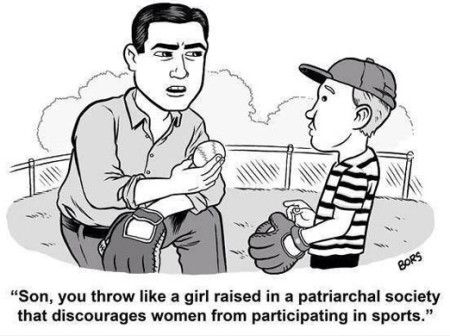
son-you-throw-like-a-girl-raised-in-a_12707Yeah, it’s all advertising, so at some core level it’s all inherently corporatized and bullshit on account of that perspective. On the other hand, if the growing prevalence of these ads indicates (and even encourages) movement towards the tipping point when the patriarchy/kyriarchy transmutes? I can get on board with that.

So, maybe less of a banner moment (sorry, Dr. Ledbetter!) and perhaps more of a weathervane. Showing the shifts in the cultural currents, a change in the wind of how people think and talk and feel.

* Okay, my hesitation was a little different because I hadn’t yet revived JALC, so I didn’t have to make the “blog or not to blog” call on it. Just the (arguably more public) “to Facebook or not to Facebook” call.

** Yes, this was posted 3 days ago, but I read it today. As such, she reminded me today. And I am grateful for that.

*** In case I haven’t said so clearly enough, please go read the entire post in its entirety. All of it.

———-

Image credit: http://www.funniestmemes.com/funniest-memes-son-you-throw-like-a-girl-raised-in-a/

Cruise Control

So one of the things that cruises are notorious for —

Wait, did I ever mention that The Trip was a cruise? I can’t recall and I’m too damn lazy to go look it up. In case this is new news, and just to get this down on the record: The Trip was a cruise.

Display on the first cruise day, in the Windjammer (the buffet restaurant)So anyhow, one of the things that cruises are notorious for is the quantity and quality of the food you’re served. Actually, I’m not enough of a hard-cross cruise traveler to know whether all cruises are known for having good food, or if it’s more like the same rep an all-you-can-eat Vegas buffet has: food that’s notable  more for the available amount than for the flavor profile. (Even if most cruise ships have food that’s more adequate than exceptional, the ship we were on is on this list of the “best cruise ships for foodies,” so trust me when I say that not only was there tons of food available, it was tasty, tasty stuff.)

Now, there’s a whole lot of rhetoric out there about how it’s inevitable to gain weight on a cruise, with various fat-panic/fat-shaming suggestions on how to approach that “problem.” For example:

  1. controlling your on-ship behavior to minimize weight gain
  2. doing a little prophylactic weight loss ahead of time to build your “buffer zone”
  3. going on x, y, or z post-vacation diet plan
  4. deliberately infecting yourself with a parasite or the norovirus in order to stay skinny

(Okay, maybe I made that last one up. And, for once, no, I won’t be providing links to sources. I don’t feel like actively participating in Diest Culture, and you can find this kind of shit so easily with the simplest of google searches.)

It was an interesting comparison across the years, thinking back to the first-ever cruise Mr. Mezzo and I took back in 2007, right when I was at the verge of learning about fat acceptance and adopting that perspective for myself and my worldview. That first cruise also had lots of good food. I indulged, and I know I gained weight — though at this distance, I can’t recall what the number was. And I felt so ashamed for all of it. For my lack of dietary discipline, for my laziness in not becoming a cruise-ship gym-rat, and then for my inability to diet and lose the weight after I got back on land.

martinisThis time around, I decided adamantly against imbibing a guilt-and-shame chaser with any of the meals, martinis, or desserts I had while vacationing. I have no idea if my food was any less rich or sugar-laden this time around as in ’07. (I’d guess not much appreciable difference, then and now.) But I do know I’m feeling lots better than I did 7 years ago — if for no other reason than the fact that I’m not mired deep in a self-shaming and self-punishment cycle. ‘Cos honestly, when I let those voices loose in my head, it’s never to my benefit. Spiritually, emotionally, or physically.

Having said that, I am feeling a bit logy after-the-fact. I’m guessing, based on my HCG experience from the spring, that I’m mostly feeling the after-effects of the dramatic uptick in added sugar during those two weeks (read: desserts, martinis and Belgian chocolate). And I’m kind of fascinated by the way, as far as I can tell, that my spring detox journey helped me more attuned to my body so I could notice this change, but my history of fat acceptance work and my ongoing growth around overall self-acceptance has in a place where I’m not upset or blaming myself about it.

belgian-chocolateInstead, I’m just quietly moving back to some of the cooking routines and rituals I used during the spring, adopting something that’s closer to “clean eating” than I was doing recently. Now, don’t get me wrong. I am not on some extreme ascetic kick. Beyond my own natural sense of fullness, I am setting zero limits on the quantity of food I’m eating.  I’m even having a little taste of “added sugar” each night after dinner (I say again: Belgian chocolate. You don’t think we were coming home without a small stash of that to enjoy, did you?)

I’m just trying to listen to my body. And if my body is craving greens and chicken rather than my cruise staples of pasta and red meat, I’ma good with that.

Plus a little of that Belgian chocolate. Yummy and absolutely guilt-free.

———-

Image credits:

Fruit buffet: http://forsythfamily.com/caribbeancruise.htm

Martinis: http://zynkah.hubpages.com/hub/10-Best-Flavored-Martini-Recipies

Chocolate: http://www.moonlight-mile.com/belgian-chocolate/


Validation and Valediction

I chose not to give a valedictory address when I graduated high school.

This was less of a break with tradition than it might initially seem: unlike most high schools, my school didn’t automatically tap the class valedictorian to give a commencement address. Instead, individuals wanting to give a speech at this event were asked to submit an application in hopes of being selected for the honor.

Obviously, there were many years where the speaking line-up demonstrated how the sort of go-getter likely to become class valedictorian was also the same sort of go-getter likely to want to make a graduation speech.

But not every year. And not my graduation year.

———-

When I tell the story now, I jokingly say that by the time I got to high school graduation, the only message I would have wanted to share with my classmates was something pithy like Fuck off, all of you. And, as I have rehearsed the explanation nowadays, however brassy and outspoken my parents were, I thought that level of candor might have gone beyond their comfort level and thus decided that silence would be the better part of courtesy.

It’s not as if that narrative is too far off the truth.

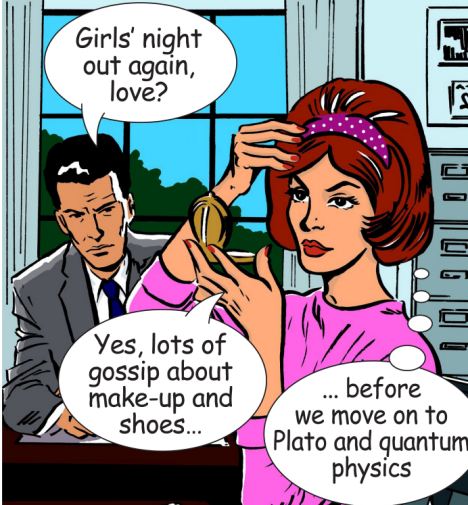
girls-night-out-quantum-physicsI recall my high school years as miserable ones. My teachers were good, and I’m not going to be so hyper-dramatic as to claim I was entirely friendless or outcast. But the prevailing tone I recall from those years is the unceasing, oppressive  cultural message from my peers that I was too smart for a girl, too ambitious for a girl, and definitely too outspoken for a girl. And despite all my “inappropriate” displays of intelligence throughout my high school career, I think a good number of my peers were shocked to have a girl come out with the #1 class rank, simply on account of my gender.

So yeah, by the time graduation rolled around, I was in no mood to say a fond good-bye to my high school class. Instead, I was ready to close that door and get on to the next stage of my life, in hopes that my intelligence wouldn’t be so scorned and devalued in my college career.*

And yet I know that underneath all the teenage bluster, all the self-protective layers of scorn and judgement I held for my BMW-driving, Reagan-loving classmates, was also a part of me that didn’t want to risk making a speech from a place of fear and exhaustion.  Fear of becoming a target again, of being snickered and whispered at. The exhaustion of feeling as if I was swimming against the tide during so many minutes and hours of my existence. Yeah, I was ready to close the door and move on, but I still can’t tell you how much of that feeling was rooted in a sense of victory and how much in defeat.

———-

My recollections are prompted by a post today on Everyday Feminism titled 5 Ways Girls are Taught to Avoid ‘Smart.’ The author, Kelsey Lueptow, begins by stating “I started censoring myself in the seventh grade.” She then goes on to outline the cultural mores and messages that help encourage her, and me, and however-many bright, ambitious girls besides, into the habits of self-betrayal and self-suppression.

The list hits some of the highlights you might anticipate: the cultural value placed on female attractiveness, the primacy of the marriage plot as a goal for women’s lives, and the social enforcement of passivity — both through the positive reinforcement of “ladylike” behavior, but also through the negative responses to female displays of intelligence (everything from the infamous “bossy” label to more overt verbal/physical aggression).

It all reminds me of this recent PSA by Verizon that got some airplay a couple months ago:

As Amanda Marcotte analyzes in Slate:

This ad gets a couple of things right. The first thing is that the ad focuses on the parents and not the girls themselves. So much of our efforts in trying to encourage girls end up treating them like they’re the ones who are screwing up, either with too much “body talk” or being lame for playing with certain toys. This ad shifts the focus, arguing that girls are born fine and it’s the rest of us who screw them up.

Just as importantly, despite the punch line of lipstick over science, most of the ad is not reductively focused on body issues and beauty. It’s all too easy to fall back on the notion that the focus on looks alone is what’s holding girls back, in no small part because it allows liberals to hand-wring about the “beauty myth” while simultaneously allowing conservatives to scold about the evils of female vanity and sexuality. But this video tackles a much more insidious force holding girls back: the general pressure on them to be, for lack of a better term, more ladylike. It points out how we not only value beauty, but also prioritize neatness, quiet, and safety in girls while encouraging risk-taking and confidence in boys.

I don’t regret skipping out on the notion of giving a valedictory address. We all make the best choices we can at any given moment in life, and I don’t have the kind of time and energy it would take to start second-guessing this decision and all the other human, possibly-flawed things I have done in my 45 years on this earth.

But I do find myself wondering about the level of self-silencing that existed within that choice, and wondering, as well, how these cultural messages against female intelligence cause me still, even today, to silence myself.

* A hope that, fortunately enough, came to pass. Yay for women’s colleges.

———-

Image credit: http://www.dailymail.co.uk/femail/article-1357755/Why-DO-smart-girls-dumb-men.html

A Test of Spiritual Maturity

So, my next retreat weekend is in two weeks. Yup: very close in time to my return from The Trip, so I’ll admit I’ve been wrestling a bit with the decision of whether to go or not.

On the practical side of the scale against going is the fact that I just got back from a big ol’ trip and I’m not really loving the idea of getting in another plane and missing more workdays so quickly after the big vacation. It’s also true that I’ve come back to the office in time for a couple intense projects, which makes me even more uncomfortable about skipping work. Especially since one of the projects coming to deadline during this fortnight is one that I’m particularly excited and inspired by.

On the practical side of the scale towards going is the value I hold for this work, and the ways I know to my bones that it has helped move my life and my soul’s mission forward.

So, looking rationally, there’s not a super-strong weightiness towards either choice on the should I stay or should I go? see-saw. Which at some level, isn’t surprising. My life at work and at home here in Massachusetts are sufficiently rich that I bet I could always come up with a list of reasons to blow off a particular retreat weekend.

But I don’t ever skip the weekends. Like I said last time around: the weekends are always hard work, but I have never regretted going. In fact, I have always felt the gratitude and benefits of going.

And so, a week or two before The Trip — well after my usual 5-6 weeks ahead of time discipline in buying plane tickets and making travel arrangements — the fact that I hadn’t been able to bring myself to make time off and travel arrangements had me really curious. Some part of me, some strong identity, was really not wanting to go to this particular weekend. And the resistance was stronger than anything I’ve felt before.

I mean, I’ve had times where I contemplated skipping a weekend — there was one right after we moved into the house here, and I remember taking a good long look at whether it made sense to be on a plane so soon after moving. But the temptation to skip was never this strong this far into the game, so I really began to wonder if maybe the soul-centered decisions this time around was to stay in New England after returning home from Europe.

So I was putting a lot of reflection to the question. Like, a spinning myself into a panic level of reflection. After talking to a couple friends and classmates, I realized that, being as the source of my resistance was in the energetic/instinctual/emotional realm — and quite frankly, being that the primary value I hold in the work is similarly energetic and instinctual (though probably energetic/instinctual/spiritual rather than emotional) — this was not a decision I was going to be able to think myself to. I can make all the pros and cons lists I could possibly wish, but that sort of rational tool isn’t going to help me make what is ultimately a soul-based decision.

So I let go of the question and prayed to Spirit for a sign. A nice, clear, brick to the face kind of sign.

Nothing pertinent showed up during The Trip itself. (Not too surprising: there was so much to see and learn on other fronts, what room was there in the days for a message about this particular question?) So, Friday morning, I used my normal journal-writing time to pull cards on the question.

And the cards were as clear as they could possibly be: it is in my best and highest good to go down for the retreat weekend.

spiritual-disciplinesAnd I have enough spiritual discipline and maturity to follow through when the signs are as clear as this one was. So my plane tickets are purchased, and I worked with my teachers and the Center to create a somewhat-modified schedule that will allow me to balance my responsibilities to work and then take the last flight out of Boston Thursday night.

But I’ll say this much: it’s a hell of a lot easier to follow Spirit’s guidance when the cards are telling you to do what you already want to do. In this case, when the the ego-identities and emotional body are still running strong with resistance and rebellion? It is a veritable challenge to hold centered in that.

At some core, mature soul-centered place, I know I’ve made the right choice. (The sign in the cards was that clear. Really and truly.) Now I just need to hold the ego-identitites and fear-selves with a mixture of compassion and discipline. I know you’re scared. I’ll keep comforting you, and I’ll be here the whole time. But we’re going. Together, we’re going.

———-

Image credit: http://sportsandspirituality.blogspot.com/2011/11/personal-inventory-sports-spirituality.html