Under My Wig

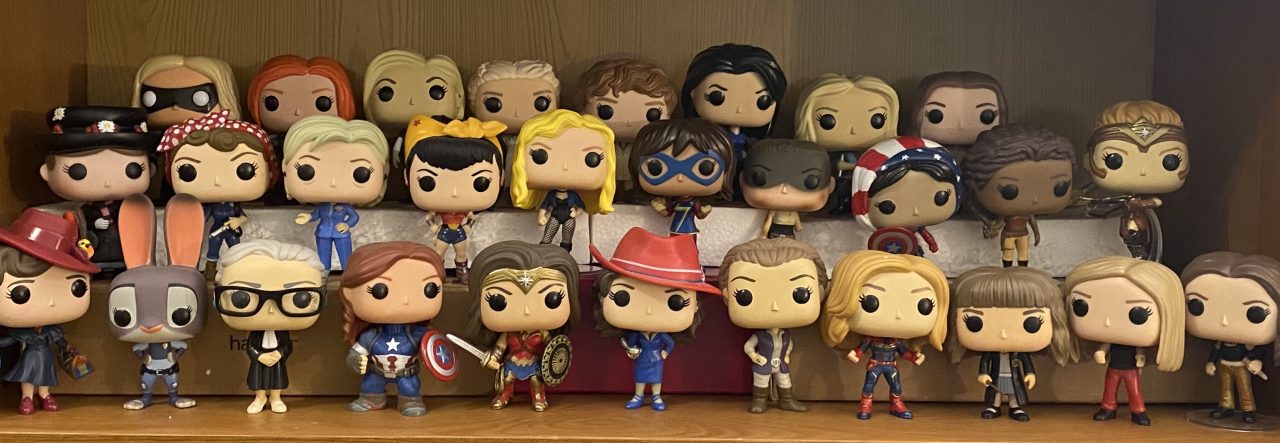
It may seem odd to learn that I am building myself quite the collection of wigs.

Or maybe that doesn’t seem odd at all, given my theatrical pursuits. It’s almost inevitable, when you contemplate the number of B’way musicals that take place in various historical times and places. Cross-reference that against my stubborn insistence that I don’t feel like myself without a super-short pixie cut, and wigs become de riguer for faking my way into the settings of most musicals. 1920s, 1860s, 1890s…they all require wigs.

Luckily enough, I’m able to recycle some of these for different shows: the top record thus far is 1 wig that has been used for 3 different shows set in the 19th century. I haven’t even bothered to take it out of its snood between productions. Still, new roles and new concepts mean I keep adding to the collection here and there.

So maybe this growing wig collection of mine strikes you as odd, dear reader, or maybe it doesn’t. What I know for damn sure is that this growing wig collection strikes me as somewhat ridiculous.

Continue reading “Under My Wig”

Taming the Paper Dragon: Again

I’ve written before about the challenges of dealing with paper clutter in the house. Well, the last several weeks of gloomy-time meant that I’d been letting all the mail pile up again in a big way — aside from those few essential bills I’d pull out and handle as soon as they arrived. So a big project for me this past weekend and the last couple of evenings has been to once again try to tame the paper dragon.

In addition to handling the most immediate paper accumulation from the last couple months, I also emptied out a couple boxes of longer-term paper accumulation. You know, the kinds of paper piles that built up in other busy times during the last year, but then got shoved into a box in some last-minute cleaning frenzy before an anticipated visitor’s arrival.*

And, after this accomplishment, I am now turning my analytic attention to the other main source of paper influx, aside from catalogs.

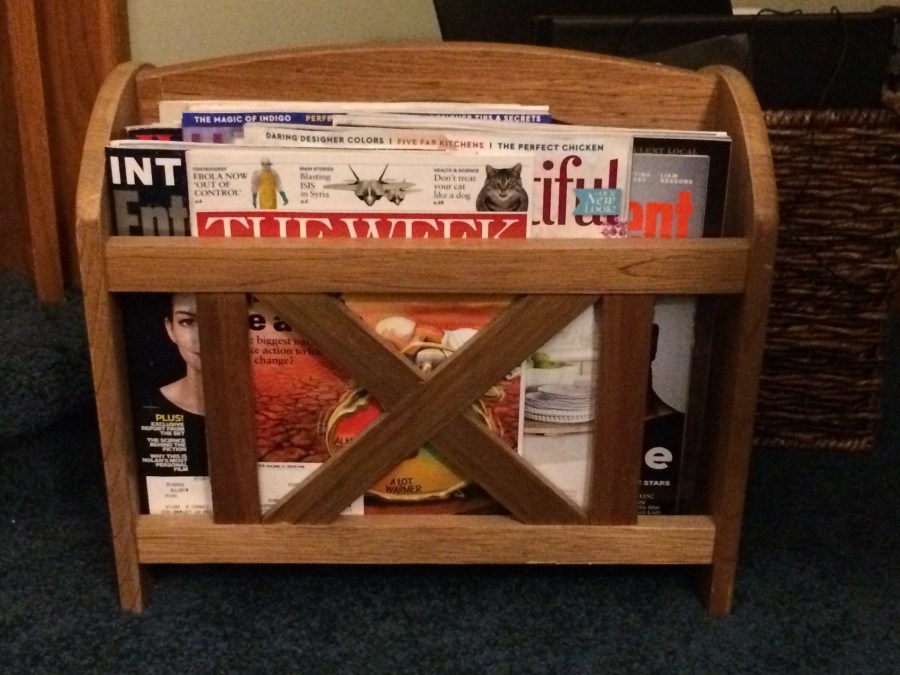
My overabundance of magazine subscriptions.

Continue reading “Taming the Paper Dragon: Again”

A Momentary Regression

Last night I was still working to finish my first Emma Watson post (and mentally beginning to compose my second for typing and pre-scheduling), when Mr. Mezzo told me he was about to head off to bed. And I remembered: I still needed to take my laundry out of the washer and hang it out to dry.

That task had occurred to me at least two or three times earlier in the evening. I think once before dinner, and definitely right before sitting down to write, and then again in the midst when I was walking to the kitchen to refill my water glass. During the last of those three moments, I even calculated to myself how I was probably about 10 minutes from concluding my post, so I could knock that out and then turn my attention to laundry before writing post #2.

But then gathering and writing my concluding thoughts became a longer and trickier process than I’d expected, and Mr. Mezzo’s schedule update summoned up this incredible sense of (internally-generated) pressure about how I needed to quickly shift attention and get the laundry hung out ASAP so’s not to disturb his chances of falling asleep. (The drying racks live in our bedroom, you see. Usually that’s a very good thing — but all good things have their down sides.)

That pressure, cascading on top of the frustrations over another wasted weekend, the awareness of how much more writing there was left to do, and the general dread over going back into a work environment that’s been kinda ugly for the last couple of weeks. All of it hit me like a ton of bricks. And then I said it.

I hate my life.

Continue reading “A Momentary Regression”

Dreaming of Readers

Today’s assignment from Blogging 101 is two fold:

publish a post for your dream reader, and include a new-to-you element in it.

So without further ado, let me get part two of the assignment out of the way post-haste by admitting that, ever since I saw the phrase “Dream Reader,” this has been stuck in my head.

The dreaded earworm strikes again!

Continue reading “Dreaming of Readers”

The Three F’s

The Day 2 challenge for Blogging 101 is about editing your blog title and tag line. To me, it’s an additive exercise to yesterday’s “who am I and why am I writing” meditation — now just taken that one next step of distilling that mission statement to its essence in order to create a title and tagline that, to quote the assignment, “give visitors context and help them decide to stick around.”

Obviously, being as I am already 5 years and/or 6 months into the game, I have a well-established blog title,* and it’s one I’m not eager to change. The question of tagline, though, is wide open for consideration, and I’m happy to talk about both these elements after the jump.

Continue reading “The Three F’s”

On Porn and “Potterotica”

I guess it’s my week to talk about sexualized body parts?

This Button Poetry video from this year’s National Poetry Slam caught my attention yesterday:

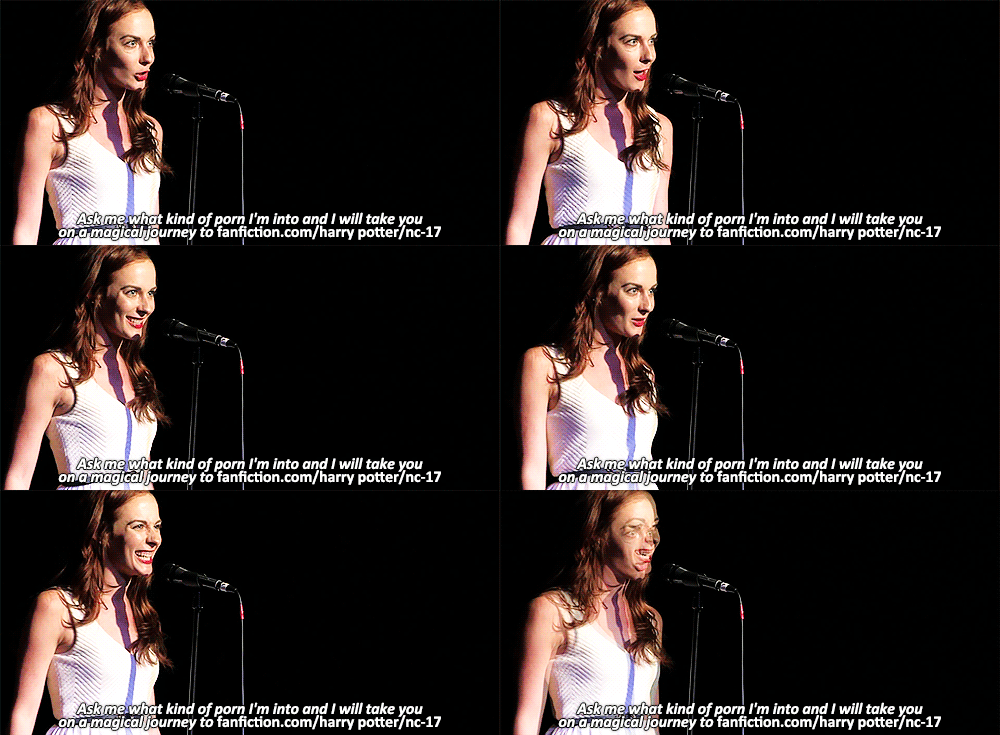
The title of Brenna Twohy’s spoken-word poem Fantastic Breasts and Where to Find Them is a punnish play on the title of a volume about the Potter-verse, Fantastic Beasts and Where to Find Them (emphasis added), published by J.K. Rowling some years ago as a companion to the 7-book saga of “the boy who lived.”

Twohy articulated the goal of her poem to Buzzfeed thusly:

I wanted to highlight how unrealistic most pornography’s portrayal of sex is, and how that creates really damaging expectations for both men and women.

twohy-ask-me-whatMission accomplished (at least for the most part) to hilarious and devastating effect. Particularly pointed is Twohy’s observation that a taste for fan-fiction erotica is to be considered “unrealistic” — while mainstream porn is somehow seen as more real. Which is about as laughable a deception as I’ve heard since… well, unfortunately, just since yesterday, when folks were declaring that public breast-feeding is immoral. (Seriously, y’all. The patriarchy just needs to shut up and die in a fire. Now.)

In yesterday’s Independent, Jonathan Owen discusses a recent poll of British teenagers that reveals:

the majority [of poll participants] warn of the “damaging” and “addictive” effect of sexual images and videos readily available online. 80 per cent say it is too easy for young people to stumble across it and most recall “accessing pornography was seen as typical” while they were at school.

At least 70 per cent agree that “pornography leads to unrealistic attitudes to sex” and “can have a damaging impact” on views of sex or relationships.

A quick visit to Professor Google turned up a wealth of other articles unpacking the sexual myths and unrealistic expectations fostered by the mainstream porn industry. For example:

The gist of all these different articles is perhaps most entertainingly summarized by Noah Brand and Ozy Frantz in Alternet:

The problem is, learning about sex from porn is like learning about firearms from action movies. Action movies sacrifice realism for the sake of storyline or a really cool explosion. Action movies don’t teach you gun safety. Action movies don’t talk about alternatives to violence. And action movies use some tropes—such as the infinite ammo supply—that may move the story along but don’t reflect reality. That’s not a problem, as long as everyone treats them as entertaining fantasies.

Unfortunately, for many young people becoming sexually active today, the entertaining fantasies of mainstream porn are the teacher they’ve spent the most time with, and mainstream porn is a terrible teacher.

Even more than the general unrealistic nature of mainstream pornography, Twohy chooses to highlight a particular strain of misogyny and violence against women that runs through so many adult films.

[SIDEBAR] I will admit to having some level of discomfort over a piece that lambastes porn culture for allowing men to fantasize about sex with barely-legal teens while offering — however ironically — the “more empowering” alternative of a book series where the main characters are under-18 for a majority of the time. Also, having quickly perused some of the titles and advertised pairings in the “mature” section of the Harry Potter stories on fanfiction.net, I see the potential for a lot of uncomfortable power dynamics (Snape & Hermione) and Stockholm syndrome (Draco & oh, everybody).** Blurred lines of consent all over the place… [/SIDEBAR]

Nonetheless, the general thrust*** of Twohy’s piece feels really true and honest and on-point about the culture that mainstream porn participates in and which it helps perpetuate. To quote HuffPo (who also quotes part of Twohy’s poem):

a 2010 Violence Against Women study found that 90 percent of porn video content online and off included verbal or physical aggression towards women.

“I know a slaughterhouse when I see one,” Twohy says of the porn industry. “It looks like 24/7 live streaming, reminding me that men are going to fuck me whether I like it or not, that there is one use for my mouth and it is not speaking, that a man is his most powerful when he’s got a woman by the hair.”

Twohy suggests that the “slaughterhouse,” an uneasy analogy where the slicing instruments aren’t knives but part of a video editing suite, does more than just provide shots of women’s segmented body parts. It also creates a culture where domestic violence isn’t only expected, but accepted.

And more than that, Twohy steps — for an uncomfortable, searingly honest moment — into the ways that we all internalize these messages about how men and women are expected to perform in romantic and sexual situations — men, rough, cruel, aggressive; women, compliant and sex kittenish.

The first time a man I loved held me by the wrists and called me a whore, I did not think “Run.” I thought, “This is just like the movies.”

I have seen that training, on film and in real life.

It everybody fucks over, the patriarchy does.

* Yes, I dare say it has.

** You know how yesterday I took a bullet and read the comments sections on things so you wouldn’t have to? That favor-doing stops tonight — I was not going down that particular rabbit hole. Not for anything.

*** Sorry, couldn’t resist.

———-

Image credit: http://iwatchforsasha.tumblr.com/post/95066205780/fantastic-breasts-and-where-to-find-them


Handing Out Sticks

Famous blogger Matt Walsh has kicked off a bit of a tempest by writing two posts about Robin Williams’ death. The first one, basically, tried to draw a bright-line boundary between the concepts of depression and suicide. This interpretive framework (and Walsh’s reasons for wanting to drawing this sharp boundary) is pretty well summarized here:

First, suicide does not claim anyone against their will. No matter how depressed you are, you never have to make that choice. That choice. Whether you call depression a disease or not, please don’t make the mistake of saying that someone who commits suicide “died from depression.” No, he died from his choice. He died by his own hand. Depression will not appear on the autopsy report, because it can’t kill you on its own. It needs you to pull the trigger, take the pills, or hang the rope. To act like death by suicide is exactly analogous to death by malaria or heart failure is to steal hope from the suicidal person. We think we are comforting him, but in fact we are convincing him that he is powerless. We are giving him a way out, an excuse. Sometimes that’s all he needs — the last straw.

Then, after the post went viral and lots of people took issue with it, Walsh wrote a somewhat testy follow-up to: 1) decry the vitriol of individuals who misrepresented/misunderstood his first post and 2) provide more detailed justification of his position.

Among the many voices I’ve seen either directly or indirectly rebutting Walsh’s argument….

Pastor Jean-Daniel Williams, who writes:

If I commit suicide, perhaps, as you claim, it will be ‘’my’’ choice. But I doubt it. I have spent more than half my life listening to my own body betray me, my own mind telling me that it would be better to die. . . . Living is the pro-active choice. Is suicide a choice? It has been a free choice every time I have ever said no so far. I have chosen to say no. That is not because we can blindly, arrogantly, say that it is a moral choice, though. It is because I have been really lucky that I am (still) healthy enough to say no. The thing is, saying ‘’no’’ to suicide is evidence that I am healthy enough to say no. But, if I should ever commit suicide, it will not be because ‘’I’’ made the choice, but because my depression would have.

Kristi, on the blog “What is Matt Walsh wrong about today?” provides some valuable information about the effect of depression on one’s cognitive and decision-making capabilities:

Matt says suicide is a choice, but what makes a choice a choice is the presence of logic, reason, and objectivity to evaluate its merits. Depression can rob your brain of the ability to think that way. My friend Derek, a pharmacist, knows a thing or two about this. In his own words:

“In a euthymic (or normal, mildly-positive) attitude, the effect of a choice is either a reward, perhaps the blast of dopamine from a great run, or a detriment, the exhaustion of inactivity. In a person with clinical depression, both sides of that choice respond with a similar lack of neurotransmission.

A patient suffering from severe depression may not even be able to tell the choice apart. Even if objectively they know that running is good, couch is bad, they will experience the same neurochemical state regardless.”

[. . . ] So no, depression doesn’t appear on autopsy reports. But when a 500-lb thirty-year old drops dead at his desk, the autopsy reads “cardiac arrest” rather than “morbid obesity”. As usual, Matt is glossing over nuances. He thinks things are black and white—that a choice is a choice. He’s wrong. In absence of a healthy neurological system, not all actions are choices.

[SIDEBAR] Even though the fat activist in me is yearning to give significant bandwidth to the false assumptions and lack of medical evidence in Kristi’s facile conflation of “cardiac arrest” and “morbid obesity,” I’m mostly going to let it slide because I’m on a different topical horse tonight. Allow me merely a gentle hat tip to my HAES basics post, my critique of BMI, and my puzzlement at the unproductive insanity of fat-shaming. [/SIDEBAR]

[SIDEBAR THE SECOND] I am clearly way too ill-informed about the blogosphere as I hang out typing furiously in my little isolated corner of the wild, wild web. I don’t think I had ever heard of Matt Walsh till this folderol, yet he’s a prominent enough Internet figure to have earned his own dedicated counter-narrative. I don’t know if I’m impressed or horrified. [/SIDEBAR THE SECOND]

Although he doesn’t name check Walsh at all, Peter DeGiglio might as well be writing a targeted counterpoint against Walsh, articulating more reasons for understanding Williams’ death as being caused by the disease of depression:

I tried to get the old friend to understand by using my go-to comparison in this conversation. I asked, “Well, what if it was cancer?” His answer came back like a clichèd line from an after-school special. He proclaimed, “Well, that you can’t help!”

And therein, my friends, lies the problem in our dialogue on mental illness. [. . .]

What I believe people need to understand is that Robin Williams took his own life because he lost his battle with a serious medical condition. Take again my cancer analogy. Think about it: The last possible stage of any type of cancer that can effect a person is death. When one loses their battle with cancer, they die. The cancer cells take over and shut down the body for good. The same can be said for Bi-Polar Disorder and Major Depressive Disorder (aka simply “Depression”). The last possible stage of these diseases is death. The difference is that instead of cancer cells destroying the body, the body is destroyed instead by thoughts and feelings, causing the afflicted person to be convinced that the only way to end the suffering is through death at their own hands.

Essentially, he had “Thought Cancer”

———–

I feel half-vulture playing all this out on the screen. Yet another fan doing pop psychology when a celebrity dies, and doing so without much regard for the feelings of those individuals who are actually, acutely, intimately affected by his death.

So why am I even sailing these rocky waters?

Because however much I disagree with Walsh’s perspective, no matter how fervently I believe that those suggesting we say Williams died of depression are onto a deep psychological and spiritual truth — well, here’s an uncomfortable truth of my own.

Part of me wants Walsh to be right.

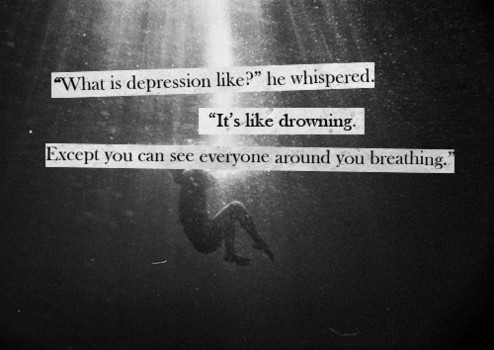
I want to believe that my depression is something I can rein in, get under control. I’ve been really lucky to be able to manage the condition for several years now without prescriptions. This is nothing I’m saying as a mark of strength, of health, or of any other sort of virtue. The operative word is “luck.” Yes, I work damn hard to maintain my psychological health, but I also know you can do everything “right” and still be challenged with disease. So, yeah, I am deeply grateful for my good fortune, but I know that tomorrow’s health and tomorrow’s brain chemistry are far from guaranteed.

It’d be easier if Walsh were right. More comforting, in a childish control-freak kind of way. To know that I just need to find and follow the proper recipe so’s to be sure that I will never have to stare down the maw of despair and depression again.

But that’s not how life works.
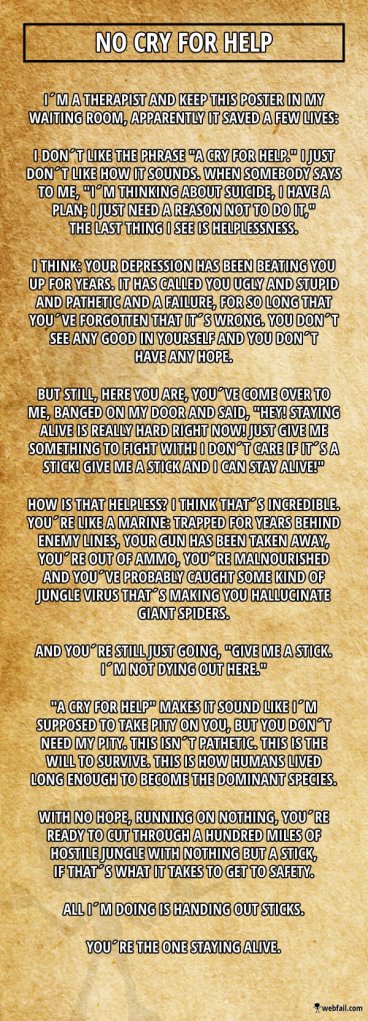
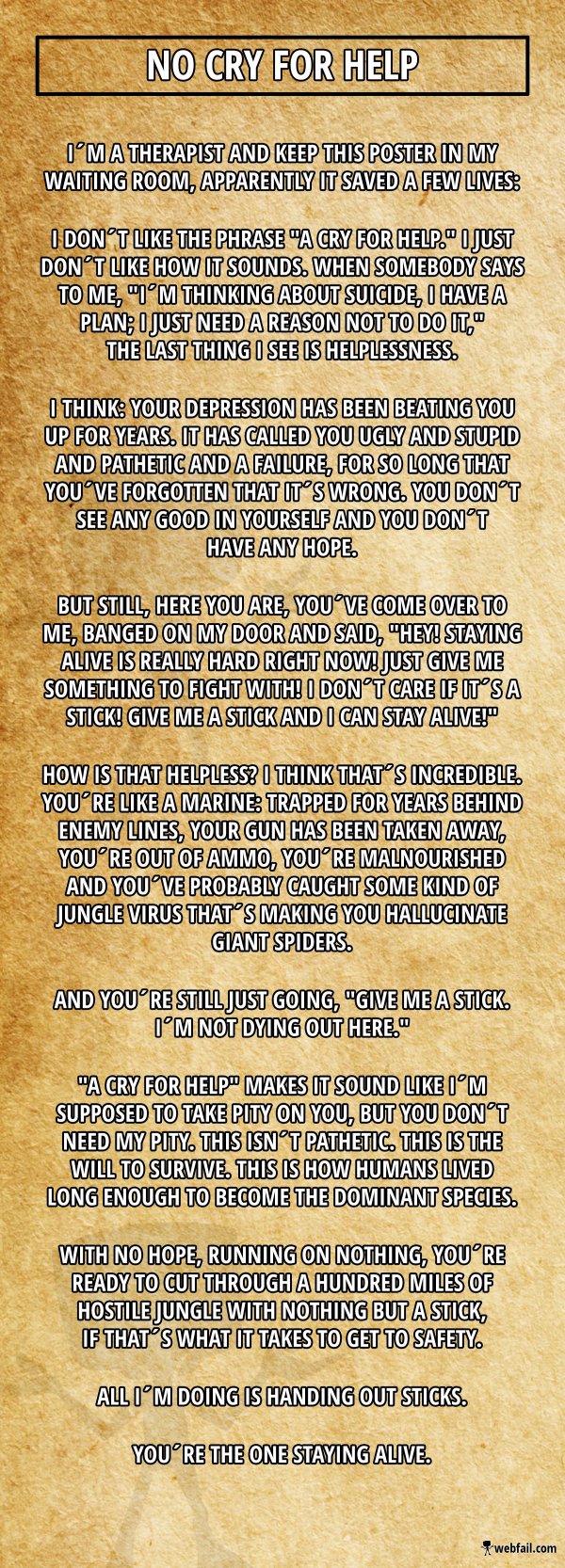
no-cry-for-help

———-

Image credit: http://en.webfail.com/855852d8b8b
Creating (a) Space

Somewhere in the back of my mind, I’d been holding the hope that we would be all the way unpacked and organ-imized at the one-year anniversary of moving into our “house on the hill.”

Well, we still have a few weeks till that anniversary — 24 days, to be exact — but I’m ready to call it: I will not be making that hoped-for deadline.

buried-boxesQuite frankly, the momentum for unpacking and all has ground to a complete halt during the last few months.

There’s plenty of good reasons for that. First, there was The Cruise, which took us out-of-town for more than a fortnight, and which required a certain amount of packing/unpacking of its own accord. There’s also the fact that one of the benefits we wanted to create by moving north from Philly was the ability to spend our weekends up at the lake in NH — and we’ve certainly spent a few of our summer weekends happily living out that intention. And then there’s been a few busy patches at work (she says, putting it ever-so-mildly).

But as I began to be aware that the one-year anniversary was approaching and to realize that I was going to miss my secret goal, I started looking at the ways I’ve been giving zero effort to unpacking, and I asked myself what other factors might have contributed to this stop in momentum. And I began wondering if those other factors had both a practical and an energetic dimension to them.

On the practical front, we’ve hit the stage where some of the unpacked boxes are definitively things we want to keep (old tax files, my cross-stitching supplies, etc.) but that don’t actually have any storage furniture to be unpacked into. (Some of our old furniture — including the filing cabinet and some shelving units — got jettisoned during the move, either because it was too old to be worth keeping, or because the ceiling in our finished basement — which is where these items are intended to be stored — is just a teensy-weensy bit too low.)

The energetic front is sort of linked to the practical lack of storage furniture: I didn’t have a vision for the room where the unpacked boxes are currently living.

———-

Let me set the stage to make this all (I hope!) slightly more comprehensible. The architectural features of the house mean that the finished basement falls roughly into three separate rooms, plus a wide long hallway. These “rooms” are open to one another, but still function as separate areas of space. When we moved in, we knew that the first room at the bottom of the stairs was going to be a little library/reading nook area, and that was, for the most part, set up pretty quickly. The hallway was wide enough that we could put up shelves for my prodigious CD collection (plus our movies), which was perfect because the third room, where the hallway leads to, was where we wanted to set up a media room. Those CD shelves were also taken care of pretty quickly, while the future media room and the undetermined center room were where the tons and tons of unpacked boxes waited for attention.

As we unpacked, we kept consolidating the geography so that a higher and higher percentage of unpacked boxes were in the center room, the room we simply began calling “unpacking central.” By taking this approach, we were able to get the media room clear — or, at least, clear enough — so we could start setting it up. The decor is still what we’ve been calling nouveau dorm room, but the core elements — big screen TV, soundbar, PS3 — are there, and we can deal with having milk-crate shelving for the time being.

And then there’s unpacking central.

———-

It was actually really helpful for a while not to have any other vision for the center room aside from its current role as unpacking central. The unpacking process, as a whole, has required me to really come face to face with all my hoarding/shopaholic impulses — facing up not only to the shame around that specific behavior pattern, but also to all the emotional baggage and patterning that led me to be a hoarder to begin with. Quite frankly, it’s been hard emotional work. Good work, important work, work well-worth the doing. Absolutely worth the effort. But hard, nonetheless.

Amidst that hard work, I definitely appreciated not having the extra burden of pressure in thinking “We could already have our ______ (game room, exercise room, whatever), if only I could get my fucking act together!

Yeah, it was nice to not have that piece of internal monologue running.

But my recent spate of inaction had me wondering if I had now become just a little bit too complacent in that room’s identity as “unpacking central” — like, somewhere in the back of my mind, was I thinking “Well, we don’t even know what we’re gonna use the room for, so what’s the hurry to finish cleaning it up?!?

So tonight, Mr. Mezzo and I did a little bit of talking and visioning about the kind of hybrid storage/crafting/creative nook we want to create for that center room. We don’t have everything figured out, but enough is settled that we can take advantage of Massachusetts’ tax free shopping weekend with an Ikea run tomorrow to get a couple storage pieces.

Two birds with one stone: start creating and carrying forward a vision to help re-inspire me towards the unpacking, plus some furniture pieces that mean unpacked item actually have a damn place to go.

So maybe we won’t hit the one-year moving anniversary. Maybe by Yule, instead…

———-

Image credit: http://doingitwright.wordpress.com/2013/07/13/the-5-laws-of-moving-house/

At War with Stephen Covey

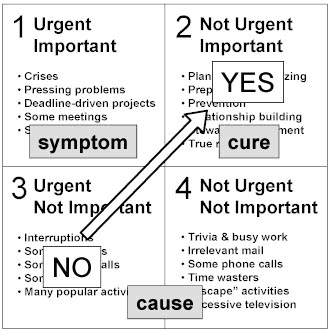
Have you ever seen Stephen Covey’s Four Quadrants of time management? I wouldn’t be surprised if you had: Gaia knows they’re everywhere across the Internet, and they’re also featured as a core component of many many management and success seminars.

covey_quadrants

I’ve cherry-picked a reproduction of the quadrants that makes the point I want. The trick, according to this structure, is to maximize your investment in the “Important but Not Urgent” quadrant, so that important things don’t elevate to “Urgent and Important” (i.e., crisis level). In the meantime, be very wary of the “Urgent but Not Important” category, because this is where the majority of the time sucks and distractors are likely to be housed. (The expectation here is that “Not Urgent/Not Important” things are fairly easy to jettison, while the urgent unimportant things can sometimes be harder to let go of. Fair enough.)

But what if it’s pretty much all urgent and important?

I feel as if I live much of my life by what I have come to call the “bonfire method of project management.”  Which conflagration is burning hottest and brightest, most likely to take down the homestead? Well, throw a little water (effort, time attention) in that direction so it dies down a touch. Now re-assess: which fire is hottest now?

Lather, rinse, repeat. (Yes, I know: I’m mixing my elements along with my metaphors. Bad witch!)

This pattern may be nothing more than an ongoing demonstration at the way I suck at self-motivation and planning ahead. Regardless, I am living a week where pretty much everything feels legitimately Important. And the tension I’m feeling is that the most urgent (time-sensitive) of these important things are all the items driven by external responsibilities — hitting the next work deadline, doing my homework for the retreat weekend, packing for the trip — while the items on the list that are arguably less urgent (i.e., most readily postpone-able) are the tasks and practices I have chosen for myself — journal-writing, ed-reading, JALC.

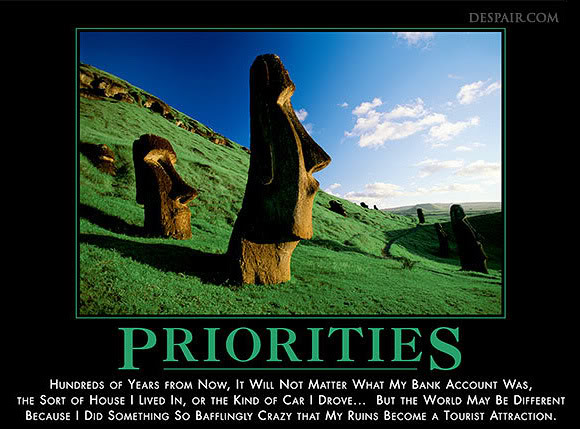
priorities_despairYes, this is, admittedly, an oversimplification. After all, no one forced me into my wacky non-profit career, and even though the retreat homework and travel is a function of me following someone else’s  direction, the retreat is also an investment in my soul’s growth.

Still, this is another pattern that often runs in my life: putting a higher priority on my responsibilities to others as compared to my responsibility to myself. After all, one of the trickiest parts of Covey’s whole structure is figuring out an answer to this key question: Important to whom?

I was listening to The Jayhawks recently, and there’s a snatch of song lyric that captures this for me:

I don’t expect you to see
But she’s important to me, babe
I guess it’s just one man’s problem

(MetroLyrics)

After all, I bet those “Urgent but Not Important” things you’re supposed to be so wary of in your ruthless Covey-an self-management structure are things that are actually legitimately important to someone, if not to you. So that ruthlessly efficient choice setting you up for success could also be the kind of choice that’s screwing some other poor sap over.

Maybe blogging or journal-writing or reading about education all seem like stupid priorities compared to Huge Essential Work projects and Elevated Cutting-Edge Soul Development work. Or, at least, maybe they would seem that way to someone outside my skin, outside my system, outside my soul and aura.

But they feel vitally important to me, babe. One woman’s priorities.

Which is why I continue cheating my sleep these past few days, trying to sprinkle some water on every last one of these important bonfires.

I don’t exactly know how I’m gonna make it to the plane intact at this pace, or, after that, how I’ll have enough gas in the tank to survive the weekend. But I’m just gonna have to figure that out step by step and minute by minute.

Because every bit of this matters.

———-

Image credits:

Covey’s quadrants: http://www.myrkothum.com/a-beginners-guide-to-time-management/

Priorities: http://s205.photobucket.com/user/johanan_rakkav/media/Parody%20Posters/poster_priorities.jpg.html


In Need of Eyebrow Pencil

You ever heard of trichotillomania? It’s a disorder where someone pulls out their own hair — sometimes a little, sometimes a lot, sometimes just eyebrows & eyelashes, sometimes from the scalp or other areas of the body.

The Trichotillomania Learning Center defines the disorder thusly:

Trichotillomania (trick-o-til-o-MAY-nee-ah) is a disorder that causes people to pull out the hair from their scalp, eyelashes, eyebrows, pubic area, underarms, beard, chest, legs or other parts of the body, resulting in noticeable bald patches. Hair pulling varies greatly in its severity, location on the body, and response to treatment. For some people, at some times, trichotillomania is mild and can be quelled with a bit of extra awareness and concentration. For others, at times the urge may be so strong that it makes thinking of anything else nearly impossible.

Trichotillomania (also referred to as TTM or “trich”) is currently defined as an impulse control disorder but there are still questions about how it should be classified. It may seem to resemble a habit, an addiction, a tic disorder or obsessive-compulsive disorder. Most recently, it is being conceptualized as part of a family of “body-focused repetitive behaviors” (BFRBs) along with skin picking and nail biting.

I’m bringing this up on account of the fact that my eyebrows are currently half-gone. Seriously. At this point, I’m trying to figure out whether it’s better to just pluck the rest of things out and draw my “eyebrows” on with a makeup pencil until they have a chance to grow back, or continue muddling forward with my patchy half-torn-out eyebrows as-is. (At least the frames of my glasses and the cut of my bangs provide some level of camouflage, whichever approach I choose.)

FrankenfurterEyebrowNow, I’ve never been sure as to whether the term “trichotillomania” officially applies to me — I don’t have any sort of formal diagnosis, nor have I bothered to have a doctor’s consultation about the topic. And I feel some level of concern around the possibility of taking a condition that is a very real source of struggle for folks (see: ABC News, Psych Central, Psychology Today and U.S. News & World Report) and co-opting it as a description for my own unconscious stress-behaviors.

And yet, half of my eyebrows are gone, and I don’t see any of the rest of my co-workers with strangely patchy brows. I was also particularly fascinated to see the connection drawn by the TLC between hair-pulling and other repetitive behaviors like nail-biting. Because after sternly self-discplining myself to cease that habit for a month so I could be well-manicured for The Cruise, I am fully off-the-wagon on that score, and my nails have all been bit to shreds.

So I guess it’s safe to say I’m not handling my stress as well as one might hope.

Oh well. At some level, it’s hard to get myself worked up over this particular limitation in my ability to handle the stresses of life. Maybe the the term trichotillomania would fit, if I ever chose to talk to a diagnostician about it. Even if that’s true, I’m fortunate enough to have a very mild expression of this behavior: now-and-again patchy eyebrows and occasionally a pulled-outeyelash or two. I’ve had this habit for decades, and it’s never escalated beyond that.

So all things considered and as odd as this may sound: I remain profoundly grateful for the plain dumb luck that has allowed me to have such (relatively) good fortune in my life. Even if I will be combing my bangs a little bit low for a few weeks….

———-

Image credit: http://globalgrind.com/2013/08/06/guide-steps-to-perfect-eyebrows-photos/