Seasonal Spice

I had myself a bit of a pajamas day today. I take some comfort in the fact that I took a shower and changed into fresh PJ’s during the late afternoon. I don’t know why that matters to me as strongly as it does, but it does somehow feel more ambitious to have done that instead of to be wearing the same set of PJs from sun-up to bedtime again.

There’s a few contributing factors to this kind of nesting day. Last night’s Shakespeare event was very fun, but we didn’t get home till after 12:30 AM — nothing much for younger folks, but WAY later than Mr. Mezzo and I are used to being out. There’s also been a lot of stress and tension in the office, so I am plum worn out from that.

There’s also the undeniable shift over to autumn.

Continue reading “Seasonal Spice”

Learning as We Go

When I mentioned yesterday that I’d been doing affair piece of thinking recently about the tricky ground of enjoying problematic bits of artistic/cultural expression, it actually wasn’t because I’m a particularly huge fan of Miley Cyrus, Nicki Minaj, or Taylor Swift. Yes, I have a single or two in the iTunes library, but that’s about as far as it goes. The timeliness of yesterday’s VMAs provided an irresistible springboard to broach the subject in a post, but that was an after-the-fact exploration of the topic, not the inspiration for this line of internal study.

One piece that has the topic on my mind is that I purchased Roxane Gay’s book of essays Bad Feminist, and am eagerly waiting for the day I clear my reading decks enough to start seeing an absorbing what she has to say about these matters.

Henry_Rollins_TA_2More pressingly, I’ve been trying to figure out since last Thursday what to say about Henry Rollins.

Rollins writes a regular blog for the LA Weekly, and last Thursday, he wrote a provocatively titled essay* where he expressed his anger and confusion about Robin Williams’ suicide. The post is actually a fascinating exercise in internal contradiction, because Rollins acknowledges the impossibility of understanding another person’s pain in the grips of depression — speaking explicitly of friends and roommates who have struggled with the same, but also, to my perception, with a strong undercurrent of Rollins having had his own personal experiences with depression. And yet, for all that evident level of understanding — and even for the explicit admission that “I get it, but maybe I don’t,” Rollin’s essay lands on this position:

I simply cannot understand how any parent could kill themselves.

How in the hell could you possibly do that to your children? . . . I think as soon as you have children, you waive your right to take your own life.

[. . . ] Almost 40,000 people a year kill themselves in America, according to the Centers for Disease Control and Prevention. In my opinion, that is 40,000 people who blew it.

Now, whatever my level of benign mostly-indifference is for Miley, Nicki and Taylor, I am unabashedly a fan of Henry Rollins — especially his spoken-word performances. (Stand-up? Storytelling? I never quite know what to call it.) In all my years in Philly, the only time I ever went down to Atlantic City was one night when Mr. Mezzo and I got tickets to see a Rollins spoken-word show there.**

Yet, however much I enjoy his spoken-word stuff, the level of impatience and humorously channeled rage those spoken-word pieces often reveal have always had me wondering about the level of Rollins’ impatience with human fallibility and weakness. I know “weakness” is such a charged word, but that’s really how it always played to my system.

Rollins would speak with such disdain about the mental/ethical weaknesses of prejudice, and would talk in such detail about the ind of discipline he used in his own life — the whole ascetic “straight-edge” thing, eschewing drugs and alcohol, dedicated to weights and fitness, and minimizing his possessions. I enjoyed going to his shows and listening to the recordings, but I always assumed if I were ever to meet Rollins, he’d have little but disdain for my life, with my weight, my occasional drinking, and my addictions to shopping and hoarding and physical possessions.

So I was disappointed to see last Thursday’s column, but I won’t say I was especially surprised. With the sorts of bright-line divisions I imagined him drawing between “strength” and “weakness,” I could imagine how his thought process would have led him to classifying suicide as an act of weakness. (Just so we’re clear: not at all a perspective I agree with. But I could halfway imagine the thought chain that took him there.)

Thus began a more intense meditation on “being a fan of problematic things.” For there I was, caught between the place of deeply — DEEPLY — disagreeing with Rollins’ essay, and yet knowing the equally deep affection I have for his past work.

And then things took a turn.*** Saturday morning, I got word that a brief apology had been posted on Rollins’ own website:

The article I wrote in the LA Weekly about suicide caused a lot of hurt. This is perhaps one of the bigger understatements of all time. I read all the letters. Some of them were very long and the disappointment, resentment and ringing clarity was jarring.

That I hurt anyone by what I said, and I did hurt many, disgusts me. It was not at all my intent but it most certainly was the result.

I have had a life of depression. Some days are excruciating. Knowing what I know and having been through what I have, I should have known better but I obviously did not.

In this post, Rollins promised a longer follow-up essay in the LA Weekly today. In it, he does a damn solid apology. Doesn’t take the “that’s not what I intended!”  road, or any of the derailment bingo plays that so often crop up in these hard conversations.

After reading carefully and responding as best I could, it was obvious that I had some work to do in order to educate myself further on this very complex and painful issue. I am quite thick-headed, but not so much that things don’t occasionally permeate.

In the piece, I said there are some things I obviously don’t get. So I would like to thank you for taking the time to let me know where you’re coming from. None of it was lost upon me. [. . .]

I understand it is my task to learn about this. It might take a while, but I will get on it. It is my belief about an ingrained sense of duty that will make this challenging, but I am always up for improvement.

What I most appreciated here — especially in the light of the ways I am in ongoing study of my own limitations (limitations of perspective, of compassion, of blind privilege…) — is Rollins’ acknowledgement that he has a lot to learn, and that he’s still struggling with his conflicting feelings about this issue. He doesn’t offer defensive justifications, but he doesn’t pretend to have it all magically worked out in the distance between Thursday and Monday.

Instead, there’s self-reflection, self-awareness, an owning of the rigid beliefs that led to the initial conclusions. And a commitment to continued learning, continued study, continued growth.

I’m up for that.

* Call me censor, call me chicken-shit, but here’s where I draw my own small moral line in the sand. I’ll include the accurate title in the hyperlink, and you can go read the essay for yourself, but I am not reproducing that particular sentiment here in my own digital living room.

** Train down, played the slots enough to pay for dinner, watched the show, then took the train back home. Do we know how to party, or do we know how to party?

*** Every now and then, my limited capacity to only do one post a day actually helps rather than hinders.

———-

Image credit: Jonathan Klinger, shareable via a Creative Commons License (retrieved from http://commons.wikimedia.org/wiki/File:Henry_Rollins_TA_2.jpg )
Creating (a) Space

Somewhere in the back of my mind, I’d been holding the hope that we would be all the way unpacked and organ-imized at the one-year anniversary of moving into our “house on the hill.”

Well, we still have a few weeks till that anniversary — 24 days, to be exact — but I’m ready to call it: I will not be making that hoped-for deadline.

buried-boxesQuite frankly, the momentum for unpacking and all has ground to a complete halt during the last few months.

There’s plenty of good reasons for that. First, there was The Cruise, which took us out-of-town for more than a fortnight, and which required a certain amount of packing/unpacking of its own accord. There’s also the fact that one of the benefits we wanted to create by moving north from Philly was the ability to spend our weekends up at the lake in NH — and we’ve certainly spent a few of our summer weekends happily living out that intention. And then there’s been a few busy patches at work (she says, putting it ever-so-mildly).

But as I began to be aware that the one-year anniversary was approaching and to realize that I was going to miss my secret goal, I started looking at the ways I’ve been giving zero effort to unpacking, and I asked myself what other factors might have contributed to this stop in momentum. And I began wondering if those other factors had both a practical and an energetic dimension to them.

On the practical front, we’ve hit the stage where some of the unpacked boxes are definitively things we want to keep (old tax files, my cross-stitching supplies, etc.) but that don’t actually have any storage furniture to be unpacked into. (Some of our old furniture — including the filing cabinet and some shelving units — got jettisoned during the move, either because it was too old to be worth keeping, or because the ceiling in our finished basement — which is where these items are intended to be stored — is just a teensy-weensy bit too low.)

The energetic front is sort of linked to the practical lack of storage furniture: I didn’t have a vision for the room where the unpacked boxes are currently living.

———-

Let me set the stage to make this all (I hope!) slightly more comprehensible. The architectural features of the house mean that the finished basement falls roughly into three separate rooms, plus a wide long hallway. These “rooms” are open to one another, but still function as separate areas of space. When we moved in, we knew that the first room at the bottom of the stairs was going to be a little library/reading nook area, and that was, for the most part, set up pretty quickly. The hallway was wide enough that we could put up shelves for my prodigious CD collection (plus our movies), which was perfect because the third room, where the hallway leads to, was where we wanted to set up a media room. Those CD shelves were also taken care of pretty quickly, while the future media room and the undetermined center room were where the tons and tons of unpacked boxes waited for attention.

As we unpacked, we kept consolidating the geography so that a higher and higher percentage of unpacked boxes were in the center room, the room we simply began calling “unpacking central.” By taking this approach, we were able to get the media room clear — or, at least, clear enough — so we could start setting it up. The decor is still what we’ve been calling nouveau dorm room, but the core elements — big screen TV, soundbar, PS3 — are there, and we can deal with having milk-crate shelving for the time being.

And then there’s unpacking central.

———-

It was actually really helpful for a while not to have any other vision for the center room aside from its current role as unpacking central. The unpacking process, as a whole, has required me to really come face to face with all my hoarding/shopaholic impulses — facing up not only to the shame around that specific behavior pattern, but also to all the emotional baggage and patterning that led me to be a hoarder to begin with. Quite frankly, it’s been hard emotional work. Good work, important work, work well-worth the doing. Absolutely worth the effort. But hard, nonetheless.

Amidst that hard work, I definitely appreciated not having the extra burden of pressure in thinking “We could already have our ______ (game room, exercise room, whatever), if only I could get my fucking act together!

Yeah, it was nice to not have that piece of internal monologue running.

But my recent spate of inaction had me wondering if I had now become just a little bit too complacent in that room’s identity as “unpacking central” — like, somewhere in the back of my mind, was I thinking “Well, we don’t even know what we’re gonna use the room for, so what’s the hurry to finish cleaning it up?!?

So tonight, Mr. Mezzo and I did a little bit of talking and visioning about the kind of hybrid storage/crafting/creative nook we want to create for that center room. We don’t have everything figured out, but enough is settled that we can take advantage of Massachusetts’ tax free shopping weekend with an Ikea run tomorrow to get a couple storage pieces.

Two birds with one stone: start creating and carrying forward a vision to help re-inspire me towards the unpacking, plus some furniture pieces that mean unpacked item actually have a damn place to go.

So maybe we won’t hit the one-year moving anniversary. Maybe by Yule, instead…

———-

Image credit: http://doingitwright.wordpress.com/2013/07/13/the-5-laws-of-moving-house/

Life, Liberty, and the Pursuit of Home Baking

I stumbled across this post today —

[SIDEBAR] Okay, let’s be real: a friend of mine posted it on Facebook, which is just about how all the articles I write about on JALC initially come to my attention. I like to pretend I’ve minimized Mark Zuckerberg’s presence in my life, and I certainly try not to use the platform as a way to “show off” or brag on my life. Clearly, though, I spend rather a lot of time there, if the frequency of my JALC-sourcing articles posted there is any indication. In all honesty, there’s a lot of nights (tonight included), where I pop on over for the precise purpose of finding bloggerly inspiration. [/SIDEBAR]

Anyhow. So, I “stumbled across” this post today by Glennon Doyle Melton writing about her kitchen. Evidently, she’d written about her kitchen recently and then been flooded with all sorts of helpful ads and offers so she could remodel it to make if more acceptable. Melton talks about how that initial flood of pretend-helpful criticism prompted her to feel some insecurity, and even consider starting the wheels on some sort of kitchen remodel.

But as I lay down to sleep, I remembered this passage from Thoreau’s Walden: “I say beware of all enterprises that require new clothes and not a new wearer of the clothes.” Walden reminds me that when I feel lacking- I don’t need new things, I need new eyes with which to see the things I already have. So when I woke up this morning, I walked into my kitchen wearing fresh perspectacles.

Melton’s descriptions of the everyday miracles that can be seen when looking through “perspectacles”* are brilliantly on the mark. I think my favorite is the coffee maker —

I can’t even talk about this thing. Actually, let’s take a moment of reverent silence because this machine is the reason all my people are still alive. IT TURNS MAGICAL BEANS INTO A LIFE-SAVING NECTAR OF GODS. EVERY MORNING.

— but it’s ALL well worth the reading, and it reminds me of a favorite Louis CK bit:

(I don’t care if I’ve posted this here before. I may post it a million more before I’m done with JALC.)

Melton’s ultimate point is pretty well-summed-up here:

In terms of parenting, marriage, home, clothes – I will not be a slave to the Tyranny of Trend any longer. I am almost 40 years old and no catalog is the Boss of Me anymore. . . . I know how I like my house. I like it cute and cozy and a little funky and I like it to feel lived in and worn and I like the things inside of it to work.  That’s all. And for me – it’s fine that my house’s interior suggests that I might not spend every waking moment thinking about how it looks.

Sometimes it seems that our entire economy is based on distracting women from their blessings. Producers of STUFF NEED to find 10,000 ways to make women feel less than about our clothes, kitchens, selves so that we will keep buying more.

This dose of perspective is especially timely since Mr. Mezzo and I are actually preparing for a kitchen remodel. Or planning for one. Or preparing to plan for one — that’s probably the best statement of where we are in the process.

It’s not like Melton’s perspectacles are making me rethink the notion entirely. As far as I can tell, there are a few key distinctions between her situation and ours. To begin with, and most importantly: not all the things inside of it actually work the way they’re supposed to. Everything in our kitchen is original to the house’s late 1980’s construction, and the age has begun to show. The oven’s temperature control is wonky, the dishwasher racks are beginning to rust, and I’m just waiting for the day our microwave gives up the ghost. In addition, there’s a few other features — poorly designed pantry, completely unwanted trash compactor, an island that’s bigger than we want and a wasted wall that could be used for more counters and cabinets if we shrunk said island — I would enjoy changing, which is why then it makes more sense to go for the full redo rather than just replacing one or two appliances.

Also, unlike Melton’s title (“Give Me Gratitude or Give Me Debt,”) we don’t have to go into debt for this project. Our house prices was “discounted” from what you might expect this house and zip code to have been priced at — in large part because of this old, teetering-on-the-edge-of-functional kitchen. So we’ve been able to save and set aside a small nest egg that is earmarked for the kitchen remodel.

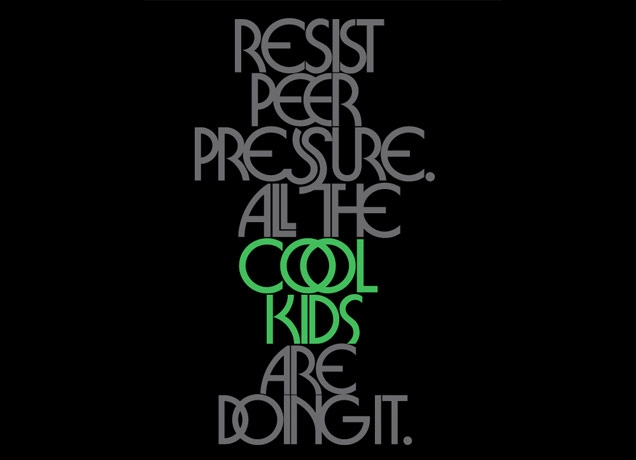
resist-peer-pressureStill, as we prepare to evaluate new designs for the kitchen, choose appliances and cabinets and counters, I know that Melton’s warning about falling victim to the “tyranny of trend” will be good ones to carry with me. ‘Cos, you know what? If it helps our project stay within budget, maybe we don’t need to get the most expensive marble countertops, or whatever the top-trend new shiny kitchen things are. A better designed space where all the things inside it work? So I can once again have the capacity to bake bread and cookies?

It’s a great way to think of the core goal.

* I am SO adding this term to my daily lexicon.

———-

Image credit:

https://www.threadless.com/product/1685/Resist_peer_pressure_All_the_cool_kids_are_doing_it


Crowning Glory

Uneasy lies the head that wears the crown.

~~ Henry IV, Part II, 3.1

I was on the search for something quick and whimsical today, and I think I may have found it:

Australian retailer BlackMilk just launched its Princess & Villains collection inspired by the ladies of Disney. To be clear, this is a line for adults. As in, adult humans are encouraged to wear this clothing on their bodies. (h/t Jezebel)

I’m pretty much in agreement with Jezebel’s Kara Brown about the ugly/tacky quotient on these. Seriously. This is a line of clothing I am not particularly upset doesn’t run into plus sizes. (I know: from a general fat activism perspective, it’s troubling when any high fashion line perpetuates thin-ness as the only body type worth draping in fashionable clothing. But speaking only for my own personal taste in clothing? I’m not real upset to have this particular line barred from me on account of the sizing and sourcing choices.)

But if nothing else, it’s a good excuse for a bit of a link-fest. (That turned into something more substantive than I originally expected. I quite literally cannot stop myself from pontificating, sometimes…)

———-

First off, some things I learned existed while Googling for this post: Disney wedding dresses. And haute couture adaptations of Disney Princess gowns. (Who knew?)

And then there’s this gallery on DeviantArt that presents Disney Princesses/Heroines garbed in “their” Princes’ outfits. True confession: There’s a number of these folks I don’t recognize at all. I used to keep up with Disney releases, but clearly I stopped doing so longer ago than I thought I had…

Anyhow. This Princess-to-Prince gallery I remember seeing back when it went viral last fall, but this one, which presents more historically accurate gowns for the characters, was new to me today.

———-

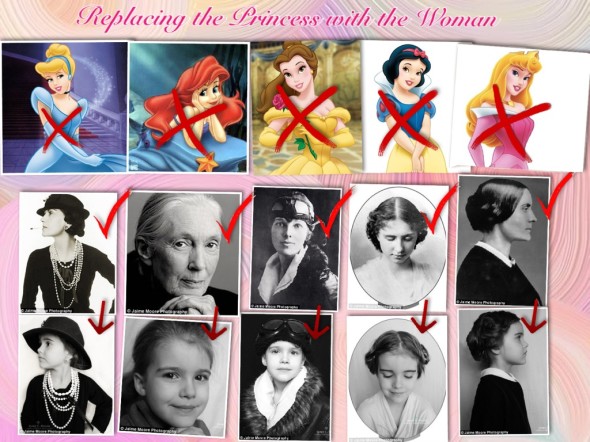
Princess-Culture-590x442“Princess Culture” is a bit of a tricky, problematic thing.

In one corner of the debate are those who point to its influence as another source for the misogynist miasma that helps reinforce the ways girls/women should be primarily focused on their attractiveness and marriageability. For example, Peggy Orenstein, author of Cinderella At My Daughter:

It’s part of this culture that encourages girls to define themselves through beauty and play-sexiness—and eventually, real sexiness—and I don’t think that’s the yardstick we want our daughters measuring themselves by.

Experts say femininity, identity and sexuality have become a performance for girls. Girls perform sexual confidence but they don’t connect it to erotic desire. It’s not about their own desire, their own self-determination.

As a parent, I didn’t realize how much of my job was going to be protecting my kid’s childhood from being a marketer’s land grab—companies telling her who she should be.

See also: Merida’s attempted Princess makeover.

Disney’s redesign of the character tamed her unruly hair, expanded her breasts, shrank her waist, enlarged her eyes, plastered on makeup, pulled her (now-glittering) dress off her shoulders, and morphed her defiant posture into a come-hither pose. The bow-wielding Merida of Brave — a character who explicitly fought against the princess world her mother tried to push her into in the film — was becoming what she hated, and inadvertently revealing the enormously problematic nature of Disney’s Princess line.

And yet, there are also those who see Disney Princesses in a different light. Possibly as a mild expression of societal — I would say “patriarchal” — values already embedded in the culture. Values more strongly caused and propagated by other sources:

It’s true that princess culture is complicit in keeping in place many of the troubling stressors women and girls suffer. But when you talk to me about impossible beauty standards and eating disorders, I’d point to Photoshop and the “obesity epidemic” before I’d point to stylized animation. When you talk to me about early sexualization of children, consider the retailers selling padded inch-thick push-up bras in the kid’s department before looking at Disney’s chaste kisses between adults. (Unless you think a kid shouldn’t see their parents kissing, in which case… I don’t think we’ll ever be on the same page.)

These are problems, sure, but they’re not problems Disney created, and Disney isn’t the primary villain here. At least not while my seven-year-old is walking by billboards for Victoria’s Secret the size of a school bus.

And then there’s even a more pointed critique of those wishing to critique Princess Culture:

Some say “Princess Culture” promotes materialism, patriarchy, and a sadistic need for long, shiny hair. Many moms worry a Snow White doll will turn their pre-K Amazons into simpering ninnies more concerned with looks than grades and goals. But they’re wrong—and I speak from personal experience. The truth is, Princess Culture helped me become more confident, more adventurous, and more okay with being different. It also helped me understand and embrace the concept of feminism at a very early age. Seriously. (Elle.)

I have enough passing nostalgia for my years loving Disney animation that I can definitely feel the pull to defend what may have been treasured bits of childhood. Still, I’m more on the side of those who remain troubled by Princess Culture. To quote Orenstein’s book (as excerpted here at NPR):

It is tempting, as a parent, to give the new pink-and-pretty a pass. There is already so much to be vigilant about, and the limits of our tolerance, along with our energy, slip a little with each child we have. So if a spa birthday party would make your six-year-old happy (and get her to leave you alone), really, what is the big deal? After all, girls will be girls, right? I agree, they will — and that is exactly why we need to pay more, rather than less, attention to what is happening in their world. According to the American Psychological Association, the girlie-girl culture’s emphasis on beauty and play-sexiness can increase girls’ vulnerability to the pitfalls that most concern parents: depression, eating disorders, distorted body image, risky sexual behavior. In one study of eighth-grade girls, for instance, self-objectification — judging your body by how you think it looks to others — accounted for half the differential in girls’ reports of depression and more than two-thirds of the variance in their self-esteem. Another linked the focus on appearance among girls that age to heightened shame and anxiety about their bodies. Even brief exposure to the typical, idealized images of women that we all see every day has been shown to lower girls’ opinion of themselves, both physically and academically. Nor, as they get older, does the new sexiness lead to greater sexual entitlement. According to Deborah Tolman, a professor at Hunter College who studies teenage girls’ desire, “They respond to questions about how their bodies feel — questions about sexuality or arousal — by describing how they think they look. I have to remind them that looking good is not a feeling.”

As such, I’m very glad to see signs of the Princess Counter-Culture. Like Orenstein’s media and activity suggestions for interested parents — including a Hiyao Miyazaki shout-out!! Or Supreme Court Justice Sonia Sotomayor giving career advice on Sesame Street:

Or Goldieblox:

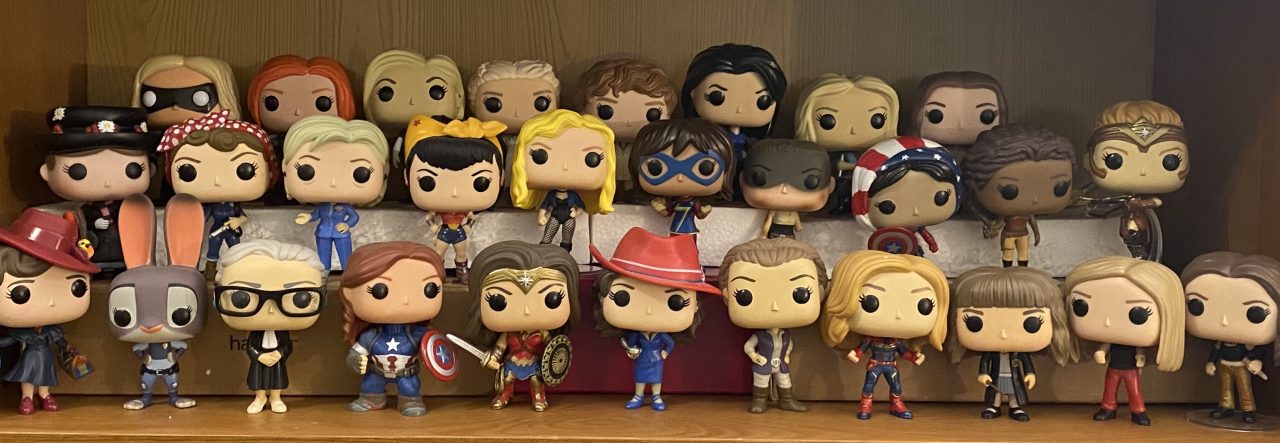
And yet. True confession #2: I have these on my desk at work:

pop-vinyl-queens

Plus a Cruella de Ville stapler.

cruella-stapler

So I’m as complicit in this commercialized mess as anyone….

———-

Image credits:

Replace the princesshttp://saraelyafi.com/2013/05/14/it-is-time-to-replace-the-princess-with-the-woman

Pop! Vinyl: http://www.toywiz.com/mini2packmalqueen.html?gclid=CjwKEAjwjN2eBRDbyPWl0JLY5lYSJACPo0Ui-tViTSQrsDJ_yiUBBT-KxYkbnS8F4leDh8iEbSD3eRoC8yXw_wcB

Cruella: http://whirlyjoy.com/2012/12/11/why-my-mascot-is-cruella-de-vil/

25 Songs, Day 1: Music to Wash Dishes By

(Part one of my exploration of the 25 songs in 25 slightly-more days blogging challenge — a way to bank and pre-schedule a few posts for JALC while I’m off a-travelling.)

25-songs-25-days

Day 1: A song from your childhood

I guess I’m like lots of folks in that I have tons of music memories from my childhood. Sesame Street 8-tracks in the car on long car trips, immersing myself in my mom’s copy of Sgt. Pepper at around the age of 8, watching my parents and their friends try to learn the Hustle in our Sao Paolo living room. But the song I’m choosing today is Dancing Queen, by ABBA.

I’m sure they’re especially front-of-mind right now because we have tickets to go see the ABBA Museum when we’re in Stockholm. But it’s also true that we listened to them a bunch during my childhood and tween years.

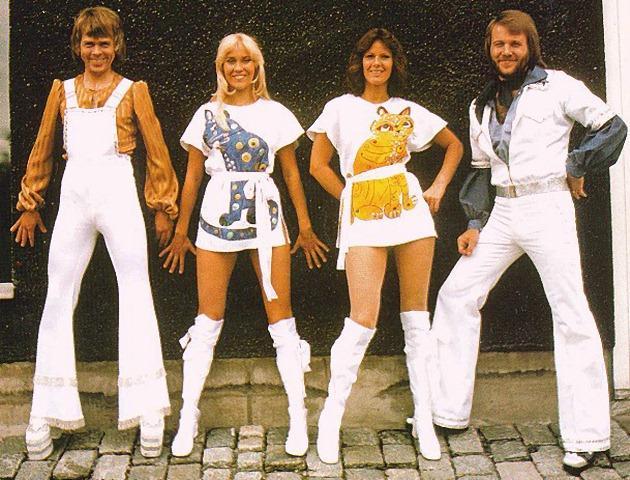
abbapicOne of the traditions we had up at the lake house during the summer was that whoever was washing the dinner dishes got to choose the music the house would listen to during that chore. On a nice night, most everyone would be out on the screened porch while the “KP crew” washed and dried and put away, but the cottage is small enough that any music being played loudly enough to reach the kitchen is also going to reach that porch and its occupants.

Clearly, the most liberal interpretation of this tradition hypothetically allowed the KP crew to “inflict” music that the rest of the family hated upon them, but there was also nothing that barred the inflict-ee from complaining vociferously about a particularly-hated music selection. So, during my tween years, I recall some small music wars, broken along generational lines, of course. My sister and me in one camp, our parents in another.

And ultimately, after a few small skirmishes, we all fell into a more nuanced expression of this tradition. For the most part we tried to choose things that maybe one side of the generation gap liked better than the other, but it would be music that we all enjoyed at least to some degree.

And that’s where ABBA came in. One of us would start the tape recording of Arrival while the other began to run the water and fill the dish basin with soap suds. By the time When I Kissed the Teacher was over, we’d be ready to wash. That evening’s DJ would crank up the volume, shimmy over to the kitchen as the opening piano glissando and ah-ah-ahs of Dancing Queen rang out into the air. And away we’d go, singing along as the dishes were done.

I enjoy a lot of ABBA’s songs, and know a surprising number of them by heart. (Even the minor hits and obscurities like When I Kissed the Teacher.) Since my fondness for the oeuvre is so wide-ranging, I almost chose Mamma Mia as my example song. After all, it and its original video have become so darn iconic, so fully representative of the Abba phenomenon:

That’s the song that became the title for the Broadway and movie musicals, and that’s the song that (to my awareness), has has been recreated in any number of endearing fashions, including this twofer from Down Under:

(Yes, Muriel’s Wedding used a different song, but those costumes! The camera angels! Those head turns! That’s a Waterloo/Mamma Mia cross-pollinated homage if I ever saw one! And Priscilla‘s just plain fun.)

But when I think back to my tween and teen years on the KP crew, it’s Dancing Queen that first rings in my head. (Now that our ABBA listening is the iTunes playlist derived from ABBA Gold, that sense of Dancing Queen as the lead-off track has only been intensified.)

Back during those fractious, difficult years, I remember our ABBA dishwashing nights as a small reminder that we all did have some threads of connection and commonality in our family: sister to sister, child to parent. I think that emotional resonance is one of the reasons I still have such fondness for ABBA’s Scandinavian disco fabulousness, and one of the reasons I’m very much looking forward to my ABBA pilgrimage in Stockholm.

———-

Image credit: http://cnsnews.com/news/article/barbara-boland/abba-went-badly-dressed-get-tax-deduction

Peace Out

peace_out_by_wirdoudesigns-d62lrkoSo today’s proposal went in and things got locked down at work, the suitcases are pretty much packed, the house-sitter is keyed up, and the boarding passes are printed. Guess it’s almost time for vacation.

Of course, all of this is being done in my usual human & imperfect fashion. The house is WAY messier than I would have preferred the house-sitter to see, but I ran out of time. There’s a couple tasks at work I wanted to get done before I “handed the baton,” but I ran out of time. (Sense a theme here?) I didn’t get as many posts in the bank as I wanted to, but — sing it with me! — I ran out of time.

Oh well, I do the best I can. And sometimes my best includes packing rather too many clothes so that I have lots of options and therefore (with any luck) can stave off some of the waves of physical and existential insecurity that happen when I’m with my extended family. The luggage scale confirms that I am within airline limit, so I’ll just count my blessings on that score and let my ego-selves have this little piece of comfort. If having the extra clothes options helps me stay in my body, enjoy all the new sights and sounds, and maybe even get deeper insight into my lineal and family patterns? That’s a trade I’m willing to make.

———-

For all the “cut corners” and imperfect execution around different pieces of the pre-trip preparations, there’s one piece of preparation I’m giving its due measure to: taking the time to set an intention for this journey.

I’m not using the term in the way it so often gets public airplay in a manifestation/law of attraction kind of context. Phillip Moffitt, in Yoga Journal, does a good job of defining intention-setting from a Buddhist perspective, a definition much more in harmony with my use of the process:

Setting intention, at least according to Buddhist teachings, is quite different than goal making. It is not oriented toward a future outcome. Instead, it is a path or practice that is focused on how you are “being” in the present moment. Your attention is on the ever-present “now” in the constantly changing flow of life. You set your intentions based on understanding what matters most to you and make a commitment to align your worldly actions with your inner values.

The extra layer in my practice is to use the process as another way of seeking Spirit’s guidance — usually through drawing a card and using the card’s message as a springboard to help shape the intention I create. (See here for a description of someone doing a similar practice as a way to kick into a new year.)

Drawing a card allows me to get out of my own way and get more of a true read on whatever it is I’m going to be studying/transmuting in a particular experience. Instead of fooling myself into thinking I know what I’m going to be studying, in a very assumptive, ego-driven, self-fulfilling prophecy kind of way.

So, my card has been drawn and I will shortly go to do a little writing meditation on the card’s message. Then, if my usual system holds true, I’ll let my unconscious work on the question while I’m sleeping, and I’ll formally put pen to paper to scribe my intention tomorrow morning. Maybe even while I’m at the airport.

Stay safe, y’all. Catch you on the flip side.

———-

Image credit: http://wirdoudesigns.deviantart.com/art/Peace-Out-367171800

These Precious Things

The final (Day 20!) prompt from Writing 101:

For our final assignment, tell the tale of your most-prized possession. If you’re up for a twist, go long — experiment with longform and push yourself to write more than usual. [. . .]

How long is long? That’s entirely up to you to decide. You can go with a set number — 750, 1000, or 2000 words, or more (or less!). Alternatively, you could choose your longest post thus far in the challenge, and raise the bar by, say, 300 words, 20 percent, three paragraphs — whatever works for you.

I’m not exactly sure I’m going to push the “longform” angle too strongly. After all, I am long-winded even in the lightest of breezes. (A quick survey of prompts 11-19 from the Writing 101 experience reveals an array of posts ranging from 615 words up to 1,040. And that doesn’t even take into consideration the posts where I get extra-ranty: this morning’s post about Burwell v. Hobby Lobby went to 1,255, while my attempted takedown of George Will went on for a full 1,609 words.)

So I don’t know how much “longer-form” this will turn out to be when compared to other long posts I’ve posted, but if nothing else, I will write something that surpasses the 1,040 mark (the longest of the set of Writing 101 posts I’ve written in the last week.)

———-

These precious things
Let them bleed
Let them wash away
These precious things
Let them break their hold over me

~ Tori Amos, Precious Thing

I’ll admit, my first thought when contemplating writing about my “most-prized possession” is the same one I have whenever I’m asked to name my favorite move/book/song: Just one?!?

I am a collector, you see.Which is really just a polite way of trying not to call myself a hoarder.

Invertigo-Fun-in-Limbo-1During the move and the endless unpacking process, I’ve had a chance to really think about various possessions and ask myself about my level of emotional connection to them. To ask myself: what is that value of this to me? Is it precious? Is it prized? Or am I just holding onto it from inertia?

And there have been a number of objects that, when interrogated through that lens, have made their way straight out of the moving box into the Goodwill box. But there are still a lot a lot of Things left, which is where my habits of clinging and attachment and cocooning myself for protection come strongly into play.

I read once somewhere about how a key distinguishing feature between a hoarder/clutter-bug and someone of a more minimalist persuasion boils down to the level of emotional meaning the clutter-bugs infuse into objects. (Too lazy to look it up right now.*) I can’t speak to the minimalist perspective because that has never been me, but I can sure say I’ve lived — am living — the piece about infusing objects with emotional weight.

And the strength of those emotional attachments create the spiderwebbing that has kept me bound to so many things. The books I have held because they symbolize the years I spent in grad school, or my spiritual journeys through neo-paganism, Unitarian Universalism, and buddhism. The veils and hip scarves from when I took belly dancing classes and was more comfortable in the movement and miracle that is my body. The artwork and knick-knacks that remind me of different childhood years, different homes, the seasons and tides of my life. These precious things hold memories for me, which makes them harder for me to release.

Then in addition to my sentimentality, there’s a whole other complex that imbues objects with disproportionate value to me. The trauma-driven need for safety: the desire to have supplies on hand hand so that I can be prepared for life’s twists and turns. That’s where the different stashes come into play. Office supplies, candles, kitchen tools, clothes across the various body sizes I’ve had during the past couple of years. Never know when a lemon zester will come in handy.

Add these two complexes together, and no wonder I’m having such a hard time releasing the clutter. Especially when you factor in two other threads.

First are the items that I know I don’t want to keep but that have such familial baggage around them I haven’t figured out how to free myself. Some day I could tell you a whole damn story about this antique china I got floating around with nowhere to live and no real soul-resonance for me. I know these items should not be in our house, I have known it to my bones since the lightning bolt of awareness hit me back in early February. But I hold such intense layers of fear around the shit-storm I would cause if I tried to get rid of these items that I remain paralyzed, stewing in my childish immaturity.

Also, I know that amidst the stuff-mountains inspired by these various complexes rest objects that are legitimately of sufficient value — whether emotionally, spiritually, or practically — that they are truly precious. I might eventually get myself to a place where I am living an incredibly minimalist life, but even in my most zen-like of imagined homes, I see a coffee maker, my journals, my wedding ring on my finger.

These precious things. Let them break their hold on me. Let me continue to examine and discern and piece by piece, may I release and be released.

———-

Well, this did not rate as “longform” for me, but it’s been an odd, upset kind of night, so this is quite literally the best I can do with this topic in this context. So, 946 words it is.

* Scholarly blasphemy! Someone come rescind the Ph.D. I never finished! (Oh, wait…)

———-

Image credit: http://artsmeme.com/2011/09/21/invertigo-dance-theatre-fun-clutter/

My Old Ohio Home

Catching up on Writing 101. Day 11, brought to you by the letter “L” for late and the number “18” for the actual day it was posted on.

Today, tell us about the home you lived in when you were twelve. For your twist, pay attention to — and vary — your sentence lengths.

Good heavens, Daily Post people! What is it with your obsession with writing about our homes!?!

First there was that long post about my current home. . . . Oh, wait.

That post could have been about any place anywhere in the world. It was just my own nesting instincts that led it to be home-focused.

But how about this childhood home thing? I was free-writing about that in my pen and paper journal recently. . . . Oh, wait!

That was free writing, which is, indeed, a habit strongly encouraged by the Writing 101 folks. However, the definition of what “free writing” is pretty much mandates that specific topics come from inside of me rather than being externally imposed.

So if there’s any spooky obsessiveness around the topic of home and childhood, that’s all on me, baby.

———-

For all of the times we moved during my childhood, we did a pretty good job at scheduling most of those disruptions to take place during summer vacation. That detail, plus my September birthday — meaning that every school grade neatly lines up with a single chronological year for me — makes it super-easy for me to dial up past houses/apartments in my memory. It goes something like this: 12 years old would put me in 7th grade,* which means we’re talking about that second time in Ohio.

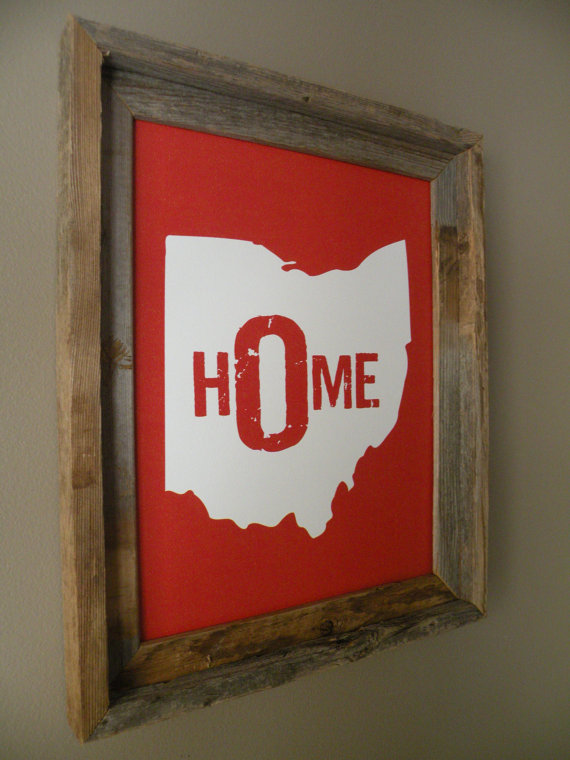
ohio-home-etsyI could share the street address with you, but I won’t. The number is burned into my brain but also disconnected from the current paper trail of my existence. So it’s possible that these digits might sometimes get used as the PIN number on my frequent flyer accounts. (Hypothetically speaking, of course.) And I needs to keep my miles.

I’m close to having a picture of the floor plan in my mind. Even though it was in the Midwest, it was another of those “two-story center entrance colonials” I was so glad to avoid in my most recent round of house-hunting. Standing in the front entryway, the staircase was to the right side of the entry hall, with an open doorway at the foot of the stairs leading to the front-to-back living room, with the screened porch jutting even further back off the horse’s perimeter. A waist-high railing separated the back side of the family room from the “breakfast area” and kitchen. Then, continuing the counterclockwise circle, was the dining room and, past that, the formal living room. I never visited there except during Christmastime, when the tree would be placed in the bay window, decorated and lit with bright colors. We’d sit there after dinner and talk — no lights except the tree and the electric candles in the windows.

The master suite was directly to the right at the top of the stairs. Its front-to-back  arrangement echoed the family room below. Meanwhile, down the hall to the left was the guest room, a bathroom, maybe even an extra extra bedroom that had been turned into dad’s home office? The end of the hall, I’m sure about: my room in front, my sister’s in back. My carpet and walls were bright yellow, and I had a habit of rethinking and re-arranging the furniture in my room when I was in need of a bit of self-re-invention.

You may notice that I’ve been focusing my attention on the sheer physicality of this house. It’s not like I’m breaking any rules with that decision. After all, the prompt was to talk about the home I lived in back then. So here I am, talking. Or writing.

But I am going to stop here, having written about the house, but without really writing about the living in that house. As I recall it, 7th grade was an especially tough one on the awkward-adolescence and misfit-family-member scale. And there’s some memories that just don’t need reliving right now.

* “Age minus 5” is the formula that holds true for me.

———-

Image credit: https://www.etsy.com/listing/124506359/ohio-home-print-red?

(In case this specific item gets sold and the link becomes defunct, go here to get to the Etsy seller’s main store-front.)

Melting My Heart

Years and years ago, I saw a Christmas-themed TV commercial where an adorable redhead is running to tell her parents that Santa had arrived! As they walk into the living room to see mountains of gifts piled up, Dad says something about “Those must have been some cookies you left out for Santa last night.” And the adorable redhead says….

Wait, let me do a Youtube check and see if I can embed the punchline for you to see with your own eyes:

(I [heart] the Internet.)

cheese-dogI have remembered this commercial with shocking clarity because it made such a profound impression on me. I, like this fictional Santa, am much more a lover of cheese than of cookies. Y’all may recall that different times throughout my HCG journey I talked about missing cheese, and when I was in that last stage of partial food restriction (fats okay, but still no carbs or grains), the thing I was most happy to bring back into my daily routine was cheese. I’m still having a cheese and egg white omelet for breakfast most mornings,* and there’s plenty of days where my late afternoon protein boost is a cheese stick or two. (Except the days it’s a small container of cashews.)

From childhood into adulthood, when I had toast or an English muffin for breakfast, I would always want to have a slice of melted cheese on top, instead of jelly. And my absolutely favorite food during my childhood was  macaroni and cheese. Lest I oversell the contrast between my childhood self and my sage maturity today, let me be really clear: I have not outgrown that love for mac & cheese. (Nor do I ever want to.)

But, even though I feel greatly abashed and embarrassed to say this — especially on a week when there’s been this whole kerfuffle about the FDA’s attempt (thankfully abandoned) to ban the making of artisanal cheeses — I have a confession to make.

I love Velveeta.

Your toxic kisses make my heart race
Faster than a cheetah
I’ve been stapled and spindled
My willpower’s dwindled
You melt resistance down like hot Velveeta!

~Reefer Madness, “Mary Jane/Mary Lane

I know, I know. Velveeta isn’t even really a cheese. The label on the box says “pasteurized recipe cheese food,” and I don’t know exactly what that means, but I do know it means “not really a real cheese.

And yet, it was a core pillar of my formative cheesy experiences. Something about its peculiar, pasteurized and processed nature gives it that uniquely “liquid gold” melty-ness. So, for many many childhood foods in my memory — the melted sauce for mac & cheese, melting a slice of cheese on top of that English muffin, cheeseburgers on the grill, cheese melted into an omelet for Sunday brunch, or even our cheese fondue on Christmas Eve — Velveeta was part of the recipe.

During those few years when we lived in Brasil, whenever Dad would head stateside for a business trip, we’d send him with an extra-large suitcase. It’d be mostly empty on the flight to the USA, and then would return chock-full of Velveeta cheese blocks and cans of Campbell’s Tomato Soup. Mom would host her own personal Velveeta cooking festival,** and I, hopelessly picky about food and struggling always to adjust to the heat, the flavors and the concrete surfaces of Sao Paolo, would feel, if only for a few dinners, like I was home.

As years have worn on, I have come more and more to replace Velveeta with really real cheeses in my life. So now, the morning omelet is made with colby-cheddar shred, the afternoon cheese sticks are mozzarella or cheddar, and if I’m melting cheese on top of toast it’ll be swiss or provolone. As for that Christmas Eve fondue? My brother-in-law, who is quite a talented cook but who doesn’t get much of a chance to express that with his work schedule, has taken that over and concocts a new and yummy combination every year.

But still. A block of Velveeta has been a perpetual staple in my fridge for my entire adult life, maintaining its prominence for two specific dishes: mac & cheese and queso. There’s even an unopened package in my fridge right now. (Why do you think it was so easy for me to get the precise wording off the box describing how it’s not really a real cheese?)

I bought it on autopilot right before I started the HCG journey, so it’s been sitting there a while. That hasn’t especially worried me — I figure the expiration date is probably 2023 or something. But I haven’t quite figured out whether I’m going to start eating it again, or toss it out unopened. I’m also not sure which imagined outcome of eating it scares me more: the possibility that my reset palate will find the flavor to be not-very-enjoyable and that my nostalgic love for Velveeta will be tarnished, or the possibility that renewed relationship with Velveeta will slide me right down the rabbit-hole of over-processed food all the time….

Until I can figure that out, I guess the package will just sit there on the bottom shelf of the fridge.

[Post-script] Writing 101, Day 10 prompt:

Tell us about your favorite childhood meal — the one that was always a treat, that meant “celebration,” or that comforted you and has deep roots in your memory.

Free free to focus on any aspect of the meal, from the food you ate to the people who were there to the event it marked.

Today’s twist: Tell the story in your own distinct voice.

Obviously, rather than following the suggestion to the letter, I ended up following the thread of a beloved food throughout multiple times and events. I also didn’t fret overmuch about “finding my voice.” If there is nothing else I am certain about in writing JALC, I do know that my voice here is authentic and authentically mine.

I can’t remember if I’ve talked about this before, but every time I sit down to write a post, and every time I feel blank or blocked within the process, the same prayer runs through me like a mantra: “Say it plain, say it true.” And yeah, my version of saying things “plain” is a slightly unusual version of the term.*** But that prayer, that compass guides me to true north. Every time. [/Post-script]

* Okay, it’s really one whole egg and a half-cup of egg whites.

** Our family’s separate body of Campbell’s Tomato Soup cuisine will, alas, have to wait for another day.

*** Perhaps the understatement of the year.

———-

Image credit: http://veryhilarious.com/i-notice-you-have-cheese/