
These Precious Things

The final (Day 20!) prompt from Writing 101:

For our final assignment, tell the tale of your most-prized possession. If you’re up for a twist, go long — experiment with longform and push yourself to write more than usual. [. . .]

How long is long? That’s entirely up to you to decide. You can go with a set number — 750, 1000, or 2000 words, or more (or less!). Alternatively, you could choose your longest post thus far in the challenge, and raise the bar by, say, 300 words, 20 percent, three paragraphs — whatever works for you.

I’m not exactly sure I’m going to push the “longform” angle too strongly. After all, I am long-winded even in the lightest of breezes. (A quick survey of prompts 11-19 from the Writing 101 experience reveals an array of posts ranging from 615 words up to 1,040. And that doesn’t even take into consideration the posts where I get extra-ranty: this morning’s post about Burwell v. Hobby Lobby went to 1,255, while my attempted takedown of George Will went on for a full 1,609 words.)

So I don’t know how much “longer-form” this will turn out to be when compared to other long posts I’ve posted, but if nothing else, I will write something that surpasses the 1,040 mark (the longest of the set of Writing 101 posts I’ve written in the last week.)

———-

These precious things
Let them bleed
Let them wash away
These precious things
Let them break their hold over me

~ Tori Amos, Precious Thing

I’ll admit, my first thought when contemplating writing about my “most-prized possession” is the same one I have whenever I’m asked to name my favorite move/book/song: Just one?!?

I am a collector, you see.Which is really just a polite way of trying not to call myself a hoarder.

Invertigo-Fun-in-Limbo-1During the move and the endless unpacking process, I’ve had a chance to really think about various possessions and ask myself about my level of emotional connection to them. To ask myself: what is that value of this to me? Is it precious? Is it prized? Or am I just holding onto it from inertia?

And there have been a number of objects that, when interrogated through that lens, have made their way straight out of the moving box into the Goodwill box. But there are still a lot a lot of Things left, which is where my habits of clinging and attachment and cocooning myself for protection come strongly into play.

I read once somewhere about how a key distinguishing feature between a hoarder/clutter-bug and someone of a more minimalist persuasion boils down to the level of emotional meaning the clutter-bugs infuse into objects. (Too lazy to look it up right now.*) I can’t speak to the minimalist perspective because that has never been me, but I can sure say I’ve lived — am living — the piece about infusing objects with emotional weight.

And the strength of those emotional attachments create the spiderwebbing that has kept me bound to so many things. The books I have held because they symbolize the years I spent in grad school, or my spiritual journeys through neo-paganism, Unitarian Universalism, and buddhism. The veils and hip scarves from when I took belly dancing classes and was more comfortable in the movement and miracle that is my body. The artwork and knick-knacks that remind me of different childhood years, different homes, the seasons and tides of my life. These precious things hold memories for me, which makes them harder for me to release.

Then in addition to my sentimentality, there’s a whole other complex that imbues objects with disproportionate value to me. The trauma-driven need for safety: the desire to have supplies on hand hand so that I can be prepared for life’s twists and turns. That’s where the different stashes come into play. Office supplies, candles, kitchen tools, clothes across the various body sizes I’ve had during the past couple of years. Never know when a lemon zester will come in handy.

Add these two complexes together, and no wonder I’m having such a hard time releasing the clutter. Especially when you factor in two other threads.

First are the items that I know I don’t want to keep but that have such familial baggage around them I haven’t figured out how to free myself. Some day I could tell you a whole damn story about this antique china I got floating around with nowhere to live and no real soul-resonance for me. I know these items should not be in our house, I have known it to my bones since the lightning bolt of awareness hit me back in early February. But I hold such intense layers of fear around the shit-storm I would cause if I tried to get rid of these items that I remain paralyzed, stewing in my childish immaturity.

Also, I know that amidst the stuff-mountains inspired by these various complexes rest objects that are legitimately of sufficient value — whether emotionally, spiritually, or practically — that they are truly precious. I might eventually get myself to a place where I am living an incredibly minimalist life, but even in my most zen-like of imagined homes, I see a coffee maker, my journals, my wedding ring on my finger.

These precious things. Let them break their hold on me. Let me continue to examine and discern and piece by piece, may I release and be released.

———-

Well, this did not rate as “longform” for me, but it’s been an odd, upset kind of night, so this is quite literally the best I can do with this topic in this context. So, 946 words it is.

* Scholarly blasphemy! Someone come rescind the Ph.D. I never finished! (Oh, wait…)

———-

Image credit: http://artsmeme.com/2011/09/21/invertigo-dance-theatre-fun-clutter/
At the Vocational Lost and Found

[Set-up] This is the Day 16 prompt for Writing 101 — the conclusion of a three part series that began with me “losing” academia, continued with the story of how I found my career path as a non-profit fund-raiser, and now…

Today, imagine you work in a place where you manage lost or forgotten items. What might you find in the pile? For those participating in our serial challenge, reflect on the theme of “lost and found,” too.

There’s been a slight re-imagining of the topic to fit my own memoirist approach to blogging. But not as much as I might initially have imagined. [/Set-up]

———-

During my own journey from academia into non-profit management, I was aided greatly by an online community that continues to this day under the moniker Versatile Ph.D.  The community was founded by Paula Chambers, whose own biography on the site reads like its own saga of “lost and found”:

In 1991 at age 29, she left the entertainment industry and returned to school. . . . Midway through her PhD program, she realized that she would probably be happier in a nonacademic career, and founded a listserv called WRK4US (Work For Us) while dissertating, to provide a safe space where humanities PhD students could openly discuss non-academic careers. . . . After graduating in 2000, Dr. Chambers . . . became a successful grant writer and fundraiser. . . . All the while, she continued managing WRK4US in her spare time. Eventually, Paula finally realized that helping academics find non-academic careers was her true calling. She transformed WRK4US the listserv into Versatile PhD, a web-based socially positive business, in 2010. Paula runs The Versatile PhD from her home office in Los Angeles and is an in-demand speaker on the university circuit.*

And, no, I don’t work there, but I do maintain my participation, as best I can: reading the threads of discussion on the user fora, answering questions when I can and when I feel I have something worthwhile to add.

In order to maintain itself as a safe space for people to explore alt-ac careers, VPhD has a strict confidentiality policy — an entirely appropriate move, considering the unfortunate myopia too many tenured professors still have about alt-ac career paths, and the very real trouble that can be caused by such blindness and prejudice when the privileged old guard discovers someone is looking for different career options.

Out of respect for this entirely-appropriate policy, I’m not going to be dishing specifically on anyone’s life story. But even painting in broad brushstrokes, it’s amazing to consider the mixture of variability and commonality that exists within these many post-academic transitions. Everyone’s path is uniquely unique, but there are also threads of intersection, shared losses and common discoveries.

For example, there have been numerous explorations of the grieving process that occurs during the ac-to-post-ac transition. As JC articulates in hir blog From Grad School to Happiness:

You’re not just losing the concrete academic work that you either loved or hated. You’re losing an identity that you’ve had for years or decades. You’re losing a culture, and a prestigious job title, and a career path that you were convinced was going to lead to lifelong happiness. Whether you’re leaving voluntarily or because of circumstances outside of your control, it’s normal to feel some grief and sadness at such a tremendous loss of identity.

At VPhD, we’ve discussed this same loss of identity from all the moments of the journey, from voices deep in the midst of the losing, to those of us who are years-if-not-decades past the initial grieving process and can still remember the pains, the tears, and — thankfully — the coming through into a better place.

On the flip side, there’s the trajectory of self-discovery many of us traverse: finally having the space to figure out what it is we’re good at and what we actually like to do. There are places where that process is terrifying, but it can also be really exciting.

Currer Bell** writes on the site How to Leave Academia: “You do indeed have skills that workplaces value.” And it’s true.

be-more-awesomeBut perhaps more exciting to me than simply tallying up my list of transferable skills was to understand how certain things that were taken for granted at UPenn, or even devalued there, were immensely valuable once I kicked into my non-profit career. In grad school, I was no great shakes for reading and assimilating text quickly, at least not when compared to my grad school peers. Out in my non-profits? I get pretty high marks on that score. And that wacky dedication I felt to making sure student papers were graded quickly and thoroughly, even when it got me in trouble with my dissertation research? That deadline focus and those quick editing skills have been priceless when negotiating a calendar of aggressive grant deadlines.

I think there’s a certain strain of perfectionism that infects most academic settings, and so to immerse yourself in that environment can often lead one to sink deeper and deeper into the self-perception of “not good enough.” So to find out that out in the big wide world, you can indeed be good enough? And not just good enough in a “barely getting by” kind of way, but in a “fulfilled by my life and impacting the world positively” kind of way?

It’s the best thing I ever came across in the vocational lost and found.

* Apologies if my edits cut the bio to ribbons — I’m trying to use briefer quotes and write shorter things, now and again. (At least “shorter” by my own long-winded standards…)

** Love it!

———-

Image credit: https://popforms.com/maximize-your-strengths/


My Old Ohio Home

Catching up on Writing 101. Day 11, brought to you by the letter “L” for late and the number “18” for the actual day it was posted on.

Today, tell us about the home you lived in when you were twelve. For your twist, pay attention to — and vary — your sentence lengths.

Good heavens, Daily Post people! What is it with your obsession with writing about our homes!?!

First there was that long post about my current home. . . . Oh, wait.

That post could have been about any place anywhere in the world. It was just my own nesting instincts that led it to be home-focused.

But how about this childhood home thing? I was free-writing about that in my pen and paper journal recently. . . . Oh, wait!

That was free writing, which is, indeed, a habit strongly encouraged by the Writing 101 folks. However, the definition of what “free writing” is pretty much mandates that specific topics come from inside of me rather than being externally imposed.

So if there’s any spooky obsessiveness around the topic of home and childhood, that’s all on me, baby.

———-

For all of the times we moved during my childhood, we did a pretty good job at scheduling most of those disruptions to take place during summer vacation. That detail, plus my September birthday — meaning that every school grade neatly lines up with a single chronological year for me — makes it super-easy for me to dial up past houses/apartments in my memory. It goes something like this: 12 years old would put me in 7th grade,* which means we’re talking about that second time in Ohio.

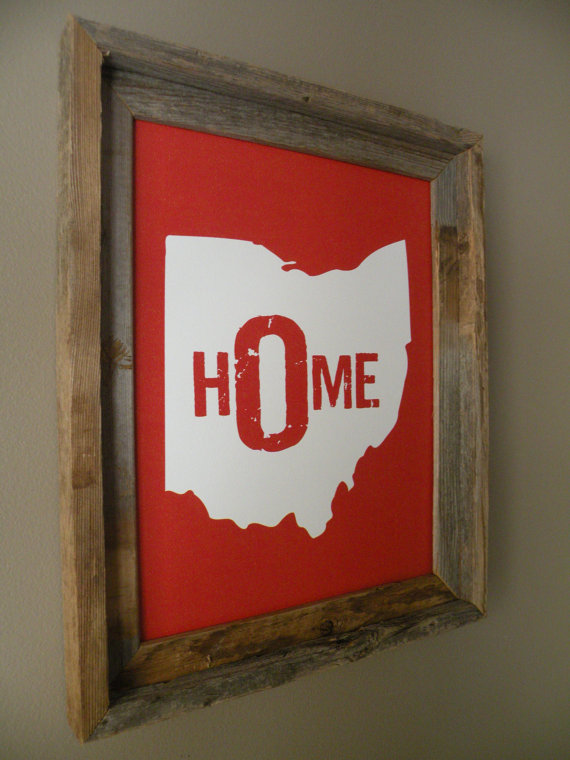
ohio-home-etsyI could share the street address with you, but I won’t. The number is burned into my brain but also disconnected from the current paper trail of my existence. So it’s possible that these digits might sometimes get used as the PIN number on my frequent flyer accounts. (Hypothetically speaking, of course.) And I needs to keep my miles.

I’m close to having a picture of the floor plan in my mind. Even though it was in the Midwest, it was another of those “two-story center entrance colonials” I was so glad to avoid in my most recent round of house-hunting. Standing in the front entryway, the staircase was to the right side of the entry hall, with an open doorway at the foot of the stairs leading to the front-to-back living room, with the screened porch jutting even further back off the horse’s perimeter. A waist-high railing separated the back side of the family room from the “breakfast area” and kitchen. Then, continuing the counterclockwise circle, was the dining room and, past that, the formal living room. I never visited there except during Christmastime, when the tree would be placed in the bay window, decorated and lit with bright colors. We’d sit there after dinner and talk — no lights except the tree and the electric candles in the windows.

The master suite was directly to the right at the top of the stairs. Its front-to-back  arrangement echoed the family room below. Meanwhile, down the hall to the left was the guest room, a bathroom, maybe even an extra extra bedroom that had been turned into dad’s home office? The end of the hall, I’m sure about: my room in front, my sister’s in back. My carpet and walls were bright yellow, and I had a habit of rethinking and re-arranging the furniture in my room when I was in need of a bit of self-re-invention.

You may notice that I’ve been focusing my attention on the sheer physicality of this house. It’s not like I’m breaking any rules with that decision. After all, the prompt was to talk about the home I lived in back then. So here I am, talking. Or writing.

But I am going to stop here, having written about the house, but without really writing about the living in that house. As I recall it, 7th grade was an especially tough one on the awkward-adolescence and misfit-family-member scale. And there’s some memories that just don’t need reliving right now.

* “Age minus 5” is the formula that holds true for me.

———-

Image credit: https://www.etsy.com/listing/124506359/ohio-home-print-red?

(In case this specific item gets sold and the link becomes defunct, go here to get to the Etsy seller’s main store-front.)

Quicksand of a Different Sort

Some days it’s like moving through quicksand. Each step, each motion carries the extra weight of pushing through the muck, knowing that every motion carries its own risk of dragging me deeper into the suffocating, drowning mud.

Some days it’s like being wrapped in fabric. It’s hard to hear things clearly. Lights and colors are dulled. The sharpness of time and recollection fade around the edges. Thoughts and attempts to find voice are all muffled, and not even muffled in nice, soft flannel. More like rough-spun wool, with its scratchy, sharp-edged fibers.

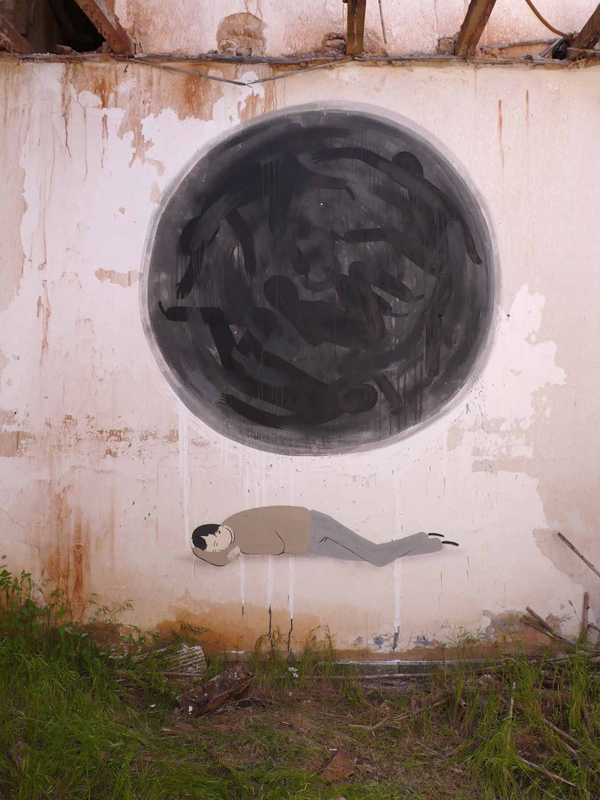
escif_May10_2_uSome days it’s like swimming in the riptide. An immense effort is required to make even the slightest bit of progress, and the risk is high that all one’s energy reserves can be depleted making this insignificant progress. Without vigilant awareness — and the judicious support of a life preserver here and there — the risk is also high of getting pulled under to breathe salt water and seaweed.

Some days it’s like the gravitational pull of a black hole. The forces of weight and gravity are so strong as they could cause a star to collapse in on itself, devouring the light and heat and energy of nature’s expression. The dark spiral of the bed-covers entwine me, holding me still and silent. Sound can’t travel in space, and the same dearth of oxygen bubbles around me, constantly suffocating.

Most days it’s like living with some sort of energetic tapeworm. Whatever nourishment I take in — rest, joy, encouragement — there’s some portion of that soul food that gets siphoned away, devoured by the parasite I carry in my brain chemistry. It seems selfish how much more nourishment I crave and request: you can’t see the hidden passenger thieving my life, thieving your gifts of kindness, love, appreciation.

Every day there is the vigilance. Have I stayed in bed a little too long? Is my resilience a little bit too shaky? Is my energy level a little too low?

I was first treated for depression back around the age of 15. Looking back beyond that, I think that some pieces of that tapestry were woven into the fabric of my life long before then. And I’m well aware that there is a vast chasm of difference between true clinical depression and the kinds of smaller sadnesses and blue moods that so often get referred to by the term.

Yet for me, there is a tonal connection from one to the other. A dotted line that sometimes-but-not-always connects the border of everyday sadness into the terra horribilis of a depressive episode. So I remain ever-watchful at any sign of sadness, energy drop, memory lapse. Analyzing any break in routine, any chink in the psychological structure.

Is today the day the beast starts crawling back?

———-

Post in response to the Day 17 prompt for Writing 101:

We all have anxieties, worries, and fears. What are you scared of? Address one of your worst fears.

Today’s twist: Write this post in a distinct style from your own.

I don’t usually go so full-out poetical, so this was a dip into the waters of that styling. Can’t decide if I think it’s genuinely evocative, or just too, too precious. It was an experiment worth trying, if nothing else.

Also, full disclosure: the “depression as tapeworm” metaphor is one I first saw a few weeks ago in a post by Mani Cavalieri on Quora. (I can’t figure out how to directly link to his answer, but you’ll find it as part of this thread.) I was very deliberate in not going back to re-read the post tonight, so my own spring-boarding off the metaphor would be solely (mostly?) my own. Still, credit where credit is due: I don’t think that metaphoric thread would have been anywhere on my radar without reading his writing on the subject. And it’s so brilliant and so entirely apt.

———-

Image credit: http://www.unurth.com/Escif-In-The-Mountains-Spain


Found Money

[Set-up] It looks like I’m going to continue to need a little flexibility and creativity with Writing 101 . Today’s actual assignment is the completion of a three part series I started back on “Day 4.” Of course, I haven’t actually written part two of this three-part series — because that’s one of the pieces I skipped during last week’s work insanity. So I guess I won’t actually be jumping right into this week’s assignments. Instead, there will be a targeted reach-back to last Wednesday’s assignment, as a precursor to whenever I get around to doing today’s.

So, Day 13, written on what should actually be Day 16 of the sequence:

On day four, you wrote a post about losing something. Today, write about finding something. . . . Today’s twist: if you wrote day four’s post as the first in a series, use this one as the second installment — loosely defined.

You could pick up the action where you stopped, or jump backward or forward in time. You might write about the same topic, but use a different style, or use the same style to tackle a neighboring topic.

[/Set-up]

———-

So, gentle reader, when I last left the abbreviated summary of my life’s career trajectory, I had drifted into both an environment (academia) and a profession (faculty) for which I was profoundly ill-suited. To some degree, the inner rumblings around that ill-suitedness began very early. And yet, I struggled to persevere. Buckled down to overcome the deficiencies of my mass-market, public school background. Shifted graduate programs to one where I had more natural gifts and talents than my first Ph.D. curriculum.

Why was I so damn stubborn? In part because I am really, truly so damn stubborn. But a lot of it was rooted in a basic survival-level fear that there wasn’t anything besides teaching/professor-ing that I could ever make a living at.

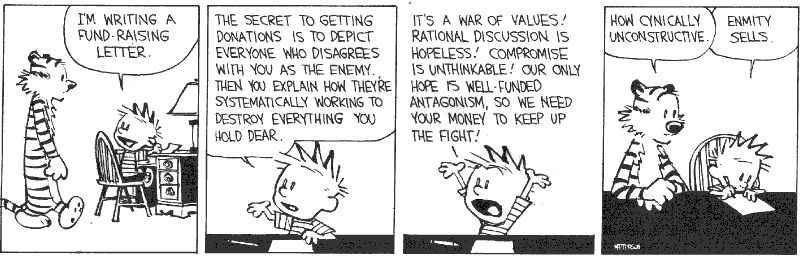
calvin-on-fund-raising

I dare say I kinda fell into my career. It’s not like I wandered around elementary school saying “I want to be a fund-raiser when I grow up!” And, really, who would go around saying that? Do the ins-and-outs of non-profit management get any airplay in the Sesame Street/Richard Scarry “People in my Neighborhood” set?

Nowadays there’s definitely more awareness at the college level of non-profit careers. But that’s a big shift from when I went to school, back when dinosaurs roamed the earth.

I actually wrote my first successful grant proposal as a bit of volunteer service for a community choir where I was singing. I’d somehow talked my way onto the choir’s board as a general member-at-large, and was eager to find ways to prove my worth and contribute. So when the Board president asked for someone to help write some grant proposals, I figured it’d be an easy thing to do. I’m a good writer. I even know how to teach writing, don’t I? A grant proposal should be simple!

And here’s the kicker: it kinda was.

This is not to minimize the ways that grant-writing is intensely different from the stylistic and argumentative conventions of academic prose. But where I always found myself struggling and straining against those academic conventions, the general transparency of grant guidelines, and the need to build a tight, compelling argument out of plain language was a genre of writing that made instinctive sense to me.

And then we got the money.

So suddenly, something that both came naturally to me — writing plain, strong prose — and that I had studied intensely — how to analyze genre and build written arguments* — had real, honest-to-goodness street creed and value to it. I had worked for less than a weekend, and my choir now had several thousand dollars to show for that effort.

Now, obviously, that initial grasp of what it took to be a grants professional was, in its own way, appalling naive. I had a lot to learn in the first few years of my career — though the learnings were sufficiently connected to my existing strengths and background knowledge that success was possible.

And I still have moments where I question whether fund-raising is really the “forever career” for me. The division and tension I have seen at every non-profit between those who raise the money and those actually out doing the work is one that troubles me. I know the privileges of being in the fund-raising camp. But I also have never entirely been able to let go of a nagging self-quesitoning about whether I really want to spend the rest of my life being “just a fund-raiser” — after all, the Gospel of Matthew suggests that “you cannot serve both God and mammon” (6:24).

But even with those ongoing questions about whether there is a third career yet to unfold in my life, I remain profoundly grateful that I was able to lose academia and find my way into grants and fund-raising. I have become very good at what I do, I have seen the benefits of my efforts take shape in programs and services and buildings, and I have been able to make a living for myself.

* Or “analyze funder guidelines and build a responsive case for support.”

———–

Image credit: http://s102.photobucket.com/user/pb82/media/Cartoons/calvin-on-fund-raising.gif.html

What I Learned in Grad School

Okay, so the big super-huge work project got even more intense than I’d anticipated, so I went full-out on it till Thursday night. Then, instead of sleeping and catching up on my rest and my writing, Mr. Mezzo and I have been out of town for the past two days celebrating my niece’s graduation. So, suddenly I missed an entire week’s worth of Writing 101 assignments, and the next crop of assignments is due to start up again tomorrow morning.

Now, one thing I learned in grad school is the strategic folly of always trying to go back and play catch-up.

Let’s say you fall behind on your reading for Week 3 in a particularly dense syllabus — like, say, the kind of syllabus where the professor keeps adding new articles to the reading list year after year, without taking away any of the older, less-academically-relevant ones. (Not that I ever had any grad classes like that back in the day. This is all purely a hypothetical exercise…..)

lawrence-wink

Anyhow.

One approach to take to this conundrum would be to start Week 4 by going back to the things you missed in Week 3, hoping to address all of the backlog and all the new assignments. But, if each week’s workload is too robust to be handled in a week, the only thing you gain by that approach is to just get farther and farther behind.

So after one or two courses where I tried to do the virtuous “going back and catching up on everything” routine, I developed a new discipline around falling behind on homework.

Step one for me is to jump right back into the stream at this moment. Hit the reset button, start with the new crop of work, do all of it to the best of my ability — and then, if I do end up with some luxurious extra time after that, only then will I try to go back and fill in what I’ve missed, using my own instincts to triage out what’s most important and what’s most able to be let go.

So, tomorrow I’ll be jumping back into the Writing 101 flow with this coming week’s assignments, and I’ll go back and fill in the missed ones in whatever order I choose to do them.

I have some hope that the work week will be a little quieter than the past fortnight has been. If that turns out to be the case, I may get home early enough to manage a double-posting day or two throughout the week, which would help with the backlog. I also could get creative and see if there’s a way I can kill two assignments with one essay, as it were. Or there may just be an assignment or two that I let slide by, water flowing under the bridge of best intentions, never to be seen or recaptured again.

And I’m okay with that. Aside from the specific workflow strategies I am applying here to my bloggy-life, the main thing I learned in grad school was the complete psychic and energetic uselessness of perfectionism and how pointless it is to do that inner ballet of self-flagellation when one shows one’s humanity by doing an imperfect or fallible thing.

Admittedly, that main lesson only partly sunk in. I keep learning and studying and practicing into that one. Step by step, I continue ever onward — following the trajectory away from self-punishing perfectionism and towards maturity and self-acceptance.

Here, now, with Writing 101, is as good a time to practice that as any.

———-

Image credit: http://giphy.com/gifs/pzmTB7cwkfx0Q

Melting My Heart

Years and years ago, I saw a Christmas-themed TV commercial where an adorable redhead is running to tell her parents that Santa had arrived! As they walk into the living room to see mountains of gifts piled up, Dad says something about “Those must have been some cookies you left out for Santa last night.” And the adorable redhead says….

Wait, let me do a Youtube check and see if I can embed the punchline for you to see with your own eyes:

(I [heart] the Internet.)

cheese-dogI have remembered this commercial with shocking clarity because it made such a profound impression on me. I, like this fictional Santa, am much more a lover of cheese than of cookies. Y’all may recall that different times throughout my HCG journey I talked about missing cheese, and when I was in that last stage of partial food restriction (fats okay, but still no carbs or grains), the thing I was most happy to bring back into my daily routine was cheese. I’m still having a cheese and egg white omelet for breakfast most mornings,* and there’s plenty of days where my late afternoon protein boost is a cheese stick or two. (Except the days it’s a small container of cashews.)

From childhood into adulthood, when I had toast or an English muffin for breakfast, I would always want to have a slice of melted cheese on top, instead of jelly. And my absolutely favorite food during my childhood was  macaroni and cheese. Lest I oversell the contrast between my childhood self and my sage maturity today, let me be really clear: I have not outgrown that love for mac & cheese. (Nor do I ever want to.)

But, even though I feel greatly abashed and embarrassed to say this — especially on a week when there’s been this whole kerfuffle about the FDA’s attempt (thankfully abandoned) to ban the making of artisanal cheeses — I have a confession to make.

I love Velveeta.

Your toxic kisses make my heart race
Faster than a cheetah
I’ve been stapled and spindled
My willpower’s dwindled
You melt resistance down like hot Velveeta!

~Reefer Madness, “Mary Jane/Mary Lane

I know, I know. Velveeta isn’t even really a cheese. The label on the box says “pasteurized recipe cheese food,” and I don’t know exactly what that means, but I do know it means “not really a real cheese.

And yet, it was a core pillar of my formative cheesy experiences. Something about its peculiar, pasteurized and processed nature gives it that uniquely “liquid gold” melty-ness. So, for many many childhood foods in my memory — the melted sauce for mac & cheese, melting a slice of cheese on top of that English muffin, cheeseburgers on the grill, cheese melted into an omelet for Sunday brunch, or even our cheese fondue on Christmas Eve — Velveeta was part of the recipe.

During those few years when we lived in Brasil, whenever Dad would head stateside for a business trip, we’d send him with an extra-large suitcase. It’d be mostly empty on the flight to the USA, and then would return chock-full of Velveeta cheese blocks and cans of Campbell’s Tomato Soup. Mom would host her own personal Velveeta cooking festival,** and I, hopelessly picky about food and struggling always to adjust to the heat, the flavors and the concrete surfaces of Sao Paolo, would feel, if only for a few dinners, like I was home.

As years have worn on, I have come more and more to replace Velveeta with really real cheeses in my life. So now, the morning omelet is made with colby-cheddar shred, the afternoon cheese sticks are mozzarella or cheddar, and if I’m melting cheese on top of toast it’ll be swiss or provolone. As for that Christmas Eve fondue? My brother-in-law, who is quite a talented cook but who doesn’t get much of a chance to express that with his work schedule, has taken that over and concocts a new and yummy combination every year.

But still. A block of Velveeta has been a perpetual staple in my fridge for my entire adult life, maintaining its prominence for two specific dishes: mac & cheese and queso. There’s even an unopened package in my fridge right now. (Why do you think it was so easy for me to get the precise wording off the box describing how it’s not really a real cheese?)

I bought it on autopilot right before I started the HCG journey, so it’s been sitting there a while. That hasn’t especially worried me — I figure the expiration date is probably 2023 or something. But I haven’t quite figured out whether I’m going to start eating it again, or toss it out unopened. I’m also not sure which imagined outcome of eating it scares me more: the possibility that my reset palate will find the flavor to be not-very-enjoyable and that my nostalgic love for Velveeta will be tarnished, or the possibility that renewed relationship with Velveeta will slide me right down the rabbit-hole of over-processed food all the time….

Until I can figure that out, I guess the package will just sit there on the bottom shelf of the fridge.

[Post-script] Writing 101, Day 10 prompt:

Tell us about your favorite childhood meal — the one that was always a treat, that meant “celebration,” or that comforted you and has deep roots in your memory.

Free free to focus on any aspect of the meal, from the food you ate to the people who were there to the event it marked.

Today’s twist: Tell the story in your own distinct voice.

Obviously, rather than following the suggestion to the letter, I ended up following the thread of a beloved food throughout multiple times and events. I also didn’t fret overmuch about “finding my voice.” If there is nothing else I am certain about in writing JALC, I do know that my voice here is authentic and authentically mine.

I can’t remember if I’ve talked about this before, but every time I sit down to write a post, and every time I feel blank or blocked within the process, the same prayer runs through me like a mantra: “Say it plain, say it true.” And yeah, my version of saying things “plain” is a slightly unusual version of the term.*** But that prayer, that compass guides me to true north. Every time. [/Post-script]

* Okay, it’s really one whole egg and a half-cup of egg whites.

** Our family’s separate body of Campbell’s Tomato Soup cuisine will, alas, have to wait for another day.

*** Perhaps the understatement of the year.

———-

Image credit: http://veryhilarious.com/i-notice-you-have-cheese/

The Quicksand of Inertia

Xena_640px-ROC_quicksandAll week, as I was posting my responses to the Writing 101 prompts, I had the half-beginnings of other posts germinating — ideas and titles rolling around my brain, as well as possible citations/quote-sources accumulating on my Pinterest “bookmarks” board. However, things were also very busy on the work and home front, so there wasn’t time to do anything with those germinating ideas.

Instead, I kept telling myself that I’d find time over the weekend to start catching up. Maybe I’d have a couple double-post days where I responded to the prompt and laid down some independent thought, or at least I could get some drafts started that I could then flesh out and schedule for posting somewhere down the line.

And yet? Yesterday, when as it turns out, there was no Writing 101 prompt even to handle?*

I did bupkis.

That’s slightly an overstatement. Mom spent part of the day with us. It was her first-ever visit to the house,** so the early-morning pre-arrival hours were spent in those last frantic moments of cleaning,*** and then there was the time spent visiting itself.

Still, she left early afternoon, so there was a good stretch of time where I could have been writing or outlining or something. Instead, I watched lots of things on DVR and did many sudoku.

Call it whatever you will. The energetic crash after a stressful week. A small eruption of the depressive brain chemistry I will be managing until the day I die. A well-served piece of down-time. Laziness.

All of those names are likely true in their own small portion. Beneath those different labels, the feeling-tone was rather like sinking into quicksand for a day. There were moments in it when I was awake enough to ask myself whether the TV zombie thing was really feeding my soul and my sense of enjoyment, and after a certain point, I was awake enough to sense that yes, I’d kinda reached my limit for truly enjoying the TV and no, these extra hours of watching past that point were not feeding my life. But I remained in the inertia and never really pulled myself out of it till the moment I crawled off to bed.

This fear comes from being handed a branch while waist deep in quicksand. While it’s easy and reasonable to be scared of sinking in the quicksand, it’s utterly terrifying to think that once you haul yourself out, you are unwittingly volunteering for the next awful thing to come.

But here’s where the whole inertia concept really starts working. Inertia tells you, “Sink. It’s easy and natural.” [. . .]

Amazingly, what happens next is a true testament. . . . Science be damned, the inevitable motion of life is a stronger force than inertia could ever wish to be.

~ Karli Marullli, “Inertia, Quicksand, and Other Things that Suck

So, here we are today. Don’t know yet whether there will be a double-post day, or if some rough-drafting will occur to set up future double-post days. Don’t know how many hours I’ll spend doing work for my employer.**** But if nothing else, this post is up and the TV is off.

I’ll take it. Every step forward is a step forward. And every step matters.

Oh, and one last thing, a factoid offered in the spirit of public service. While searching for an image to accompany this post, I have made the unsettling discovery that there is such a thing as a quicksand fetish. Rule 34 strikes again.

* A detail I didn’t notice till yesterday: the folks at Blogging U give us the weekend off. (And themselves, which is only fair. After all, my employer doesn’t usually expect me to be devoting much weekend time to their endeavors.)

** Two prior attempts to schedule things during her time in the northeast — she’s a snowbird and spends half the year way far away below the Mason-Dixon line — had to be cancelled for various act-of-Gaia kinds of reasons. like blizzards and trips out of town to see relatives in the hospital.

*** Have you ever noticed that no matter how much a matter adult one becomes, there’s an almost-universal regression to that teenager-cleaning-your-room feeling when parents are due to visit one’s abode?

**** Alas, this is one of those rare weekends where I am expected to buckle down on their behalf — at least to some degree.

———-

Image credit: http://hercxena.wikia.com/wiki/Return_of_Callisto

Clap Along: Happy or Complacent?

[Bookend] So the first prompt for Writing 101 is a simple one: free-write about anything you want to for 20 minutes, and then copy that free-writing into a blog post. Here’s where the synergy between pen & paper journalings and blogging work to my advantage. I was thinking today as I wrote my morning pages that there was blog-post fodder in there. Little did I know how quickly that blog-post would be taking shape, and how (mostly) un-edited an exploration of the topic it’d be…* [/Bookend]

Clap along if you feel like a room without a roof.

Clap along if you feel like happiness is the truth.

Clap along if you know what happiness is to you.

~~ Pharrell Williams, “Happy”

happyOkay, I am wrestling a bit with the happy/complacent thing. I definitely appreciate how in the last couple of retreat weekends there’s been an emphasis on reminding us to claim our love of life. More specifically: claim the way I love my life (not just life in general). I feel the importance of that, the way it’s something that moves beyond the victim identity. (And I’m realizing this happy/complacent thing could turn into a blog-post, and Connor’s language about victim mentality gives me an easy entree that doesn’t require me to give up all the secrets and intricacies of the center’s teachings.) And I’m conscious of the ways my classmate noticed my habit of deflecting happiness around the current state of things — always saying something like “There’s still more to study,” or “I’m still me in it, so I have a lot to keep learning.” So it’s interesting to me. I can feel a little bit about how that niggling piece of dissatisfaction, the eternal questioning, could be an expression of the victim-self. Always looking at my life and finding it wanting, rather than appreciating it fully today, exactly as it is. So I’m wondering how to have a fuller appreciation for all of the ways I have been given (have helped build?) a really good life. Really feel the gratitude of that, a certain peace of mind.

And yet. I don’t want to sink into complacency. I don’t want loving my life to take me to the place where I think I’ve arrived. Where I allow myself to fall asleep in my privileges, to play princess in the castle. To believe that because I’ve been gifted with a good life, I can just enjoy these comforts and stop studying, stop growing. Wallow in my privilege and to hell with anyone else and their challenges. So that’s part of what i fear will occur if I were to permit myself full-on happiness with my life, rather than the milder happiness-with-a-question-mark (or happiness-with-a-caveat) that I usually permit myself.

It’s an interesting level of self-distrust that fear conveys. If I’m “too happy,” I’ll get lazy. But if the study, the writing, if this all comes so naturally to me — then is the fear even remotely on target? It feels rather way off the Soul’s Truth of things. Like if I can more fully trust and honor the ways I love the learning, the ways I love awakening (both on an individual and a collective level), the way my Soul Ph.D. is connected (at least in part) to the gathering of knowledge and the synthesis of all these facts and articles and insights that come my way. If I can more fully trust that, then there’s a space to trust that if I were to be fully happy in my life, then I would move more fully into my soul’s natural expression. So allowing myself more happiness with loving my life could create space for more gathering, more learning, more awareness. Possibly see the potential here as loving my life being an awakening movement, rather than an anesthetizing one. Wow. Definitely a new angle on the proposition.

[Bookend] Thus endeth the free-write. More than 20 minutes’ worth and without the super-messy on-ramp of my opening paragraphs. Not quite as coherent and well-transitioned as the posts I normally try to write, but as a kernel of an idea, not all that off-the-mark from other things I’ve written here. Cool! [/Bookend]

* I did make a few silent edits, to protect the privacy of a couple individuals and fill in an extra clarifying word here or there when I had drifted too far into speaking my own private language. I definitely worked to keep those edits to a minimum.

———-

Image credit. http://treesflowersbirds.com/2012/06/05/a-happy-little-tale-that-almost-wasnt/


Permission to Speak

One week later and I’m still reading and link-collecting and doing a lot of thinking about the Isla Vista murders. Part of me feels apologetic about this, even self-indulgent. After all, I wasn’t even remotely affected directly by these events. I have no six-degrees-of-separation ties to any of the individuals involved or to the locations where the events occurred. (I mean, yes, I was born in the same state, but we moved away from CA before I turned two, and I have zero sense of myself as a west coaster.* I don’t even know where Santa Barbara is in geographic relation to my birthplace.)

gag orderSo there’s lots of ways that I’m privileged to have some distance from these events: a fact for which I am extremely grateful, and one which also makes me somewhat embarrassed to be giving it such brain-space and blog-space. I even felt the temptation to title “Yet Another Post” from me about these events with some variant on the plea “Stop me, before I post again!

But then I read this post from the Standing on the Side of Love blog.** In it, the author juxtaposes the legacy of Elliot Rodger’s misogynist writings and videos with the passing of Maya Angelou and her legacy of speaking out about the existence and effects of sexual violence. Then both of these events were further counterpointed against the simultaneously bombshell and matter-of-fact observation that in the week prior to writing her post, the blogger herself had been sexually assaulted.

These milestones all occurring this week make it so clear to me that patriarchy still rules our society, that sexual assault and misogyny are not limited to one incident but are a ubiquitous threat, in varying levels, to all of us. The humanity of every person is threatened by this reality. I wanted to share my story both to help me heal personally, and to provide information that yes, all women, and all people of all gender identities might find useful.

And then, in following the links from that post and my Facebook feed, I came across two other sites. First, a report on a study which reveals the way adolescent and tween girls understand (and wildly under-report) sexual harassment “as ‘normal stuff’ that ‘just happens’ because it’s what ‘guys do.'” Then there’s the tumblr analogue of the #YesAllWomen twitter movement: When Women Refuse, a collection of stories about domestic and sexual violence that is intended to demonstrate “that Rodger’s mass murder was not an anomaly, but instead part of a larger cultural pattern of violence against women.”

And I thought about my own checkered history of experiencing sexual violence, street harassment and misogyny. The rape in college. Years in Philly which were very mild, all things considered, but still contained a few catcall/honking incidents, the occasional groping, and a couple drunken “encounters” where I wasn’t entirely sure in my (inebriated) head that it’d be a good idea to “back out now.” And all of that happened soaked in the cultural miasma of a patriarchal system. For example: the many incidents throughout my schooling where the message from peers (and some teachers/administrators) was that I was too smart, too ambitious, too opinionated for a girl to be. And so part of the lessons I took from my childhood were about learning to live small, stay quiet, conceal the truth of my mind’s intelligence and my heart’s wisdom.

I am not sharing this in hopes of earning my own “victim cred,” nor to make a simplistic point about how my past experiences make it “okay” for me to be as deeply affected by last weekend’s events as I have been. Well, maybe it’s a bit of yes and no on that last point. Yes, it’s likely my resonance with these events and the ensuing discourse has been deepened by my own past traumas. But no, I don’t need any sort of excuse to be thinking or feeling deeply about this — or about anything else, for that matter.

It’s a messy tangle, rather than a straight line trajectory (this is why the metaphor to miasma is so present with me right now), but I am certain there’s a web of connections between the cultural expectations of women’s silence,docility, and availability; the patterns of sexual violence, harassment, and patriarchal retribution that have come so harshly to light this past week; and my own instincts towards self-silencing as I considered writing “Yet Another Post” touching on these issues.

But it’s a knot that needs untangling. And so I keep writing — even if sometimes all I’m writing about is about the right to write.

Every hard-fought sentence, every awkward phrase, every word a prayer. May we release this. May we be healed.

* Nope. I’m a New Englander, through and through, no matter what my birth certificate says.

** Yay, Unitarian Universalists!!

———-

Image credit: http://ravenblackcat.com/blog/2012/5/18/countdown-to-blackout-anxiety-a-gag-order.html