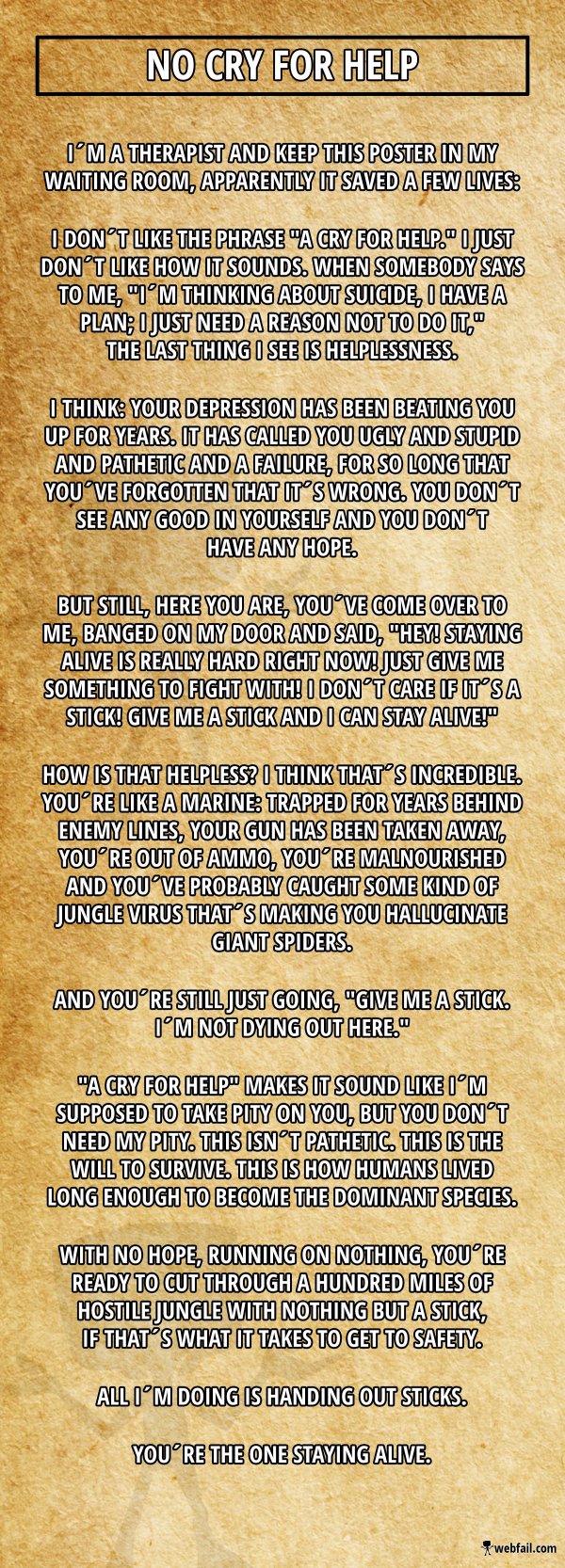
Handing Out Sticks

Famous blogger Matt Walsh has kicked off a bit of a tempest by writing two posts about Robin Williams’ death. The first one, basically, tried to draw a bright-line boundary between the concepts of depression and suicide. This interpretive framework (and Walsh’s reasons for wanting to drawing this sharp boundary) is pretty well summarized here:

First, suicide does not claim anyone against their will. No matter how depressed you are, you never have to make that choice. That choice. Whether you call depression a disease or not, please don’t make the mistake of saying that someone who commits suicide “died from depression.” No, he died from his choice. He died by his own hand. Depression will not appear on the autopsy report, because it can’t kill you on its own. It needs you to pull the trigger, take the pills, or hang the rope. To act like death by suicide is exactly analogous to death by malaria or heart failure is to steal hope from the suicidal person. We think we are comforting him, but in fact we are convincing him that he is powerless. We are giving him a way out, an excuse. Sometimes that’s all he needs — the last straw.

Then, after the post went viral and lots of people took issue with it, Walsh wrote a somewhat testy follow-up to: 1) decry the vitriol of individuals who misrepresented/misunderstood his first post and 2) provide more detailed justification of his position.

Among the many voices I’ve seen either directly or indirectly rebutting Walsh’s argument….

Pastor Jean-Daniel Williams, who writes:

If I commit suicide, perhaps, as you claim, it will be ‘’my’’ choice. But I doubt it. I have spent more than half my life listening to my own body betray me, my own mind telling me that it would be better to die. . . . Living is the pro-active choice. Is suicide a choice? It has been a free choice every time I have ever said no so far. I have chosen to say no. That is not because we can blindly, arrogantly, say that it is a moral choice, though. It is because I have been really lucky that I am (still) healthy enough to say no. The thing is, saying ‘’no’’ to suicide is evidence that I am healthy enough to say no. But, if I should ever commit suicide, it will not be because ‘’I’’ made the choice, but because my depression would have.

Kristi, on the blog “What is Matt Walsh wrong about today?” provides some valuable information about the effect of depression on one’s cognitive and decision-making capabilities:

Matt says suicide is a choice, but what makes a choice a choice is the presence of logic, reason, and objectivity to evaluate its merits. Depression can rob your brain of the ability to think that way. My friend Derek, a pharmacist, knows a thing or two about this. In his own words:

“In a euthymic (or normal, mildly-positive) attitude, the effect of a choice is either a reward, perhaps the blast of dopamine from a great run, or a detriment, the exhaustion of inactivity. In a person with clinical depression, both sides of that choice respond with a similar lack of neurotransmission.

A patient suffering from severe depression may not even be able to tell the choice apart. Even if objectively they know that running is good, couch is bad, they will experience the same neurochemical state regardless.”

[. . . ] So no, depression doesn’t appear on autopsy reports. But when a 500-lb thirty-year old drops dead at his desk, the autopsy reads “cardiac arrest” rather than “morbid obesity”. As usual, Matt is glossing over nuances. He thinks things are black and white—that a choice is a choice. He’s wrong. In absence of a healthy neurological system, not all actions are choices.

[SIDEBAR] Even though the fat activist in me is yearning to give significant bandwidth to the false assumptions and lack of medical evidence in Kristi’s facile conflation of “cardiac arrest” and “morbid obesity,” I’m mostly going to let it slide because I’m on a different topical horse tonight. Allow me merely a gentle hat tip to my HAES basics post, my critique of BMI, and my puzzlement at the unproductive insanity of fat-shaming. [/SIDEBAR]

[SIDEBAR THE SECOND] I am clearly way too ill-informed about the blogosphere as I hang out typing furiously in my little isolated corner of the wild, wild web. I don’t think I had ever heard of Matt Walsh till this folderol, yet he’s a prominent enough Internet figure to have earned his own dedicated counter-narrative. I don’t know if I’m impressed or horrified. [/SIDEBAR THE SECOND]

Although he doesn’t name check Walsh at all, Peter DeGiglio might as well be writing a targeted counterpoint against Walsh, articulating more reasons for understanding Williams’ death as being caused by the disease of depression:

I tried to get the old friend to understand by using my go-to comparison in this conversation. I asked, “Well, what if it was cancer?” His answer came back like a clichèd line from an after-school special. He proclaimed, “Well, that you can’t help!”

And therein, my friends, lies the problem in our dialogue on mental illness. [. . .]

What I believe people need to understand is that Robin Williams took his own life because he lost his battle with a serious medical condition. Take again my cancer analogy. Think about it: The last possible stage of any type of cancer that can effect a person is death. When one loses their battle with cancer, they die. The cancer cells take over and shut down the body for good. The same can be said for Bi-Polar Disorder and Major Depressive Disorder (aka simply “Depression”). The last possible stage of these diseases is death. The difference is that instead of cancer cells destroying the body, the body is destroyed instead by thoughts and feelings, causing the afflicted person to be convinced that the only way to end the suffering is through death at their own hands.

Essentially, he had “Thought Cancer”

———–

I feel half-vulture playing all this out on the screen. Yet another fan doing pop psychology when a celebrity dies, and doing so without much regard for the feelings of those individuals who are actually, acutely, intimately affected by his death.

So why am I even sailing these rocky waters?

Because however much I disagree with Walsh’s perspective, no matter how fervently I believe that those suggesting we say Williams died of depression are onto a deep psychological and spiritual truth — well, here’s an uncomfortable truth of my own.

Part of me wants Walsh to be right.

I want to believe that my depression is something I can rein in, get under control. I’ve been really lucky to be able to manage the condition for several years now without prescriptions. This is nothing I’m saying as a mark of strength, of health, or of any other sort of virtue. The operative word is “luck.” Yes, I work damn hard to maintain my psychological health, but I also know you can do everything “right” and still be challenged with disease. So, yeah, I am deeply grateful for my good fortune, but I know that tomorrow’s health and tomorrow’s brain chemistry are far from guaranteed.

It’d be easier if Walsh were right. More comforting, in a childish control-freak kind of way. To know that I just need to find and follow the proper recipe so’s to be sure that I will never have to stare down the maw of despair and depression again.

But that’s not how life works.

no-cry-for-help

———-

Image credit: http://en.webfail.com/855852d8b8b

A Little of that Human Touch

Ain’t no mercy on the streets of this town
Ain’t no bread from heavenly skies
Ain’t nobody drawin’ wine from this blood
It’s just you and me tonight

Tell me in a world without pity
Do you think what I’m askin’s too much ?
I just want something to hold on to
And a little of that human touch
Just a little of that human touch

~ Bruce Springsteen, Human Touch

While I’ve been under the weather* having a very individual-sort of challenging week, the rest of the country has been having its own sort of shitty week, what with the floods and the plagues and human decency going all to shit in Ferguson Missouri.

Because I’m still a bit ailing, I’m going to make this more of a link-fest than a work of original commentary — for the most part. Here’s a basic timeline that takes events up to President Obama’s statement Thursday afternoon.

And now a few scattered threads of what’s caught my attention since.

First, some basic pointers from Kate Harding on understanding these events from a lens of racial-cultural privilege.

2. Recognize that Michael Brown’s death was not an isolated incident.

In 2012, more than 300 black people were executed by police, security guards, or vigilantes. In the last month, three other unarmed African-American men—Eric Garner in New York, John Crawford III in Beavercreek, Ohio, and Ezell Ford in Los Angeles—have been killed by police. Those are the ones we know about.

3. Stop saying “This can’t be happening in America.”

I understand the impulse, I really do. But that impulse only comes to those who are insulated and isolated from how America treats poor people and people of color every day. Langston Hughes wrote “America never was America to me” in 1935. If you didn’t quite understand that poem in your junior high or high-school lit classes, read it again, while you think about what’s happening in Ferguson. Let it sink in.

Then, two articles pondering the, um, “selective” ways that many mainstream media outlets choose to portray black victims of violent crime: one from NPR and one from HuffPo. The HuffPo piece particularly illustrates the discomfiting tension that exists between the portrayal of black victims of crime as compared to white (alleged) perpetrators of crimes. Yes, Virginia, race privilege is so fucked up that white criminals still get treated better than black crime victims:

This is by no means standard media protocol, but it happens frequently, deliberately or not. News reports often headline claims from police or other officials that appear unsympathetic or dismissive of black victims. Other times, the headlines seem to suggest that black victims are to blame for their own deaths, engaging in what critics sometimes allege is a form of character assassination. When contrasted with media portrayal of white suspects and accused murderers, the differences are more striking. News outlets often choose to run headlines that exhibit an air of disbelief at an alleged white killer’s supposed actions. Sometimes, they appear to go out of their way to boost the suspect’s character, carrying quotes from relatives or acquaintances that often paint even alleged murderers in a positive light.

Amidst the outrage and indignation over Mike Brown’s death, Feministing calls attention to an equally discomfiting tension — one around the way that black male victims of crime receive more media attention, public support, societal outrage/sympathy than do black female crime victims.

How are the deaths and beatings of women — cis and trans — at the hands of the police or with their complicity so much less compelling? I think the obvious answer here is misogyny and transmisogyny, not on one specific occasion or by one specific person, but at the systemic level: what tweets get tweeted and retweeted, what events seem newsworthy, and what bodies are deemed to hold value.

I want to mourn the deaths of Mike Brown and Eric Garner and Trayvon Martin, and I want to question why the deaths of Renisha McBride and Islan Nettles and Kathryn Johnston haven’t gotten similar traction. Why the beating of Marlene Pinnock isn’t on all of our lips. Why the nation is not familiar with the names of Stephanie Maldonado, or of Ersula Ore. And how many women’s names do we not know because they don’t dare come forward? Because the violence they experience at the hands of the police is sexual, and the shame and stigma around sexual violence silences them?

The truth is that, in the predominantly male-led civil rights organizations who lead efforts to respond to police brutality, in the male-dominated media that covers them, and in the hearts and minds of many people in this country, women who are of color, who are sex workers, undocumented immigrants, transgender (or, god forbid, more than one of those at once) are rarely candidates for “innocence,” and are often blamed for their own deaths, forgotten, or hardly counted at all.

But finally, the piece that gives me small glimmer of hope is the contrast between Wednesday’s protest — and the militarized police response to them (text and images from Slate), and last night.

The man at the front of the march, was Missouri Highway Patrol Capt. Ronald S. Johnson, a Ferguson native.

“I’m not afraid to be in this crowd,” Johnson declared to reporters.

Johnson, a towering African American man who wiped sweat from his brow as he pointed out neighborhood hangouts and restaurants he used to frequent, was put in charge of crowd control earlier in the day, replacing the St. Louis County police who had been overseeing the police response to the protests. . . .

Protesters said they were still angry, demanding justice for Brown and answers from local police about why he was shot and who the offending officer was.

But, they said, Johnson’s willingness to physically interact with them, rid the streets of heavy police equipment, and help them coordinate protests was a welcome change in tone.

“Thank you so much for being here,” said Karen Wood, who fought back tears as she held both of Johnson’s hands imploring him to bring answers to residents and maintain calm in the streets.

“This is about human rights, about human beings,” she cried. (Washington Post)

It’s about human rights. Human beings. Meeting one another in an open-hearted way, with that human touch.

ari-hug-it-outAnd no, it’s not a magic wand to make all the troubles and tensions magically go away. There’s still hard work to be done, hard conversations to be had.

But ain’t it something to see how that human touch at least makes the hard work possible?

* It’s been a lovely stomach bug/depression cocktail — I don’t recommend it.

———-

Image credit: http://giphy.com/gifs/pzl20V6IWOjK

Bubbles of Holiness

I’ve been watching the spontaneous online “wake” that’s sprung up after news of Robin Williams’ death broke yesterday evening. Like so many fans I’ve seen commenting on news reports and Facebook posts, I’m saddened and touched by this loss more strongly than I’ve been affected by other celebrity deaths.

what dreams may comeIt’s kind of silly. I certainly came no closer to meeting or crossing paths with Williams than with any other famous person. And yet the humanity and empathy that shone through his stand-up and scripted performances so strongly to me made me feel, just a little tiny bit, like Williams was part of my heart’s family. And so I’m feeling a surprisingly personal (almost even self-indulgent) sense of loss.

I deliberately chose not to say anything about this last night. In part that stems from an ongoing practice of learning to slow myself down, to take at least a tiny bit of reflective time before commenting on emotionally-charged events. Mostly, I was waiting to see if the initial reports of Williams’ death as an “apparent suicide” would turn out to be confirmed. (Which they were today by the county sheriff’s office.)

I’m fortunate enough that I haven’t tripped across a lot of judgement-monkeys in my online travels. I’m sure they’re out there, though. The kind of folks described by Dean Burnett in The Guardian:

However, despite the tremendous amount of love and admiration for Williams being expressed pretty much everywhere right now, there are still those who can’t seem to resist the opportunity to criticise, as they do these days whenever a celebrated or successful person commits suicide. You may have come across this yourself; people who refer to the suicide as “selfish”. People will utter/post phrases such as “to do that to your family is just selfish”, or “to commit suicide when you’ve got so much going for you is pure selfishness”, or variations thereof.

If you are such a person who has expressed these views or similar for whatever reason, here’s why you’re wrong, or at the very least misinformed, and could be doing more harm in the long run.

Burnett goes on to say some very smart things about the real, visceral, illogical and non-discriminatory nature of clinical depression — puncturing a number of misconceptions about our typical (lack of!) understanding for mental illness. He also has some incredibly on-point things to say about the lack of compassion — one could even say, “emotional selfishness,” of someone wanting to take this kind of finger-wagging response to the news of Williams’ death.

But why would you want to publicly declare that the recently deceased is selfish? Especially when the news has only just broken, and people are clearly sad about the whole thing? Why is getting in to criticise the deceased when they’ve only just passed so important to you? What service are you providing by doing so, that makes you so justified in throwing accusations of selfishness around? . . . Perhaps you feel that those expressing sorrow and sadness are wrong and you need to show them that you know better, no matter how upsetting they may find it? And this is unselfish behaviour how, exactly?

A brilliant but tortured individual has taken his own life, and this is a tragedy. But levelling ignorant accusations of selfishness certainly won’t prevent this from happening again. People should never be made to feel worse for suffering from something beyond their control.

Darn tooting.

Hollis Easter also has posted two very useful essays: one generally giving counsel about how to (and not to) talk about suicide in the wake of Williams’ death, and one focusing more specifically on the possible risks of using the common phrase “suicide is a permanent solution to a temporary problem” when talking about Williams’ (or anyone’s) suicide.

In a beautiful yes/and to Burnett’s post, Easter has many of the same cautions (and more besides) against the sorts of judgmental comments Burnett criticizes — as well as calling appropriate attention to the faux-sympathetic-but-subtly-judgemental ones like talking about how “if only he’d fought harder or gotten help!” Easter also has concrete advice about how to openly and compassionately talk about suicide if there’s anyone in your life who shares with you that they’re having suicidal thoughts and ideas. I say the advice is about how to talk to people in the situation, but that’s not exactly true, since a lot of the best advice boils down to this:

But really, just do your best to be direct in listening about suicide. Avoid catchphrases and pat advice, and just listen.

Make it less about what you say and more about what they say.

The advice is especially on point for this circumstance, but the core of it — hold compassion, stay in empathy, do more listening than talking — feel pretty on point in lots of life’s situations. The notes about compassion and empathy even bring me full-circle back to the ways that I value Robin Williams. How I would even say I love him — this wild, human, warm-hearted, genius I never knew beyond celluloid and VHS tape and video disc. How I will miss him.

One final quote, from Anne Lamott:

Gravity yanks us down, even a man as stunning in every way as Robin. We need a lot of help getting back up. And even with our battered banged up tool boxes and aching backs, we can help others get up, even when for them to do so seems impossible or at least beyond imagining. Or if it can’t be done, we can sit with them on the ground, in the abyss, in solidarity. You know how I always say that laughter is carbonated holiness? Well, Robin was the ultimate proof of that, and bubbles are spirit made visible.

Rest in peace.

———-

Image credit: http://addisonround2.blogspot.com/2012/07/meiles-nera.html

At War with Stephen Covey

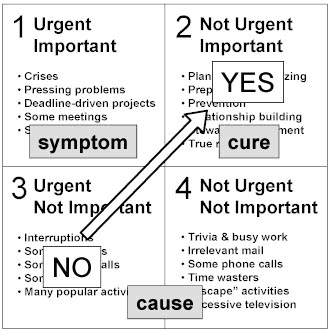
Have you ever seen Stephen Covey’s Four Quadrants of time management? I wouldn’t be surprised if you had: Gaia knows they’re everywhere across the Internet, and they’re also featured as a core component of many many management and success seminars.

covey_quadrants

I’ve cherry-picked a reproduction of the quadrants that makes the point I want. The trick, according to this structure, is to maximize your investment in the “Important but Not Urgent” quadrant, so that important things don’t elevate to “Urgent and Important” (i.e., crisis level). In the meantime, be very wary of the “Urgent but Not Important” category, because this is where the majority of the time sucks and distractors are likely to be housed. (The expectation here is that “Not Urgent/Not Important” things are fairly easy to jettison, while the urgent unimportant things can sometimes be harder to let go of. Fair enough.)

But what if it’s pretty much all urgent and important?

I feel as if I live much of my life by what I have come to call the “bonfire method of project management.”  Which conflagration is burning hottest and brightest, most likely to take down the homestead? Well, throw a little water (effort, time attention) in that direction so it dies down a touch. Now re-assess: which fire is hottest now?

Lather, rinse, repeat. (Yes, I know: I’m mixing my elements along with my metaphors. Bad witch!)

This pattern may be nothing more than an ongoing demonstration at the way I suck at self-motivation and planning ahead. Regardless, I am living a week where pretty much everything feels legitimately Important. And the tension I’m feeling is that the most urgent (time-sensitive) of these important things are all the items driven by external responsibilities — hitting the next work deadline, doing my homework for the retreat weekend, packing for the trip — while the items on the list that are arguably less urgent (i.e., most readily postpone-able) are the tasks and practices I have chosen for myself — journal-writing, ed-reading, JALC.

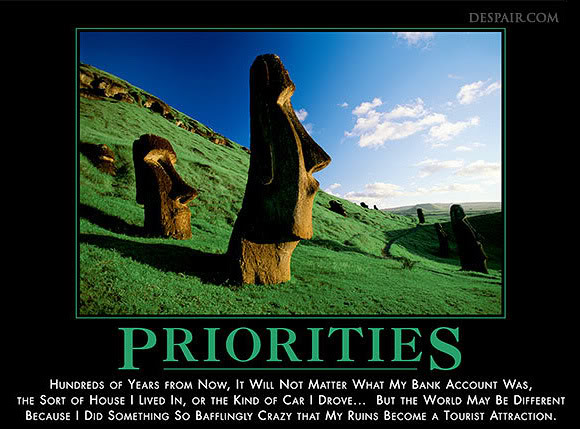
priorities_despairYes, this is, admittedly, an oversimplification. After all, no one forced me into my wacky non-profit career, and even though the retreat homework and travel is a function of me following someone else’s  direction, the retreat is also an investment in my soul’s growth.

Still, this is another pattern that often runs in my life: putting a higher priority on my responsibilities to others as compared to my responsibility to myself. After all, one of the trickiest parts of Covey’s whole structure is figuring out an answer to this key question: Important to whom?

I was listening to The Jayhawks recently, and there’s a snatch of song lyric that captures this for me:

I don’t expect you to see
But she’s important to me, babe
I guess it’s just one man’s problem

(MetroLyrics)

After all, I bet those “Urgent but Not Important” things you’re supposed to be so wary of in your ruthless Covey-an self-management structure are things that are actually legitimately important to someone, if not to you. So that ruthlessly efficient choice setting you up for success could also be the kind of choice that’s screwing some other poor sap over.

Maybe blogging or journal-writing or reading about education all seem like stupid priorities compared to Huge Essential Work projects and Elevated Cutting-Edge Soul Development work. Or, at least, maybe they would seem that way to someone outside my skin, outside my system, outside my soul and aura.

But they feel vitally important to me, babe. One woman’s priorities.

Which is why I continue cheating my sleep these past few days, trying to sprinkle some water on every last one of these important bonfires.

I don’t exactly know how I’m gonna make it to the plane intact at this pace, or, after that, how I’ll have enough gas in the tank to survive the weekend. But I’m just gonna have to figure that out step by step and minute by minute.

Because every bit of this matters.

———-

Image credits:

Covey’s quadrants: http://www.myrkothum.com/a-beginners-guide-to-time-management/

Priorities: http://s205.photobucket.com/user/johanan_rakkav/media/Parody%20Posters/poster_priorities.jpg.html


Advertising Awareness

Although it was all over my Facebook wall a month or so ago, I never forwarded the Always #LikeAGirl ad before today, nor did I choose to say anything on JALC about it.

My hesitation was similar* to that when Pantene urged women “Don’t let labels hold you back” several months ago, in an ad Sheryl Sandberg helped take epically viral, or when the Dove “Real Beauty Sketches” ad went epically viral some months before that:

My feelings about these female empowerment campaigns ad campaigns are always pretty similar, one to the next. Basically, I feel conflicted. On the one hand, these ads do bring up aspects of my own lived experience, whether it’s the double standards I’ve faced around being “bossy” or “bitchy,” or my habit of being hyper-self-critical, around my physical appearance and, sometimes, pretty much everything else about me.

On the other hand, it’s a little bit galling — okay, a lot galling — to have these quasi-empowering “accept yourself” messages come from companies for whom a significant percentage of the profit margin is based on the proposition that women will feel bad enough about themselves to buy your product so that we can be groomed, tweezed, moisturized or shampooed in such a way as to overcome our innate debased female-ness and become more socially acceptable.

Quite frankly, my conflicted feelings about this trend have reached a high enough level that I never even bothered to watch the Always ad above, or Pantene’s went-viral-one-month-ago “Sorry Not Sorry” ad before tonight when I was preparing this post for JALC.

So, yeah, I’ve never been in the corner of Dr. Bernice Ledbetter, who writes over on HuffPo that these ads are “truly a banner in the battleground of the feminist movement.”

I actually find that perspective quite sincerely and incredibly baffling. Do you not see how the women in the Dove ad are mostly, white, thin, not-too-old, and conventionally attractive to such a degree that the deeper message of the piece can easily function as little more than “The hearts of conventionally beautiful women can grow a little warmer today”? Can you explain to me how women getting shinier, bouncier hair is a viable solution for misogynist attitudes and prejudices against female intelligence, agency and ambition? As Emily Shire observes about the #LikeAGirl ad:

Yes, it’s far more appealing on the surface to have pads and tampons promoted as somehow part of a larger goal to change the meaning of “like a girl.” But the campaign is shamelessly emotionally exploitative. It demonstrates real problems—femaleness as a derogatory statement, decrease in self-confidence as women mature—in a beautiful and clear way, but then pretends a corporate manufacturer of panty liners meant to “help you feel fresh ever day” can solve them.

(And again, notice here how problems that are deeply-rooted and systemic, based in cultural norms, problems that are perpetuated and policed as much by external messages as by internalized ones — the very nature of what I call “the miasma of misogyny” — are presented as something to be solved by women’s policing of their femaleness and their female bodies.)

And yet, however much I’m able to see the problematics in these “short films,” their innate and even troubling limitations, I still admit I kind of like them. My affection hasn’t been strong enough for me to join in amplifying their viral distribution, or perhaps my awareness of the flaws has been too strong to allow me to join in the fun. But I don’t have it in me to work up the same kind of feminist outrage about these ads as I’ve displayed here on other occasions.

Which is why I so appreciate Natalie Baker over at Bitch Magazine for reminding me today that it’s possible to live in a yes/and rather than an either/or place.**

So here we are, once again, stuck in another good vs. not good enough debate: either these ads are radically tackling sexism through a historically appalling medium or it doesn’t matter what these ads say because corporations don’t actually care and will say anything to make a buck.

What if it’s both? That is to say, what if these companies are forwarding feminist messaging despite not actually caring about it? And what if that still helps us?

Like Jezebel said back when the Always ad was first released:

While all ad companies are bullshit liars to a point, willing to do or say whatever it takes to get your money, I would rather have empowerment cheese over shame-based guilt, which seems to be the two usual suspects in a capitalist economy.

That’s a sentiment I can get on board with, especially when I think back to Super Bowl Sunday’s usual dreck. To return to Baker:***

For those of us who surround ourselves with intersectional anti-oppressive ideology, what’s considered progress in the mainstream can feel like a joke. But that’s our piece of the jigsaw—to be progressive is by definition to be ahead of the curve. While we don’t need to be naively over-celebratory about billion-dollar conglomerates pandering to female consumers, I do get immense enjoyment from the fact that such companies are doing so, not because they want to, but because they have to. . . . I can get down with those messages, even when they’re being generated out of corporations’ self-interest.

In fact, I like that they’re doing it out of self-interest. I don’t want feminism to be charity. I want companies to consider supporting feminism to be necessary for their survival.

(Emphasis added.)

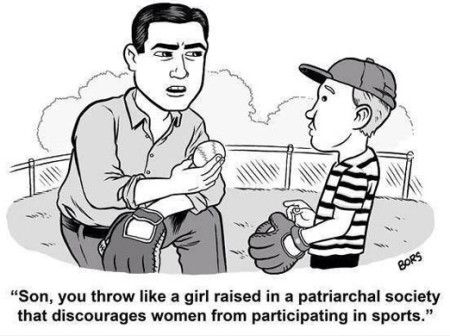
son-you-throw-like-a-girl-raised-in-a_12707Yeah, it’s all advertising, so at some core level it’s all inherently corporatized and bullshit on account of that perspective. On the other hand, if the growing prevalence of these ads indicates (and even encourages) movement towards the tipping point when the patriarchy/kyriarchy transmutes? I can get on board with that.

So, maybe less of a banner moment (sorry, Dr. Ledbetter!) and perhaps more of a weathervane. Showing the shifts in the cultural currents, a change in the wind of how people think and talk and feel.

* Okay, my hesitation was a little different because I hadn’t yet revived JALC, so I didn’t have to make the “blog or not to blog” call on it. Just the (arguably more public) “to Facebook or not to Facebook” call.

** Yes, this was posted 3 days ago, but I read it today. As such, she reminded me today. And I am grateful for that.

*** In case I haven’t said so clearly enough, please go read the entire post in its entirety. All of it.

———-

Image credit: http://www.funniestmemes.com/funniest-memes-son-you-throw-like-a-girl-raised-in-a/

Crowning Glory

Uneasy lies the head that wears the crown.

~~ Henry IV, Part II, 3.1

I was on the search for something quick and whimsical today, and I think I may have found it:

Australian retailer BlackMilk just launched its Princess & Villains collection inspired by the ladies of Disney. To be clear, this is a line for adults. As in, adult humans are encouraged to wear this clothing on their bodies. (h/t Jezebel)

I’m pretty much in agreement with Jezebel’s Kara Brown about the ugly/tacky quotient on these. Seriously. This is a line of clothing I am not particularly upset doesn’t run into plus sizes. (I know: from a general fat activism perspective, it’s troubling when any high fashion line perpetuates thin-ness as the only body type worth draping in fashionable clothing. But speaking only for my own personal taste in clothing? I’m not real upset to have this particular line barred from me on account of the sizing and sourcing choices.)

But if nothing else, it’s a good excuse for a bit of a link-fest. (That turned into something more substantive than I originally expected. I quite literally cannot stop myself from pontificating, sometimes…)

———-

First off, some things I learned existed while Googling for this post: Disney wedding dresses. And haute couture adaptations of Disney Princess gowns. (Who knew?)

And then there’s this gallery on DeviantArt that presents Disney Princesses/Heroines garbed in “their” Princes’ outfits. True confession: There’s a number of these folks I don’t recognize at all. I used to keep up with Disney releases, but clearly I stopped doing so longer ago than I thought I had…

Anyhow. This Princess-to-Prince gallery I remember seeing back when it went viral last fall, but this one, which presents more historically accurate gowns for the characters, was new to me today.

———-

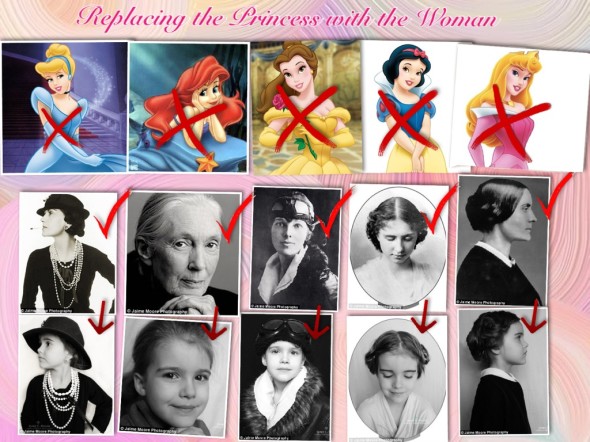
Princess-Culture-590x442“Princess Culture” is a bit of a tricky, problematic thing.

In one corner of the debate are those who point to its influence as another source for the misogynist miasma that helps reinforce the ways girls/women should be primarily focused on their attractiveness and marriageability. For example, Peggy Orenstein, author of Cinderella At My Daughter:

It’s part of this culture that encourages girls to define themselves through beauty and play-sexiness—and eventually, real sexiness—and I don’t think that’s the yardstick we want our daughters measuring themselves by.

Experts say femininity, identity and sexuality have become a performance for girls. Girls perform sexual confidence but they don’t connect it to erotic desire. It’s not about their own desire, their own self-determination.

As a parent, I didn’t realize how much of my job was going to be protecting my kid’s childhood from being a marketer’s land grab—companies telling her who she should be.

See also: Merida’s attempted Princess makeover.

Disney’s redesign of the character tamed her unruly hair, expanded her breasts, shrank her waist, enlarged her eyes, plastered on makeup, pulled her (now-glittering) dress off her shoulders, and morphed her defiant posture into a come-hither pose. The bow-wielding Merida of Brave — a character who explicitly fought against the princess world her mother tried to push her into in the film — was becoming what she hated, and inadvertently revealing the enormously problematic nature of Disney’s Princess line.

And yet, there are also those who see Disney Princesses in a different light. Possibly as a mild expression of societal — I would say “patriarchal” — values already embedded in the culture. Values more strongly caused and propagated by other sources:

It’s true that princess culture is complicit in keeping in place many of the troubling stressors women and girls suffer. But when you talk to me about impossible beauty standards and eating disorders, I’d point to Photoshop and the “obesity epidemic” before I’d point to stylized animation. When you talk to me about early sexualization of children, consider the retailers selling padded inch-thick push-up bras in the kid’s department before looking at Disney’s chaste kisses between adults. (Unless you think a kid shouldn’t see their parents kissing, in which case… I don’t think we’ll ever be on the same page.)

These are problems, sure, but they’re not problems Disney created, and Disney isn’t the primary villain here. At least not while my seven-year-old is walking by billboards for Victoria’s Secret the size of a school bus.

And then there’s even a more pointed critique of those wishing to critique Princess Culture:

Some say “Princess Culture” promotes materialism, patriarchy, and a sadistic need for long, shiny hair. Many moms worry a Snow White doll will turn their pre-K Amazons into simpering ninnies more concerned with looks than grades and goals. But they’re wrong—and I speak from personal experience. The truth is, Princess Culture helped me become more confident, more adventurous, and more okay with being different. It also helped me understand and embrace the concept of feminism at a very early age. Seriously. (Elle.)

I have enough passing nostalgia for my years loving Disney animation that I can definitely feel the pull to defend what may have been treasured bits of childhood. Still, I’m more on the side of those who remain troubled by Princess Culture. To quote Orenstein’s book (as excerpted here at NPR):

It is tempting, as a parent, to give the new pink-and-pretty a pass. There is already so much to be vigilant about, and the limits of our tolerance, along with our energy, slip a little with each child we have. So if a spa birthday party would make your six-year-old happy (and get her to leave you alone), really, what is the big deal? After all, girls will be girls, right? I agree, they will — and that is exactly why we need to pay more, rather than less, attention to what is happening in their world. According to the American Psychological Association, the girlie-girl culture’s emphasis on beauty and play-sexiness can increase girls’ vulnerability to the pitfalls that most concern parents: depression, eating disorders, distorted body image, risky sexual behavior. In one study of eighth-grade girls, for instance, self-objectification — judging your body by how you think it looks to others — accounted for half the differential in girls’ reports of depression and more than two-thirds of the variance in their self-esteem. Another linked the focus on appearance among girls that age to heightened shame and anxiety about their bodies. Even brief exposure to the typical, idealized images of women that we all see every day has been shown to lower girls’ opinion of themselves, both physically and academically. Nor, as they get older, does the new sexiness lead to greater sexual entitlement. According to Deborah Tolman, a professor at Hunter College who studies teenage girls’ desire, “They respond to questions about how their bodies feel — questions about sexuality or arousal — by describing how they think they look. I have to remind them that looking good is not a feeling.”

As such, I’m very glad to see signs of the Princess Counter-Culture. Like Orenstein’s media and activity suggestions for interested parents — including a Hiyao Miyazaki shout-out!! Or Supreme Court Justice Sonia Sotomayor giving career advice on Sesame Street:

Or Goldieblox:

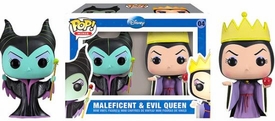
And yet. True confession #2: I have these on my desk at work:

pop-vinyl-queens

Plus a Cruella de Ville stapler.

cruella-stapler

So I’m as complicit in this commercialized mess as anyone….

———-

Image credits:

Replace the princesshttp://saraelyafi.com/2013/05/14/it-is-time-to-replace-the-princess-with-the-woman

Pop! Vinyl: http://www.toywiz.com/mini2packmalqueen.html?gclid=CjwKEAjwjN2eBRDbyPWl0JLY5lYSJACPo0Ui-tViTSQrsDJ_yiUBBT-KxYkbnS8F4leDh8iEbSD3eRoC8yXw_wcB

Cruella: http://whirlyjoy.com/2012/12/11/why-my-mascot-is-cruella-de-vil/

Knock on Wood

In addition to lots of laundry and lots of sleep, one other thing I’ve been doing since getting back home from The Trip is catching up on the video lectures and quizzes for the Coursera course I’m taking about the Beatles.*

In a lot of ways this is a “gimme” course: I’ve watched, listened and read enough about the band and its members to be reasonably well-informed from the get-go. Still, it’s fun to hear this professor’s take on things, and I have learned a new thing or two along the way.

Like the full story embedded in the lyrics to Norwegian Wood.

In the song, a young mad is “had” — i.e., fooled — by a comely lass when he accompanies her to her (pretentiously under-furnished) apartment expecting sexytimes, only to be rebuffed when she says she needs to get a good night’s sleep prior to the next workday.

That much I’d understood. But this next part was the part I’d missed: when he wakes up the next morning alone, the song’s narrator sets the girl’s apartment on fire in revenge for the (so-called) cock-blocking.

To quote Paul McCartney (the co-lyricist), looking back at many years’ distance:

[A] lot of people were decorating their places in wood. Norwegian wood. It was pine really, cheap pine. But it’s not as good a title, Cheap Pine, baby…

So she makes him sleep in the bath and then finally in the last verse I had this idea to set the Norwegian wood on fire as revenge, so we did it very tongue in cheek. She led him on, then said, ‘You’d better sleep in the bath’. In our world the guy had to have some sort of revenge. It could have meant I lit a fire to keep myself warm, and wasn’t the decor of her house wonderful? But it didn’t, it meant I burned the fucking place down as an act of revenge, and then we left it there and went into the instrumental.

He sets her apartment on fucking fire. (Who knew? Okay, bad question: evidently everyone in the world knew but me.)

Norwegian_wood__by_CyberfishTalk about a disproportional response to sexual rejection. In his discussion of this song and the story its lyrics tell, the professor said something mild about how the song could be seen as “sort of misogynistic,” and I found myself spluttering at the computer screen, “you think?!?”

I kind of get why the professor chose not to open up the topic for much further exploration. Although some elements of historical and cultural context are inevitably coming into the discussion, his chosen approach is primarily to be taking a musicological quasi-close-reading approach to the stylistic features of the songs and albums — melody, harmonics, orchestration, lyrical complexity, etc. At some level, I suppose I could be thankful he at least called out the misogyny of the scenario, rather than allowing the song’s portrayal of sexual entitlement to remain normalized.

Still, I am so wishing I had magic access to Paul McCartney right now to ask some follow up questions. When you decided that in the song’s world, this guy deserved his revenge, did you mean to portray that as a reasonable response, or an UNreasonable one? You were about 23 when you wrote the song — do you think you’d want to tell a similar or different sort of story if you were writing about sexual miscommunication and rejection today? What acts of friendliness are permitted between two individuals before one is seen as “leading the other on”?

Alas, my press pass is expired (on account of me never having one), and I still haven’t made an appointment with Mr. Ollivander to collect my magic wand. So my curiosity will have to remain unsatisfied.

By the way? Check here for a handy-dandy chart that’s been making the rounds to let you know when a woman owes her partner sex. And despite the geneder-specificity of the graphic, it really cuts both (all?) ways: no individual (gender-inclusive) ever owes another individual (again, gender-inclusive) sex.

———-

Image credit: http://www.deviantart.com/art/Isn-t-it-good-Norwegian-wood-165422713

* Yes. I am an epic nerd. I’m okay with that.

25 Songs, Day 7: Of Battles and Beautiful Banality

(Part seven of my exploration of the 25 songs in 25 slightly-more days blogging challenge — a way to bank and pre-schedule a few posts for JALC while I’m off a-travelling.)

25-songs-25-days

Day Song 7: A song that reminds you of the past summer

Since we are are still in the midst of summer 2014, I began thinking about this prompt by casting my mind back to the summer of 2013, even looking up a couple of those “songs of the summer” lists. And there were a few titles that jumped out at me. Imagine Dragon’s Radioactive playing into the closing credits for season 6 of True Blood, as a group of Hep-V vamps closed in on Merlotte’s to attack it. The mini-kerfuffle around Daft Punk backing out of their appearance on the Colbert Report, and the brilliant dance video Colbert and friends concocted in response to the “crisis”:

But when I really thought back on my summer, it became very clear to me that my song choice needed to go in a different direction:

Obviously, I’ve mentioned here and there about our move from Philly to Boston, but I don’t think I’ve talked in detail about how things unfolded. I came up first, in March, signing a short-term lease on an apartment so I could start the new job that was precipitating our whole New England adventure. Meanwhile, Mr. Mezzo stayed behind to put our house on the market and start his own job search.

And we have much to be grateful for around this, because things went about as smoothly as you could possibly hope for. The Philly house sold within a couple months, Mr. Mezzo had a job offer in the same couple weeks we were executing the house sale paperwork, and he and all our worldly goods were up in Massachusetts come late-July.

All told, we were only apart for about 4, 4-and-a-half months: a much shorter time than it could have been, and a much shorter time than we’d feared it might be.

Still. I don’t recommend it, and it was NOT fun. So we tried to be very intentional about doing things to stay connected to one another, even while living apart. And one of those things was our weekly Game of Thrones date night.

Even though most of our TV-watching is done via the commercial-forwarding magic of the DVR, we made the commitment to watch each new episode during its first telecast. (A commitment easier to keep by HBO’s lack of commercials and the knowledge that real-time viewing was going to be the only way to stay ahead of the water cooler recaps in our separate offices come Monday morning.) Then, as soon as the final credits and “exciting scenes from next week” had concluded, one of us would call the other and we’d talk and compare notes. What scenes we’d enjoyed, what we thought would happen next, what plot twists had surprised and shocked us. (I’m sure you can imagine our conversation after the Red Wedding episode…)

It was a completely everyday, frivolous, fun sort of conversation. And that’s what made it so wonderful. Amidst all the other things we were needing to talk about — contract this, inspection that, employment status here and there — having this weekly ritual helped us stay connected with the sort of everyday, seemingly-banal sort of contacts that are such an essential part of weaving the tapestry of a shared life together.

So, thank you, George R.R. Martin. You may be a murderous bastard who kills off everyone I most love in Westeros, but you gave Mr. Mezzo and me the gift of connection during a tough time. Honor and gratitude.

———-

Image credit:

25 Songs, Day 6: You’re My Best Friend

(Part six of my exploration of the 25 songs in 25 slightly-more days blogging challenge — a way to bank and pre-schedule a few posts for JALC while I’m off a-travelling.)

25-songs-25-days

Day Song 6: A song that reminds you of a best friend

True confession: as soon as I read this prompt, Queen’s You’re My Best Friend lodged itself in my memory and it won’t let go. (Talk about an earworm…)

There’s multiple layers to my association, here. First is the literal content of the song, of course.

You’re the best friend
that I ever had
I’ve been with you such a long time
You’re my sunshine
And I want you to know
That my feelings are true
I really love you
You’re my best friend

(AZLyrics)

The song is all about “best friends,” of course. Which is probably why the song was featured in the Kenneth Branagh-directed film, Peter’s Friends, back in the early 90’s. I can’t find the exact clip on YouTube, but here’s the film’s trailer, which also features Queen’s song prominently.

The film is centered on a New Year’s Eve gathering of a group of besties in college, gathering ten years later. Various cracks in connection emerge, showing ways folks have changed and drifted apart, at least to some degree.  Yet there are stunning moments of connection, both in a nostalgic way…

…and also at the film’s conclusion — which I am not linking here on the odd chance that someone who hasn’t yet seen the film would want to do so. As such, I won’t reveal any spoilers about how things unfold, but I don’t think anyone will be especially surprised to hear that by the end of the film, the old friendships have been re-established — yes, evolved and transmuted from years of growth and change, but the connections remain sound.

best-friends-iAnd that’s the kind of thing that’s a total mystery to me. I feel as if I never quite got the hang of sustaining long-term friendships. What with my innate shyness and the frequency we moved during my childhood, it seemed as if I’d make a group of friends, and then lose touch with everyone when the family and I were yet again displaced.*

Facebook has helped me re-establish some soft connections with folks from my middle school, high school, and college days. And I truly, truly appreciate having that small chance to have a window into people’s lives, and to be able to make small pieces of contact — a “like” here, a brief comment conversation there. But I’ve not yet felt a deep enough level of comfort to really re-connect. Would I invite someone our for coffee, or even send a real personal letter or email? No, that would feel too invasive. Not really sure if that’s an accurate read on the situation, or if it’s my old habits of self-isolating coming into high gear.

So, despite my jaunty image, above, I kinda sorta feel as if I might suck as a friend. Which is probably why it’s easier for me to respond to this prompt with a memory of someone else’s fictional best friends than any songs connected to my own friendships.

* Have I talked about this before? I think I’ve talked about this before. Too strapped for time to go check.

———-

Image credit: http://didthatjusthappenblog.wordpress.com/2013/04/01/i-have-the-best-friends/

25 Songs, Day 5: The Dreaded Earworm

(Part five of my exploration of the 25 songs in 25 slightly-more days blogging challenge — a way to bank and pre-schedule a few posts for JALC while I’m off a-travelling.)

25-songs-25-days

Day Song 5: A song that is often stuck in your head

Ah yes, the dreaded earworm. The song that infects the aural passages and the bloodstream, often causing physical pain and existential crisis akin to that once faced by Anton Chekhov a long time ago in a future inhabited by Ricardo Montalban:

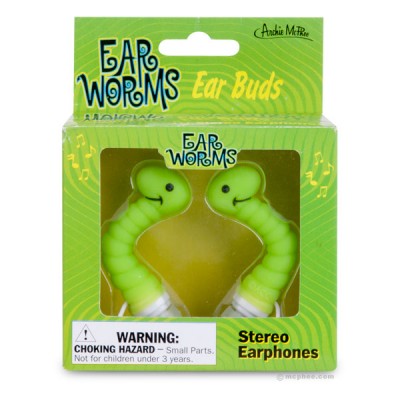
ear_worms_ear_budsI have a strangely high tolerance for earworms. For me, they impact the same part of my brain where my affection for guilty pleasures and things delightfully kitschy resides, so even if the pleasure of said ear worm is of a different flavor than, say, my love for the Gayatri Mantra, I do often find a sincere sort of pleasure in hearing the “ear worm song.”

So I was incredibly puzzled as to what song to write about tonight. Old classics from my formative years, like It’s a Small World or Supercalifragilisticexpialidocious?

Entries from my young adulthood like Macarena, Mambo No. 5, or Lambada? Why are all of these Latinate one-hit wonders? Only Gaia knows… Also, is there anyone else out there who immediately spotted the Kaoma sample when JLo came out with her Pitbull collab, On the Floor? Just me, then.

Perhaps I should feature recent ear worms that are imprinted on my mind’s eye as much as anywhere else — I think of the Olympic swim team and Call Me Maybe, Lara Spencer dancing Gangnam Style on the set of GMA, or that wacky moment where I was just slightly ahead of the coolness curve when Ylvis’ The Fox went supernova-viral

But ultimately, I cast back into the early 80’s for this ditty from my early teen years: Toto’s Africa.

There’s a few reasons this bubbled to the top of the pile. First, is its innate infectiousness. Second, is the fact that we sang an arrangement of it in high school chorus, meaning I will never ever ever get those “Doo doo doo doo doo doo doo”s out of my head.

Third is the way it has spawned other infectious ditties, such as Straight No Chaser’s arrangement of 12 Days of Christmas:

Fourth and finally, is this brilliant deconstruction of the song, by author Steve Almond:

Rather than expose us to the hard-won truth of individual experience, the song immerses us in the Karo syrup of an entire culture’s mass delusion. It is the love child of imperialism and muzak.

Almond’s spoken essay makes me both hate the song and love it all the more. And hate myself a little for loving it. Which is the quintessential definition of a guilty pleasure, if not of an ear worm.

———-

Image credit: http://mcphee.com/shop/ear-worms-ear-buds.html