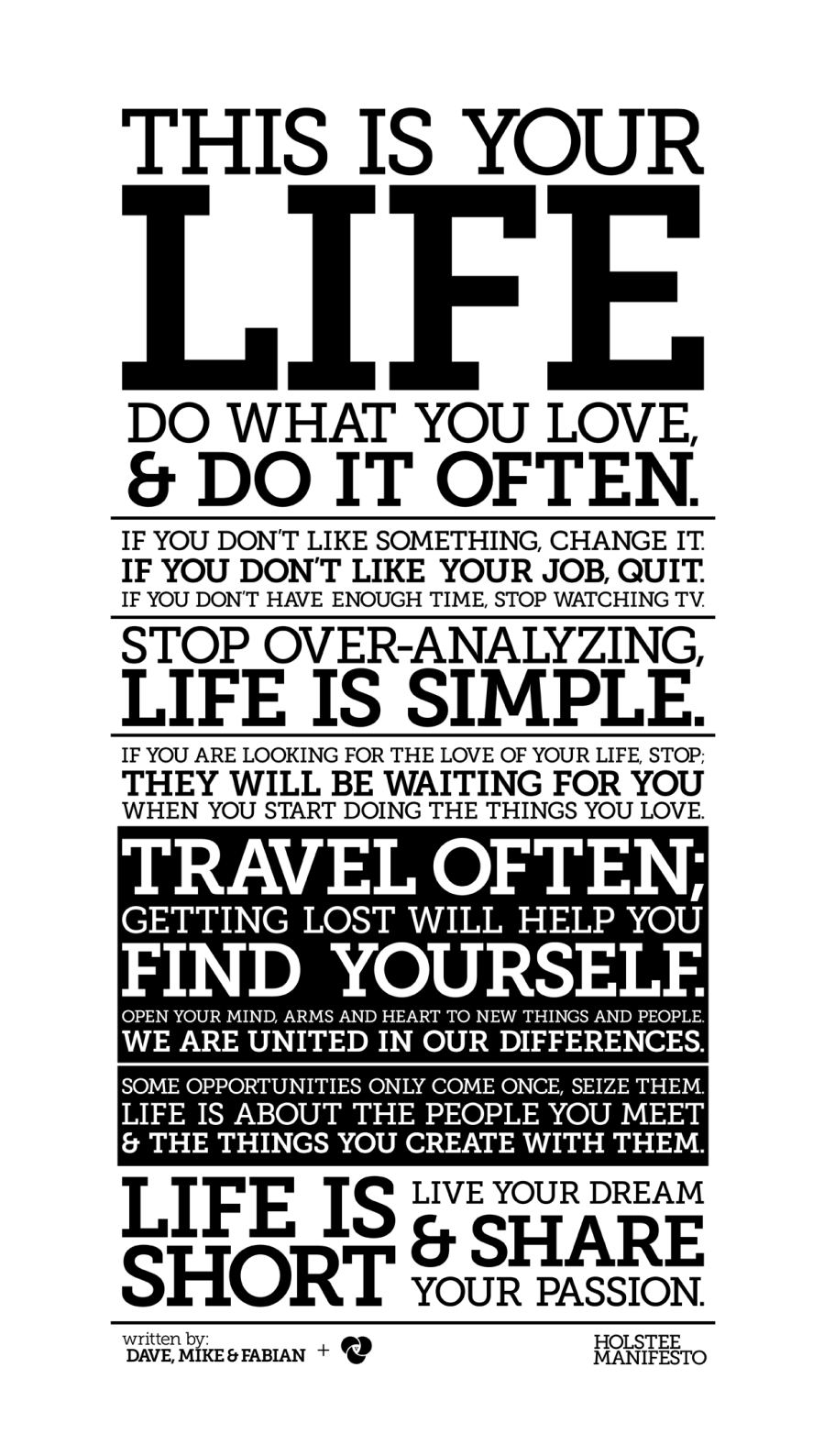
In Medias Manifesto

Because I have decided that 5 hours of sleep per weeknight is just too much of a luxury, I have decided to enroll in another challenge over at WordPress’s Blogging U. Blogging 101 is intended for individuals right in the start-up phases of bloggy creation. This invitation to register articulates the deliverables in this fashion:

On Day 30, you’ll have six (or more!) published posts and a handful of drafts, a customized theme that reflects your personality, a small but growing audience, a good grasp of blogging etiquette — and a bunch of new online friends.

So, considering that I first founded JALC some 5 years ago, and revived it more than 6 months ago, I am either well behind the times or way ahead of the game on this one. Still, I think it’ll be a good exercise for me.

I’ve been in recent conversations about the value of design thinking, and the ways that taking the time to step back and question your automatic habits and questions can be a good way to unlock a more intentional creativity. I see the Blogging 101 container as a way for me to foster that sort of intentionality here on JALC.

So, here we go…

Continue reading “In Medias Manifesto”

Going (Semi-)Viral

A funny thing happened this past week. A friend of mine shared an upsetting incident on Facebook where she experienced public prejudice against breast-feeding. Her story then went viral, earning (well-deserved) media coverage and public outrage.

That’s not the funny part. The funny thing is what happened next: I wrote a blog post about the event, and then I went viral, too.

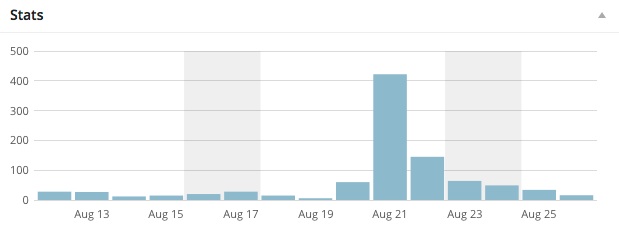
See exhibit A, WordPress’s visitor stats summary for JALC during the last couple weeks:

stats copy

The August 12-19 stretch shows me with my customary rate of site visitors — usually somewhere in the 15-25 range, with slight upticks and down-drops depending on factors like weekday vs. weekend, if I skipped a day, etc.

August 20 is when I posted about Ingrid’s experience: you can already see the uptick to 60 site visitors in those hours between hitting “Publish” and midnight, as a few folks started sharing my post within their own networks.

The next day, August 21st was when things hit big (relatively speaking). Yeah, that’s more than 400 hits — and from there, things have dropped off until yesterday and today I seem to have re-equalized back where I started.

So, all told, this is a very mild flavor of “going viral,” as compared to Youtube videos that get hundreds of thousands, or even millions of hits. Still, it was such a disproportionate spike in attention that it feels like the junior baby blogger version of “going viral.” And the sorts of study and self-examination the experience has invited for me — well, I wonder how different these reflections would be if I were talking about 4,000 hits rather than 400. I’m thinking: perhaps not that different at all.

First: Who woulda thunk it? For the most part, my writing here on JALC has been divorced from expectations about achieving any particular readership level on any timetable. The practice for me has been a practice of showing up, of experimenting with regular, focused writing. Finding my voice again. Yes, at some level there’s the prayer of my words being read and having positive impact — otherwise I’d just be writing in my diary rather than in a blog. But I’ve maintained a pretty decent level of non-attachment from any expectations about how many readers I want to have and how quickly I want them to appear.

And if you asked child-free me what sort of post I’d predict might be the first one to get public traction, there’s no way on this earth I would have predicted it be something about breast-feeding and the mommy wars. Talk about a subject that’s completely outside of my field of knowledge! (Okay, not completely, since I do have breasts as an anatomical feature of my body. But still.)  You never know what’s going to hit a nerve and garner that flash of attention. Like catching lightning in a bottle, that is. Write something true and honest and authentic, and I guess sometimes it’ll hit a nerve, fall in with a moment of zeitgeist. But to predict what’s going to hit that zeitgeist energy? Not within my current powers, as so clearly evidenced by the disconnect between my expectations and the actual happening of which JALC post first topped 550 views.

SecondYou never know what’s going to hit a nerve and garner that flash of attention. I’ll admit, however well I’ve maintained a state of non-attachment around my readership numbers where they were at a low and steady pace, that there was something sincerely exciting about seeing the bar graph keep climbing during the 21st. And when I sat down the evening of the 21st to write my first post-viral post, I could absolutely feel myself on a precipice. Feeling the demand that I “measure up” to this new level I’d achieved, feeling the temptation towards finding some other juicy topic that’d be “click bait” and that could build some kind of popularity for myself.

I walked myself back from that precipice, reminding myself: it’s like catching lightning in a bottle, that is. All I can do is continue showing up at the screen, writing as true and authentically as I can, taking on the topics that grab me and won’t let go until I say what I have to say. That’s why I wrote my post to begin with — even though I’ve spent years trying not to comment on parenting choices or the mommy wars. Something about Ingrid’s story just grabbed me, and I couldn’t rest until I wrote about it. That’s the feeling I need to keep following: I can’t rest until I write about this, rather than I think this will get good traffic.

So who knows? Maybe another post of mine will hit a zeitgeist moment a few weeks from now. Or a few years from now. Or never again. It’s all in service, however it unfolds.

I just need to keep in the practice of it. Say it plain, say it true. Stay as authentic as I can be.

“Showing Up” In Virtual Space

Okay, I’ll admit: I am not feeling flush with inspiration tonight. I’ve looked at some of the go-to feminist sources on my Facebook feed for something to pontificate about. I’ve been thinking about what’s going on in my life to see if there’s something insightful or reflective that I want to say. And I got nuthin’.

However, I’m quite aware that I skipped posting Friday and Saturday night (though I did try and compensate with a split-the-difference Saturday afternoon post), so I’d like to turn that trajectory around by getting something up.

secret-to-bestseller

Especially since I’ll be off-the-grid at the end of this coming week and through the weekend — meaning, inevitably, more silence — and it’s another crazy deadlines week starting tomorrow — which may mean yet still more silence.

So what’s a young girl middle-aged blogger to do?

———-

I’m sure we’ve all heard, at one time or another, the notion that the most important ingredient to any learning/mastery/creative process is to “just show up!”

For example, this quote from an interview with Isabel Allende:

What’s the most important thing you’ve learned about writing?

Show up. Show up in front of the computer or the typewriter. And if I show up long enough – it happens.

Or this post from a blogger who cautions against advice that makes writing seem too “difficult” — an excuse for us to continue procrastinating, he says — and who insists on the simple necessity of the “just show up” message:

I am not about to tell you that writing is easy. Writing is hard. Writers never stop fearing that what they write isn’t good enough. They can’t come up with good ideas. They come up with brilliant ideas that don’t work. They write terrible things and good things. And they try to make sure that people never see the terrible things, and that as many as possible see the good things.

No writer I know thinks writing is easy.

But no writer I know thinks writing is complicated.

If you’ve been waiting to write because you think that one day someone will give you the advice that makes writing easy, stop waiting. No one can make it easy.

All we can do is make it simple.

Show up. Write.

Or there’s any number of similar sentiments in this collection of bits of writing advice from actual real writers.*

And I get this approach. I do. I believe in this approach. Even though I eventually decided not to finish my dissertation or my Ph.D., I will tell you that my most productive months on that project were once I was able to shift from a place of full-on “frozen by depression and writer’s block” to embracing the idea of daily writing on the project. Every day, putting my inner critic into her lockbox for at least a tiny little bit and putting fresh words on the page. (I know the recommendation of a Ph.D. dropout may not mean much in this context, but this was one of my productivity bibles. I can’t speak highly enough for how it benefitted my life and my work.)

So, yes, I’m a believer in “just” showing up at the page.** It’s why I strive for a daily journal-writing practice. It’s why I am often the one at work most willing to send out that “sacrificial first draft” to get a project moving. (‘Cos this much I know for sure: if we don’t get started, we ain’t never getting to the finish line.)

Mucha-MuseIn short: I am not the kind of writer who sits waiting for my muse to waft in looking like an Alphonse Mucha engraving, with her artful Art Nouveau tresses and dresses wafting on an unseen breeze. But I’m not yet sure I’ve figured out the finer points of bringing this insight into my blogging practice.

Because everything I know about “showing up at the page” is predicated on the notion of there being a first draft — whether you call it “sacrificial” or, following Anne Lamott, “shitty” — and then an editing process by which the first draft becomes something more polished, worthy of publication. But when the draft-to-publish cycle is as truncated as it is in the blogosphere, what does it look like to have the practice of showing up at the (web)page? Does it mean publishing things that are half-formed, rougher? (In short, publishing shittier things?) Does it mean cultivating more of a practice of drafting, revising, and editing for blogposts? (Which, I’ll admit, feels a touch daunting for my life’s schedule. Maybe I should cut back on even more TV…)

I don’t have this conundrum worked out yet. But, with the willingness to navel-gaze and write about the writing process, I at least found something to reflect on that justifies a post for tonight.

I’ll take care of tomorrow’s post — if there is one — tomorrow.

* ‘Scuse the snark — the post’s title, although clear as clear could be just hit a nerve tonight. D’you think maybe we’d be expecting writing advice form fry-cooks or makeup artists?

** Had to use the scare quote, ‘cos the word “just” in “just show up” kind of cheapens how essential showing up at the page is. It obscures the raw, radical courage of showing up.

———-

Image credits:

Secret to a bestseller: http://elizparker.wordpress.com/2014/04/30/writers-show-up-by-getting-a-writing-buddy/

Mucha, “Muse”: http://www.alfonsmucha.org/Muse.html

Step by Step, Across the Galaxy

norman-rockwell-facebookOne or two days ago, I did that thing you’re never supposed to do: I shared an infographic on my Facebook wall without actually double-checking the sources and the veracity of the information.

You can read all about it here. About the infographic, I mean, not the Facebook part of things. The Facebook faux pas is a tale as old as time, as the sages say.

At the very bottom of the post is a copy of the original infographic with what turned out to be incorrect (or at least, unverifiable) stats about the cultural decline of reading. Once he found that the original stats — which were really super shocking (80% of households haven’t bought a book in the last year, stuff like that) — were unverified, the infographic creator did a v.2 that brought in some different statistics that could be verified.

The funny-ironic thing, as far as I was concerned, is the way I would have been equally happy to post the v.2 “corrected” info graphic rather than the more dramatic/problematic v.1. Because what had most caught my eye was a quote that stayed intact between v.1 and v.2, in large part because it was so obviously aspirational rather than scientific: “If you read one hour per day in your chosen field, you will be an international expert in 7 years.”

The concept is attributed to motivational speaker Earl Nightingale on personal development/coaching to success sites like here, or most clearly presented by author and success coach Brian Tracy here:

Earl Nightingale said many years ago that one hour per day of study in your chosen field was all it takes. One hour per day of study will put you at the top of your field within three years. Within five years you’ll be a national authority. In seven years, you can be one of the best people in the world at what you do.

I’ve been chewing over that notion ever since I saw the quote.

I talk now and again about the fields of public education and educational reform. It’s the field I’ve been working in for a few years now, but I still only feel as if I know the tiniest bit about it. So the quote on the infographic started me thinking: what could I accomplish if I followed through on my often-stated desire to become more of an expert in my field? If I made a more serious commitment to reading/learning more about education? Could I make the time for regular self-study, and, if so, how might that benefit my work and my life?

Now, the truth is that I already have lots of daily practices going on. The morning journal-writing. Blogging here on JALC. Coursera classes. Regular commitment to ongoing household responsibilities like dishes and laundry and such. So I found myself of two minds as I considered this new daily practice. On the one hand, I found it a little bit intimidating. Can I really take another thing on?

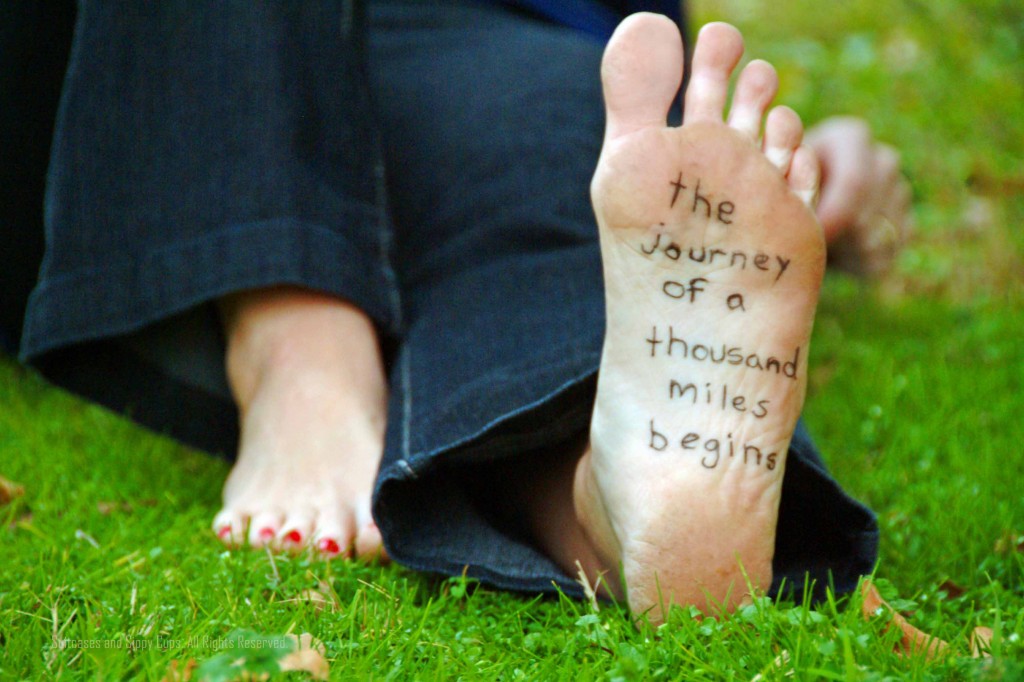
journey-beginsOn the other hand, I find Nightingale’s concept really inspiring in its reminder that small, sustained effort can add up in really significant ways. Yes, in many ways, this is a familiar and often-stated concept. After all, isn’t there a proverb about the thousand-mile journey beginning with one small step? But sometimes it is really impactful for me when a new phrasing or formulation allows me to see a familiar-ish concept in a new way. Like when I read a book, some years ago, spring-boarding off the proverb to point out that the author’s small steps had, without her really noticing, carried her across the universe.* The Nightingale quote now, like de Grandis some years ago, helps shift my attention away from the sense of a slow, endless slog — 1,000 miles times 5,280 feet/mile, divided by 2.5 feet/step** — towards the reminder of what can be accomplished with sustained effort.

And yeah, I have a fair number of daily practices already. But I also spend enough time doing the TV/Facebook zombie thing that the hours could almost add up to being their own part-time job. Besides, the activities in question here (reading and thinking) are things that come to me as naturally as breathing. And even if an hour each day feels a bit like a stretch, I know that smaller pieces of effort can also add up:

As I’ve said before, we overestimate what we can do in a week, and underestimate what we can do in a year. But if you spend 15 minutes a week reading your industry journal and it takes you four weeks to read it, is that a bad thing? Of course not- it probably only comes once a month anyway!

So, in concert with this fellow, I’ve started spending 15 minutes each night reading a bit about education, starting with another book I borrowed from the company “library.”

As with so much else in my life, I imagine this to be a “progress, not perfection” kind of movement. I imagine there will be times when my daily practices need to be triaged and weighed against one another. Last night, for example, after our drive up to the lake, I found myself prioritizing education reading and early bedtime over JALC post. (Heck, we have baseball tickets and I won’t be able to post tonight, either, so a midday Saturday post kinda works better anyhow.)

Some nights I can imagine prioritizing JALC over ed-reading,and some nights I can imagine prioritizing both of those activities over sleep. Day by day, I’ll work it out. Heck, I wasn’t entirely sure I’d be able to stick with JALC when I resurrected it, and yet here we are 5 months later. (Which is, by the way, 4 months longer than JALC’s first-phase lifespan. Go figure.)

Step by enjoyable step, around the world and back again.

* The book in question is currently not available to me, so I can’t confirm the precise quote. (After the Facebook error, I feel as if I should be extra-aware about such things as the accuracy of my citations and the credibility of those sources I quote.)

** Why doesn’t my keyboard have a division sign? Ah, the indignities of aging, when one’s native symbol set slowly gets displaced by the new generation’s symbology…

———-

Image credits:

Norman Rockwell: http://mote-historie.tumblr.com/post/76317464830/now-son-do-you-know-what-you-did-wrong-yes-sir

The journey begins: http://www.suitcasesandsippycups.com/2012/01/a-journey-of-a-thousand-miles-blah-blah-blah.html

J is for Jetlag

Okay, so there have been a few glitches here in JALC-land.

First off was a certain irregularity in the pace of scheduled posts. This has nothing to do with WordPress and was purely operator error: I had time before we left for the airport to tag and schedule the first 4 of the 6 posts I had “in the bank.” I chose an every-other-day pace, because I assumed it’d be easy to find little bits of time during travel and evenings to quickly tag & schedule the remaining 2 posts, and also to take my Game of Thrones idea and lay some quick text down.

Except then I got swept up in vacation mode, and the pace of travel and excursions was so intense, that the blog pretty much completely left my head until I sat down on our last at-sea day (21 July) to lay down that Game of Thrones text and realized — much to my chagrin — that nothing new had ben posted since the 16th. ‘Cos I’d never actually tagged and scheduled songs number 5 and 6, you see. Whoops.

jet-lag-is-comingSecondly, I know I’ve been a touch delayed in getting back to writing since returning home. Chalk this up, as well, to a touch of over-optimism on my part about my available time and energy. We landed early evening Wednesday, and although I was wise enough to know I wouldn’t have any writing in me that night, I did expect to be ready to type something quick come Thursday. Friday, at the latest.

Reality check. I am not as young as I used to be, and it turns out I was sufficiently tired-out and jet-lagged that I was in bed at around 8:30 both Thursday and Friday night. (Yup, partying like a rock star.) So, obviously, no blogging either of those evenings.

———-

first-world-problems-shampooNow, Im hoping that none of this is coming off as whining. Because a few missed blog posts and a little bit of jet lag are a tiny price to pay for a once-in-a-lifetime European trip.

So please understand: I am not complaining about any of this. (Were I to do so, it would really be the obnoxious epitome of first world problems. To the extreme.) I am filled with gratitude for where I have travelled, what I saw, what I was able to learn. What I am sure I will continue to learn as I reflect on these weeks, and as the unwinding of my life’s journey brings new layers of meaning and insight to these events and sights.

Instead, I’m simply reporting out on the various bits of foolishness that have led to JALC being in a bit more of a gone fishin’ mode than I’d expected or hoped might occur.

Now that I am (mostly) caught up on my rest and feeling (mostly) human again, I expect to be catching up on the news, which will likely inspire the occasional feminist screed. And yes, there will be some reflections on the trip and what I learned, and my usual hodgepodge of ongoing learning, reading and introspection.

TL;DR: I’m back at the keyboard.

It’s good to be home.

———-

Image credit:

Jet Lag: http://www.fitacrosscultures.com/jet-lag/

First world problems: http://moneyramblings.com/first-world-problems/


Peace Out

peace_out_by_wirdoudesigns-d62lrkoSo today’s proposal went in and things got locked down at work, the suitcases are pretty much packed, the house-sitter is keyed up, and the boarding passes are printed. Guess it’s almost time for vacation.

Of course, all of this is being done in my usual human & imperfect fashion. The house is WAY messier than I would have preferred the house-sitter to see, but I ran out of time. There’s a couple tasks at work I wanted to get done before I “handed the baton,” but I ran out of time. (Sense a theme here?) I didn’t get as many posts in the bank as I wanted to, but — sing it with me! — I ran out of time.

Oh well, I do the best I can. And sometimes my best includes packing rather too many clothes so that I have lots of options and therefore (with any luck) can stave off some of the waves of physical and existential insecurity that happen when I’m with my extended family. The luggage scale confirms that I am within airline limit, so I’ll just count my blessings on that score and let my ego-selves have this little piece of comfort. If having the extra clothes options helps me stay in my body, enjoy all the new sights and sounds, and maybe even get deeper insight into my lineal and family patterns? That’s a trade I’m willing to make.

———-

For all the “cut corners” and imperfect execution around different pieces of the pre-trip preparations, there’s one piece of preparation I’m giving its due measure to: taking the time to set an intention for this journey.

I’m not using the term in the way it so often gets public airplay in a manifestation/law of attraction kind of context. Phillip Moffitt, in Yoga Journal, does a good job of defining intention-setting from a Buddhist perspective, a definition much more in harmony with my use of the process:

Setting intention, at least according to Buddhist teachings, is quite different than goal making. It is not oriented toward a future outcome. Instead, it is a path or practice that is focused on how you are “being” in the present moment. Your attention is on the ever-present “now” in the constantly changing flow of life. You set your intentions based on understanding what matters most to you and make a commitment to align your worldly actions with your inner values.

The extra layer in my practice is to use the process as another way of seeking Spirit’s guidance — usually through drawing a card and using the card’s message as a springboard to help shape the intention I create. (See here for a description of someone doing a similar practice as a way to kick into a new year.)

Drawing a card allows me to get out of my own way and get more of a true read on whatever it is I’m going to be studying/transmuting in a particular experience. Instead of fooling myself into thinking I know what I’m going to be studying, in a very assumptive, ego-driven, self-fulfilling prophecy kind of way.

So, my card has been drawn and I will shortly go to do a little writing meditation on the card’s message. Then, if my usual system holds true, I’ll let my unconscious work on the question while I’m sleeping, and I’ll formally put pen to paper to scribe my intention tomorrow morning. Maybe even while I’m at the airport.

Stay safe, y’all. Catch you on the flip side.

———-

Image credit: http://wirdoudesigns.deviantart.com/art/Peace-Out-367171800

On Modulations and Tone

(Quick hit: another proposal due tomorrow, and also much in the way of packing/preparing for the house-sitter. Still, since these grounds will be semi-fallow for a stretch of time, I am compelled to put something up, even if it’s more quotes from others’ writing than words of my own.)

tone_police_sheriffAs I’ve been expressing my outrage over various current issues during the last several weeks, I’ve been aware of a delicate push-pull within my system around the issue of tone: how to speak strongly without “going overboard.” In short, being just a little tiny bit invested in tone policing myself.

Obviously, that investment has only been a few pences’ worth — I know what bullshit tone policing is:

The tone argument is a form of derailment, or a red herring, because the tone of a statement is independent of the content of the statement in question, and calling attention to it distracts from the issue at hand. Drawing attention to the tone rather than content of a statement can allow other parties to avoid engaging with sound arguments presented in that statement, thus undermining the original party’s attempt to communicate and effectively shutting them down.

And, therefore, I don’t do a whole lot of policing myself. But I do a little.

For example, I know I’ve said the phrase “morally repugnant” a few times in the last week as I’ve been responding to SCOTUS’ shenanigans. Plenty strong of a description, I suppose. But a step or two shy of the word I hear in my head to label these decisions and the misogynist world-view they embody: evil. (Yeah, I went there.)

I’ve been lucky thus far not to have anyone outside of myself pull the tone policing card on my writing. If that had occurred, I’d probably have responded with an explanation of the ways that anger is justifiable, appropriate, and even inevitable in situations that reveal the many injustices of the kyriarchy. To quote Do or Die:

Living in a world that reminds you daily of your lesser worth as a human being can make a person very tired and emotional. When someone says something oppressive . . . it feels like being slapped in the face, to the person on the receiving end. The automatic response is emotion and pain. It’s quite exhausting and difficult to restrain the resulting anger. And, frankly, it’s cruel and ridiculous to expect a person to be calm and polite in response to an act of oppression. Marginalized people often do not have the luxury of emotionally distancing themselves from discussions on their rights and experiences. 

[. . .] Now, I’m not saying it’s okay to be abusive, or oppressive in response to a person who fucks up. But anger is valid. Anger is valid, anger is important, anger brings social change, anger makes people listen, anger is threatening, and anger is passion. Anger is NOT counterproductive; being “nice” is counterproductive. Nobody was ever given rights by politely asking for them. Politeness is nothing but a set of behavioral expectations that is enforced upon marginalized people.

And this is all true to my understanding of the world and of human psychology, and of activism and social justice work.

But a day or two ago, I happened across something that puts even another lens on the occasional necessity of outrage and outraged speech.

If you speak about injustice and privileged people get offended, people will condescendingly explain to you that things are easier to hear if you are nice, and that you are more likely to convince people if you speak to them respectfully.

This is true, and often important to keep in mind – but people who say that to you in a conversation about injustice are usually missing the point.

They’re ignoring something fundamentally important about addressing injustice: Sometimes, the goal is not to convince privileged people to treat others better. Sometimes, the goal is to convince marginalized people that the way they are being treated is unjust and that it’s possible to resist.

Now, I’ll admit to the smallest bit of discomfort about the phraseology around “convincing marginalized people . . . that it’s possible to resist.” Something about it rings a bit too close to “white savior” territory for my liking.

Nonetheless, there’s a piece of this that’s really opening my perspective. What are the ways my writing is for the public (it is in a public forum after all), and what are the ways I am the primary beneficiary of my words? How does my writing help me overcome the habits of self-silencing?  Are there times I’m hoping to change minds and hearts, and other times where I have no expectation to “convert” disbelievers but simply need to sound a rallying cry for myself, my friends, my allies? Or sometimes a paradoxical mixture of both those strands?

What my purpose for writing isn’t an either/or but instead is a plurality, a yes/and?

———-

Image credit: http://thetonepolice.tumblr.com

25 Songs in Slightly-More Days

I mentioned in passing that we have a bit of a family trip coming up in July: Mr. Mezzo and I will be cruising the Baltic on one of those once-in-a-lifetime before the kids grow up and leave us in the dust trips. (My sister’s kids, not mine.)

OUAT-my-feelsAs much as there is part of me that would want to try and keep up with my posting and with current events while we are a-travelling — so many news stories! so many feels about those news stories! —

In the mature part of my heart and brain, I know that to try and do that would quite simply be bananas. Although I think we’ll be able to find some sort of “Internet cafe” on the boat, I don’t want to count on a robust enough wifi connection to sustain my long-windedness. Besides, this truly is a once-in-a-lifetime experience, and I’d like to give myself the chance to really experience it, rather than be devoting my energy to surfing the news sites and waxing loquacious about what I find. Slate, Salon and HuffPo will all still be going strong when I get back stateside…

But I also don’t want to leave JALC completely shuttered for the time we’re a-sea. So, I’m going to start (slowly!) taking on a “25 songs in 25 days” blog challenge I stumbled across.

25-songs-25-days

It seemed one of those challenges that was tailor-made for me. After all, when asked to write about only three songs back during the Writing 101 experience, I was kind of jammed up by needing to reduce all my passion for music into only three pieces. (And even then, I stretched it to four songs, rather than three. *grin*)

I also like how instead of just asking something banally impossible like “What’s your favorite song?” — favorite for what purpose? in what context? current favorite or for-the-most-of-my-life favorite? — these questions are asked from very specific lenses. I think it’ll be fun to see where these different angles of inquiry take me.

So here’s the plan. During this holiday weekend, alongside of the packing, the Wimbeldon-watching, the last-minute shopping and the job-work I need to do, I’ll be responding to the first however-many of the prompts on this list: as many as I’m able to, but you can see that I do have a few other things on the to-do list. So I’ll just have to see how many I get written.

Whatever that number is, I’ll use the handy scheduling feature (thank you, WordPress!) to scatter those song posts semi-evenly throughout the time we’re away. That way, there’s at least a little bit of activity on JALC, and it’ll also be a cool chance for me to talk about something — music — that has always been an important part of my life.

I’ll chip my way through the remainder of the 25 songs list once I’m back in the States. So it’ll definitely take me more than 25 days, but it’ll still be a fun project.


Of Conversation and Community

fremont-troll-bridgeI’ve been thinking about comment policies today. You see, there’s  a comment sitting in the mod-queue for yesterday morning’s post about Burwell v. Hobby Lobby. It’s mildly snarky, not particularly offensive in its content — no slurs, hate speech, or anything like that. But the one-liner is also sufficiently, provocatively disconnected from the facts and the issues at hand that I keep asking myself: “Are you someone trying to have a sincere disagreement, or are you just a troll?

To borrow an operative definition from Hubspot:

Trollers are people who leave comments on posts to try to get a rise out of either the author, or other commenters. The best practice for dealing with trolls comes down to one easy-to-remember phrase: Don’t feed the trolls. This means the more you engage with trolls, the bigger and stronger they become — that’s what they want! To get a rise out of you.

So the distinction I’m trying to spot is whether A) the would-be commenter strongly disagrees with my politics but is wiling to have a substantive discussion, or if B) the sole purpose of the provocative one-liner is to be a shit-stirrer. And of course, with nothing but words on a screen and my regrettable lack of psychic insight to go on, that is a very hard distinction to distinct.

Are you human or troll?

It’s a little bit of a conundrum. Do I delete the would-be-comment and take the chance that I’m silencing someone who’s coming from a real-person rather than a trollish perspective? Or do I approve the comment, respond to its reality-disconnect, and take the risk of getting dragged underneath the troll bridge? It’s a tricky, charged decision. Not because of this one specific comment on its own — again, let me acknowledge that it’s more a snarky one-liner than anything else — but because my choice today carries the weight of creating a precedent for how I may address disagreement, dissension and doucehoundery on JALC in the future.

I’ve been thinking about the aggressively clear commenting policies at two of the feminist communities I’ve long-admired: Shapely Prose (where I participated) and Shakesville (where I’ve not participated but look admiringly from afar). Both of these documents are the result of years of community-building, resulting in a vibrant commentariat and also an astronomically high frequency of trolls and bigots targeting their posts and threads for attention. Obviously, JALC is a baby newborn blog, with a teeny-tiny readership and an even smaller community (if that term can even legitimately be applied.) So a lot of what those policies contain aren’t on-point for me. I do not have or need a group of co-moderators to keep up with the comment traffic, nor do I yet have an establishing commenting culture I need/want to protect.

And yet, there are value statements in those policies that ring true to me.

Whether you can comment at Shakesville is ultimately at our discretion—and plaintive, angry, or accusatory wailing about free speech will be met with yawning indifference. This isn’t a public square. This is a safe space. (Shakesville.)

I am not a representative of the government; when I tell you, directly or indirectly, to shut up, it does not in any way violate your Constitutional rights. If you want to speak freely, the fine folks at WordPress will be happy to provide you with the exact same kind of platform I use. . . . [W]e have probably, on occasion, banned or berated a perfectly decent person who might have eventually blossomed into the kind of commenter we can’t wait to hear from. And you know what? We’re okay with that. We’re not proud of it, and we certainly don’t set out to exclude bright, interesting people from the conversation here. But if it happens every now and again, oh well — because overall, our being hardasses helps keep this blog readable and only rarely crazy making. (Shapely Prose)

All of this is resonant with the sort of community I would want to create, if I am ever so fortunate as to have JALC (or some future endeavor) blossom into becoming an online community. And you know what? Even though I feel an embarrassing level of grandiosity in modeling my choices after these communities that have literally changed my life for the better, there’s another, more immediate lens through which I’ve been contemplating my decision.

If nothing else is certain, I know the would-be comment is an anti-feminist statement. And there are so many other places in the world where the patriarchy and the kyriarchy hold sway as the dominant discourse. (Exhibit A: SCOTUS and Burwell v. Hobby Lobby.*)

Do I really need to give that perspective untrammeled sway in my own digital living room? No, no I do not:

My blog is my living room in my home. I set the rules. I determine the tone. I determine the topic of conversation. When you post a comment on my site, you agree to abide by my rules, you stick to the topics I determined, and you keep the tone I deem OK to be used in my home (imagine reading out loud your comment in front of my wife, mother and kids). I have the right to warn you and to kick you out of my home – it’s my party, after all. You have no right to be here, no right to say anything – it is up to me to welcome you here, and up to you to ensure you are welcomed. (A Blog around the Clock)

So, ultimately, would-be commenter: I’m sorry not-really-all-that-sorry, but your comment will not be getting airplay this week. It’s not as if I’m setting a zero-tolerance policy for anti-feminist speech here on JALC. (Not yet, at least.) But anti-feminist speech that looks a bit more trollish than human?

Just not worth the odds.

* And also McCullen v. Coakley. (But as far as the June 26th decision goes? I can’t even, right now. Not enough spoons.)

———-

Image credit: http://mystrangefamily.wordpress.com/2013/09/04/under-the-bridge-with-the-fremont-troll/