Found Money

[Set-up] It looks like I’m going to continue to need a little flexibility and creativity with Writing 101 . Today’s actual assignment is the completion of a three part series I started back on “Day 4.” Of course, I haven’t actually written part two of this three-part series — because that’s one of the pieces I skipped during last week’s work insanity. So I guess I won’t actually be jumping right into this week’s assignments. Instead, there will be a targeted reach-back to last Wednesday’s assignment, as a precursor to whenever I get around to doing today’s.

So, Day 13, written on what should actually be Day 16 of the sequence:

On day four, you wrote a post about losing something. Today, write about finding something. . . . Today’s twist: if you wrote day four’s post as the first in a series, use this one as the second installment — loosely defined.

You could pick up the action where you stopped, or jump backward or forward in time. You might write about the same topic, but use a different style, or use the same style to tackle a neighboring topic.

[/Set-up]

———-

So, gentle reader, when I last left the abbreviated summary of my life’s career trajectory, I had drifted into both an environment (academia) and a profession (faculty) for which I was profoundly ill-suited. To some degree, the inner rumblings around that ill-suitedness began very early. And yet, I struggled to persevere. Buckled down to overcome the deficiencies of my mass-market, public school background. Shifted graduate programs to one where I had more natural gifts and talents than my first Ph.D. curriculum.

Why was I so damn stubborn? In part because I am really, truly so damn stubborn. But a lot of it was rooted in a basic survival-level fear that there wasn’t anything besides teaching/professor-ing that I could ever make a living at.
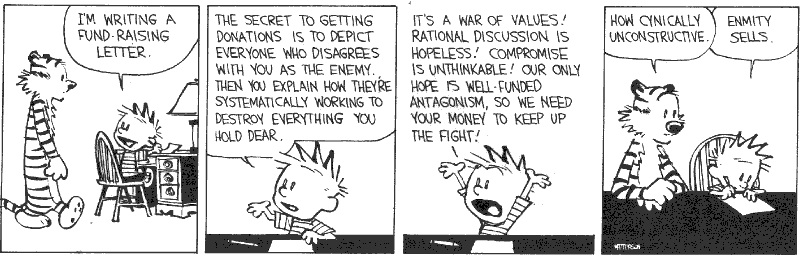
calvin-on-fund-raising

I dare say I kinda fell into my career. It’s not like I wandered around elementary school saying “I want to be a fund-raiser when I grow up!” And, really, who would go around saying that? Do the ins-and-outs of non-profit management get any airplay in the Sesame Street/Richard Scarry “People in my Neighborhood” set?

Nowadays there’s definitely more awareness at the college level of non-profit careers. But that’s a big shift from when I went to school, back when dinosaurs roamed the earth.

I actually wrote my first successful grant proposal as a bit of volunteer service for a community choir where I was singing. I’d somehow talked my way onto the choir’s board as a general member-at-large, and was eager to find ways to prove my worth and contribute. So when the Board president asked for someone to help write some grant proposals, I figured it’d be an easy thing to do. I’m a good writer. I even know how to teach writing, don’t I? A grant proposal should be simple!

And here’s the kicker: it kinda was.

This is not to minimize the ways that grant-writing is intensely different from the stylistic and argumentative conventions of academic prose. But where I always found myself struggling and straining against those academic conventions, the general transparency of grant guidelines, and the need to build a tight, compelling argument out of plain language was a genre of writing that made instinctive sense to me.

And then we got the money.

So suddenly, something that both came naturally to me — writing plain, strong prose — and that I had studied intensely — how to analyze genre and build written arguments* — had real, honest-to-goodness street creed and value to it. I had worked for less than a weekend, and my choir now had several thousand dollars to show for that effort.

Now, obviously, that initial grasp of what it took to be a grants professional was, in its own way, appalling naive. I had a lot to learn in the first few years of my career — though the learnings were sufficiently connected to my existing strengths and background knowledge that success was possible.

And I still have moments where I question whether fund-raising is really the “forever career” for me. The division and tension I have seen at every non-profit between those who raise the money and those actually out doing the work is one that troubles me. I know the privileges of being in the fund-raising camp. But I also have never entirely been able to let go of a nagging self-quesitoning about whether I really want to spend the rest of my life being “just a fund-raiser” — after all, the Gospel of Matthew suggests that “you cannot serve both God and mammon” (6:24).

But even with those ongoing questions about whether there is a third career yet to unfold in my life, I remain profoundly grateful that I was able to lose academia and find my way into grants and fund-raising. I have become very good at what I do, I have seen the benefits of my efforts take shape in programs and services and buildings, and I have been able to make a living for myself.

* Or “analyze funder guidelines and build a responsive case for support.”

———–

Image credit: http://s102.photobucket.com/user/pb82/media/Cartoons/calvin-on-fund-raising.gif.html

What I Learned in Grad School

Okay, so the big super-huge work project got even more intense than I’d anticipated, so I went full-out on it till Thursday night. Then, instead of sleeping and catching up on my rest and my writing, Mr. Mezzo and I have been out of town for the past two days celebrating my niece’s graduation. So, suddenly I missed an entire week’s worth of Writing 101 assignments, and the next crop of assignments is due to start up again tomorrow morning.

Now, one thing I learned in grad school is the strategic folly of always trying to go back and play catch-up.

Let’s say you fall behind on your reading for Week 3 in a particularly dense syllabus — like, say, the kind of syllabus where the professor keeps adding new articles to the reading list year after year, without taking away any of the older, less-academically-relevant ones. (Not that I ever had any grad classes like that back in the day. This is all purely a hypothetical exercise…..)

lawrence-wink

Anyhow.

One approach to take to this conundrum would be to start Week 4 by going back to the things you missed in Week 3, hoping to address all of the backlog and all the new assignments. But, if each week’s workload is too robust to be handled in a week, the only thing you gain by that approach is to just get farther and farther behind.

So after one or two courses where I tried to do the virtuous “going back and catching up on everything” routine, I developed a new discipline around falling behind on homework.

Step one for me is to jump right back into the stream at this moment. Hit the reset button, start with the new crop of work, do all of it to the best of my ability — and then, if I do end up with some luxurious extra time after that, only then will I try to go back and fill in what I’ve missed, using my own instincts to triage out what’s most important and what’s most able to be let go.

So, tomorrow I’ll be jumping back into the Writing 101 flow with this coming week’s assignments, and I’ll go back and fill in the missed ones in whatever order I choose to do them.

I have some hope that the work week will be a little quieter than the past fortnight has been. If that turns out to be the case, I may get home early enough to manage a double-posting day or two throughout the week, which would help with the backlog. I also could get creative and see if there’s a way I can kill two assignments with one essay, as it were. Or there may just be an assignment or two that I let slide by, water flowing under the bridge of best intentions, never to be seen or recaptured again.

And I’m okay with that. Aside from the specific workflow strategies I am applying here to my bloggy-life, the main thing I learned in grad school was the complete psychic and energetic uselessness of perfectionism and how pointless it is to do that inner ballet of self-flagellation when one shows one’s humanity by doing an imperfect or fallible thing.

Admittedly, that main lesson only partly sunk in. I keep learning and studying and practicing into that one. Step by step, I continue ever onward — following the trajectory away from self-punishing perfectionism and towards maturity and self-acceptance.

Here, now, with Writing 101, is as good a time to practice that as any.

———-

Image credit: http://giphy.com/gifs/pzmTB7cwkfx0Q

Hashtag Feminism

#wecandoitI had so much else to say last night about that damn George Will op-ed that I didn’t have time to touch on one thread of the counter-discourse against his misinformed and misogynist rant: the hashtag conversation about #SurvivorPrivilege.

Feminist writer and activist Wagatwe Wanjuki states in an interview on Buzzfeed:

I honestly started the hashtag as a way to share my frustration with the notion that survivors have privilege. It’s one of those situations where I felt like I should laugh so I don’t cry, so I used my sarcasm to start a conversation about how difficult it is to be a survivor. I hope the hashtag will help highlight the absurdity of George Will’s column and that survivors are struggling in the aftermath of sexual violence. No one wants to be the victim of a violent crime.

If you peruse the tweets reproduced in that article, or in similar articles at DCist, Feministing, Ms., and PolicyMic — or, for the moment, if you follow the live twitter feed, though batten down the hatches for the inevitable MRA backlash in 3, 2, 1… — you will see an array of experiences that is likely every bit as heart-breaking and outrage-inducing as you would expect it to be.

For example:

https://twitter.com/wagatwe/statuses/476056156792954880

https://twitter.com/sarahnmoon/statuses/476099428756242432

Meanwhile, in another corner of the galaxy, Shonda Rhimes gave the commencement speech at Dartmouth this past Sunday. (Transcript here.) Among the customary mixture of self-revelation (“Shonda, how do you do it all? The answer is this: I don’t”) and platitudes (“Don’t be a dreamer, be a do-er”) is a passage about the importance of activism in the world:

And while we are discussing this, let me say a thing. A hashtag is not helping. #yesallwomen #takebackthenight #notallmen #bringbackourgirls #StopPretendingHashtagsAreTheSameAsDoingSomething

Hashtags are very pretty on twitter. I love them. I will hashtag myself into next week. But a hashtag is not a movement. A hashtag does not make you Dr King. A hashtag does not change anything. It’s a hashtag. It’s you, sitting on your butt, typing into your computer and then going back to binge watching your favorite show. For me, it’s Game of Thrones.

Volunteer some hours. Focus on something outside yourself. Devote a slice of your energies towards making the world suck less every week.

(Emphases added by HuffPo.)

As part of an ongoing work project, I’ve been having some conversations with colleagues about the nature of societal and systems change.* We’ve been talking about this topic within the context of educational reform, but the core principles around creating change carry across contexts and topics — including misogyny, patriarchal structures and rape culture.

Let me distill these conversations down to a kindergarten level.  The research suggests that in order for real change to occur, real, lasting, sustained change, three pillars all need to be in place:

  1. People need to know the truth about something (especially when evidentiary truth goes against your assumptions or beyond the limitations of your personal experience)
  2. People need to care, to think that a particular issue matters and that the effort of making change is worth something
  3. People need do-able, impactful actions they can take to make individual change or influence systemic/societal change

So in one way, Shonda’s right: talk alone is not enough to “make the world suck a little less every week.” But I think she goes too far when she says “A hashtag is not helping.” Because action alone isn’t enough — or maybe action would be enough on its own if we lived in a miraculous utopia where everyone was instinctively knowledgeable about and motivated towards right action.

But we don’t live in that magical utopia, so unless people are given information to help them drop their privilege blinders, and unless they are inspired to give a shit, then nothing is gonna evolve.

In other words: hashtags help.

* There are moments my job sucks, and then there are moments when it is really-super-cool.

———

Image credit: http://nymag.com/thecut/2013/12/can-feminist-hashtags-dismantle-the-state.html


Letters Never Sent

So the Day 5 prompt for Writing 101 reads:

You stumble upon a random letter on the path. You read it. It affects you deeply, and you wish it could be returned to the person to which it’s addressed. Write a story about this encounter.

Today’s twist: Approach this post in as few words as possible.

Okay then. Being as I am not a fiction-writer and am instead more of a quasi-memoirist, and seeing as how I have never actually had this experience of stumbling across a random piece of correspondence, I’m going to have to take a bit of a sideways approach, here.

I will, however, try to adhere to the suggestion about keping things short — which is a thing that does not come naturally to me. But, like some smart guy once said, brevity is the soul of something-or-other.

———-

“atlantis is sinking but paradise is not lost”

Atlantis2 This graffitied phrase was on the foundation of an abandoned structure not too far from my Philly townhouse. I never knew what the structure had been, or what spray-paint poet had left this inscription on the vestigial remains of concrete and I-bar. But I would walk that route often, and the phrase was something I absorbed at a cellular level.

Some versions of the legend of Atlantis talk about the city as a paragon of enlightenment, beauty, creativity. A place of such technological advancement that it was brought low by the gods — either because the Atlanteans sank into greed and hubris, or because the gods themselves didn’t want the competition of dealing with such evolved beings. Either way, the island was swallowed by the sea, never to be seen again.

The metaphor, to me, was obvious. Your current endeavours or creations could all be wiped away by a wave of Poseidon’s hand. Yet new options, new opportunities will always emerge from what appears to be flotsam and jetsam. That’s a faith I hold true in my heart.

Eventually, the old structure and its message were themselves brought down: making way for the parking lot of a new condo building. (I’m sure there’s a Joni Mitchell fan or two who can appreciate the irony of that.)

But I still carry the words tattooed in my heart. Atlantis crumbled, but paradise is not lost. Paradise is never lost.

———-

Final tally: kept it to less than 250 words. For me, that’s a fucking haiku of concision.

———-

Image credit: http://zerowoes.com/articles/revealing-the-legend-of-lost-worlds/


A Bad Beginning

The Day 4 prompt for Writing 101 is loss. Any kind of loss, from heart-wrenching to flippant. The extra twist: write so that this piece can be the first installment in a 3-part series, as opposed to the “one-off” posts that populate so many blogs. (Now that piece of advice amused me especially, considering the endless ways my posts speak in interwoven dialogue to one another. I think the comments field on JALC have more ping-backs connecting my different posts in conversation with one another than I have actual comments from people!)

During the hours between seeing the prompt and sitting down to write, I wondered whether I’d talk about my father’s death. After all, JALC was birthed during those first months of shock and grief, and we have just recently marked (or not marked, as the case may be) the fifth anniversary of his passing.* Ultimately, that didn’t sense as the way to go.

Instead, a meditation on how I parted ways with graduate school and the ivory tower.

———-

Sometimes a good ending is prefigured by a bad beginning.

2011LinkAsTarotFoolNot that it seemed like anything bad at the time. Indeed, when I was on the verge of beginning my Ph.D. program, it looked as if — to quote a piece of adolescent dystopia — the odds were ever in my favor.

What’s not to be happy about? An Ivy League program, full graduate fellowship, and I received the offer letter so early in February that even my professors were shocked.  Even while waiting for and weighing the other offers that came, having that one letter in my hands meant that, even if the details hadn’t quite been settled yet, I had my life all wrapped up and figured out.

And there, I believe, lies the root of the problem. I had set myself on a course without enough self-knowledge to know whether it was a path that would truly suit me.

Or.

Did I set myself on this path so much as drifting there? After all, school and academics had been the only thing in my life at which I had truly excelled. During the public school years, the fruits of that natural talent were made bitter by the shames and embarrassments of not being talented at the right sorts of things — the prettiness, social, and popularity scales. Once I was at college, the environment was one that more fully valued my intellectual gifts. Why wouldn’t I think that it was the environment where I was meant to stay for the rest of my lifetime?

And so, whether by aimless drift or by self-deluded intention, I was going to become a professor.

Never mind the amazing naïveté of the choice. My complete lack of understanding about what a professor’s life and work actually are like. My false sense of limitation around how school and classes were the only environment where I could be successful. My immaturity in thinking that I would perceive the cloistered nature of academia as a safe cocoon rather than a strait jacket.

I was going to be a professor. Until I realized that no, I wasn’t. I really wasn’t.

* And there’s two more ping-backs!

———-

Image credit: http://jennysrp.blogspot.com/2011/04/you-fool.html

A Dinosaur with a Quill

I work in a very laptop-obsessed office. Every meeting we have is vaguely comical: all of us clustered around a table together and making zero eye contact because so many of us are staring at the screen and/or typing busily away taking notes. It’s especially funny in the offices furnished more by a bistro table than an actual conference table — imagine, if you will, some bizarre version of office jenga.

DINO_PEN_COL_921211fI’m not going to say I’m immune to exhibiting some of these behaviors myself. I carry my laptop into most meetings, in case something comes up in conversation that I need to pull down off a website or pull up out of my email or the document server. But unless I’m capturing the formal minutes of a meeting, I don’t usually use the computer to take notes. Instead, I use the old-fashioned tools of pen and paper.

Yes, I know: this makes me a veritable dinosaur in the contemporary work world. I’ve even read a viciously dismissive article by an Evernote aficionado* that talks about how anyone who takes pen and paper notes automatically loses her respect:

I knew right away, when you walked in here with a paper notebook — a paper notebook! — I realized that this meeting was not going to be a good use of our time. . . . You could be one of those romantic types who say that the visceral process of putting pen on paper liberates your creativity and engages lateral thinking. If you’re an after-hours poet, then, yes, that paper notebook will come in handy. For this, though, can you please go back and grab your laptop?

I’ve tried multiple times to adopt electronic note-taking methods. Nothing yet has worked to my satisfaction. I’m not sure that nothing ever will, and I wouldn’t be surprised to find myself, some stretch of time in the future, trying another technique, another structure, another iPad app, to crack the note-taking enigma.

But for now, I’m at peace with my antiquated habits. Especially now that I’ve tucked away these two articles (one and two) that suggest my handwriting habits may not be such a bad thing after all. Both articles summarize a study done at UCLA (or was it Princeton? the study authors split their affiliations between those two universities, but I’m fuzzier about which campus actually housed the research) comparing the efficacy of typed note-taking versus handwritten notes. As summarized by Wray Herbert in HuffPo:

Those who took notes in longhand, and were able to study, did significantly better than any of the other students in the experiment — better even than the fleet typists who had basically transcribed the lectures. That is, they took fewer notes overall with less verbatim recording, but they nevertheless did better on both factual learning and higher-order conceptual learning. Taken together, these results suggest that longhand notes not only lead to higher quality learning in the first place; they are also a superior strategy for storing new learning for later study. Or, quite possibly, these two effects interact for greater academic performance overall.

The scientists had an additional, intriguing finding. At one point, they told some of the laptop users explicitly not to simply transcribe the lectures word-by-word. This intervention failed completely. The laptop users still made verbatim notes, which diminished their learning. Apparently there is something about typing that leads to mindless processing. And there is something about ink and paper that prompts students to go beyond merely hearing and recording new information — and instead to process and reframe information in their own words.

Take that, bitchy Evernote ambassador! Science trumps your unfounded assumptions and prejudice! (Actually, science probably won’t do a damn thing to chip away at Ms. Evernote’s preconceptions. We always cling mostly strongly to the myths that are most unfounded.)

Anyhow, I’m sure there’s a connection between my old school pen-and-paperness at work and the continued parallelism of me blogging while maintaining a pen-and-paper journal as well.

Sometimes my diarizing feeds into the blog: keeping a physical journal can help me have space to process and synthesize things prior to presenting them out here. Sometimes the diarizing stays contained on the notebook pages: a place to process things that are too raw, too private, or just too far off-topic to make sense here. So, partly because of the ways it supports my writing on JALC, and partly for how it supports my life outside of here, I see myself happily filling more notebooks with pen-scribbles for years to come.

* Who is oh-so-coincidentally hawking her own “How to Use Evernote Effectively” e-book.

———-

Image credit: http://www.thehindu.com/opinion/open-page/with-ipad-and-notebook-around-who-needs-a-pen-anymore/article2883480.ece