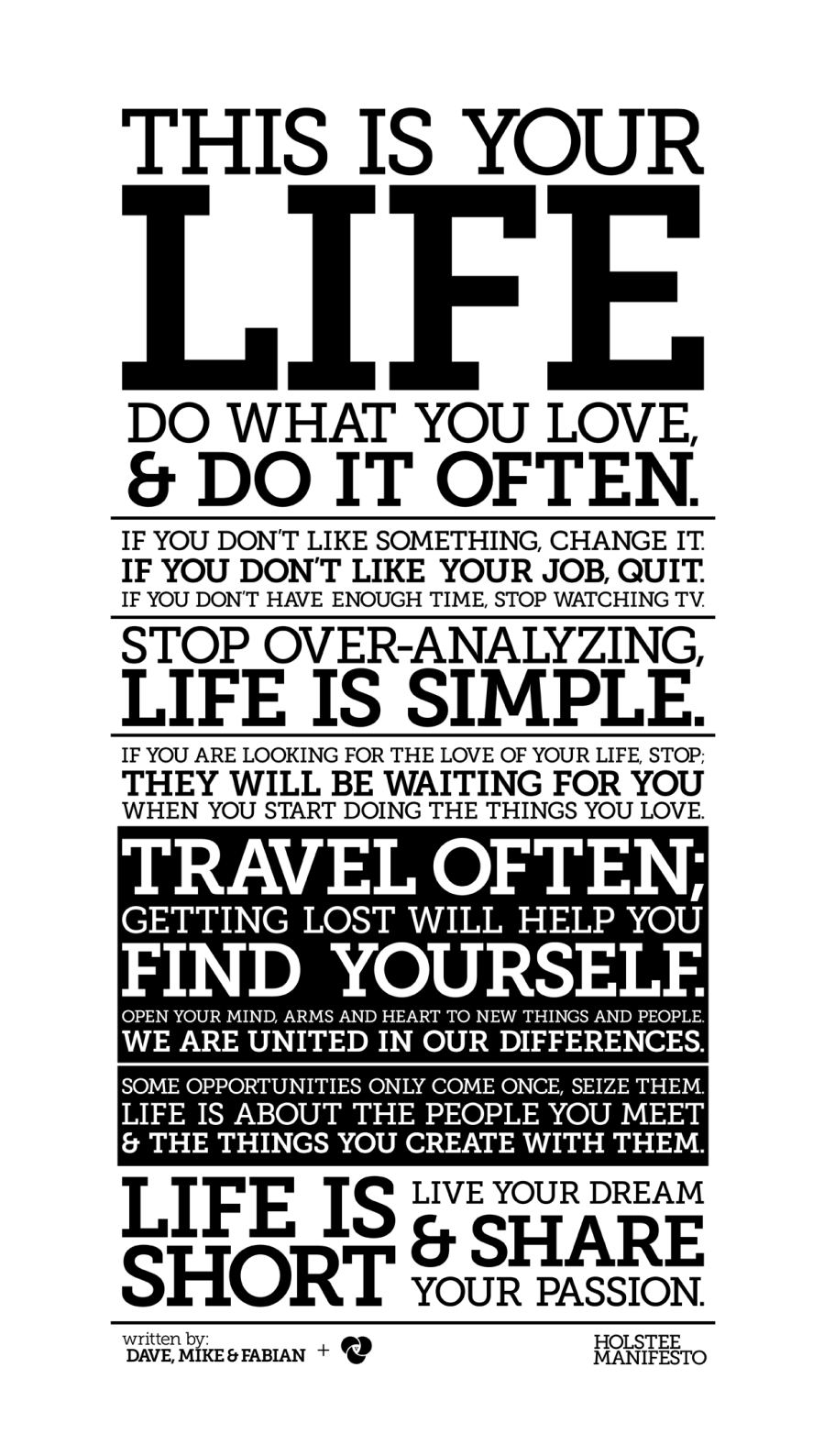
In Medias Manifesto

Because I have decided that 5 hours of sleep per weeknight is just too much of a luxury, I have decided to enroll in another challenge over at WordPress’s Blogging U. Blogging 101 is intended for individuals right in the start-up phases of bloggy creation. This invitation to register articulates the deliverables in this fashion:

On Day 30, you’ll have six (or more!) published posts and a handful of drafts, a customized theme that reflects your personality, a small but growing audience, a good grasp of blogging etiquette — and a bunch of new online friends.

So, considering that I first founded JALC some 5 years ago, and revived it more than 6 months ago, I am either well behind the times or way ahead of the game on this one. Still, I think it’ll be a good exercise for me.

I’ve been in recent conversations about the value of design thinking, and the ways that taking the time to step back and question your automatic habits and questions can be a good way to unlock a more intentional creativity. I see the Blogging 101 container as a way for me to foster that sort of intentionality here on JALC.

So, here we go…

Continue reading “In Medias Manifesto”

Judging Dread

Turns out that, as with dancing, sports are a thing that I greatly enjoy to watch, even though I don’t have any particular talent — or any talent at all, really — for doing those things with my own body. Now, it’s not like I’m a rabid sports fan that must find something live and sportsy to watch whenever I have a free minute:

But I do follow a few of the “big” sports casually — baseball, football, a little hockey (a more recent addition from when my nephew started playing it). And I’ve always been a huge fan of the Olympics and Grand Slam tennis.

Continue reading “Judging Dread”

Valhalla was Co-Ed

QUICK HIT: The choir season starts up again tonight, which means my Wednesday posts for the foreseeable future will have to be:

  1. Pre-written and scheduled
  2. Quick and somewhat insubtantial
  3. Non-existent in a “night off” kind of way)

Obviously, today I’ve chosen option 2. Well, not entirely obviously, since I could have pre-written and scheduled this post. But trust me: I didn’t do that. Because my life and to-do list are not currently at such a level of organization and under-controlness. I’d love to tell you otherwise, but I don’t have it in my to maintain that level of facade.

Where was I? Oh yeah: QUICK HIT tonight. In more ways than one. (Go below the fold to see what I mean…)

Continue reading “Valhalla was Co-Ed”

Going (Semi-)Viral

A funny thing happened this past week. A friend of mine shared an upsetting incident on Facebook where she experienced public prejudice against breast-feeding. Her story then went viral, earning (well-deserved) media coverage and public outrage.

That’s not the funny part. The funny thing is what happened next: I wrote a blog post about the event, and then I went viral, too.

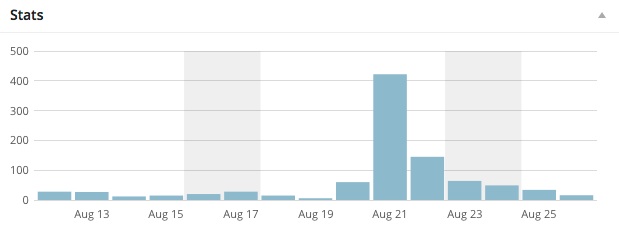
See exhibit A, WordPress’s visitor stats summary for JALC during the last couple weeks:

stats copy

The August 12-19 stretch shows me with my customary rate of site visitors — usually somewhere in the 15-25 range, with slight upticks and down-drops depending on factors like weekday vs. weekend, if I skipped a day, etc.

August 20 is when I posted about Ingrid’s experience: you can already see the uptick to 60 site visitors in those hours between hitting “Publish” and midnight, as a few folks started sharing my post within their own networks.

The next day, August 21st was when things hit big (relatively speaking). Yeah, that’s more than 400 hits — and from there, things have dropped off until yesterday and today I seem to have re-equalized back where I started.

So, all told, this is a very mild flavor of “going viral,” as compared to Youtube videos that get hundreds of thousands, or even millions of hits. Still, it was such a disproportionate spike in attention that it feels like the junior baby blogger version of “going viral.” And the sorts of study and self-examination the experience has invited for me — well, I wonder how different these reflections would be if I were talking about 4,000 hits rather than 400. I’m thinking: perhaps not that different at all.

First: Who woulda thunk it? For the most part, my writing here on JALC has been divorced from expectations about achieving any particular readership level on any timetable. The practice for me has been a practice of showing up, of experimenting with regular, focused writing. Finding my voice again. Yes, at some level there’s the prayer of my words being read and having positive impact — otherwise I’d just be writing in my diary rather than in a blog. But I’ve maintained a pretty decent level of non-attachment from any expectations about how many readers I want to have and how quickly I want them to appear.

And if you asked child-free me what sort of post I’d predict might be the first one to get public traction, there’s no way on this earth I would have predicted it be something about breast-feeding and the mommy wars. Talk about a subject that’s completely outside of my field of knowledge! (Okay, not completely, since I do have breasts as an anatomical feature of my body. But still.)  You never know what’s going to hit a nerve and garner that flash of attention. Like catching lightning in a bottle, that is. Write something true and honest and authentic, and I guess sometimes it’ll hit a nerve, fall in with a moment of zeitgeist. But to predict what’s going to hit that zeitgeist energy? Not within my current powers, as so clearly evidenced by the disconnect between my expectations and the actual happening of which JALC post first topped 550 views.

SecondYou never know what’s going to hit a nerve and garner that flash of attention. I’ll admit, however well I’ve maintained a state of non-attachment around my readership numbers where they were at a low and steady pace, that there was something sincerely exciting about seeing the bar graph keep climbing during the 21st. And when I sat down the evening of the 21st to write my first post-viral post, I could absolutely feel myself on a precipice. Feeling the demand that I “measure up” to this new level I’d achieved, feeling the temptation towards finding some other juicy topic that’d be “click bait” and that could build some kind of popularity for myself.

I walked myself back from that precipice, reminding myself: it’s like catching lightning in a bottle, that is. All I can do is continue showing up at the screen, writing as true and authentically as I can, taking on the topics that grab me and won’t let go until I say what I have to say. That’s why I wrote my post to begin with — even though I’ve spent years trying not to comment on parenting choices or the mommy wars. Something about Ingrid’s story just grabbed me, and I couldn’t rest until I wrote about it. That’s the feeling I need to keep following: I can’t rest until I write about this, rather than I think this will get good traffic.

So who knows? Maybe another post of mine will hit a zeitgeist moment a few weeks from now. Or a few years from now. Or never again. It’s all in service, however it unfolds.

I just need to keep in the practice of it. Say it plain, say it true. Stay as authentic as I can be.

Teaching, Trust and Testing

The aspirational arithmetic behind that whole “study an hour a day to become an international expert in your field” thing goes something like this:

  1. Studying/reading an hour a day adds up to you reading/absorbing about a book a week;
  2. Which adds up to about 50 books over the year;
  3. Which adds up to a whole lot of learning.

Now, obviously, by setting more moderate goals about how much “ed-reading” I’m trying to do each day, I have ensured that my own personal arithmetic will be adding up a bit more modestly. Still, I’m pleased to say I’ve finished the first book I started when I set this plan for myself. Two-and-a-half weeks ain’t so bad, all things considered.

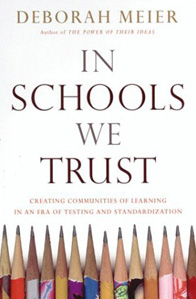
SchoolsWeTrustCoverEven though it’s a complete non-sequiteur, the first thing I noticed about Deborah Meier’s In Schools We Trust was that it was published by Beacon Press. I know of Beacon as the UUA‘s publishing house, but I’d not noticed till today what a vast array of non-UU books is in Beacon’s catalog. Upon reflection, this only makes sense, or else I fear Beacon might have what they call an “unsustainable business model.” Still, I hadn’t even remotely thought of Beacon as publishing education books till I picked this one up. Now I might as well export their entire catalog over to my reading wish list as I continue my ed-reading self-study project.

But on to more substantive matters…

Meier’s book is subtitled Creating Communities of Learning in an Era of Testing and Standardization, and although it was published in 2002, it still senses, to my readerly eyes, as speaking to the current state of schools and schooling. After all, who could read the following passage —

[S]ocial distrust plays itself out in education in the form of draconian attempts to “restore accountability” through standardized schooling and increasing bureaucratization.

The tragedy of this approach is that it undermines what I think is the best way to make schools trustworthy and raise standards. Standardization and bureaucratization fuel the very distrust thy are aimed to cure. Even more tragically, standardization and bureaucratization undermine the possibilities for the kind of education we all claim is sorely lacking. (2)

— and not feel its contemporaneousness?

In case you’re interested, here’s a few other reviews:

Meier arranges her book into three sections. Part One discusses different aspects of building a culture of trust within schools: teacher collaboration, parent engagement, being aware of the powerful impacts and implications of race and class differences within the members of a school community (teachers, children, educators). Meier also discusses the importance of creating an environment where children feel safe taking learning risks:

Learning happens fastest when the novices trust the setting so much that they aren’t afraid to take risks, make mistakes, or do something dumb. Learning works best, in fact, when the very idea that it’s risky hasn’t even occurred to kids. . . . No one is sorting or ranking us. . . . We’re in the company of people who are most firmly on our side, no matter what. (18)

Throughout these chapters, Meier offers concrete suggestions drawn from her own experience founding small, innovative public schools in NYC and Boston. Meier outlines 7 key qualities for such schools on pages 20-22. To paraphrase:

  1. Safety, both physical safety from violence and also safety from ridicule and safety to learn and make mistakes.
  2. A supportive “expert-to-learner” ratio, achieved by understanding that school communities can draw on other adults and older peers to create a more vibrant & effective learning community.
  3. Opportunities for students to show their own expertise and passion for a topic/subject.
  4. Flexibility in how learners can experience, explore and assimilate new content knowledge.
  5. Setting aside rigid timetables to allow “time for ideas to grow” (21).
  6. Learning that is engaging and enjoyable.
  7. A commitment to connecting school/curricular content to students’  authentic, lived experiences.

Part Three of the book addresses some customary fallacies and misconceptions about the small-school movement, arguing against the common belief that small, successful urban schools are so rare, the products of such exceptional circumstances (a superstar principal, a deep-pocketed foundation, etc.) that their  models of success could never be replicated to serve all the U.S. children in need of better, safer, more engaging schools. In fact, Meier argues, the “failures” often seen in attempts to scale up successful small schools are most often caused by city and state bureaucracies making choices that impose standardization at the cost of standards — at the cost of actual success in teaching and learning.

There’s no way to guarantee that any particular system will work, or will work forever, or will not need endless revising. But until we get over the idea that there is a one-size-fits-all solution to schools, above all for schools that are trustworthy enough to do the job well, we won’t allow ourselves to do the difficult long-term work of redesigning the system, not just the schools. What we need is a new kind of system whose central task is to protect the public space needed for innovation. We need a lean, mean system, with a limited but critical accountability function, to be the guardian of our common public interest, but one that respects the fact that schools must be first and foremost responsive to their own constituents — the members of their community — not to the system. That’s the rub. (172-3, emphasis added)

———-

You may have notched I skipped passed Part Two of Meier’s book. I did so because its contents — a devastating critique of standardized testing and its primacy in the U.S. educational system — seemed to me not-entirely connected to the book-ended discussion in Parts One and Three about what successful school models could look like and how to achieve them.

Don’t get me wrong: I think Meier’s critique of big testing is powerfully on point. When I called it a “devastating critique,” up above, that was not empty praise on my part.

Quite frankly, I’m afraid to start a more detailed summary with pull-quotes, for fear I will instead try to type out all 70 pages of this verbatim. And I just don’t have that kind of time.* Suffice to say, for the moment, that Meier has added immensely to the depth of my understanding of standardized testing, as well as to the depth of my contempt for its current use in schools. Even if you’re not interested in Meier’s thoughts about school design, Part Two of her book is eminently worth reading as its own little “capsule volume.”

So, a valuable first book in my new Earl-Nightengale-inspired ed-reading project. With any luck, I’ll finish book #2 at a similar fortnightly pace and circle back here.

Now all I need to do is figure out if there’s any sort of note-taking system I want to use to capture what I’m learning and any connections I start to make. Are these “21st century book reports” enough for that purpose, or is there something else that’s worth the doing?

* Or that level of disregard for copyright and the limits of “fair use” conventions.

———-

Image credit: http://en.wikipedia.org/wiki/In_Schools_We_Trust

At War with Stephen Covey

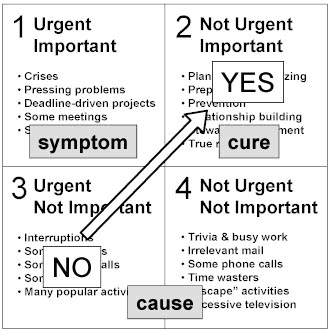
Have you ever seen Stephen Covey’s Four Quadrants of time management? I wouldn’t be surprised if you had: Gaia knows they’re everywhere across the Internet, and they’re also featured as a core component of many many management and success seminars.

covey_quadrants

I’ve cherry-picked a reproduction of the quadrants that makes the point I want. The trick, according to this structure, is to maximize your investment in the “Important but Not Urgent” quadrant, so that important things don’t elevate to “Urgent and Important” (i.e., crisis level). In the meantime, be very wary of the “Urgent but Not Important” category, because this is where the majority of the time sucks and distractors are likely to be housed. (The expectation here is that “Not Urgent/Not Important” things are fairly easy to jettison, while the urgent unimportant things can sometimes be harder to let go of. Fair enough.)

But what if it’s pretty much all urgent and important?

I feel as if I live much of my life by what I have come to call the “bonfire method of project management.”  Which conflagration is burning hottest and brightest, most likely to take down the homestead? Well, throw a little water (effort, time attention) in that direction so it dies down a touch. Now re-assess: which fire is hottest now?

Lather, rinse, repeat. (Yes, I know: I’m mixing my elements along with my metaphors. Bad witch!)

This pattern may be nothing more than an ongoing demonstration at the way I suck at self-motivation and planning ahead. Regardless, I am living a week where pretty much everything feels legitimately Important. And the tension I’m feeling is that the most urgent (time-sensitive) of these important things are all the items driven by external responsibilities — hitting the next work deadline, doing my homework for the retreat weekend, packing for the trip — while the items on the list that are arguably less urgent (i.e., most readily postpone-able) are the tasks and practices I have chosen for myself — journal-writing, ed-reading, JALC.

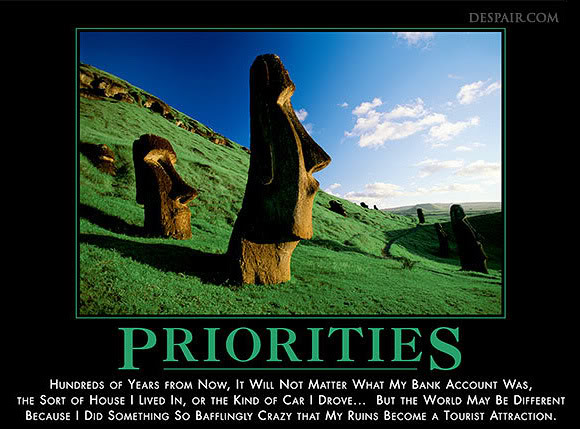
priorities_despairYes, this is, admittedly, an oversimplification. After all, no one forced me into my wacky non-profit career, and even though the retreat homework and travel is a function of me following someone else’s  direction, the retreat is also an investment in my soul’s growth.

Still, this is another pattern that often runs in my life: putting a higher priority on my responsibilities to others as compared to my responsibility to myself. After all, one of the trickiest parts of Covey’s whole structure is figuring out an answer to this key question: Important to whom?

I was listening to The Jayhawks recently, and there’s a snatch of song lyric that captures this for me:

I don’t expect you to see
But she’s important to me, babe
I guess it’s just one man’s problem

(MetroLyrics)

After all, I bet those “Urgent but Not Important” things you’re supposed to be so wary of in your ruthless Covey-an self-management structure are things that are actually legitimately important to someone, if not to you. So that ruthlessly efficient choice setting you up for success could also be the kind of choice that’s screwing some other poor sap over.

Maybe blogging or journal-writing or reading about education all seem like stupid priorities compared to Huge Essential Work projects and Elevated Cutting-Edge Soul Development work. Or, at least, maybe they would seem that way to someone outside my skin, outside my system, outside my soul and aura.

But they feel vitally important to me, babe. One woman’s priorities.

Which is why I continue cheating my sleep these past few days, trying to sprinkle some water on every last one of these important bonfires.

I don’t exactly know how I’m gonna make it to the plane intact at this pace, or, after that, how I’ll have enough gas in the tank to survive the weekend. But I’m just gonna have to figure that out step by step and minute by minute.

Because every bit of this matters.

———-

Image credits:

Covey’s quadrants: http://www.myrkothum.com/a-beginners-guide-to-time-management/

Priorities: http://s205.photobucket.com/user/johanan_rakkav/media/Parody%20Posters/poster_priorities.jpg.html


Step by Step, Across the Galaxy

norman-rockwell-facebookOne or two days ago, I did that thing you’re never supposed to do: I shared an infographic on my Facebook wall without actually double-checking the sources and the veracity of the information.

You can read all about it here. About the infographic, I mean, not the Facebook part of things. The Facebook faux pas is a tale as old as time, as the sages say.

At the very bottom of the post is a copy of the original infographic with what turned out to be incorrect (or at least, unverifiable) stats about the cultural decline of reading. Once he found that the original stats — which were really super shocking (80% of households haven’t bought a book in the last year, stuff like that) — were unverified, the infographic creator did a v.2 that brought in some different statistics that could be verified.

The funny-ironic thing, as far as I was concerned, is the way I would have been equally happy to post the v.2 “corrected” info graphic rather than the more dramatic/problematic v.1. Because what had most caught my eye was a quote that stayed intact between v.1 and v.2, in large part because it was so obviously aspirational rather than scientific: “If you read one hour per day in your chosen field, you will be an international expert in 7 years.”

The concept is attributed to motivational speaker Earl Nightingale on personal development/coaching to success sites like here, or most clearly presented by author and success coach Brian Tracy here:

Earl Nightingale said many years ago that one hour per day of study in your chosen field was all it takes. One hour per day of study will put you at the top of your field within three years. Within five years you’ll be a national authority. In seven years, you can be one of the best people in the world at what you do.

I’ve been chewing over that notion ever since I saw the quote.

I talk now and again about the fields of public education and educational reform. It’s the field I’ve been working in for a few years now, but I still only feel as if I know the tiniest bit about it. So the quote on the infographic started me thinking: what could I accomplish if I followed through on my often-stated desire to become more of an expert in my field? If I made a more serious commitment to reading/learning more about education? Could I make the time for regular self-study, and, if so, how might that benefit my work and my life?

Now, the truth is that I already have lots of daily practices going on. The morning journal-writing. Blogging here on JALC. Coursera classes. Regular commitment to ongoing household responsibilities like dishes and laundry and such. So I found myself of two minds as I considered this new daily practice. On the one hand, I found it a little bit intimidating. Can I really take another thing on?

journey-beginsOn the other hand, I find Nightingale’s concept really inspiring in its reminder that small, sustained effort can add up in really significant ways. Yes, in many ways, this is a familiar and often-stated concept. After all, isn’t there a proverb about the thousand-mile journey beginning with one small step? But sometimes it is really impactful for me when a new phrasing or formulation allows me to see a familiar-ish concept in a new way. Like when I read a book, some years ago, spring-boarding off the proverb to point out that the author’s small steps had, without her really noticing, carried her across the universe.* The Nightingale quote now, like de Grandis some years ago, helps shift my attention away from the sense of a slow, endless slog — 1,000 miles times 5,280 feet/mile, divided by 2.5 feet/step** — towards the reminder of what can be accomplished with sustained effort.

And yeah, I have a fair number of daily practices already. But I also spend enough time doing the TV/Facebook zombie thing that the hours could almost add up to being their own part-time job. Besides, the activities in question here (reading and thinking) are things that come to me as naturally as breathing. And even if an hour each day feels a bit like a stretch, I know that smaller pieces of effort can also add up:

As I’ve said before, we overestimate what we can do in a week, and underestimate what we can do in a year. But if you spend 15 minutes a week reading your industry journal and it takes you four weeks to read it, is that a bad thing? Of course not- it probably only comes once a month anyway!

So, in concert with this fellow, I’ve started spending 15 minutes each night reading a bit about education, starting with another book I borrowed from the company “library.”

As with so much else in my life, I imagine this to be a “progress, not perfection” kind of movement. I imagine there will be times when my daily practices need to be triaged and weighed against one another. Last night, for example, after our drive up to the lake, I found myself prioritizing education reading and early bedtime over JALC post. (Heck, we have baseball tickets and I won’t be able to post tonight, either, so a midday Saturday post kinda works better anyhow.)

Some nights I can imagine prioritizing JALC over ed-reading,and some nights I can imagine prioritizing both of those activities over sleep. Day by day, I’ll work it out. Heck, I wasn’t entirely sure I’d be able to stick with JALC when I resurrected it, and yet here we are 5 months later. (Which is, by the way, 4 months longer than JALC’s first-phase lifespan. Go figure.)

Step by enjoyable step, around the world and back again.

* The book in question is currently not available to me, so I can’t confirm the precise quote. (After the Facebook error, I feel as if I should be extra-aware about such things as the accuracy of my citations and the credibility of those sources I quote.)

** Why doesn’t my keyboard have a division sign? Ah, the indignities of aging, when one’s native symbol set slowly gets displaced by the new generation’s symbology…

———-

Image credits:

Norman Rockwell: http://mote-historie.tumblr.com/post/76317464830/now-son-do-you-know-what-you-did-wrong-yes-sir

The journey begins: http://www.suitcasesandsippycups.com/2012/01/a-journey-of-a-thousand-miles-blah-blah-blah.html

Knock on Wood

In addition to lots of laundry and lots of sleep, one other thing I’ve been doing since getting back home from The Trip is catching up on the video lectures and quizzes for the Coursera course I’m taking about the Beatles.*

In a lot of ways this is a “gimme” course: I’ve watched, listened and read enough about the band and its members to be reasonably well-informed from the get-go. Still, it’s fun to hear this professor’s take on things, and I have learned a new thing or two along the way.

Like the full story embedded in the lyrics to Norwegian Wood.

In the song, a young mad is “had” — i.e., fooled — by a comely lass when he accompanies her to her (pretentiously under-furnished) apartment expecting sexytimes, only to be rebuffed when she says she needs to get a good night’s sleep prior to the next workday.

That much I’d understood. But this next part was the part I’d missed: when he wakes up the next morning alone, the song’s narrator sets the girl’s apartment on fire in revenge for the (so-called) cock-blocking.

To quote Paul McCartney (the co-lyricist), looking back at many years’ distance:

[A] lot of people were decorating their places in wood. Norwegian wood. It was pine really, cheap pine. But it’s not as good a title, Cheap Pine, baby…

So she makes him sleep in the bath and then finally in the last verse I had this idea to set the Norwegian wood on fire as revenge, so we did it very tongue in cheek. She led him on, then said, ‘You’d better sleep in the bath’. In our world the guy had to have some sort of revenge. It could have meant I lit a fire to keep myself warm, and wasn’t the decor of her house wonderful? But it didn’t, it meant I burned the fucking place down as an act of revenge, and then we left it there and went into the instrumental.

He sets her apartment on fucking fire. (Who knew? Okay, bad question: evidently everyone in the world knew but me.)

Norwegian_wood__by_CyberfishTalk about a disproportional response to sexual rejection. In his discussion of this song and the story its lyrics tell, the professor said something mild about how the song could be seen as “sort of misogynistic,” and I found myself spluttering at the computer screen, “you think?!?”

I kind of get why the professor chose not to open up the topic for much further exploration. Although some elements of historical and cultural context are inevitably coming into the discussion, his chosen approach is primarily to be taking a musicological quasi-close-reading approach to the stylistic features of the songs and albums — melody, harmonics, orchestration, lyrical complexity, etc. At some level, I suppose I could be thankful he at least called out the misogyny of the scenario, rather than allowing the song’s portrayal of sexual entitlement to remain normalized.

Still, I am so wishing I had magic access to Paul McCartney right now to ask some follow up questions. When you decided that in the song’s world, this guy deserved his revenge, did you mean to portray that as a reasonable response, or an UNreasonable one? You were about 23 when you wrote the song — do you think you’d want to tell a similar or different sort of story if you were writing about sexual miscommunication and rejection today? What acts of friendliness are permitted between two individuals before one is seen as “leading the other on”?

Alas, my press pass is expired (on account of me never having one), and I still haven’t made an appointment with Mr. Ollivander to collect my magic wand. So my curiosity will have to remain unsatisfied.

By the way? Check here for a handy-dandy chart that’s been making the rounds to let you know when a woman owes her partner sex. And despite the geneder-specificity of the graphic, it really cuts both (all?) ways: no individual (gender-inclusive) ever owes another individual (again, gender-inclusive) sex.

———-

Image credit: http://www.deviantart.com/art/Isn-t-it-good-Norwegian-wood-165422713

* Yes. I am an epic nerd. I’m okay with that.

At the Vocational Lost and Found

[Set-up] This is the Day 16 prompt for Writing 101 — the conclusion of a three part series that began with me “losing” academia, continued with the story of how I found my career path as a non-profit fund-raiser, and now…

Today, imagine you work in a place where you manage lost or forgotten items. What might you find in the pile? For those participating in our serial challenge, reflect on the theme of “lost and found,” too.

There’s been a slight re-imagining of the topic to fit my own memoirist approach to blogging. But not as much as I might initially have imagined. [/Set-up]

———-

During my own journey from academia into non-profit management, I was aided greatly by an online community that continues to this day under the moniker Versatile Ph.D.  The community was founded by Paula Chambers, whose own biography on the site reads like its own saga of “lost and found”:

In 1991 at age 29, she left the entertainment industry and returned to school. . . . Midway through her PhD program, she realized that she would probably be happier in a nonacademic career, and founded a listserv called WRK4US (Work For Us) while dissertating, to provide a safe space where humanities PhD students could openly discuss non-academic careers. . . . After graduating in 2000, Dr. Chambers . . . became a successful grant writer and fundraiser. . . . All the while, she continued managing WRK4US in her spare time. Eventually, Paula finally realized that helping academics find non-academic careers was her true calling. She transformed WRK4US the listserv into Versatile PhD, a web-based socially positive business, in 2010. Paula runs The Versatile PhD from her home office in Los Angeles and is an in-demand speaker on the university circuit.*

And, no, I don’t work there, but I do maintain my participation, as best I can: reading the threads of discussion on the user fora, answering questions when I can and when I feel I have something worthwhile to add.

In order to maintain itself as a safe space for people to explore alt-ac careers, VPhD has a strict confidentiality policy — an entirely appropriate move, considering the unfortunate myopia too many tenured professors still have about alt-ac career paths, and the very real trouble that can be caused by such blindness and prejudice when the privileged old guard discovers someone is looking for different career options.

Out of respect for this entirely-appropriate policy, I’m not going to be dishing specifically on anyone’s life story. But even painting in broad brushstrokes, it’s amazing to consider the mixture of variability and commonality that exists within these many post-academic transitions. Everyone’s path is uniquely unique, but there are also threads of intersection, shared losses and common discoveries.

For example, there have been numerous explorations of the grieving process that occurs during the ac-to-post-ac transition. As JC articulates in hir blog From Grad School to Happiness:

You’re not just losing the concrete academic work that you either loved or hated. You’re losing an identity that you’ve had for years or decades. You’re losing a culture, and a prestigious job title, and a career path that you were convinced was going to lead to lifelong happiness. Whether you’re leaving voluntarily or because of circumstances outside of your control, it’s normal to feel some grief and sadness at such a tremendous loss of identity.

At VPhD, we’ve discussed this same loss of identity from all the moments of the journey, from voices deep in the midst of the losing, to those of us who are years-if-not-decades past the initial grieving process and can still remember the pains, the tears, and — thankfully — the coming through into a better place.

On the flip side, there’s the trajectory of self-discovery many of us traverse: finally having the space to figure out what it is we’re good at and what we actually like to do. There are places where that process is terrifying, but it can also be really exciting.

Currer Bell** writes on the site How to Leave Academia: “You do indeed have skills that workplaces value.” And it’s true.

be-more-awesomeBut perhaps more exciting to me than simply tallying up my list of transferable skills was to understand how certain things that were taken for granted at UPenn, or even devalued there, were immensely valuable once I kicked into my non-profit career. In grad school, I was no great shakes for reading and assimilating text quickly, at least not when compared to my grad school peers. Out in my non-profits? I get pretty high marks on that score. And that wacky dedication I felt to making sure student papers were graded quickly and thoroughly, even when it got me in trouble with my dissertation research? That deadline focus and those quick editing skills have been priceless when negotiating a calendar of aggressive grant deadlines.

I think there’s a certain strain of perfectionism that infects most academic settings, and so to immerse yourself in that environment can often lead one to sink deeper and deeper into the self-perception of “not good enough.” So to find out that out in the big wide world, you can indeed be good enough? And not just good enough in a “barely getting by” kind of way, but in a “fulfilled by my life and impacting the world positively” kind of way?

It’s the best thing I ever came across in the vocational lost and found.

* Apologies if my edits cut the bio to ribbons — I’m trying to use briefer quotes and write shorter things, now and again. (At least “shorter” by my own long-winded standards…)

** Love it!

———-

Image credit: https://popforms.com/maximize-your-strengths/