
Found Money

[Set-up] It looks like I’m going to continue to need a little flexibility and creativity with Writing 101 . Today’s actual assignment is the completion of a three part series I started back on “Day 4.” Of course, I haven’t actually written part two of this three-part series — because that’s one of the pieces I skipped during last week’s work insanity. So I guess I won’t actually be jumping right into this week’s assignments. Instead, there will be a targeted reach-back to last Wednesday’s assignment, as a precursor to whenever I get around to doing today’s.

So, Day 13, written on what should actually be Day 16 of the sequence:

On day four, you wrote a post about losing something. Today, write about finding something. . . . Today’s twist: if you wrote day four’s post as the first in a series, use this one as the second installment — loosely defined.

You could pick up the action where you stopped, or jump backward or forward in time. You might write about the same topic, but use a different style, or use the same style to tackle a neighboring topic.

[/Set-up]

———-

So, gentle reader, when I last left the abbreviated summary of my life’s career trajectory, I had drifted into both an environment (academia) and a profession (faculty) for which I was profoundly ill-suited. To some degree, the inner rumblings around that ill-suitedness began very early. And yet, I struggled to persevere. Buckled down to overcome the deficiencies of my mass-market, public school background. Shifted graduate programs to one where I had more natural gifts and talents than my first Ph.D. curriculum.

Why was I so damn stubborn? In part because I am really, truly so damn stubborn. But a lot of it was rooted in a basic survival-level fear that there wasn’t anything besides teaching/professor-ing that I could ever make a living at.
calvin-on-fund-raising

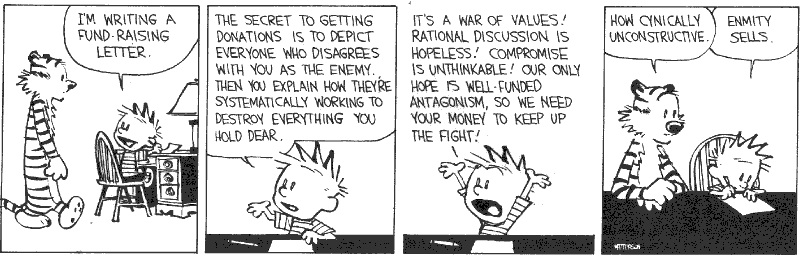
I dare say I kinda fell into my career. It’s not like I wandered around elementary school saying “I want to be a fund-raiser when I grow up!” And, really, who would go around saying that? Do the ins-and-outs of non-profit management get any airplay in the Sesame Street/Richard Scarry “People in my Neighborhood” set?

Nowadays there’s definitely more awareness at the college level of non-profit careers. But that’s a big shift from when I went to school, back when dinosaurs roamed the earth.

I actually wrote my first successful grant proposal as a bit of volunteer service for a community choir where I was singing. I’d somehow talked my way onto the choir’s board as a general member-at-large, and was eager to find ways to prove my worth and contribute. So when the Board president asked for someone to help write some grant proposals, I figured it’d be an easy thing to do. I’m a good writer. I even know how to teach writing, don’t I? A grant proposal should be simple!

And here’s the kicker: it kinda was.

This is not to minimize the ways that grant-writing is intensely different from the stylistic and argumentative conventions of academic prose. But where I always found myself struggling and straining against those academic conventions, the general transparency of grant guidelines, and the need to build a tight, compelling argument out of plain language was a genre of writing that made instinctive sense to me.

And then we got the money.

So suddenly, something that both came naturally to me — writing plain, strong prose — and that I had studied intensely — how to analyze genre and build written arguments* — had real, honest-to-goodness street creed and value to it. I had worked for less than a weekend, and my choir now had several thousand dollars to show for that effort.

Now, obviously, that initial grasp of what it took to be a grants professional was, in its own way, appalling naive. I had a lot to learn in the first few years of my career — though the learnings were sufficiently connected to my existing strengths and background knowledge that success was possible.

And I still have moments where I question whether fund-raising is really the “forever career” for me. The division and tension I have seen at every non-profit between those who raise the money and those actually out doing the work is one that troubles me. I know the privileges of being in the fund-raising camp. But I also have never entirely been able to let go of a nagging self-quesitoning about whether I really want to spend the rest of my life being “just a fund-raiser” — after all, the Gospel of Matthew suggests that “you cannot serve both God and mammon” (6:24).

But even with those ongoing questions about whether there is a third career yet to unfold in my life, I remain profoundly grateful that I was able to lose academia and find my way into grants and fund-raising. I have become very good at what I do, I have seen the benefits of my efforts take shape in programs and services and buildings, and I have been able to make a living for myself.

* Or “analyze funder guidelines and build a responsive case for support.”

———–

Image credit: http://s102.photobucket.com/user/pb82/media/Cartoons/calvin-on-fund-raising.gif.html

A Reason or a Season

[Set-up] The Day 6 prompt for Writing 101 is a character study, a prose portrait of “the most interesting person you’ve met in 2014.” I know what follows is more an artifact of imagination and projection than anything else, but this individual has been on my mind now and again for the last few weeks, so I’m going to keep trusting my inner guidance in this, as with so many other things, and write the words I have in me to say. [/Set-up]

———-

misty-forestOne of the things we’ve been doing as part of growing roots up here in Boston is to attend services and find other (small) ways to become involved at one of the local UU parishes.

All told, it’s sort of been an odd time to be “dating” this new church. The customary minister has been on sabbatical, so the Sunday services have been a patchwork of experiences, from lay-led services (that so often sound more like academic lectures than actual sermons), to guest ministers, to services led by the congregation’s brand-new ministerial intern.

I know enough about how long it takes to get through divinity school to expect that Jeff is actually in his late 20s. However, he has that indeterminate appearance so many young men have — at least to my aging eyes — where his age could possibly be anything from 12 to 29. His frame is slender, such that he looks just the tiniest bit dwarfed by his minister’s robes. The eyes behind his glasses shine with warmth and brightness, but the glasses themselves, paired with the ministerial accoutrements and the care with which I have seen him perform his duties have created in me the strongest impression of seriousness.

The first time we saw him lead a service, Mr. Mezzo even criticized him for that seriousness. “I just prefer a minister who’s less formal, more able to laugh at themselves,” he said in our car ride home that day.

And I understood that, but I had my own theory. “Imagine being so young,” I said, “and you’ve been tasked with providing spiritual leadership and guidance to an established congregation full of people with decades more life experience than you, with more years of involvement in this congregation than you. A congregation that won’t stop comparing your performance unfavorably with that of their oh-so-beloved minister.*

“I remember how intimidated I was with the responsibility of teaching my first college class as a kid of 24, and that was just a low stakes music appreciation class! I can imagine choosing to act with a certain level of gravitas if I were in his shoes.”

———-

My level of church involvement and attendance is still pretty minimal, so I haven’t have opportunities to get to know Jeff to any particular depth. A couple of conversations during coffee hour, a number of services and sermons. My perception has been that he’s come a bit more fully into a comfort level as his months of service went by. I was glad to see that.

In a weird way, I was also glad to see the announcement that Jeff would be finishing his internship with us at the halfway mark rather than completing two full years of service. He was entirely gracious in his announcement of this news, and shared that he was in a process of discerning whether it sensed best for him to continue the path of UU ordination or if a different faith tradition would be better-suited as his spiritual and ministerial home.

And I get that, I really do. A college friend of mine went through a similar journey as she entered divinity school — leaving the faith of her fathers (Catholicism) to be ordained as a UCC minister, because she knew the call to ministry in her soul was true and deep and not to be denied. I also have my own small degree of resonance, recalling the ways I was brought up an a devoutly atheist household** and remembering my own journey of exploration and discernment towards the understanding and acceptance of Spirit I now possess — however ego-limited, nonetheless true and deep and not to be denied.

I also admit to wondering whether the congregation really gave Jeff a fair shake with this position. Instead of being actively mentored week after week by a sitting minister, he was being used as “substitute teacher” during that minister’s sabbatical. And, what with the number of church members expressing to me how “unfortunate” it was that Mr. Mezzo and I were starting to attend church during this sabbatical:

You’ll see how Reverend ______ is just so much better than this.

Well, if I (minimal participation and all) have gotten such a strong picture of the level of regard these folks have for their sitting minister (and of the attendant, not-so-subtle disdain they have for anyone who isn’t Reverend ______), I kinda think Jeff mighta been able to pick up on it, too.

So between my imagined resonance with his journey, and my soft regret for any discomforts he may have felt during this year, I have been holding Jeff in the light and wishing him all manner of support and guidance and acceptance as he journeys forward. May he find the home that best feeds his soul and where he can most authentically be of service.

I’ve been too chicken-shit to reach out and tell him this. Like I said, he and I barely spoke once or twice. The idea of emailing to share any portion of this just feels awkward and invasive and as if I’d be forcing him into the box of the story I made up about his life, rather than honoring his own knowledge about his own lived experience.

But, however on-point or off-base my understanding of Jeff’s decision may be, even if I never see him or speak to him again: this much I know to be true.

A small prayer, whispered up to the ether. You will always be part of  the church’s family tree in my drawing of its branches. Thank you. I wish you well.

———-

* More on that later.

** Yes, that’s a del thing. At least as far as I’ve experienced it, it is.

Image credit: http://www.seedsofunfolding.org/issues/02_11/feature.htm